neon + jane street’s socratic tutor is an unpatched method for learning in a way that doesn’t feel like talking to a slop machine
https://t.co/rUiIYc9OCQ
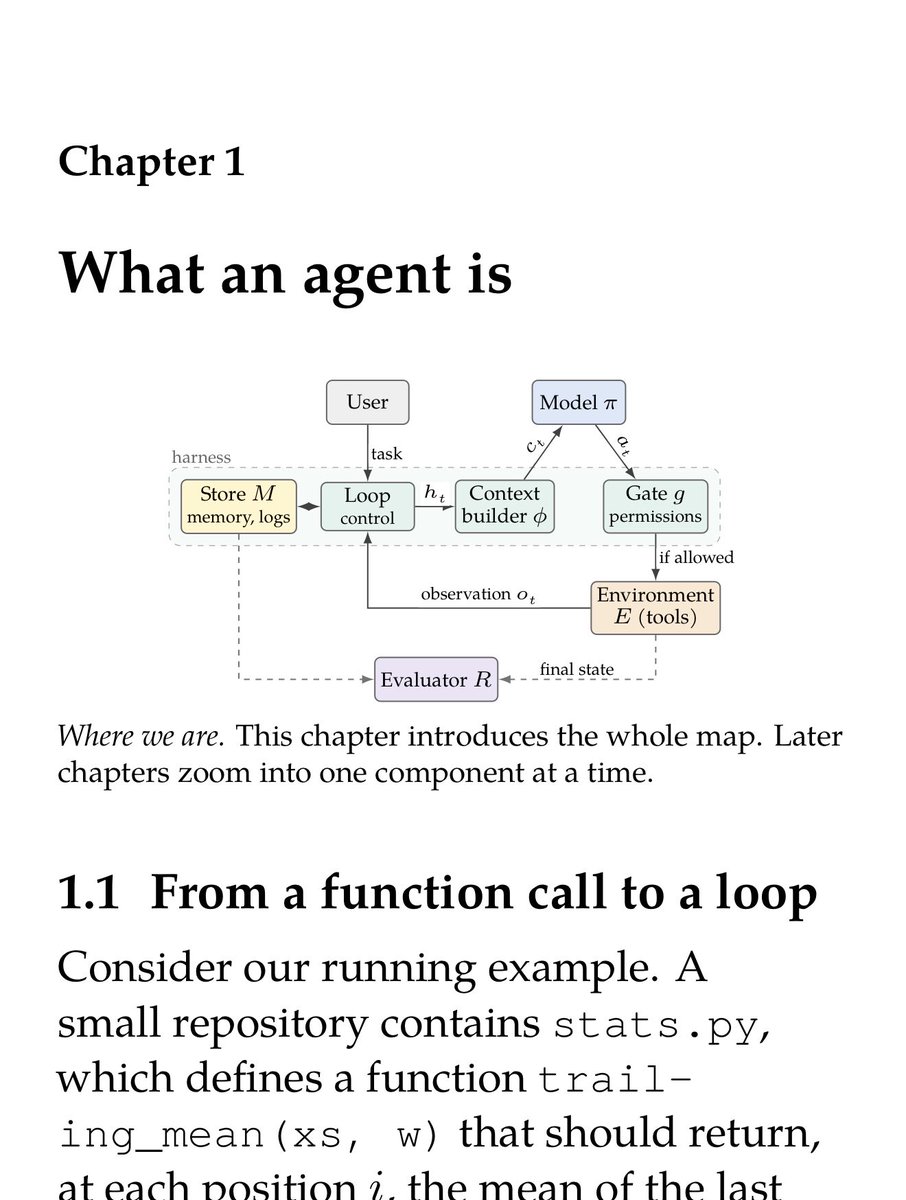
A free online textbook: AI Agents in Depth: Design Principles and Engineering Practice by Bojie Li (2026).
The textbook presents a practice-first account of how to build, evaluate, and improve reliable AI Agents.
It is aimed at readers with technical backgrounds; the book’s engineering focus requires little mathematics or machine learning apart from its chapter on model post-training.
Chapters are relatively independent, and experiments with runnable companion code and questions let readers test ideas as they study.
The book has 664 pages, 101 illustration, and 202 exercises that you can solve with an AI tutor.
Read the book online on @ChapterPal: https://t.co/ng50DZOsaE
When reading on ChapterPal, use the built-in AI tutor when you feel stuck. Solve AI-generated quizzes to test and solidify your understanding. Do exercises with the AI tutor, which guides you instead of solving them for you.
Happy Friday! Promised a series on how to write good evals. Ended up writing a 3500 word X article. Will roll this out into a bigger series in the upcoming days. Hope this is a good weekend read! https://t.co/HpQeB582RI
We started Ignite with a 4-hour lab covering the 4 Microsoft "IQs" for grounding AI agents:
Web IQ, Work IQ, Fabric IQ, Foundry IQ.
Repo: https://t.co/ZE36S6Y8xK
Slides: https://t.co/FhUWFWGYfn
Look forward to lots of launches from those teams @ Ignite this week 👀
Want to learn System Design?
This website teaches it INTERACTIVELY, not through boring theory.
Explore it, learn it, and thank me later. 👀
🔗 https://t.co/46dsNDJotm
The podcast episode with Janvi with her story (eg how she transferred internally to an AI team first): https://t.co/SSEej4XrOE
How Janvi looked for AI startups: https://t.co/pWsdcyf564
It's stories like these that really make the pod / newsletter worthwhile. Congrats @atibhi_a on the hard work - and give her a follow (+ also to @janvikalra_!)
Long post.
I am in still in the habit of “writing” technical notes by querying Astra or Fable ( or having them converse with each other). Most notes or books are finance-related. I have a couple on AI. There’s a free book by F. Fleuret titled “The little book of Deep Learning” which I like a lot. I wanted to “write” something similar: short and phone-readable, on the topic of agentic engineering. The books out there are too long for me. It’s an important topic and I am very far from mastering it. I started something and here is where I am now. Still not quite there, but readable. It’s more mathematical than most material you’ll find online, because the book reflects my tastes (of course) and math is the Great Compressor. The positives are that it’s short and you can figure out quickly if you get value out of it or not. I don’t want your attention but I feel better about wasting my time if it helps someone else.
https://t.co/UzNFUdGHQQ
Read the textbooks behind robot brains for free
1. The math
https://t.co/iqJX3CgYfw
2. Probability
https://t.co/TX7veJxLEn
3. Deep learning, by Goodfellow, Bengio & Courville
https://t.co/j96lreSdTC
4. Computer vision, from MIT
https://t.co/TyQ6dsJDxU
5. State estimation (how a robot knows where it is)
https://t.co/Yo7iwvbEgm
6. Motion planning
https://t.co/QlbWcX5ebx
7. Control
https://t.co/ujJyQb2Z4O
8. Reinforcement learning, by Sutton & Barto
https://t.co/lFs7OakquP
9. Decision making
https://t.co/0OhPGUuei8
10. Robot learning, by the Hugging Face LeRobot team
https://t.co/yUfzxD3Xv3
P.S. #8 is written by the two researchers who won the 2024 Turing Award for reinforcement learning, the method robots now use to teach themselves to walk. the full PDF is on their own site
which order to read them in is the free 12-week path in the article below
Learning AI feels mostly like learning tools, but there are foundational concepts that matter a lot!
1. Context Engineering
- Understanding context windows and token limits
- Managing what information an LLM sees
- Context compression, retrieval, and memory
2. Retrieval-Augmented Generation
- Embeddings and vector similarity
- Chunking strategies and semantic search
- Retrieval quality, reranking, and grounding
3. Agent Architecture
- Tool calling and function execution
- Planning, reasoning, and task decomposition
- State management and orchestration
- Single-agent vs. multi-agent systems
4. Model Fundamentals
- Tokens, embeddings, and attention
- Transformers and next-token prediction
- Temperature, sampling, and inference
- Fine-tuning vs. prompting vs. retrieval
5. Evaluation and Reliability
- Hallucinations and failure modes
- Deterministic vs. probabilistic systems
- Building eval datasets and benchmarks
- Measuring accuracy, latency, and cost
6. Data Engineering for AI
- Structured vs. unstructured data
- Data quality and lineage
- Ingestion pipelines and incremental processing
- Making enterprise data accessible to AI systems
7. Security and Governance
- Prompt injection and data leakage
- Permissions and access control
- Guardrails and human-in-the-loop workflows
- Observability and auditability
The tools will keep changing.
Instead of mindlessly debating Claude Code vs Codex, learning these underlying concepts will keep you up to date much more effectively!
They’ll be the people who understand the fundamentals well enough to learn any tool.
Stop confusing tool proficiency with engineering expertise!
We’ll be building AI agents on Snowflake in my November 16th boot camp! Book a discovery call before enrollment closes on Sunday at https://t.co/CWvLDHTuVZ !
https://t.co/hMj5ADmBQM
Breaking: Neurologists from zurich found the one muscle that holds all your stress. Relax it for 40 seconds and your cortisol crashes (they tested it on 200 insomniacs):
You’ve done the breathing apps, the magnesium, the "just relax" from people who sleep fine. None of it touches the one place your body actually stores the alarm — and it’s not your shoulders.. 1//6
in order to fully understand distributed systems you need to have hefty knowledge about what a system is all about
this was one of the best resources I came across twt ....