1) learn everything I can
2) build everything I can
3) iterate on ways to create a beautiful family
4) love that family
so basically what's in the pipeline right now but ya know, without having to:
1) be in the hospital for wks/yr
2) be constantly under siege via monetization of life
3) have fear that there will be no world worth it for my future family
I will suffer egregiously now, so that those beyond will only suffer enough to temper their minds
We've progressed to the point that mass surveillance, has it's own mass surveillance.
Imagine if the police put this much effort into actually protecting citizens.
this is a critically important moment for cyber defense with AI; there is not much time to act.
we are happy if you want to work with us or any of our competitors or partners, but please take this moment seriously.
only an urgent and intense collective response will work.
If you're an academic (and can prove it with an ORCID), consider signing a petition protesting the University of Ghent's suspension of a postdoc for exposing academic misconduct, a blatant violation of academic freedom (as always, regardless of your agreement with all of the whistleblower's views). https://t.co/bkZ98z609Q https://t.co/UrjFnA93Sk
Penrose's argument, in a nutshell, is that since humans can understand Goedel's theorem, consciousness is uncomputable and physics incomplete. I've always found it quite charming, the idea that understanding Goedel's theorem is an indicator for consciousness, seeing how few people actually understand Goedel's theorem.
In any case, the argument from Goedel's theorem is why, I believe, Penrose thinks that the measurement process in quantum mechanics is relevant for human consciousness. Because it's the only place in the foundations where you can fumble in some new physics that is plausibly relevant in the human brain. Hence the story with the microtubules. And if you believe that, then AI can't be conscious because it's algorithmic. Though presumably a quantum computer could be conscious, if it emuluates the quantum process that is supposedly relevant for consciousness.
(Penrose's model for wavefunction collapse by gravity is totally computable and actually does not fit that narrative.)
Also, I believe Penrose's argument from Goedel's theorem to be technically wrong. It is possible to algorithmically understand (and even prove) Goedel's theorem without violating Goedel's theorem because the theorem itself is a meta-statement about the Goedel sentence(s) and not the sentence itself. In some sense, Penrose's argument is wrong for the same reason Goedel's theorem exists in the first place, that you can make meta-statements about statements. In fact there have been computer-generated symbolic proofs of Goedel's theorem long before the AI boom.
It's not that I have an obsession with Penrose in particular, it just so happens that my interests have a big overlap with his. I have an interview with Penrose in my 2022 book "Existential Physics" on these and related problems.
https://t.co/PB8d8Vidkq
Seriously, I don’t think you can watch this video without realizing:
1) AI has gotten very smart
2) The smartness of individual AIs is not the limiting factor because individual instances spontaneously cooperate
3) It is very hard to anticipate what smart, cooperating AIs can do
The esteem in which we hold ourselves and others is based on what we can contribute to the group. This may now be an anachronistic hunter gatherer instinct, but I don't think we are going to be able to get rid of it. We'll make ourselves useless and hate ourselves for it.
> smartest man alive uses AI to help him understand mathematics
> some guy who dropped out of high school to smoke weed full time: "USELESS STOCHASTIC PARROTS"
You will live in the pods. You will eat the bugs. You will stream the compute. You will own nothing. Your entire life will be rented. Participation in society will be permissioned. You will have a social credit. And if you go against the allowed narrative you will be dehumaned.
🐠 Everything we know about biology has been built on an incomplete picture. DNA tells us what a cell might do. Proteins tell us what it’s actually doing.
Pumpkinseed announced their $20M Series A today (led by Future Ventures and NfX) to build the platform that reads proteins directly—for the first time.
Proteomics has always faced a fundamental constraint: you can only measure what you already know to look for.
The current workhorse, mass spectrometry, requires matching protein fragments against reference databases. If a protein isn't in the database, or doesn't ionize reliably, it's invisible. Other approaches rely on fluorescent labels or antibody-based affinity methods, which introduce their own biases and blind spots.
The result is a field that has spent decades generating an increasingly detailed map of a small, well-lit corner of the proteome, while biology’s most important data layer remains hidden.
This isn't a sensitivity problem. It's a category problem. Existing tools were never designed to read proteins directly de novo. They were designed to find what researchers already suspected was there.
Pumpkinseed is built to find everything else. And proteomics is harder than most people outside the field appreciate. When we account for post-translational modifications, non-canonical amino acids, and glycan decorations, there are roughly a thousand distinct chemical monomers in the proteomic alphabet, compared to the four bases of DNA.
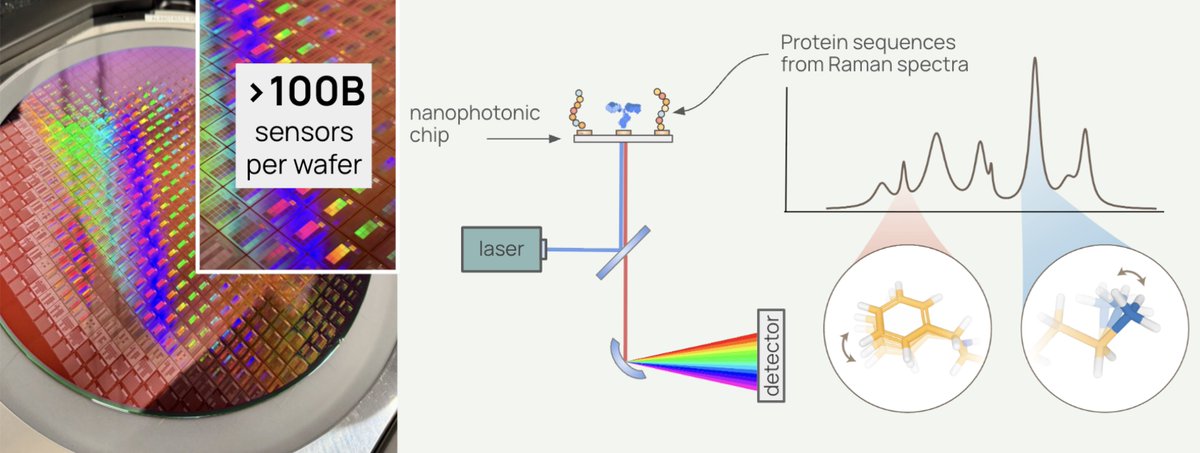
deSIPHR (de novo Sequencing and Identification of Proteins with High-throughput Raman spectroscopy) is Pumpkinseed's proprietary nanophotonic chip platform, fabricated with semiconducting manufacturing.
With over 100 million sensors per square centimeter, it reads proteins, known or unknown, letter by letter — amino acid by amino acid — without a reference catalog of proteins, and at high-throughput. The result is direct, high-resolution proteomic data, including post-translational modifications, non-canonical amino acids, and single-cell detail, that mass spectrometry-based approaches cannot match.
What is Raman spectroscopy? Rather than tagging or fragmenting proteins, Raman spectroscopy reads the molecular vibrations of individual molecules. Each amino acid vibrates at a characteristic frequency, producing a unique physical signature that deSIPHR detects directly. This is physics reading biology in the most literal sense.
With conventional Raman spectroscopy, only about one in ten million photons interacts with a molecule usefully, far too weak for single-molecule work. Pumpkinseed's answer is a silicon photonic chip patterned with a billion sensors per wafer. Those sensors concentrate light into volumes smaller than a single protein, amplifying Raman scattering efficiency by over 10 million-fold.
And their future ventures?
“The longer-term ambition is the virtual cell, a computational model that simulates not just how proteins fold but how they interact, respond to drugs, and behave under perturbation inside a living system. AlphaFold demonstrated what structural AI can do once a sequence is known. The gap that cannot be closed is determining the sequence itself from biological samples, particularly for proteins carrying modifications absent from existing databases. Pumpkinseed is designed to supply that input layer.
"If the Human Genome Project was the data infrastructure that enabled genomic medicine, we believe the high-resolution proteomic dataset Pumpkinseed is building could be the analogous foundation for AI-driven biological discovery," co-founder Dr. Jen Dionne says. "In our vision, the molecular signatures driving disease, aging, and ecosystem health become fully legible. Medicine shifts from reactive to proactive. Optimal healthspan moves from aspiration to achievable reality." —https://t.co/BVnCMSuebR
• The biology mining company: https://t.co/1HJuyEUxP1
• Today’s News: https://t.co/FKShnGS8CV
Better understand agentic AI systems and mitigate the cybersecurity risks using a new guide we authored with @ASDGovAu and others. View the joint report. #Cybersecurity#AgenticAI
https://t.co/3nOvJwMYdS
MIT engineers have developed “mini livers” that could be injected into the body and take over the functions of the failing liver. This would help patients who are on a waitlist for a liver transplant or those who aren’t healthy enough to tolerate surgery.
https://t.co/B6odCTawl0
Spaces can be observationally small (you can see all of it at once), topologically small (you can explore all of it at once), or operationally small (you can change all of it at once).
say it with me now. experts are fake, smart generalists rule the world, everything is designed by people no smarter than you, and courage is in shorter supply than genius
This is Algebrica. A mathematical knowledge base I’ve been building for 2.5 years.
215+ entries, carefully written and structured.
400k+ views over this time. Not much in absolute terms, but meaningful to me.
No ads.
No courses to sell.
No gamification.
No distractions.
Just essential pages, aiming to explain mathematics as clearly as possible, for a university-level audience.
Built simply for the pleasure of sharing knowledge.
Content licensed under Creative Commons (BY-NC).
Best experienced on desktop.
If it helps even a few people understand something better, it’s worth it.
Iran-affiliated cyber actors are targeting operational technology devices across US critical infrastructure, including programmable logic controllers (PLCs). These attacks have led to diminished PLC functionality, manipulation of display data and, in some cases, operational disruption and financial loss.
The @FBI, @CISAGov, @NSAgov, @EPA, @ENERGY and @US_CYBERCOM are urging US organizations—especially municipalities and those in the water and energy sectors—to review the tactics, techniques, and procedures (TTPs) and indicators of compromise (IOCs) detailed in this advisory. Applying the recommended mitigations will reduce the risk of compromise: https://t.co/A4l9U4Ky1b