Applied AI & Cloud Architect @AWSCloud. Building scalable systems from prototype to production. Field CTO for Startups. Prev CTO & Co-Founder @dStudienfinanz.
New art project.
Train and inference GPT in 243 lines of pure, dependency-free Python. This is the *full* algorithmic content of what is needed. Everything else is just for efficiency. I cannot simplify this any further.
https://t.co/HmiRrQugnP
Meet Amazon Nova Act — an effortless way to build AI agents that can reliably use browsers 🧑💻
With our new model, compose robust steps into complex workflows; handle everything from bookings to QA testing. Getting started takes just 3 lines of code.
See what Nova Act can do 🧵👇
What if Studio Ghibli directed Lord of the Rings?
I spent $250 in Kling credits and 9 hours re-editing the Fellowship trailer to bring that vision to life—and I’ll show you exactly how I did it 👇🏼
From the AI breakthroughs of the last few months, a wave of new startup opportunities have been unlocked.
Here are some of the ideas we think will be especially interesting to build now: https://t.co/QCIz6DnQnN
If you want to run DeepSeek R1 on #AWS, these are two starting points: 1) Bedrock notebook steps: https://t.co/vXucRjh8v2 2) load into Sagemaker https://t.co/AVMlJXP0Od (thanks to @DGallitelli95). As always, consult your legal team before doing so...
In many conversations, I noticed several common misperceptions about generative AI.
1. Technologies behind GenAI are new
While many applications made possible by GenAI are new, the technologies surrounding it are not.
- Retrieval, the backbone of RAG, is also the backbone of search and recommender systems. The first information retrieval system was described in the 1920s.
- Vector search has been around since the early 2010s.
- Language modeling was first introduced in 1951.
- The attention mechanism was introduced in 2015.
- Inference optimization techniques (quantization, low-rank factorization, distillation) have been around for a while.
While many temporary fixes will become outdated, the fundamentals will remain important. The trick is to separate the temporary fixes from the fundamentals.
All of this means that the paradigm will soon shift from scaling to "what can we do with what we have". I think the paradigm of "how do we help people be more productive with AI" is the best mindset forward. This mindset is about processes and people rather than technology.
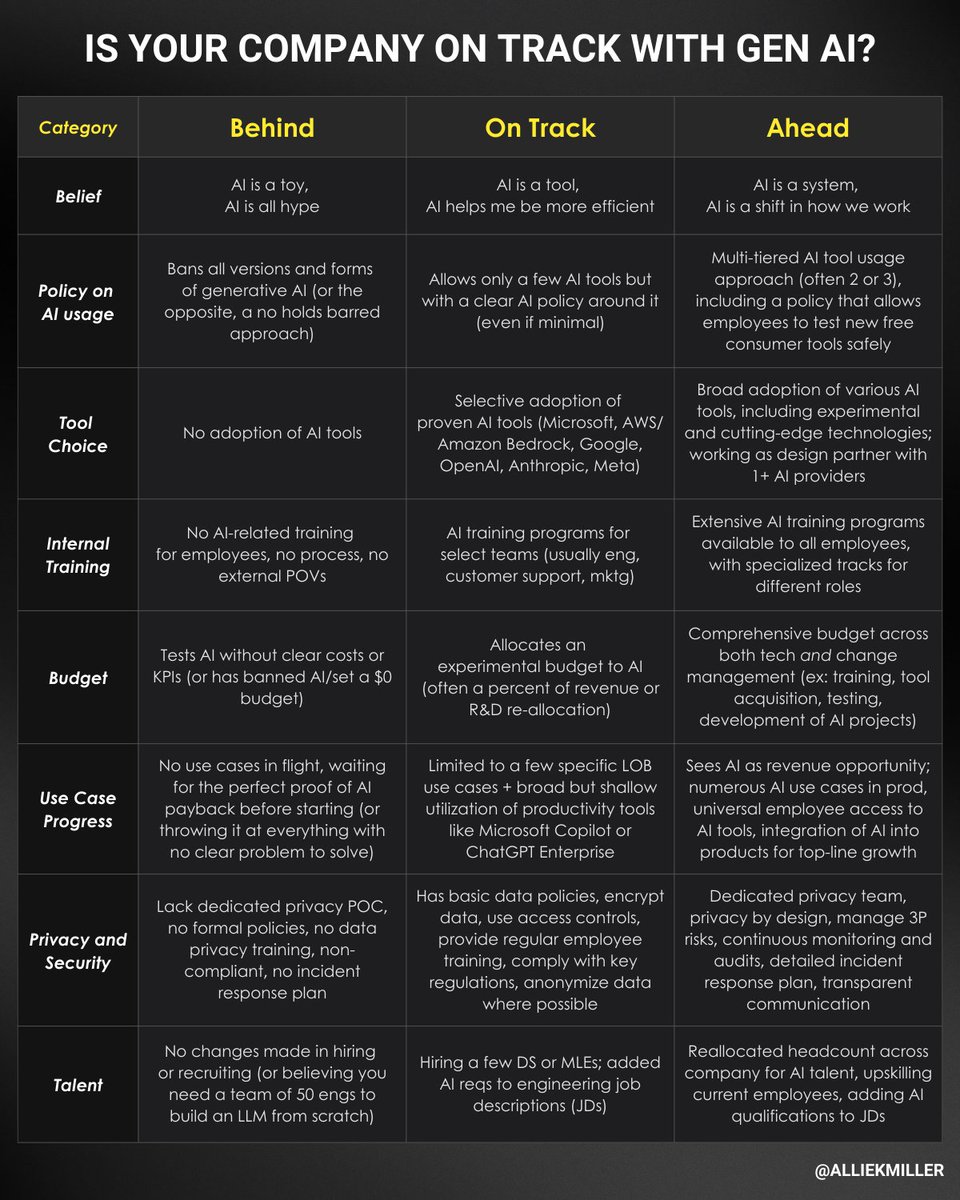
Not sure if you're behind or ahead in AI adoption? I created this guide to help you benchmark.
↓ ↓ ↓
* many who think they're behind are actually on track, and some who think they're ahead are not
** these insights are my own opinion based on years of work with hundreds of companies across various industries
Is your company on track?
Startup in Berlin, Germany? Couldn't make it to AWS re:Invent 2023 in Las Vegas? Don't worry, we've got you covered.
Join us on Friday, Jan 26th for an exclusive opportunity to network and to stay up-to-date on the latest AWS releases: https://t.co/QvuH6uiRKi
#aws#startups
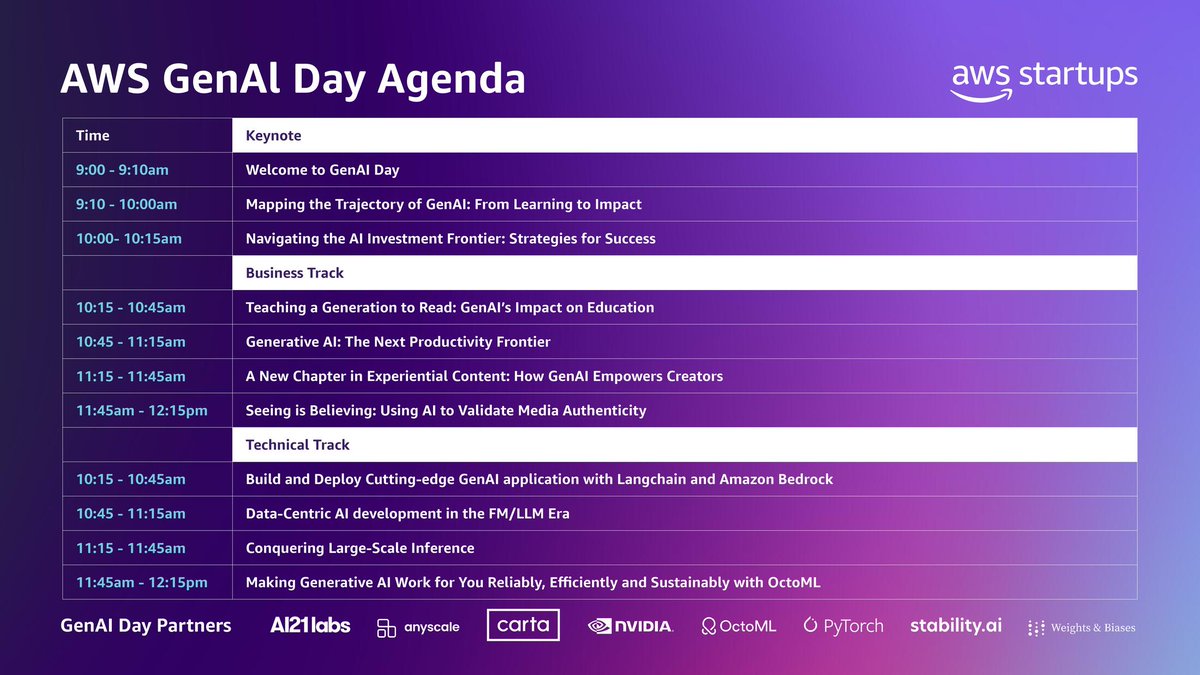
Exited for the AWS GenAI Day (new global virtual event) happening tomorrow, September 14th, 2023! 🤖💬🦄
Sign up here: https://t.co/jUI6zKdTnB (you can also attend only some bits and watch recordings later)
#aws#cloud#GenAI
For our own delight, the copy and images you are seeing were generated by AI.
What do you think of these deepfake characters? #AWSGenAIDay
Registration is now open for AWS GenAI Day. https://t.co/HDHCVSGWrP