Custody rules limit crypto’s access to the nearly $177 trillion investment advisor market. Almost no one talks about it.
This @LawofCodeFM episode is a deep dive into those rules: the history of qualified custodians, why crypto doesn't fit and the recent SEC proposal to allow advisor self-custody.
You'll hear from @rstwalker (a16z), @EmilyMMeyers (Electric Capital), @JStolkin (Multicoin Capital), @jlb410 (Simpson Thacher) and @RichJWidmann (Google Cloud).
This is the internet's most comprehensive podcast on the custody rules. You don't need to be a lawyer to follow along.
Timestamps:
0:00 Intro
2:59 What are the custody rules?
3:56 Why does custody influence crypto?
5:56 History behind the 1940 Acts
10:48 The 1962 custody rule
11:38 Fiduciary duty & Capital Gains
15:06 Fiduciary duties & DeFi
16:54 What is a qualified custodian?
20:26 The "bank" definition
25:07 Wyoming, broker-dealers and SAB 121
28:11 2023 safeguarding proposal
29:31 FTX and Galois Capital
32:01 State trust companies
34:17 Four-part test for "bank"
38:18 SEC's October 2026 proposal
42:18 Advisor self-custody
47:46 Where the proposal falls short
52:47 Custody rules from first principles
57:14 Multisigs and MPC @RichJWidmann
1:05:16 Do we need qualified custodians?
1:10:19 Open questions
Nothing in this podcast is legal or investment advice.
Buying a stock and being its registered owner aren’t always the same thing. That distinction matters for tokenization. Blockchain records could drastically simplify a complex system built for a different technological era. This opportunity goes beyond how stocks trade, it reaches what you actually own and how that is recorded.
Watch this explainer. Read the @a16z letter: https://t.co/kC7GIUtiEL
Now, how a blockchain register can collapse that flow, such that owning the token means you’re the registered owner. That’s the opportunity these rules should accommodate.
“The Real Promise Is Letting Blockchain Bypass the Stack Entirely”
@rstwalker (@a16z) & @RSSH273 (@CooleyLLP ) on the current SEC Roundup—the Commission’s first substantive transfer agent rule rewrite in 40 years.
The problem? A contradiction buried in the fine print.
AI is a world-defining category alongside the microprocessor, the steam engine, and electricity. Every one of them required an entirely new physical world to be built. We raised $1.1B to build this one.
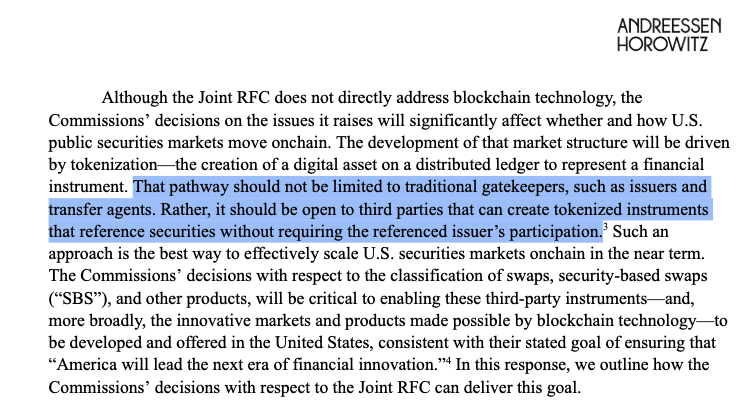
There's a fight being waged over how U.S. securities markets will move onchain.
One side wants to perpetuate intermediation. The other wants to open the door to disintermediation.
This week, @a16zcrypto again urged the SEC/CFTC to embrace the latter.
CCOs: who wants to collect and publish founders' race, gender and sexual orientation? Asking for this data right after deal-close is a strange way to kick off a healthy investor relationship. It puts founder privacy at risk without improving access to capital.
@a16z's position to the California DFPI: https://t.co/7gaDMrAEKJ
This is a 2 minute video about taxing the wealthy.
There is no mention of programs it will fund. Or why the tax dollars are needed. Or what the money would be used for. Or how those less fortunate could be supported to themselves become wealthy.
The benefits are no longer the point.
The implicit message is about punishment. Punishing those doing well is now good politics.
Sign of the times —
We are deeply saddened to hear the news of coaches passing. Hard to even know where to start with a man like Coach Wolford. One of a kind and total servant to others. A blessing to the lacrosse community for all that he gave and a legend here in central Ohio. He will forever be remembered for his passion for the game and even more importantly his dedication to developing young men. He has touched the lives of so many. Grateful for the time we shared over the past 25 years and for all that he has done for me, my two boys and everything he has given to the medicine game & Upper Arlington community. A legend that will be forever remembered! Much love coach ❤️ RIP
This week we posted four stories that point toward a future of open, programmable markets.
From tokenized securities to perps to onchain lending, financial infrastructure is being rebuilt to be more global, more liquid, and more software-driven.
Here’s what we published:
Huge win for DeFi today.
The SEC's guidance on DeFi frontends makes one thing abundantly clear –– securities laws don't apply just because users are transacting in securities.
Rather, what matters is whether the frontend is exposing users to the same types of intermediary risks that securities laws were designed to address.
The SEC's guidance explains exactly what that means –– providing a roadmap for developers and addressing ambiguities in broker-dealer regs that were inappropriately weaponized against the industry by the prior admin.
Critically, order routing isn't prohibited. But where it is done, apps need to be completely transparent so users aren't subjected to conflicts of interest risk. That makes sense and is an honest application of existing law.
This is what effective policy looks like. Huge thanks are owed to the SEC CTF for advancing this and bringing clarity for developers.