For an Estonian, or anyone from a country that has experienced communist terror, it is unfathomable to see the hammer and sickle on Swedish election ballots.
The Soviet Union/russia never had its Nuremberg, and communist symbols remain acceptable in much of Europe.
For millions of victims of communist regimes, the hammer and sickle is no less a symbol of totalitarian terror than the swastika.
BREAKING: Revolut handed over passports and Bitcoin records after a fake government request
Revolut has confirmed that customer files left the company after staff treated a fraudulent request for information as genuine. The message did not come from just a lookalike email address. It came from an unauthorised mailbox on a real government domain and passed the usual email checks. Because it looked official, Revolut sent the data. Only later, after contacting the agency itself, did the firm realise the request was bogus.
The files listed in customer notices go well beyond a name and an email. They include full name, date of birth, occupation, home address, phone number, copies of passports or driving licences, the verification selfie taken at sign-up, IBANs, account statements, withdrawal records and full transaction histories, including Bitcoin. Revolut says biometric face templates, login details and customer funds were not involved. Its systems were not hacked. No money is reported to have moved.
A spokesperson told @BeInCrypto the company had identified “a sophisticated external impersonation attack where an unauthorised third party utilised a legitimate government agency domain email to submit fraudulent requests for information.” The same statement said Revolut’s systems and customer funds were unaffected. The firm says it blocked the sender, alerted the agency, the police and regulators, and contacted what it called a limited number of people. It has not named the agency or said how many customers were affected, citing a live police investigation. On-chain investigator @zachxbt , who first circulated the notices, said the incident looked small and aimed at higher-value users.
A post circulating on X claimed a Revolut employee in charge of data security had just been sacked after asking whether the “.gov” address should be verified first. I understand that post is a parody. No evidence shows such a sacking took place.
One person who contacted me knows someone who received the Revolut notice. At the time of writing, they could not provide details of how the company had communicated with that customer beyond the existence of the email.
I understand this was human error in a process that assumes an authenticated government domain is enough. That assumption failed. It is an uncomfortable reminder that the most sensitive files a firm holds — identity documents, a face photo, a home address and a complete payment history — can leave the building without anyone breaking in. Any company that stores that pile and answers official-looking demands can make the same mistake. The test is whether Revolut, and everyone else sitting on the same kind of records, starts checking the person behind the mailbox, not just the domain on the envelope.
BREAKING: Global broad money supply surged +$10.7 trillion YoY in June, or +7.7%, to a record $150 trillion.
This marks the 9th consecutive YoY increase above +7.0%, the longest such streak since 2021.
The biggest increase over this period was recorded in February 2026, at +11.9%.
Since 2000, global money supply has risen +$124 trillion, a +6.9% compounded annual growth rate over this period.
Since 2020 alone, money supply has surged +$50 trillion, or +50%, equivalent to an average increase of ~$7.5 trillion per year.
Global money creation is expanding at a historic pace.
More bad news for Bitcoiners living in the leading country for wrench attacks. The French tax authority has been hacked and 678K records leaked.
26,805 people with income over 100K€
386 people with income over 1M€
8 people with income over 10M��
https://t.co/KlT0XqPLFR
We have some difficult news to share. Unfortunately, one of our shipping providers has experienced a data breach that exposed sensitive order data. This affects new customers in the US, UK, Sweden, Colombia, Brazil, Italy, and Portugal who received an order within the 90 days prior to August 8th, 2026.
The data exposed:
- Full names
- Shipping addresses
- Phone numbers
- Email addresses
The incident affects 11,742 customers with full exposure (name, email, phone number, shipping address) and 1,947 customers with partial exposure (name, city, email). The breach is limited due to Trezor’s strict 90-day data storage policy (we were also able to negotiate the same terms with fulfillment partners, who follow the same policy).
All affected customers have been contacted separately by email.
Our systems and devices remain secure, but affected customers could experience an increase in phishing attempts.
NEVER enter your wallet backup on a website or share it with anyone, and only check for updates on official Trezor channels.
We are deeply sorry to the community and those affected.
We are investigating this situation and will post updates on our blog:
https://t.co/JGrttMs4Ev
Mechanic blocked me despite me never having had interacted with him, or acted poorly toward him in public in any way. I'll post his message here because it contains a very interesting statement worth unpacking
"Pools have said 'our blocks are valid, even if they violate the rules we were told to respect'"
Let's unpack that.
1. Pools haven't said anything
2. Pools / miners have produced bitcoin blocks, which other bitcoin software accept as valid.
3. The only thing that can "tell you what to respect" in Bitcoin is the Bitcoin consensus protocol enforced by each individual node following Nakamoto consensus (i.e. heaviest proof of work chain following the same consensus rules).
4. The "community" of a few hundred people posting about "mandatory" actions cannot "tell you" to respect rules of their choosing. They must enforce that with their nodes. They did that, but nobody wanted to play along. That happens.
5. If miners produced blocks and those blocks were accepted by other nodes following Nakamoto consensus, then the blocks are valid by definition. This is a tautology. They didn't violate any rules except those invented by a small faction of people. Those are not the consensus rules, by definition.
I can see a lot of people got emotional about something that is not an emotional topic. It's just software. You can't just wave a magic wand and "tell" people how to run their business/life and thus their Bitcoin node. That's just how Bitcoin works.
These views do not reflect the views of @ocean_mining and are mine exclusively:
Saturday 8/8 saw the rejection of BIP110 by the Bitcoin industry despite broad support among the community.
This shattered a long-standing belief that Bitcoin's anti-fragility and hard-monetary properties would continue thanks to its decentralized network of nodes who were run by people who understood Bitcoin and would fight to preserve it.
I have been confident in Bitcoin's future and championed it as a tool for freedom.
My reasons for doing so both required that it maintain and treat as a mission-critical priority the decentralization and ultimate authority of the network of nodes determining and enforcing its rules.
They are no longer relevant.
The degree to which this undermines Bitcoin's future cannot be overstated. Proof of Work is completely pointless if the criteria for what constitutes validity is decided by the ones doing the work.
Pools have said "Our blocks are still valid, even if they violate rules we were told to respect."
They did so within a small cartel of centralized pool operators clearly acting on behalf of industry players who operated behind closed doors ensuring that their public, breathtakingly arrogant, and nonsensically premature dismissal of BIP110 as a failure would not ultimately turn out any other way.
They were not bluffing, they knew.
By contrast, BIP110 supporters operated in public.
We used neutral metrics that everyone had access to, and made the basis of our confidence publicly known. Sincere attempts were made to gauge community sentiment and engagement was public on all venues where discussion was permitted.
Public engagement with influential Bitcoiners who opposed BIP110 demonstrated clearly that their opposition was not in good faith. This led to questions about their characters and intentions which were promptly corroborated by timely Epstein leaks. This meant that it was no longer frivolous dismissal of "the other side" out of pure tribal instinct as is standard within any conflict, and instead it would become laughably naive to continue assuming good faith on their part.
Regardless, the spectacular, resolute dismissal of BIP110 necessarily reveals an equivalent stark and chilling reality with regard to decision-making about Bitcoin's consensus rules.
No one, not even BIP110's most staunch critics can dismiss the implications of this.
When Bitcoin is under attack, spontaneous defense that can withstand whatever onslaught it faces will simply be dismissed as "not economic", "a Sybil attack", "non technical", "censorship" or some other attempt to discredit and undermine it by the attackers.
My expectation for the future is that for Bitcoin, reverse-Trojan horse theory continues to play out: The dollarization of the ecosystem will continue, and Bitcoin's ultimate goal - the separation of money and state, will be forgotten, while its captured players work towards the exact opposite end - its unification.
Bitcoin is not the first protocol to become captured. It needed to become the exception, not the rule. The mechanism by which it did that is decentralization.
Work is being done to hard fork Bitcoin with a new Proof-of-Work algorithm.
I have said repeatedly in the past that in certain scenarios, should mining become captured and centralized to too great of a degree then the only defense the network would have would be to hard-fork to a new Proof-of-Work algorithm.
I stand by this perspective as a truth fundamental to Bitcoin and everyone must agree with this stance if they are to believe Bitcoin is not whatever a necessarily few mining pools say it is.
If you believe the miners acted on behalf of a silent community who secretly opposed BIP110 then I will respectfully disagree but agree that your conclusion about a PoW change being unwarranted must follow.
You have misjudged the BIP itself and are simultaneously oblivious to the mechanisms that were abused to deny it, along with the intentions of the people working them. You also did not indicate your dislike of the BIP via discernable metrics (i.e not running a URSF and committing to its rejection) - instead you relied on a few pools to decide on your behalf.
So what am I going to do?
Wait with a stalled out Knots node. Another block will be along later rather than sooner, but I'll take it. That is what my entire Bitcoin stack sees as the state of the network. If a PoW change HF comes along with the next update to @BitcoinKnots that makes blocks start showing up faster I will upgrade to it and enjoy the benefit.
I have no desire to attempt to call this new chain "Bitcoin" - Bitcoin is a case study in protocol capture and instead of dying, becomes a tool for the sickest of purposes. I can think of nothing more evil than centralized Bitcoin. It is whatever tinfoil-hat conspiracy theorist told you Bitcoin was.
But for all my day-to-day activities, all the software I use, Bitcoin is simply stuck at block 931,633. At current hashrate the next block will take ~32 hours. I sincerely doubt that anyone wants to find another 2000 blocks at this pace so HF is the only practical option.
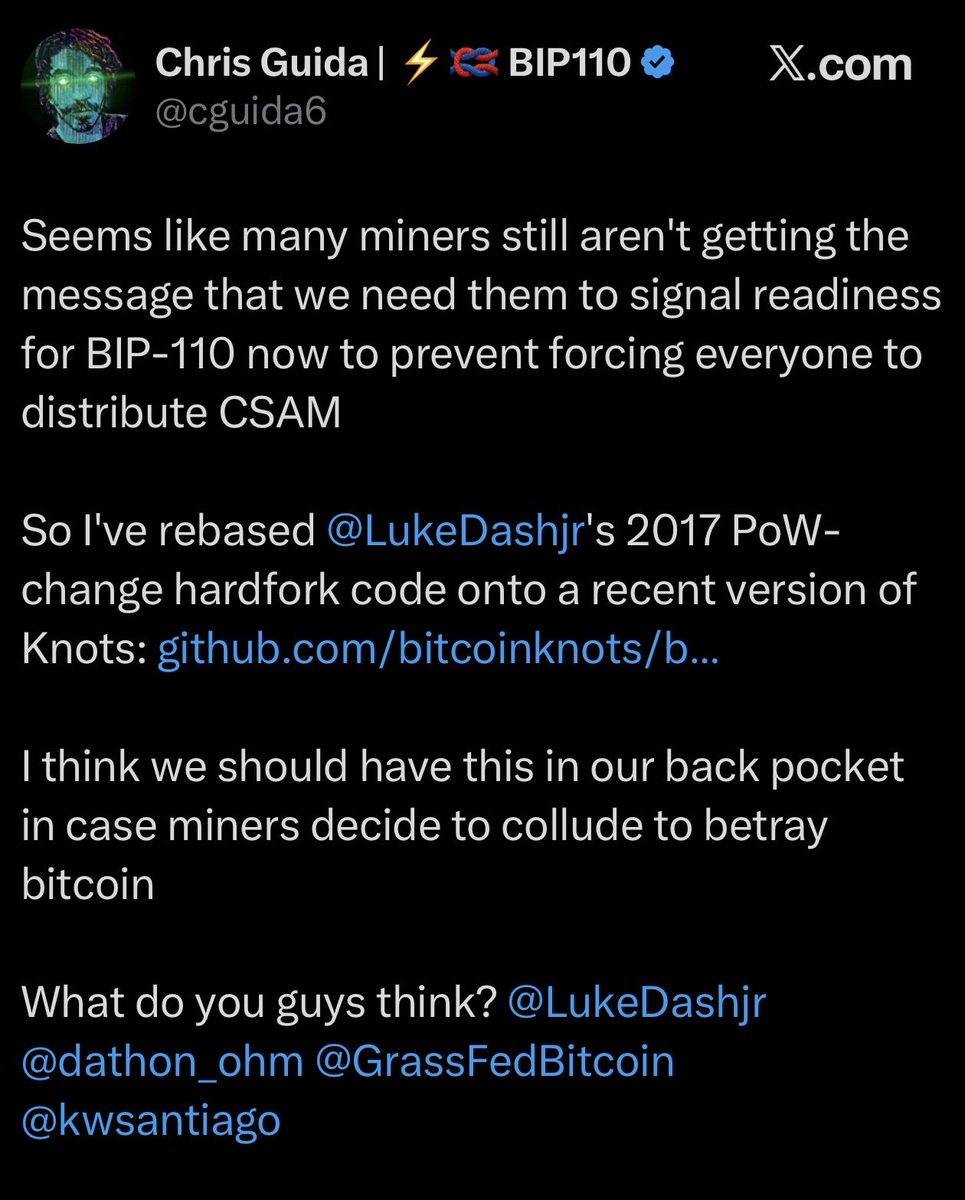
LUKE DASHJR SUGGESTS SEPT. 1 FOR BIP-110 PROOF-OF-WORK CHANGE BTC HARD FORK
Bitcoin developer Luke Dashjr suggested Sept. 1 as a potential target date for a BIP-110 proof-of-work change, saying it should occur when BIP-110 “would have activated.”
BIP-110 author Dathon Ohm says the community is now working on a proposal to change Bitcoin’s proof-of-work algorithm and “fire the miners,” accusing large mining pools of colluding against the BIP-110 movement.
Asked how the network would remain secure after firing existing miners, Ohm responded:
“We will hire new miners.”
Since we're about 48 hrs away from the BIP-110 "mandatory" signaling height, I wanted to quickly share my private node crawler stats.
Over the past several weeks, I gave a program of mine more spending power than is probably reasonable. It spent a not insignificant amount of BTC deduplicating nodes. Enjoy.
Raw node counts (% of total)
�� Total: 131,762
⚫️ Bitcoin Core: 99,401 (75.4%)
⚫️ Bitcoin Knots: 30,755 (23.3%)
⚫️ Other: 1,606 (1.2%)
Raw BIP-110 signaling counts (% of total)
🔸 Bitcoin Core: 17 (0.01%)
🔸 Bitcoin Knots: 19,388 (14.7%)
🔸 Other: 0 (Unknown)
🔹 Total: 19,405 (14.7%)
Nodes found to be duplicates (% of version)
🔴 Bitcoin Core: 17,892 (17.8%)
🔴 Bitcoin Knots: 18,049 (58.7%)
🔴 Other: Unknown
🔴 Total duplicates: 35,941 (27.2% of total)
Deduplicated node counts (% of unique)
🟢 Bitcoin Core: 81,672 (85.1%)
🟢 Bitcoin Knots: 12,706 (9.6%)
🟢 Other: 1,606 (1.7%)
🟢 Total unique: 95,984 (72.8% of total)
Of the 19,388 Bitcoin Knots BIP-110 nodes discovered signaling for BIP-110, 71% of them were eliminated as duplicates, above average for the Knots nodes, leaving only 5,663 BIP-110 signaling nodes.
That puts non-duplicate BIP-110 signaling nodes at 5.9% of non-duplicate nodes.
My criteria for deduplication includes the basics (same IP) and some additional more advanced sleuthing of available data. Additionally, you may have already surmised from my intro that part of it also involves strategically sending real transactions.
Will keep the exact details private so that it can't be easily gamed in the future. It is impossible to find ALL duplicate nodes, however false positives are somewhat unlikely with my methodology. If my software has flagged a group of nodes as duplicate, there's an extremely high probability that its either the exact same node (with multiple IPs) or in the exact same location.
If a node wasn't able to be tested thoroughly enough to be confident for whatever reason, and isn't deemed duplicate by conventional means (same IP, for example) then it isn't considered a duplicate and gives it the benefit of the doubt.
If I get more time, I may start publishing some more detailed stats more regularly, since it seems my crawler successfully finds a large amount of nodes beyond those listed every public crawler. Unfortunately it's not cheap to handle the deduplication aspect, so will need to figure out how feasible that is to continue. It also involves operating from dozens of IPs to get connected to a supermajority of the network, which is pretty bandwidth intense.
Anyway, figured I'd share, since I don't think anyone is actually doing this at all at this level. There's a lot more to this, too. Some of it might scare privacy conscious people... so I'll probably keep my publicly shared info limited to node stats.
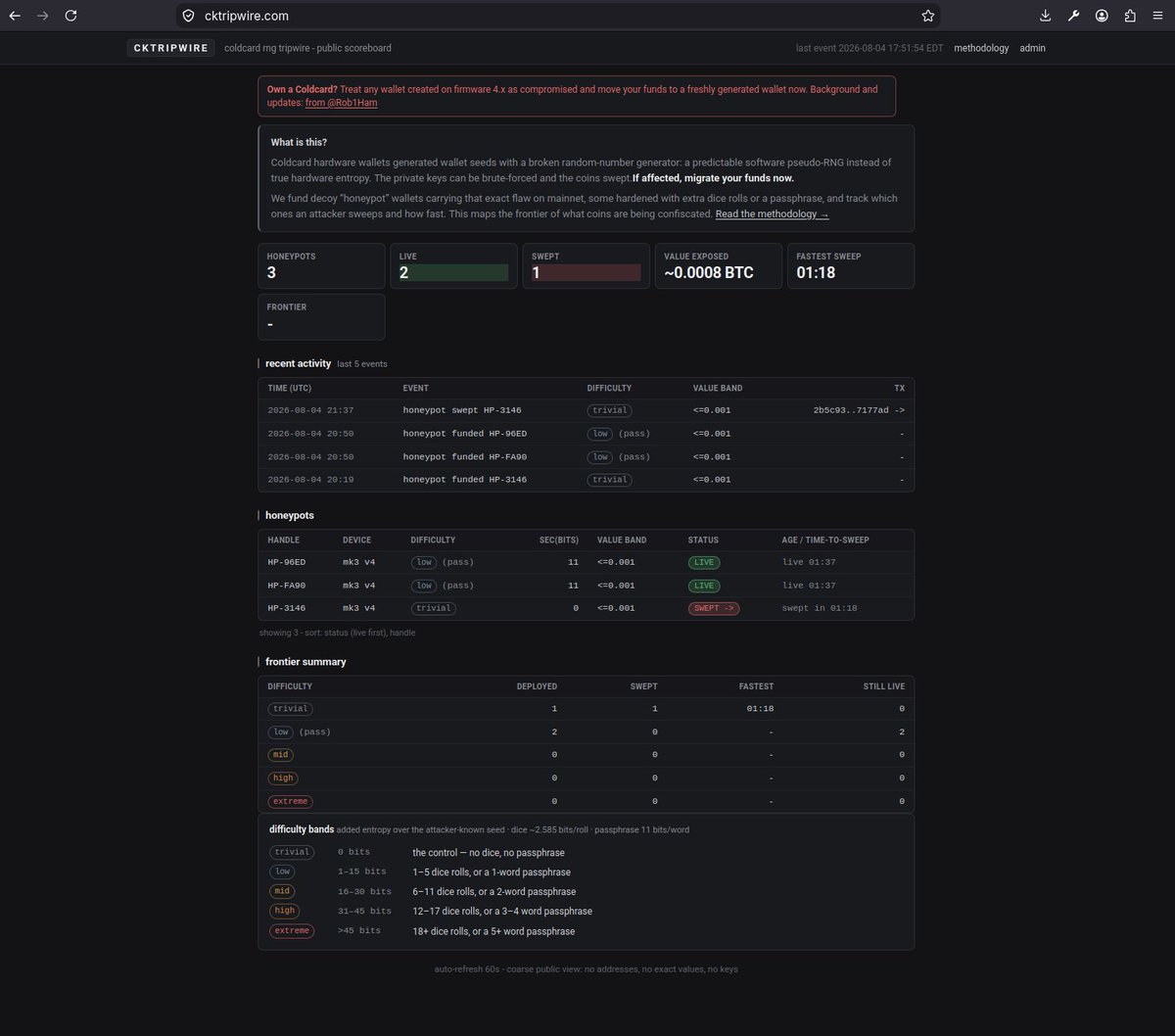
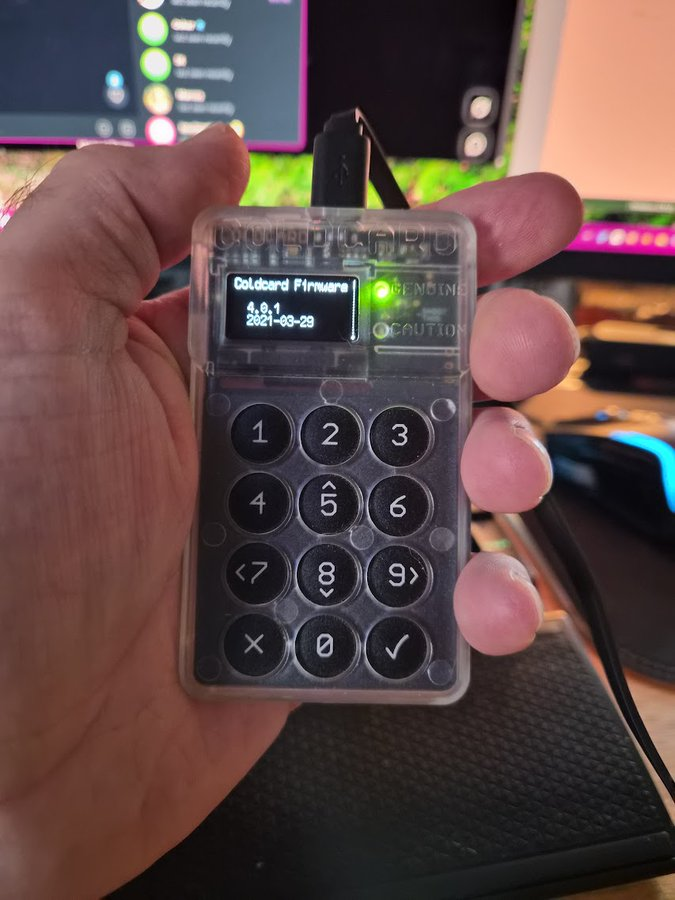
We are now mapping the ongoing Coldcard attack with a live dashboard - link below
I am deploying tripwire UTXOs that have varying levels of added entropy on top of the broken default seeds. We have different levels for 5, 10, 15, ... dice rolls, and 1, 2, 3, ... passphrase words.
This is so we can approximate the frontier of the confiscations that are actively happening.
The control UTXO with no added entropy was swept in an hour.
I took real measurements on an MK3 to calibrate a "good bad entropy" emulator in software. The control confiscation has proven it to work.
I am going to continue to deploy tripwire UTXOs along the bit curve.
Huge thanks to @Rob1Ham@otaliptus@PortlandHODL and other redteamers for the help.
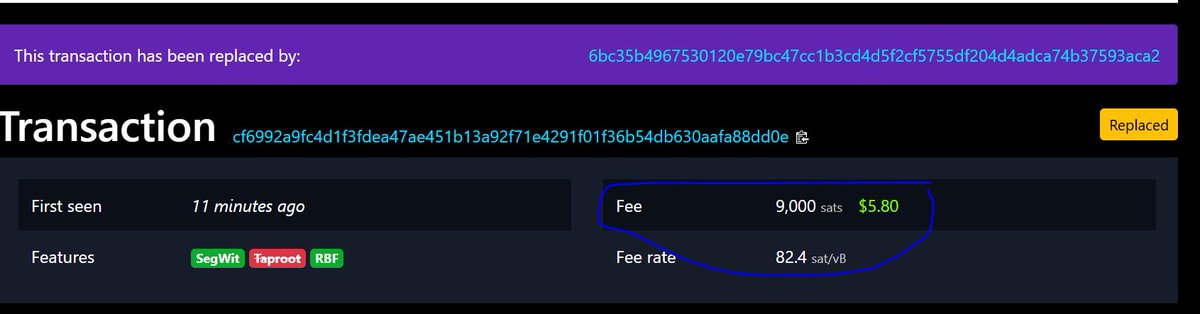
🚨 We hosted 10,000 sats on a @Pathfinder Coldcard MK3, waiting for an attacker to attempt a sweep. The attacker struck just 10 seconds after the deposit.
WatchGuard (@we_satoshis hardware ) detected the sweep attempt and raced the attacker in real time using a pre-signed Replace-by-Fee (RBF) transaction.
The defense was successful—the RBF transaction won the race, using a fee of 9,000 sats to secure the funds
. https://t.co/J0vyoJ17a4
but the attacker strike again with 9100 sats fee .... This race can continue until every last satoshi is burned in mining fees instead of ending up in the hacker's wallet...
We’re not forking
Ok we’re forking but it’s only a temporary fork
Ok it’s not temporary but it’s a majority fork
Ok it’s not a majority fork but we have miners support
Ok we don’t have miners support but it won’t cause a chain split
Ok it will cause a chain split but it won’t be permanent
Ok it will be permanent so we’re changing the mining algorithm