@DeepValueBagger But $AAPL is the most pro-China American company ever and is not hated at all?
I agree $NVDA is unjustly hated, but don't see retail ownership as the reason based on this list.
@thdxr There is a lot of resistance to the AI industry that is driven by jealousy and incumbency, even from those within the financial industry. Somehow Google, Apple, Meta escaped all this when they grew a ton. Not sure what is different with Nvidia and AI.
@FinnStockinger There are definite downsides. $AAOI is on sale right now so it must feel cheap. That aside, it could also make them stronger just as competitive pressure builds. The proposition is both offensive and defensive.
@orrdavid I think if you take a bounded task in a bounded field and wonder if there will be saturation of performance, the answer is definitely going to be yes. I don't think that implies something about the limits of AI growth on a global all-use cases scale though.
@orrdavid Here's another good example. Models are doing more work faster and more cheaply –> Have them present their results visually in html: https://t.co/xL4WKMMlRi
ok after a full day of using gpt 6.2 astra and sol on my real projects, here's my review
tl;dr - they are not a drop-in replacement for fable 5.2 and opus 5.5, but they are _really good_ once you figured out how to use their strength
1. first, the quirks
i started called these the "gpt smell", which is still here with the 6.2 series
the models' judgment on when to ask the user about something and when to go ahead is just not quite right. it'll escalate trivial decisions where clearly only one option is preferable, or choose to go down a path by itself that makes significant tradeoffs that should have needed my eyes
so as a primary driver for "let me just talk to it about everything" type of use case, they aren't great - i'd say they are close to opus 5 in this regard, and far behind opus 5.5
2. but... i found something _really_ cool
having ultrafast on sol is completely insane. with astra, it burns my wallet ultrafast, but with sol it's actually quite affordable!
the best use of sol on ultrafast that i've found is adversarial code reviews - they typically don't need to run a lot of heavy tool calls that would slow them down. most of the time is spent on the model, which gets massively accelerated by ultrafast
once you got a feel from using sol ultrafast as the code reviewer, you can never go back. it feels like pure magic
3. and... i found something else that's really cool
we are not supposed to ask the gpt 6.2 series to respond in text. we should let them respond in html! (i use lavish-axi, but you can just ask for html or use whatever fits in your harness)
i suspect they are post-trained specifically on their latest "intelligent UI" concept in chatgpt - these models are so good at visual presentations of ideas
once you allow the model to respond in visual artifacts, it's a completely different game. the reports and decisions explained by astra in html is a clear step function better than what fable and opus give me
so after a day of use, i've made two changes to my setup:
- always sol ultrafast as code reviewer
- i started preferring asking astra for planning in html artifacts over fable/opus. i think i'll keep a/b testing for a while to decide how much and for which case i fully switch over
all in all, i strongly recommend spending more time with these two models. don't expect them to be the "everything" model, but rather figure out where they fit best in your workflow. i couldn't be happier for the two use cases i found above, and i'm pretty sure there are more
@AZNCandaceOwens@ArmandDoma The US changing its mind in the last few days about doesn't change the legality of what happened in the past. Further, it's not clear that Chinese tech companies having access to and thus depending on US chips was even congruent with China's national strategic interest.
@AZNCandaceOwens@ArmandDoma You are presuming a crime happened. If chips were deliberately sold to China that are banned, then sure.
If chips were sold to a SE Asian neocloud for the explicit purpose of renting to Chinese tech companies, it has been legal *and* it has been the policy and strategy of the US
@AZNCandaceOwens@ArmandDoma For China, it was a a matter of time until when they would end this workaround. They want Chinese tech to depend on Chinese chips. The workaround allowed some leakage but Chinese chips flourished. For the US the SE Asian neoclouds presumably could be pressured in an emergency.
@AZNCandaceOwens@ArmandDoma It wasn't against the law to sell to SE Asian neoclouds. This was the workaround that both the US and China supported up till a couple of days ago when the US changed its mind and is now requiring licenses if neoclouds rent to Chinese tech companies.
@JosephMSamara@ArmandDoma Looks like people still don't get it, even people that are otherwise really smart. I don't know what to say except there's no way to square the circle that US allowed chip exports only to have China ban the exports. They ban from different worldviews but both want to ban!
@ArmandDoma Skirting is really inaccurate here. China and the US both agreed importing leading edge chips from the US was bad. They both agreed renting neocloud compute in SE Asia was fine for now. The US is changing its mind about renting. But it's unclear China wouldn't want the same!
@snmart This makes more sense to me. They know the stock price is depressed and are major shareholders themselves. There's no reason to do this unless something good is about to happen.
@theo Wow thanks for this. One detail: how slow/fast were the SSDs you were using or anything else that gives an idea on what the bottleneck might have been? Like really old SSD, laptop vs desktop setup, brand/type, etc?
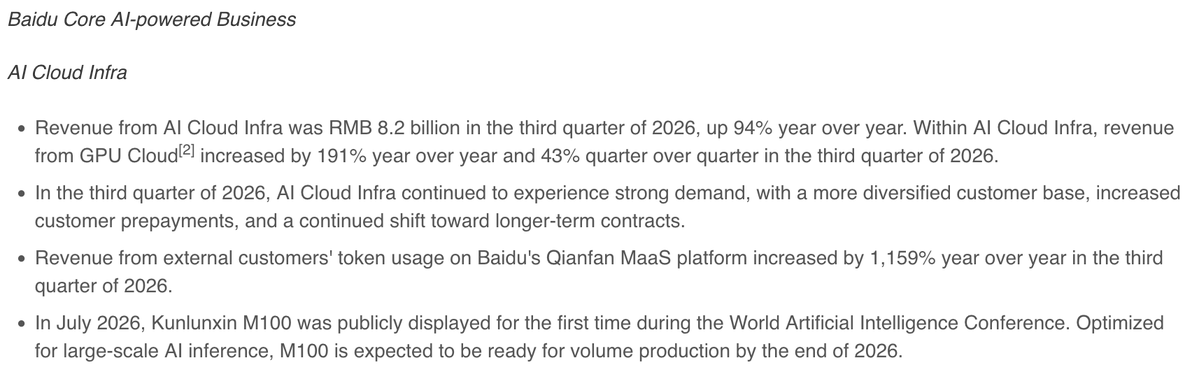
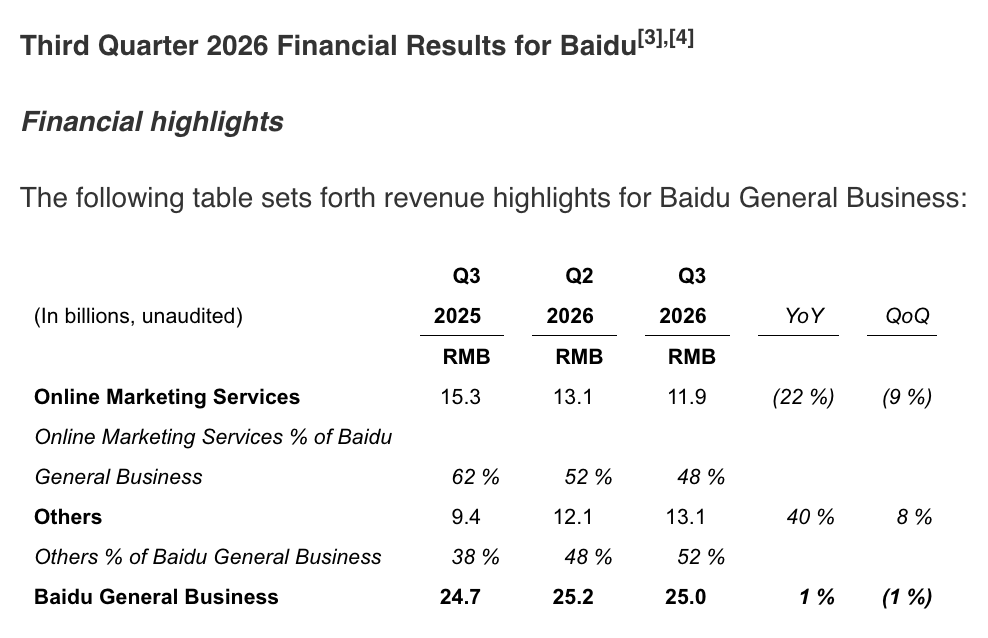
$BIDU earnings and maybe a glimpse of the future for $GOOG:
📈Cloud AI revenue up 94% YoY, GPU cloud up 191% YoY
📉Advertising revenue down 22% YoY, down 9% QoQ