Want to help build humanity’s first Moon base?
We asked @NASAAdmin Jared Isaacman and the
@NASAMoonBase team at MAX POWER "which engineering disciplines will be needed most?"
Here's what they had to say 👇
We’re going back to the Moon to stay. Building a Moon Base means giving American astronauts the infrastructure to explore more, conduct more science, and prepare for missions farther into our solar system. That’s the future we’re working toward at @NASA.
It’s an exciting week for space!
Starliner is getting back to flight.
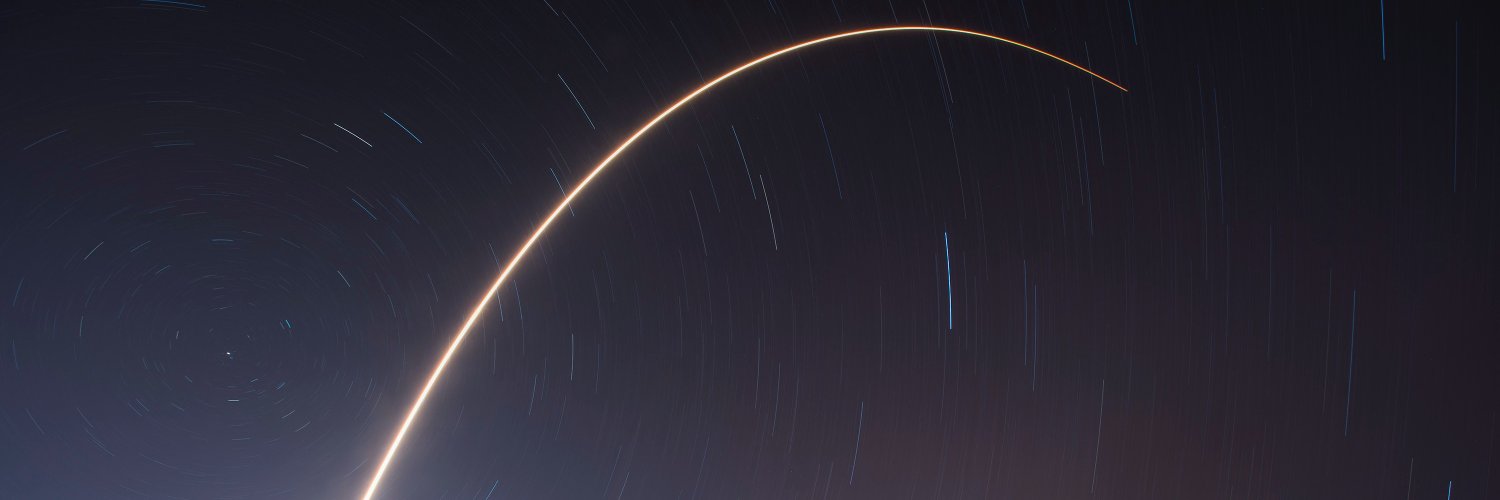
Starship achieved an important milestone and is advancing a capability that will matter for the future of space exploration
And on Thursday, Crew-13 is taking the next astronauts to the ISS.
Congrats @SpaceX! Gorgeous launch, getting Ship to orbit and managing every step in a safe, responsible, and especially inspirational way. @NASA, along with the rest of the interested public, is excited to help where we can and for Starship missions to become routine!
We have three federal academies dedicated to the maritime domain. As our ambitions in space grow, we need to invest in the people who will lead there, too.
With @POTUS’ direction to establish the United States Space Academy, we’re giving the next generation the opportunity to build that future. We have a lot to accomplish and we’re moving quickly.
Back at it again with a long one, but can't help myself on the Space Academy topic.
Interesting to read some of the policy experts who have taken skeptical, and in some cases negative, public positions on the need for a United States Space Academy. People are certainly entitled to their opinions. There are also those who believe we should not build a single spaceship or invest in technological progress until we solve every problem on Earth. That is simply not how you build a better future for our children.
I suspect, for some, the objection has more to do with the politics than the merits. So let me address a few of the common concerns and offer some rationale.
Global dependence on space is increasing at an astronomical rate. Weather forecasting, disaster response, precision navigation, communications, agriculture, national security and scientific discovery all depend on capabilities in orbit. Connecting the disconnected and expanding access to knowledge is itself foundational to solving many of the world's problems. The data we will be taking in, whether from Earth observation or instruments like Roman, will answer questions we do not even know to ask today.
And there is no going back from the trajectory we are on. A decade ago, the FAA was overseeing barely more than a dozen commercial space launches per year. Today, nearly a dozen U.S. companies are operating or developing orbital launch systems, chasing economic opportunity measured in the trillions. But the upside is far greater than economics. Think about what we stand to learn scientifically, what technologies will have to be pioneered to explore out there, and how many of those breakthroughs will make life better back here.
Our new national space transportation policy calls for the United States to support more than 1,000 launches annually by 2030. Some already believe that is off by an order of magnitude.
America will certainly establish a permanent outpost on another world in the years ahead, and we are not alone in our ambitions. That outpost will become NASA's proving ground for where we go next. Mars. And then we continue on. It is our destiny to harness more of the energy of our star, unlock more of the energy potential in matter, and venture farther outward, in the same spirit as the explorers of centuries past who discovered the New World.
And we have no idea how quickly that timeline could accelerate in a world transformed by artificial superintelligence, robotics, quantum technologies and additive manufacturing. All of it is unfolding in the context of a great power competition where falling behind could materially affect our way of life and the trajectory of civilizations.
I do know the future will require a bright new generation educated and prepared for this environment. Many will serve in inherently governmental roles. They will need specialized education in disciplines that barely exist today, including nuclear power and propulsion for space applications, before having the opportunity to continue careers across government or the private sector.
If you understand the increasingly important and contested environment above us, then a Space Academy is as timely and necessary today as the Space Force has already proven to be.
So what are the objections? It blurs the line between peaceful applications in space and the military.
This may be the weakest argument I have seen. NASA's history began with astronauts flying to space on ballistic missiles. Several Space Shuttle missions were, and remain, classified. NASA Aeronautics flies repurposed U-2 spy planes for high-altitude research and F-15s for high-speed research. Breakthroughs pioneered through NASA aeronautics have benefited civil aviation and national security alike.
The U.S. Merchant Marine Academy, under the Department of Transportation, graduates students who go into industry, government and the military. Some have even become astronauts. Three of the four Artemis II astronauts came from the military, as have many NASA astronauts throughout our history, and some have continued serving in uniform after their NASA careers.
NASA's mission is as peaceful as it is patriotic. We explore for the benefit of all humankind, but we go there under our flag. That mission would be impossible without the Guardians standing watch over the domain as we venture outward. There is no contradiction in giving future civil, commercial and national security space leaders a common educational foundation, especially when our adversaries draw no such distinction themselves.
What about the cost? Congressional leaders and Governors from both parties have been reaching out and assembling potential funding packages.
It is interesting, I face questions during congressional hearings over whether we are investing enough in STEM education. We can absorb billions of dollars in canceled programs from mismanagement. But investing in the education of the next generation, in a domain increasingly central to our scientific, economic and national security future, is somehow uneconomical?
We should look past the politics on this one.
Go back to 1963, when the world was captivated by the possibilities of space, and remember another iconic JFK speech. He reminded us that we all treasure our children's future. Fittingly, he delivered those words at a university commencement.
It is time for another great American academy. A United States Space Academy worthy of the extraordinary adventure ahead.
Always good to get out of DC and into the field where the action is happening.
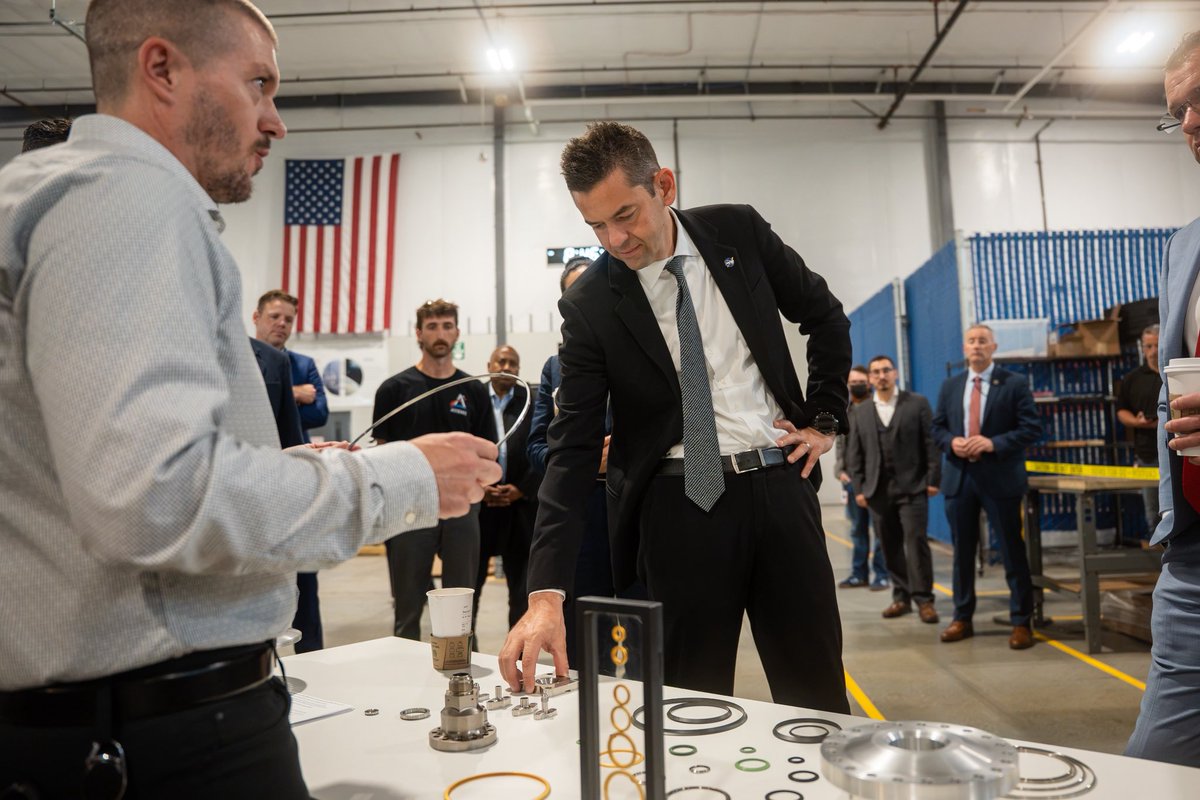
From @Livermore_Lab to United Precision, @Boeing, @_Rocketdyne, and @stoke_space, we spent the last few days with the scientists, engineers, and technicians putting some of America’s most ambitious missions into motion.
We saw incredible science, aerospace manufacturing, propulsion hardware for ESM, Orion, and SR-1, and wrapped it up with live Zenith and Andromeda tests at Stoke’s test site, which were extremely impressive.
We have an enthusiastic and engaged President @POTUS who has given us the policy, the resources, and even a new Space Academy. We have bipartisan support from Congress, the talent of the NASA workforce, the best of industry, and a playbook that changed the world in 1969 and will do so again.
We're entering a new era of lunar exploration.
With high-definition cameras on our landers, rovers, and Moonfall drones, people around the world will be able to watch as we explore the lunar surface, search for water ice, and prepare for a permanent human presence on the Moon.
CHAPEA hits the 250-day mark! 🎉
From science investigations to daily life inside the habitat, the crew of our yearlong Mars simulation is helping us better understand how future astronauts will handle the challenges of deep space exploration. Take a peek inside the mission ⬇️
Artemis III is coming together, piece by piece.
The second of four RS-25 rocket engines was recently offloaded at @NASAKennedy. These rocket engines will power the Space Launch System rocket during the launch of Artemis III, propelling the Orion spacecraft into Earth orbit.
We are doing things differently now. NASA cannot take years longer than expected and spend billions more than planned when the world is waiting for the headlines only NASA can deliver. The programs covered in the report will free up more than $3 billion in the years ahead for more missions of science and discovery. The small pilot program we implemented to rebuild core competencies has already resulted in nearly $200 million a year in savings. That means more Moon Base missions, more astronauts in space, more telescopes, more nuclear spaceships and more x-planes.
I love getting out of Washington and spending time with the people getting the job done!
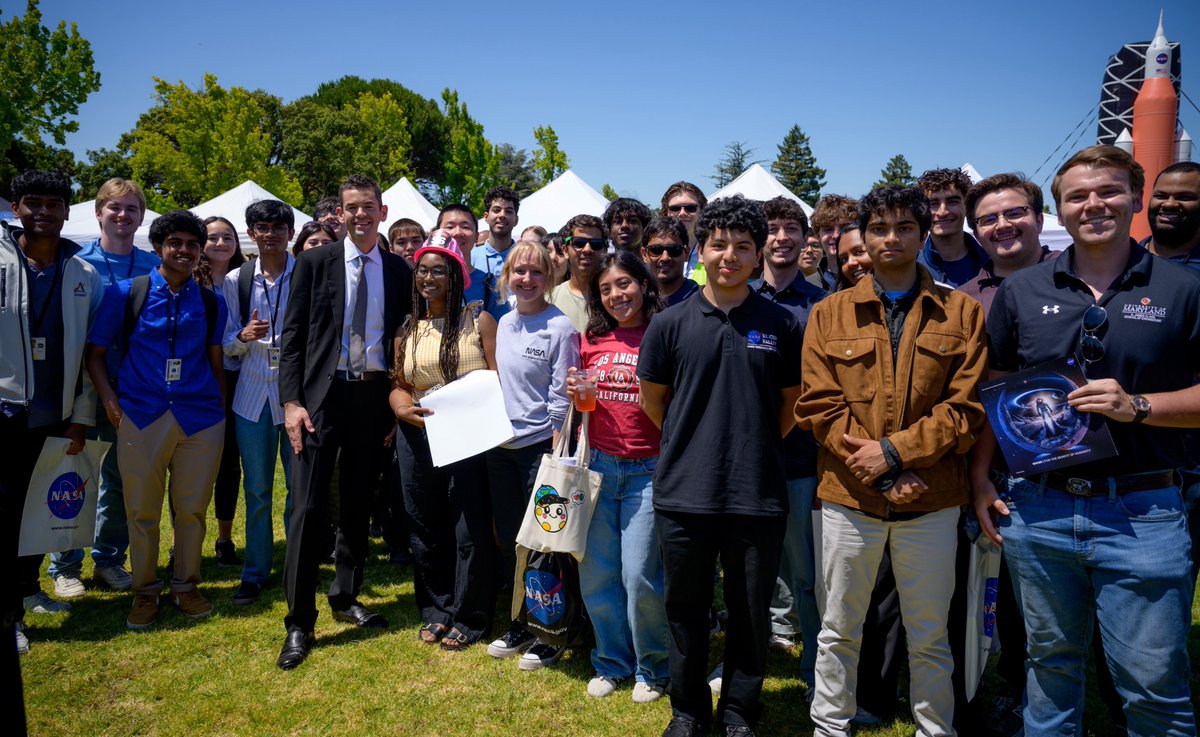
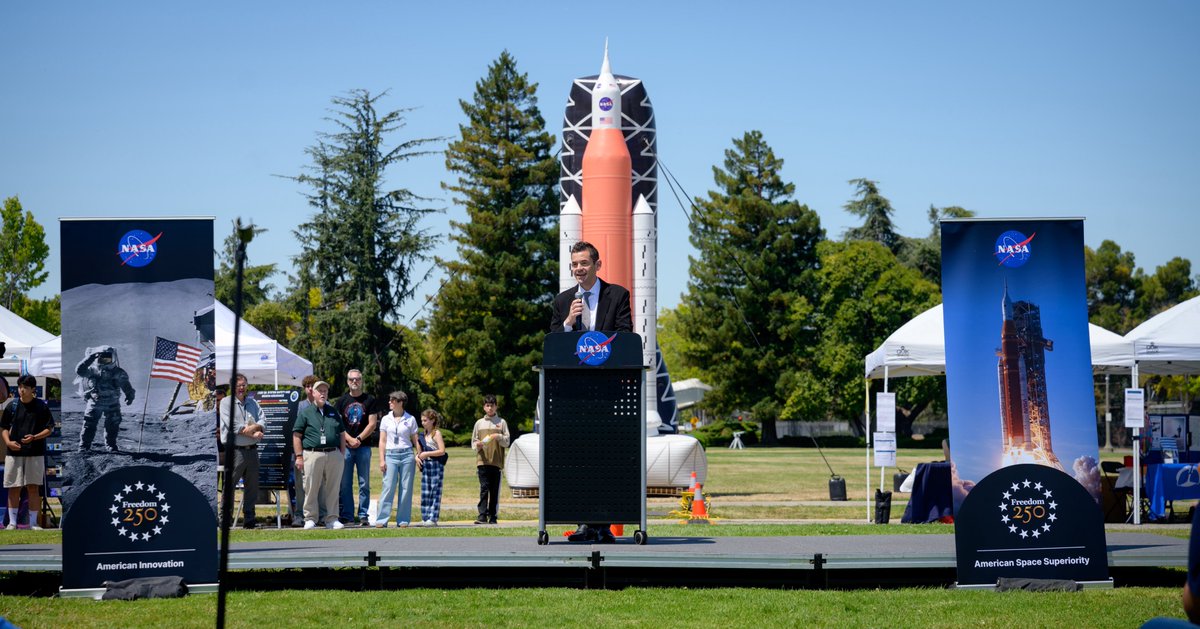
It was great visiting @NASAAmes for the annual center picnic, meeting employees, interns, and students, and hearing firsthand about the work shaping the future of science & exploration.
I also had the chance to see some of the incredible capabilities that make Ames unique…from the world’s largest vertical motion flight simulator, where every Space Shuttle astronaut trained and no doubt those that will land on the moon will train, to the newly restored Hangar One, a landmark that represents both NASA’s history and its future.
Every visit reminds me that America’s leadership in space is powered by the people who show up every day to solve hard problems and push the boundaries of what’s possible.
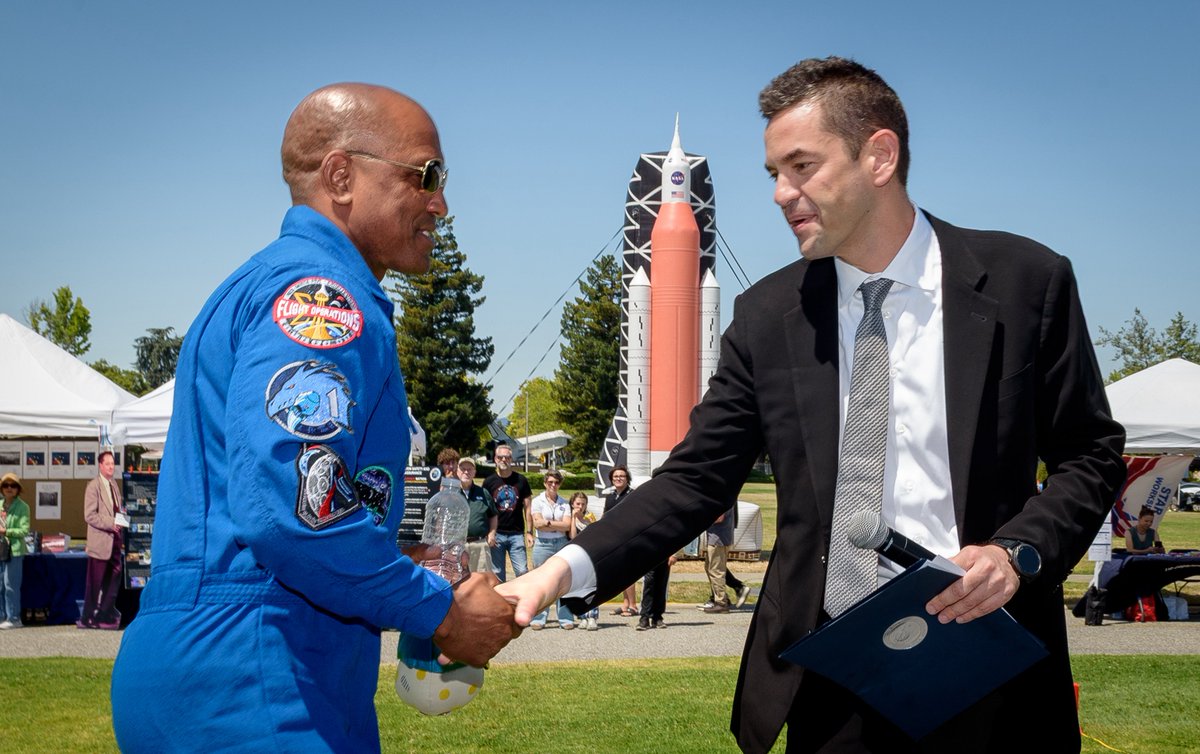
The young designer of Rise meets a @nasaartemis II astronaut!
Eight-year-old Lucas Ye had the brightest smile as Artemis II pilot @AstroVicGlover showed him Rise and congratulated him at the Ames summer picnic.
A true experience of Moon joy.