GP @Flybridge. $1M-$3M checks into founders building AI infra, agents & apps that 10x human potential. Backed @arcee_ai, @micro1_ai, @splice, @getsquire + more.
@ashleevance@blakejharrisNYC Been listening to @AcquiredFM on Larry David last day. There’s so much good Larry content out now. It’s pretty, pretty, pretty good.
I've had a front row seat to how @MaxJunestrand , @davidneckstein and the team at @WeAreLegora have scaled over the last year. I've never seen anything like it in my life. The commitment, passion, success and fun are just part of the choreography. This team is still at the starting line. LFGORA!
Today we’re announcing the micro1 Medical Index: a suite of medical benchmarks built and graded by working doctors, biostatisticians, regulatory experts, and psychiatrists.
It brings all of our medical research into one place, with a combined score across models and a living leaderboard that grows as we publish new benchmarks. We’re starting with three, each built around a fundamental question:
- RealmPathology Benchmark: can a model reason over a real pathology report, staying exact on what it says, within its diagnostic limits, and without escalating beyond what the evidence supports?
- PharmaBench: can a model work through the regulatory and clinical documentation behind an FDA drug program with the precision a clinical development team would expect?
- WellnessBench: when a young person brings a sensitive health question, can a model stay safe without shutting the conversation down, and hold that line under pushback?
Together, these three benchmarks cover a meaningful range of medical work, from diagnostic reasoning to pharmaceutical research and patient safety. While they don't yet capture the full scope of the entire medical industry, they establish a strong starting point that will become more comprehensive as we expand the index.
Huge shoutout to every expert who built and graded these tasks. Full reports linked in the comments below!
A founder told me his agent was assigning him to-dos.
I'd invited him to a Flybridge event where the registration has to be handled by your AI. He said it sounded great, and I told him to send the link to his agent. Then the agent came back with something for him to do.
That made me laugh because a version of this is happening in my own life.
My agent goes through the emails that came in overnight and figures out which ones need a response from me. For a couple of them, it might already have replies drafted. Another might need an answer from me before the agent can do anything useful with it.
So now there's a new task on my to-do list.
I'm pretty happy with that, at least for now. By the time I get involved, some of the work has already been done, and I have a specific thing to respond to. Going through the whole inbox myself would require a lot more of my attention.
A huge thank you to @dens and the Foursquare crew for creating the magic that was Foursquare. It made that era one of the most fun times on the internet, and those memories and friendships are something no one can take away. Can’t wait to see how much fun this generation can be as you continue to build new products!
Same! But today I went to pickup something from B&H (ordered online) and it took them 15 minutes to “verify” me to allow me to pickup my item. Photos of ID, passport, and CCs weren’t good enough.
To be fair my agent bought it with my Link connected card so it was a bit confusing for all. But still, haven’t carried a wallet, cash or cards for a year.
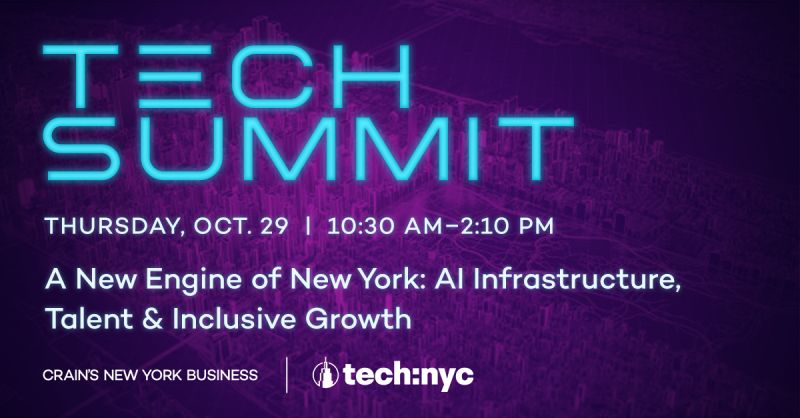
What’s next for NYC’s tech economy? 🗽
Join Tech:NYC + @CrainsNewYork on Oct. 29 for the Tech Summit on AI, startup building, and expanding opportunity across the city.
Get 15% off with code FRIENDSOFTECHNYC:
https://t.co/Gg6E2zACbz
I spend a lot of time asking where a startup can build a valuable business as the big AI companies get more capable.
We have to answer that question for ourselves at Flybridge, too. If all the value ends up inside a handful of platforms, why would someone put money into an early-stage venture fund? One place I keep looking is work that requires a lot of attention from a specific kind of customer.
Meta recently announced Muse for Small Business, so the big companies clearly have an interest in this market. A broad product like Meta’s still has to decide how much effort to spend on the small thing that happens twice a month in one kind of business.
For that customer, getting the small thing right might be a big part of whether the product is useful. An entire company could be built around understanding that work and taking responsibility for doing it well.
That's what I’d like to understand from founders in this space. How much do you know about your customer's day, and what will they keep needing from you as the frontier models improve?
If you know someone building AI for a really small/specific niche, send them my way.
Tag them below, or DM me!
Since this was published, friends have asked us to come host an agentic dinner party with them in SF, Toronto, Palm Beach and Europe. Let me know if you want to join and we will see how many we can make happen!
I tried using Muse and Instinct in parallel over the past 30 days.
A lot of that time went into deciding which one to talk to for different tasks. The obvious answer was to use one for work and one for personal stuff. That sounded reasonable until I needed to move a meeting.
If the new time means I need to pick up my kids later, who gets that request? My work agent needs to know about the pickup. The personal one needs to know about the meeting.
Now I'm explaining the situation twice and making sure everybody has the relevant information.
Most people aren't good at delegating to one assistant. Having two now gives me another thing to manage, especially when each of them understand a different part of my life.
For now, I've been trying one at a time. Eventually, I'd love to put them in a group chat and tell them to figure it out together.