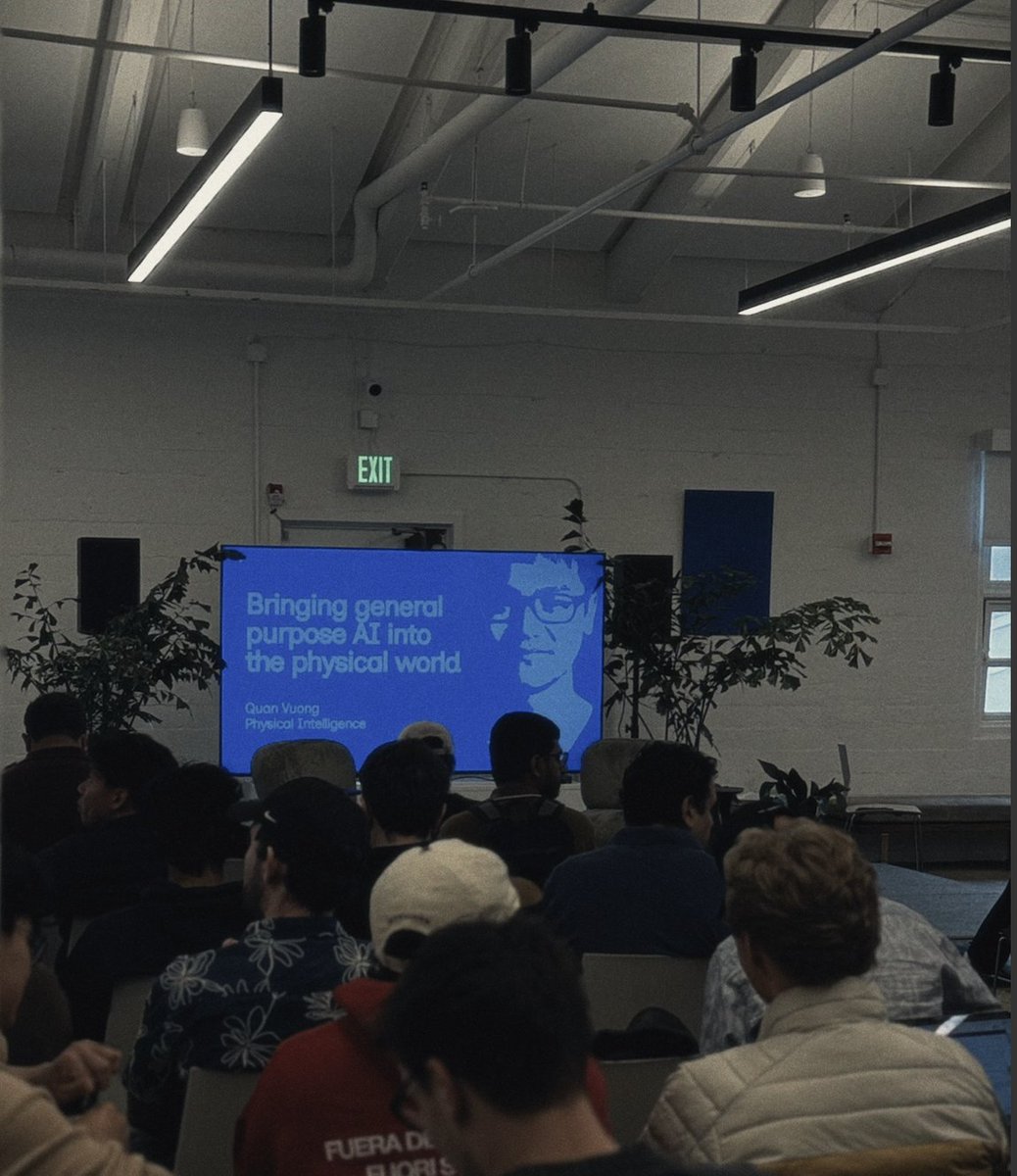
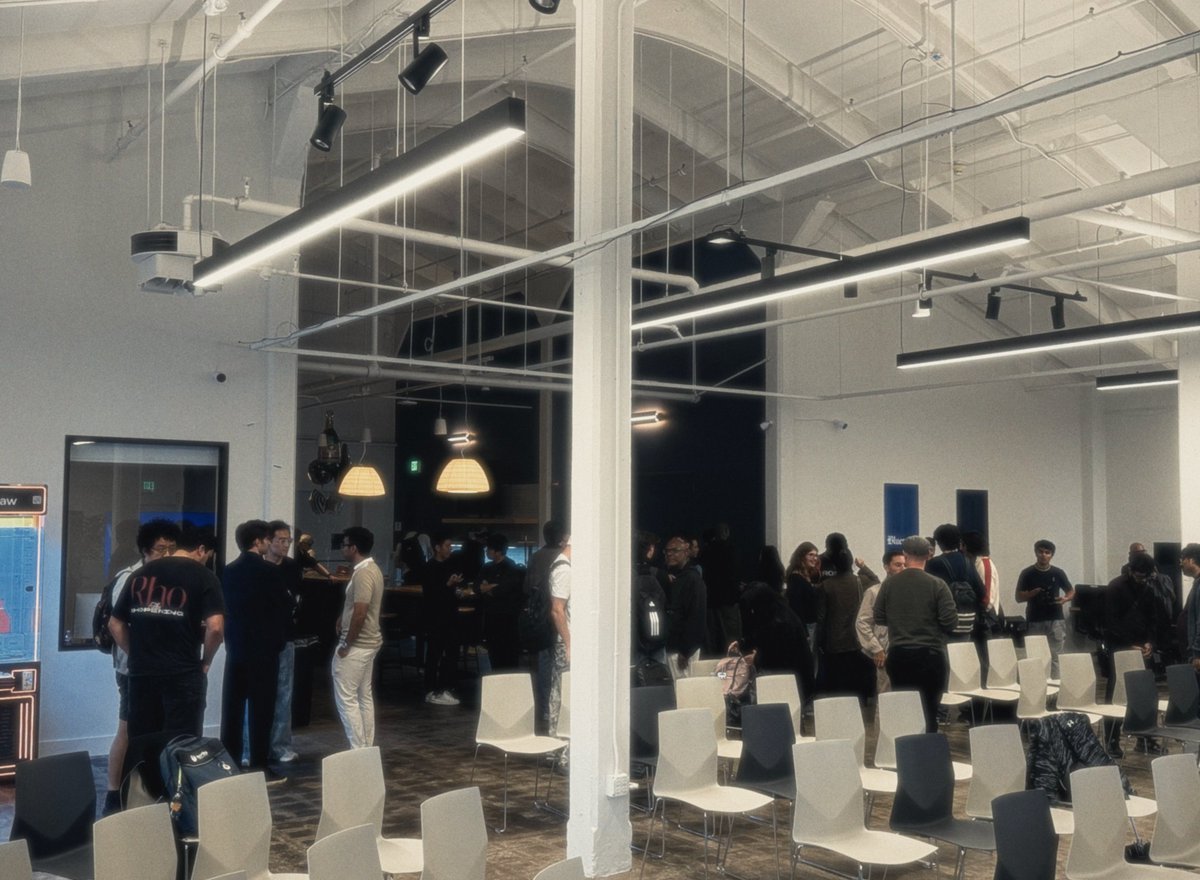
Two days at @TheHumanoidHub's first conference in SF: Cool event, cooler people!
The humanoids drew the crowds, but the real race is hands and data. the gap between a demo and deployment 🤖
Hands
@proceptionAI's ProHand ran grasp cycles nonstop. 22 joints and a skin that feels contact, plus a glove that records human hands so robots can learn from people.
@ChestnutRobotic pairs its Aero Hand with a wearable that captures how a worker does the job, so the hand can repeat it.
Data
@GenrobotAI, @BitRobotNetwork and @GroundedSI are turning everyday human video into robot training data, from 6-camera caps to labeled datasets.
@AlloyRobotics' AI agents dig through fleet logs to find out why a robot failed.
@Auki gives robots, phones and glasses one shared map of a space.
Brain
@SkildAI is building one model to run any robot body.
Robots
@lightberry's Lumi, a Unitree G1 with a social brain, traded high fives. @boosterobotics brought its $6K K1 for developers.
After his talk, @1x_tech's chief designer spoke off the cuff in the hallway. 1X wants NEO in developers' hands first, to see what they build before it reaches homes.
Touch sensors are prone to breakage on factory floors.
Enact, in Switzerland, feels force through the motors instead. $30M pre-seed.
https://t.co/Rd7MV895G4
🚨 BREAKING:
Enact has emerged from stealth with $30M in pre-seed funding!
The largest pre-seed round ever raised in Switzerland! 🇨🇭
Backed by redalpine, Notion Capital and firstminute capital.
Angel investors include Mistral founder Arthur Mensch, Yann LeCun, and Andrew Lonsberry.
The company is building robots that feel force and touch, but not through external sensors.
Through their motors. Touch sensors exist. But they tend to be too costly and fragile for real factory conditions.
Enact's approach measures force inside the motors themselves, comparing it to the way humans feel tension in their muscles, not just at their fingertips.
No separate sensors to break. No additional hardware to integrate. The capability lives in what the robot already has. And it works across anything from a simple robot arm to a full humanoid.
Founder @manumerous built the software for 1X's NEO humanoid before joining Physical Intelligence.
He founded Enact in March 2026. The 12-person team includes engineers from DeepMind, Amazon Robotics and Helsing.
He chose Zürich over Silicon Valley deliberately.
"Silicon Valley has traditionally been very strong in software and AI, but it's lacking in robotics and hardware engineering talent."
Plans to grow the team fivefold by end of 2027.
First deployments in manufacturing, infrastructure, retail and food processing across Europe.
Touch has been the missing sense in robotics for decades. Enact is building it into the motor itself.
~~
♻️ Join the weekly robotics newsletter, and never miss any news → https://t.co/GoA3ZuwWF9
Available now: NVIDIA Nemotron 3.5 Bolt E4B 4GB ⚡️
Our newest small open model is built for local assistants, interactive characters and robots that can carry on a conversation and use tools to get things done.
Watch Reachy Mini chat and move, with Bolt handling conversation and NVIDIA Cosmos handling vision. Both models run locally on Jetson Orin Nano 8GB.
Learn more: https://t.co/B8ODaWMn0O
The second flying car of the week.
This one is also in early stages: @UtopiaLabs which is in the @fdotinc San Francisco startup factory.
I share these because I just love people who are building things and companies.
And because the FAA has started allowing autonomous flying vehicles so entrepreneurs see a new market coming.
What you building?
We’re excited to announce the official release of NVIDIA Isaac Lab 3.0. 🎉
Isaac Lab 3.0 brings a new modular and lightweight architecture along with major new capabilities across the robot learning workflow: multi-physics and multi-rendering support, training at scale, and streamlined deployment on real hardware.
With Newton integration, the new OVRTX renderer, RL post-training, and LEAPP deployment, there’s a lot to explore.
Here’s a look at what’s new 🧵
(1/7)
humanoids are the first time tesla has to pay for its data
tesla got its data flywheel for free with cars. millions of people just driving around, ~15b fsd miles
optimus has nothing like that. no fleet, and you can't strap a human into the robot to puppet it
so now they have to build 10-20k bots just to make the data. learn from human video first, then let them practice
@QuanVng at @fdotinc yesterday on physical AI.
The talk ran like a product brief, crisp, no hype.
Notes for those who missed it:
1. Physical AI is a superset of LLM problems. More complex. More dimensions. Bad data costs more.
2. There is still no clear path to autonomy (think: deploy into a hospital, cross an API boundary, keep it reliable). Distill what you learn and share it. The industry benefits from this.
3. Their product bet: one model that does everything. One policy builds trust across tasks. Years of work. Several breakthroughs. Goal is to decouple data scaling from the robot body, then turn internal success into user outcomes as soon as it is real.
4. How they learn: pick a hard, open-ended task (laundry fold works because many solutions are valid). Run evals at scale. New environments surprise you, it is hard to estimate how many runs are needed
5. Scaling hierarchy from the talk: API first. Then more robots and bigger models. Edge compute and energy are the long-horizon hard problems.
6. Industry posture: measured comms. Don't undersell. Don't oversell. Reliability is the north star. The hard part is the problem itself.
7. Open systems build shared context. Shared context is how teams ship autonomy with confidence.
That is what we wrote down. Happy to be corrected on any line!
@chargndpgvtac@qiayuanliao Per the team's page, one policy ran on the real G1 in every clip with no per-motion tuning. Long-run stability isn't reported; @qiayuanliao would know best.
Humanoid whole-body control just went from a whole GPU cluster to one GPU 🇺🇸
Berkeley's SuperMimic beat a model trained 7 days on 128 GPUs after 3 hours on 1, then ran on a real Unitree G1 from China.
Video via @qiayuanliao
Formic raised $50M to put general-purpose robots on US factory floors that already pay a monthly fee 🇺🇸
100+ facilities in 30+ states. 750,000+ production hours. 99.6% uptime. 97% renew.
The launch video shows a humanoid packing cases next to a Formic palletizer.
Video via @goformic
@bernsteinres@reservoirfarms Good pick for episode 1 👌
will be interesting to see what gives first on a farm robot: the cameras in the dust or the drivetrain in the mud?
We're at @fdotinc excited to hear @QuanVng share cool projects 🤖
If you're here, we'd love connect and learn about what you're building! 🫡
DM, or look for the guy in all brown overalls 🤝🤝
The world needs more hardware builders.
I will find and fund you.
This Thursday, @QuanVng, cofounder of @physical_int is coming to our campus.
Come hear him talk, ask questions, and explore the wild hardware projects being built here.
Post a picture of your hardware for an invite.
@Figure_robot 's team doubled and its roadmap changed. Then they posted the full all-hands, all 61 minutes!
A rare look inside an American humanoid company 🇺🇸
https://t.co/sLnleytgex
Figure held an all-hands this week, and I've decided to share it here publicly
Given our rate of progress, our roadmap has completely changed over the last year, and the team has doubled
It's important to get everyone aligned on our mission going forward
on one the biggest stages in AI, a robot got Jensen Huang down on one knee - it is 25 cm tall and open source 🦆
Microduck is from Hugging Face's @pollenrobotics in France. It learned to move in @NVIDIARobotics simulator before it ever touched a floor.
Video via @Raphael_Levy_
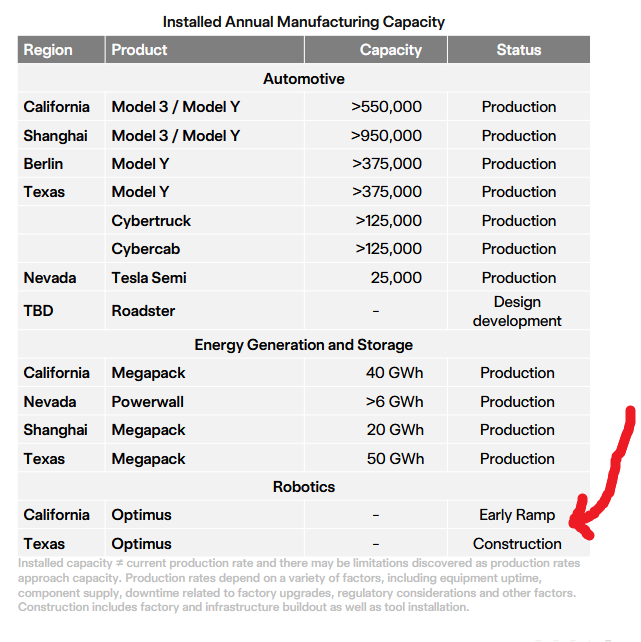
Tesla's Q3 earnings deck:
"Optimus production began in Fremont on our high-volume lines.
The bots coming off this line are the first production-quality bots that we have manufactured. While we will continue to iterate on the hardware and manufacturing process, we have proven that the current manufacturing process for Optimus is suitable for a commercial product."
As an AI hardware founder in Shenzhen, I sift through tons of smart devices daily. Most of them are pure noise.
So I spent the last 2 months putting together almost every single AI hardware project on the market that is actually worth seeing.
Click into any product to get its official website + GitHub repo.
Enjoy! 👇