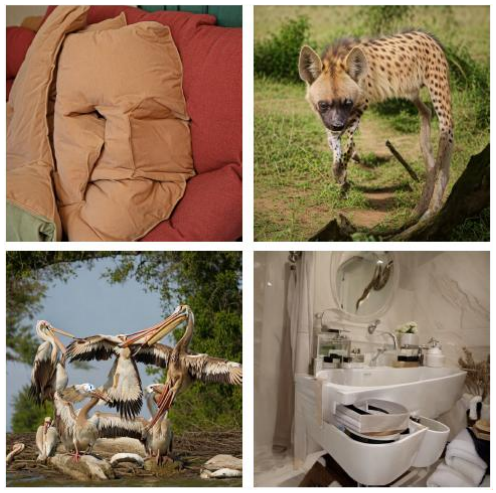
How can we design experiments that make models disagree? One section of our new @NatRevNeurosci Review with @KriegeskorteLab and @SchuettHeiko examines studies that used stimulus sets designed to elicit distinct predictions from competing models. Full text link at the end. 1/14
On the heels of GRH being proven true by AI, our group has had a bunch of work on both the theory of AI & its safety, so I've written a two-part @mldcmu blogpost series summarizing it:
Part I (or why robots may inevitably become sentient via our Capable Agents & Contravariance theories): https://t.co/3fkmRTFcLL
Part II (working towards a science of *provable* safety, using capable agents as a case study to go from barriers to guarantees): https://t.co/MI34tbIi2o
Can the adult brain acquire typical representations after missing an essential early-life experience? Super excited to share my new paper with Marge Livingstone is out now in @NatureComms! https://t.co/dJEg8wD0s4
🧵 Mech interp and NeuroAI are hard enough without you (and your agents) also having to fight the “plumbing” of inspecting and intervening on DNN internals. Introducing TorchLens 3.0, which aims to eliminate these plumbing problems once and for all, for any model. 1/
What do you see in these images? 👁️💬
Faces appearing in everyday objects (face pareidolia) offers a unique window into visual perception. But does it start with bottom-up sensory extraction or top-down expectation?
Our work addresses this debate https://t.co/ttRrDTPN6I! 👇🧵
Between the Digital Brain Project https://t.co/WEPgzvi8pO & the Stanford Digital Brain Project, there'll be a new scale of human brain-activity data to train on. Let's build a large-scale collaborative effort. Recordings of our workshop on Human Brain Foundation Models are here... https://t.co/eo8nnVVazI
@Nextar_X@bengurionu@OrenShriki The purpose here is different - understanding what a partial derivative is. I hope to share an optimization simulator in a couple of months.
Some more AI-assisted teaching. This week, I gave our @bengurionu Cognitive and Brain Sciences sophomores a primer in multivariable calculus to help them develop an intuitive understanding of gradient descent, building on a smart lecture plan originally developed by @OrenShriki.
I used Codex to develop an interactive, fully client-side @plotlygraphs demo that visualizes how fixing all but one variable collapses a multivariable function into a function of a single variable—and how partial derivatives are simply ordinary derivatives of these one-variable functions.
Because the demo runs entirely in the browser, students can open it themselves and interactively explore the surfaces, slices, and derivatives.
The demo is available online and for download here:
https://t.co/7mGxSgwqLN
Super excited to share that I'm co-founding Read/Write Labs for #NeuroAI applications to human brain health and human-aligned AI. We could not ask for a more wonderful team: https://t.co/bPZsIzpx9L
1/ Can brain inspired self-supervised objectives lead to more robust visual representations in DNNs?
Excited to share our preprint with @adeli_hossein, Tian Zeng, @KriegeskorteLab, Ning Qian
https://t.co/yXGKLWGMM4
Meet kornia==0.9.0 - more correct, much faster, more documented, better half-precision, CUDA and MPS support. More than 800 issues have been raised and fixed.
Some ops are now 2000x faster.
Others not crash :)
Way better docs. Check the release post
https://t.co/dGWm2mHYyW
@barbarikon But why wouldn’t a deep feedforward network have those same capabilities? Given that any RNN can be unrolled, why would weight sharing over time specifically favor internal deliberation, introspection, and predictive learning?
From a NeuroAI perspective, it's really annoying that feedforward neural nets rule the world. Unrolling equivalence notwithstanding, what inductive biases does recurrence buy us? Looking forward to reading this.
1/5 New preprint: what does lateral recurrence add to visual representations?
Recurrence reuses the same weights over time: more computation, no new parameters.
Does that extra computation refine representations? If so, which ones?
https://t.co/kvYvae6AMY
@johnmark_taylor I was wondering about this when I wrote the post. Obviously, AR models are a case of implicit recurrence (the generated tokens as a hidden state), but I don't think it's the same "trick" that the brain uses with recurrent connections.
Sami Mollard @MollardSami from Pieter Roelfsema's lab @Pieters_Tweet visited us at Brown @BrownCoPsy@CarneyInstitute, and the project brought together their work on incremental grouping in visual cortex with our recurrent vision models. New preprint:
https://t.co/gZm2skZ5Xd