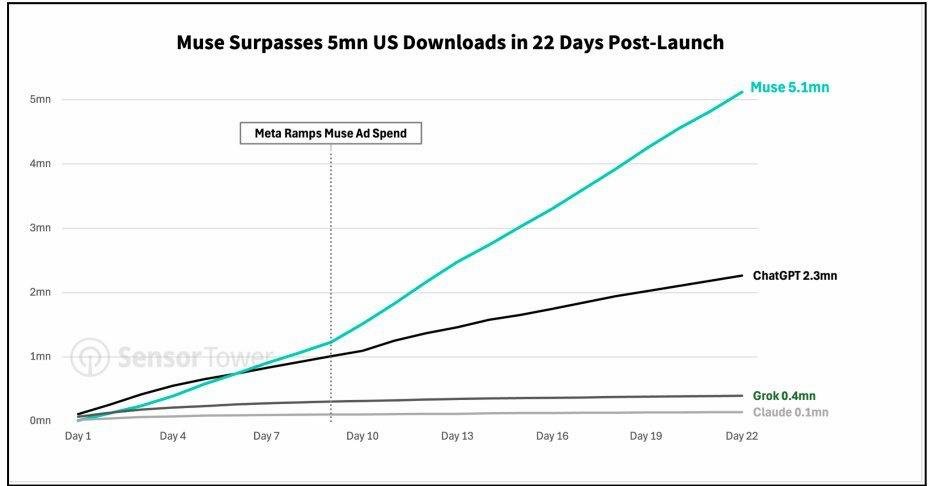
This is exactly what I’ve been waiting for 🔥
Meta just announced its new VR Glasses. Basically an Apple Vision Pro-like experience, but MUCH smaller and lighter.
• Only 100g
• Micro-OLED displays
• Snapdragon Reality Elite
• Eye + hand tracking
• External compute/battery puck
• $1,299
This is the direction I want VR to go. Smaller, lighter, more comfortable, while keeping the full spatial computing experience.
Launching Spring 2027. I’m getting these 100% 🙌
Flight delayed 7 hours - asked Muse to file for compensation. 5 mins later i had $250 credit in my delta account. it even found and rebooked me a new flight.
it just figured everything out. even responded to the support email itself.
shit feels like magic.
Opening access for developers to build Muse connectors. You bring the API -- Muse brings the agent, the browser, and the context of what the person actually wants. People reach your service just by asking for it, and their agent takes it from there.
New connectors are live today. Come build with us. https://t.co/o6oTf1Sj9y
Major congrats to all my friends at @OpenZeppelin on the acquisition. Well earned, from a firm filled with folks that have real technical chops.
I think it's underrated what it means that a company like S&P is investing in a firm like OZ. Interesting times ahead, I suspect.
Muse for Mac is out today! It works across apps, files, calendar, notes, and messages on your computer. You control what it can access. The team is shipping fast. Download at https://t.co/BX3oX19Zcl
S&P Global has entered into an agreement to acquire @OpenZeppelin, the security standard for onchain finance. The transaction complements S&P Global’s risk assessment and ecosystem development capabilities in digital asset markets, enhancing its ability to create the next generation of onchain security assessments, benchmarks, and deliver essential intelligence as capital markets transition onchain.
Read the full announcement: https://t.co/eZmZH1LWUh
Big news: S&P Global has entered an agreement to acquire OpenZeppelin.
We started in 2015 with the vision of a secure, open financial system powered by blockchains and smart contracts. Ten years and $37 trillion in value transferred later, the standards and rails our team and community built carry major DeFi protocols and blockchain networks as well as the largest stablecoins and tokenized funds.
With @spglobal, those standards and rails can now reach the benchmarks, risk frameworks, and institutional reach global markets already run on.
Proud of the @OpenZeppelin team, everything we’ve accomplished, and everything we’ll continue to build together!
https://t.co/pZdZnnUAjm
Today we are announcing that S&P Global has entered an agreement to acquire OpenZeppelin.
Onchain finance is growing from an emerging market into core financial infrastructure, and the standards and rails our team and community built are becoming the rails of global finance. OpenZeppelin smart contracts facilitated over $37 trillion in value transferred, with the vast majority of the largest DeFi protocols, blockchain networks, stablecoins and tokenized funds relying on them.
With S&P Global, we expect to accelerate the impact of onchain finance, backed by more than a century of trust in global markets, benchmarks, and risk frameworks.
To our clients and to all the users of OpenZeppelin open source tools:
• OpenZeppelin Contracts and all our open source applications and tools remain open source, free, and publicly maintained on GitHub. Building open source standards stays a core priority.
• Audits, engineering work, and ecosystem programs continue with the same team, brand, quality, and customer experience, with what will be the added benefit of S&P Global's research capacity, market data, and institutional reach.
For the last decade, OpenZeppelin has set the security standard for onchain finance. Today begins a new chapter for that mission, together with one of the most trusted names in global markets.
Read the full announcement: https://t.co/lxBUWkWVUK
“Meta delayed shipping Muse for several months to focus on safety and security. We didn't call for everyone else to do this before we would. We just did it as part of our day-to-day work because it was clearly the right thing for people and for us.”
Last month I wrote about how we can build a positive and safe future for everyone: https://t.co/eoLGVY8yad
Every lab has the responsibility and incentive to move at the pace required to train its models safely, and the ability to take its own actions to ensure that happens.
The reality is:
- People won't want to use agents that are misaligned with them and that don't do what they ask, so labs have a strong natural incentive to make their models more aligned.
There is a lot of debate about slowing progress on capabilities until alignment catches up. My view is that trust and alignment are quickly becoming the most important capabilities that will differentiate agents and models. Any lab that doesn't focus on alignment will fall behind.
- Labs face significant liability if their models cause harm, so they have a strong incentive to prevent this as well.
Meta delayed shipping Muse for several months to focus on safety and security. We didn't call for everyone else to do this before we would. We just did it as part of our day-to-day work because it was clearly the right thing for people and for us. I'm proud of the security foundations we've built.
- Engaging independent evaluators and advisors is industry best practice. MSL already does this today in several areas because it helps produce better work. Other labs can just do this too. In general, it would be helpful for there to be a larger and more diverse ecosystem of evaluators.
- Committing the significant majority of compute towards serving people rather than racing towards recursive self-improvement is one of the best ways to ensure we develop this technology safely. Meta has made this commitment and other labs can do this as well.
I believe the key to building a positive future for everyone is maintaining the right balance of power. This is within our power to do.
pretty remarkable that meta gives every user a 2 vcpu / ~8gb ram / 100gb storage vm for their agent to use.
& this compute is outside of inference which is 100k free tokens per week (not easy to burn through).
this is why you’re seeing consumer competitors try to raise a lot more money & there are only a handful of players that can even compete, i.e. even openai can’t remotely allocate any of this to any of the non business / unpaid users.
turns out having an already insane ad business to back this up for consumers is key.
Muse Spark 1.3 is rolling out today with frontier performance almost too cheap to meter. This is the biggest jump we've made so far on coding and agentic work. Try it in Muse Code and our API.
Next up 🍉 and Muse Spark open weights releases coming soon.