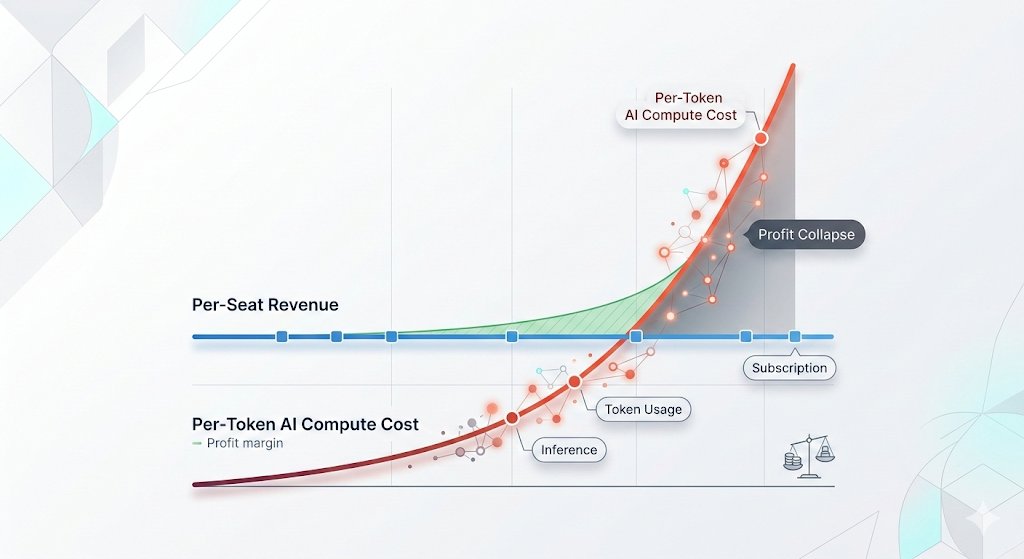
🦔Microsoft canceled its internal Claude Code licenses this week after token-based billing made the cost untenable, even for a company with effectively infinite cloud resources. Uber's CTO sent an internal memo warning the company burned through its entire 2026 AI budget in just four months. American AI software prices have jumped 20% to 37%, and GitHub (owned by Microsoft) is dropping flat-rate plans for usage-based billing across its products.
My Take
The AI subsidy era is ending in real time. The same company that put $13 billion into OpenAI and built the Azure infrastructure powering most of Anthropic's compute just looked at the bill from a competitor's coding tool and decided it was not worth paying. That is not a productivity failure on Anthropic's end. Token-based pricing is forcing every enterprise customer to confront the actual cost of running these models at scale, and the number turns out to be far higher than the flat-rate experiments suggested.
This ties directly to my Gemini Flash post yesterday. Anthropic, OpenAI, and Google all raised effective prices in the last six months. Enterprises that built workflows assuming AI costs would keep falling are now watching annual budgets evaporate in months. Two outcomes look likely from here. Either enterprises scale back AI usage to fit budgets, which slows the revenue ramp the labs need to justify their valuations ahead of IPOs, or the labs cut prices and absorb the losses, which makes the unit economics worse at exactly the wrong moment. Both paths land in the same place, the numbers stop working, and somebody has to take the writedown.
Hedgie🤗
New: @ServiceNow is the latest major public company to say it’s blown through its full year budget for AI coding tools from Anthropic in the first few months of 2026, just like @Uber CTO @praveenTweets said abt his company. “It’s a really hard problem,” CIO Kellie Romack said.
The S&P 500 is now up +9.8% over the last 10 sessions. We haven’t seen a run of gains this quick over 10 sessions since the post-Covid bounce-back in April 2020:
Another week on the road meeting with a couple dozen IT and AI leaders from large enterprises across banking, media, retail, healthcare, consulting, tech, and sports, to discuss agents in the enterprise.
Some quick takeaways:
* Clear that we’re moving from chat era of AI to agents that use tools, process data, and start to execute real work in the enterprise. Complementing this, enterprises are often evolving from “let a thousand flowers bloom” approach to adoption to targeted automation efforts applied to specific areas of work and workflow.
* Change management still will remain one of the biggest topics for enterprises. Most workflows aren’t setup to just drop agents directly in, and enterprises will need a ton of help to drive these efforts (both internally and from partners). One company has a head of AI in every business unit that roles up to a central team, just to keep all the functions coordinated.
* Tokenmaxxing! Most companies operate with very strict OpEx budgets get locked in for the year ahead, so they’re going through very real trade-off discussions right now on how to budget for tokens. One company recently had an idea for a “shark tank” style way of pitching for compute budget. Others are trying to figure out how to ration compute to the best use-cases internally through some hierarchy of needs (my words not theirs).
* Fixing fragmented and legacy systems remain a huge priority right now. Most enterprises are dealing with decades of either on-prem systems or systems they moved to the cloud but that still haven’t been modernized in any meaningful way. This means agents can’t easily tap into these data sources in a unified way yet, so companies are focused on how they modernize these.
* Most companies are *not* talking about replacing jobs due to agents. The major use-cases for agents are things that the company wasn’t able to do before or couldn’t prioritize. Software upgrades, automating back office processes that were constraining other workflows, processing large amounts of documents to get new business or client insights, and so on. More emphasis on ways to make money vs. cut costs.
* Headless software dominated my conversations. Enterprises need to be able to ensure all of their software works across any set of agents they choose. They will kick out vendors that don’t make this technically or economically easy.
* Clear sense that it can be hard to standardize on anything right now given how fast things are moving. Blessing and a curse of the innovation curve right now - no one wants to get stuck in a paradigm that locks them into the wrong architecture. One other result of this is that companies realize they’re in a multi-agent world, which means that interoperability becomes paramount across systems.
* Unanimous sense that everyone is working more than ever before. AI is not causing anyone to do less work right now, and similar to Silicon Valley people feel their teams are the busiest they’ve ever been.
One final meta observation not called out explicitly. It seems that despite Silicon Valley’s sense that AI has made hard things easy, the most powerful ways to use agents is more “technical” than prior eras of software. Skills, MCP, CLIs, etc. may be simple concepts for tech, but in the real world these are all esoteric concepts that will require technical people to help bring to life in the enterprise.
This both means diffusion will take real work and time, but also everyone’s estimation of engineering jobs is totally off. Engineers may not be “writing” software, but they will certainly be the ones to setup and operate the systems that actually automate most work in the enterprise.
$PLTR $NVDA
BREAKING: Palantir and NVIDIA announce a new Sovereign AI OS that provides a complete AI datacenter stack, combining NVIDIA’s Blackwell GPU infrastructure with Palantir’s full software platform to enable secure, production-ready AI deployments.
The architecture enables on-premise, edge, or sovereign cloud deployments where users maintain full control over data, models, and applications.
Palantir first partnered with Nvidia back in 2025 to launch Chain Reaction, a software system specifically designed to help with the building of datacenters.
It looks like they are continuing to work together as they now are finding new ways to mix Palantir’s software stack within NVIDIA’s GPU ecosystem.
“Together with NVIDIA — and building on many customers’ existing investments — we are proud to deliver a fully integrated AI operating system that is optimized for NVIDIA accelerated compute infrastructure and enables customers to realize the promise of on-premise, edge, and sovereign cloud deployments,” says Akshay Krishnaswamy, Palantir’s Chief Architect.
The two more important AI companies of our lifetime continue to advance AI forward.
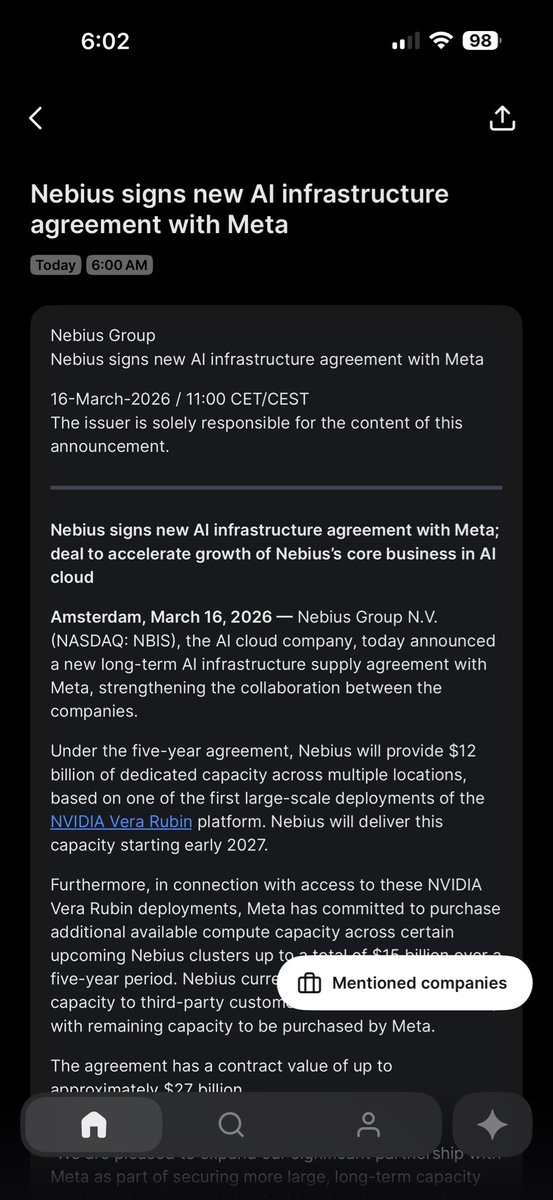
$NVDA TO INVEST $2B INTO $NBIS
NEBIUS WILL DEPLOY 5GW+ OF NVIDIA SYSTEMS BY THE END OF 2030
Nice to see Nvidia show some love to Nebius, seems like $NBIS and $CRWV are the preferred neoclouds by the world’s largest AI company.
+8%
$NVDA $MU $SNDK $LITE HOW THE TOP FIRMS ARE USING AI AGENTS IN INVESTMENT
BALYASNY ASSET MANAGEMENT ($29B AUM)
THE MOST ADVANCED PUBLIC IMPLEMENTATION
Balyasny has built what is arguably the most sophisticated AI research platform in the hedge fund industry, and OpenAI just published a full case study on it. [FACT]
WHAT THEY BUILT:
•BAMChatGPT — internal AI platform connected to 10 data pipes: transcripts, sell-side research, broker commentaries, regulatory filings, expert call notes, ESG data [FACT]
•BAM Embeddings — custom embedding model trained on 14.3M synthetic financial queries. Outperforms OpenAI’s general embeddings: 60% accuracy vs OpenAI’s sub-40% on financial document retrieval; 55% vs 47% on FinanceBench [FACT]
•Deep Research bots — agents that comb 5M+ documents and answer PM questions in minutes. Tasks that took senior analysts 2 days now take 30 minutes [FACT]
•Proactive push alerts — agents don’t wait for PMs to query; they push breaking-news moves, filing discrepancies, ESG controversies, and “unknown unknowns” [FACT]
•Merger Arbitrage Superforecaster — agent that continuously monitors and updates deal probabilities, replacing bespoke spreadsheets and manual alerts [FACT]
•Central Bank Speech Analyst — cut macroeconomic scenario analysis from 2 days to ~30 minutes [FACT]
ARCHITECTURE:
•Applied AI team: 20 researchers, engineers, domain experts (centralized) [FACT]
•GPT-5.4 as primary reasoning engine, selected via rigorous 12-dimension evaluation pipeline [FACT]
•Azure-hosted, private LLM — all data pipes through in-house gateway [FACT]
•Federated deployment: core agent framework + compliance guardrails centralized, individual teams customize agents for their asset class [FACT]
•~95% of 180 investment teams actively use the platform [FACT]
•OpenAI design partner: Balyasny directly influenced the OpenAI model roadmap through real-world analyst feedback [FACT]
ROADMAP:
•Reinforcement Fine-Tuning (RFT) for complex financial tasks
•Deeper agent orchestration across domains
•Multimodal inputs: financial charts, statements, filings
KEY QUOTE:
“It’s like adding a teammate who never forgets, always cites sources, and double-checks the details before sending anything back.” — Charlie Sweat, Portfolio Manager [FACT]
BRIDGEWATER ASSOCIATES ($100B+ AUM)
THE MOST AMBITIOUS: BUILDING A FULLY ARTIFICIAL INVESTOR
Bridgewater has gone further than anyone — they are not building AI tools for humans, they are building an AI that replaces the entire investment process. [FACT]
WHAT THEY BUILT:
•AIA Labs — dedicated AI research and investment lab, led by Co-CIO Greg Jensen and Chief Scientist Jasjeet Sekhon [FACT]
•AIA Forecaster — first publicly documented AI system to match expert human forecasters at scale [FACT]
•Live fund management — AIA systems now manage billions of dollars in real capital, generating alpha [FACT]
•System functions like “millions of 80th-percentile associates working in parallel” [FACT — direct engineer quote]
PHILOSOPHICAL APPROACH:
•Causal reasoning, not pattern matching — their core thesis is that markets cannot be navigated by statistical pattern recognition alone. Systems must understand WHY prices move [FACT]
•Explainability as capability — they do not just require explainability for compliance; they believe reasoning traces make the AI better, just as chain-of-thought improves LLM math performance [FACT]
•Markets as the ultimate AI benchmark — they argue markets are harder than chess or Go because they cannot be solved, memorized, or hacked. Perfect testing ground for AGI [FACT]
•Learning through deployment — real stakes, real capital, real feedback. Not static benchmarks [FACT]
GUARDRAILS:
•PM sign-off dashboards force human approval on suggested trades [FACT]
•AWS Bedrock Guardrails caught 75% of hallucinations in testing [FACT]
•Three-layer validation: RAG fact lookup → Bedrock policy filters → statistical sanity test. Error rates dropped from 8% to 1.6% [FACT]
DATA MOAT:
•50 years of clean, bitemporally-modeled macro data spanning every major economy and centuries of history [FACT]
•Proprietary corpus of explicit reasoning about financial market behavior [FACT]
•They believe these assets are irreplaceable and no standalone AI lab can match them [FACT]
CITADEL ($71B AUM)
CAUTIOUS BUT DELIBERATE
WHAT THEY BUILT:
•Citadel AI Assistant — chatbot trained on licensed third-party content: transcripts, regulatory filings, brokerage research reports, and Citadel’s own investment strategies [FACT]
•Highlights risks, generates customized research and reading lists based on portfolio [FACT]
•Rolled out over the past year, now used by “nearly all” equities investors [FACT]
THE CAUTIONARY TALE:
•Citadel’s first Seattle AI lab (led by ex-Microsoft star Li Deng) dissolved in 2020 after cultural friction — ML talent lived on an island, disconnected from pod PMs who own P&L [FACT]
•Ken Griffin said at JPMorgan conference (Oct 2025): “Generative AI is not helping hedge funds produce market-beating returns” [FACT]
•CTO Subramanian: “I don’t think just by using AI you’re going to become a much better investor. But AI is a tool investors are going to use, and how you use it will drive performance.” [FACT]
KEY LESSON:
Nine-figure AI budgets fail if the tools are not embedded in the PM’s actual workflow. Culture > technology. [INFERENCE, 95% probability]
D.E. SHAW
THE MOST ELEGANT ARCHITECTURE
WHAT THEY BUILT:
•Three-layer stack: Assistants → LLM Gateway → DocLab [FACT]
•Any desk can build custom tools “with as little as ten lines of code” [FACT]
•Central team enforces prompt logging and model-use policies [FACT]
•LLM Gateway brokers calls to two dozen external models, strips PII before routing [FACT]
•DocLab tags confidence scores and audit hashes with every retrieval [FACT]
•Published reusable building blocks: APIs, prompt templates, evaluation harnesses [FACT]
•“Prompt cost meter” per desk with automatic throttles when budget exceeded [FACT]
PHILOSOPHY:
Federated innovation with hard governance. No “one-size-fits-all” bot — each desk customizes, but within strict guardrails.
POINT72 ($45.7B AUM)
THE PLATFORM BET
WHAT THEY BUILT:
•New CTO Ilya Gaysinskiy building “follow-the-sun” engineering hubs in Warsaw and Bengaluru [FACT]
•Internal marketplace where any pod PM can spin up a fine-tuned model on demand [FACT]
•Automated code-review pipeline for quant build times [FACT]
•GPT variants run in locked Azure V-Net [FACT]
•Permanent, uneditable record of every AI question/answer for SEC audit readiness [FACT]
HARD-WON LESSON:
Spent first 6 months just normalizing ticker aliases, vendor IDs, and office nicknames before fine-tuning a single model. Data hygiene is the “hidden iceberg.” [FACT]
MAN GROUP ($160B AUM)
THE PRACTICAL APPROACH
WHAT THEY BUILT:
•Alpha Assistant — can read, reason, code, and backtest in one loop [FACT]
•Drafts trade rationales and surfaces anomalies in alt-data [FACT]
•Can draft but NOT execute — human-in-the-loop enforced [FACT]
•ManGPT — used by ~40% of employees monthly for research summarization, translation, coding [FACT]
KEY INSIGHT:
PMs will not trust a model that cannot “explain itself like a junior analyst.” First release focused on plain-language rationales, not signal discovery. PM adoption doubled in 3 months. [FACT]
UNIVERSAL PATTERNS — WHAT EVERY FIRM CONVERGES ON
1.Private LLMs are table stakes. Every firm runs air-gapped models. The battle has shifted from “whether to wall off data” to “how to govern fine-tuning cycles and cost.” [FACT]
2.Human-in-the-loop is mandatory. No firm allows AI to execute without PM approval. Bridgewater dashboards, Man Group’s draft-only mode, D.E. Shaw’s confidence scores — every success story keeps a human veto. [FACT]
3.Centralize infrastructure, customize locally. Balyasny and D.E. Shaw both use federated models: core platform centralized, individual teams customize agents for their strategy. [FACT]
4.Audit trails from day one. Point72 and Balyasny keep permanent records of every AI interaction. CTOs say it is 10x cheaper to build compliance logging in from day one than retrofit. [FACT]
5.Culture determines ROI more than technology. Citadel’s failed Seattle lab proves that disconnected AI talent generates zero alpha. Man Group’s empathy-first design doubled adoption. [FACT]
6.Cost discipline is emerging. GPU/cloud costs now rival prime-broker financing. D.E. Shaw throttles API calls per desk budget. Point72 benchmarks “cost per incremental insight.” [FACT]
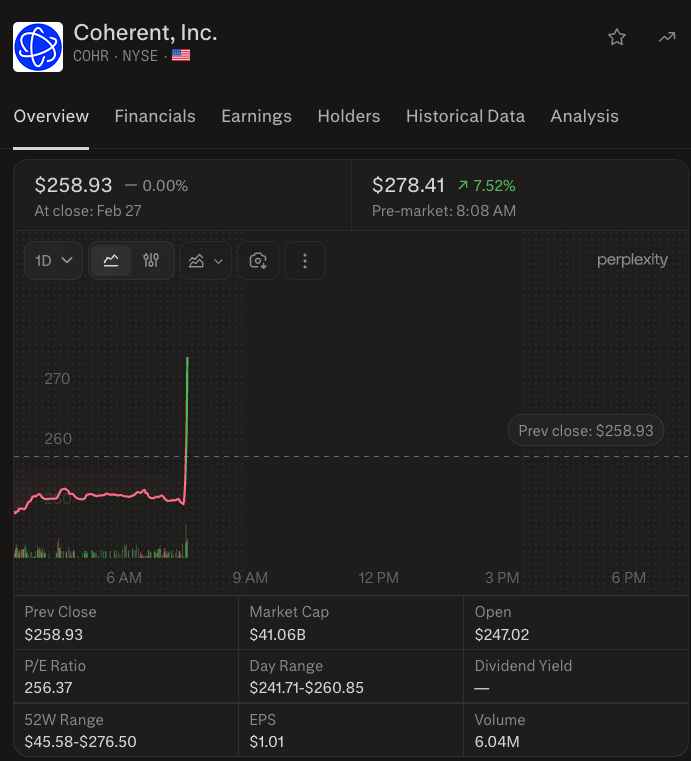
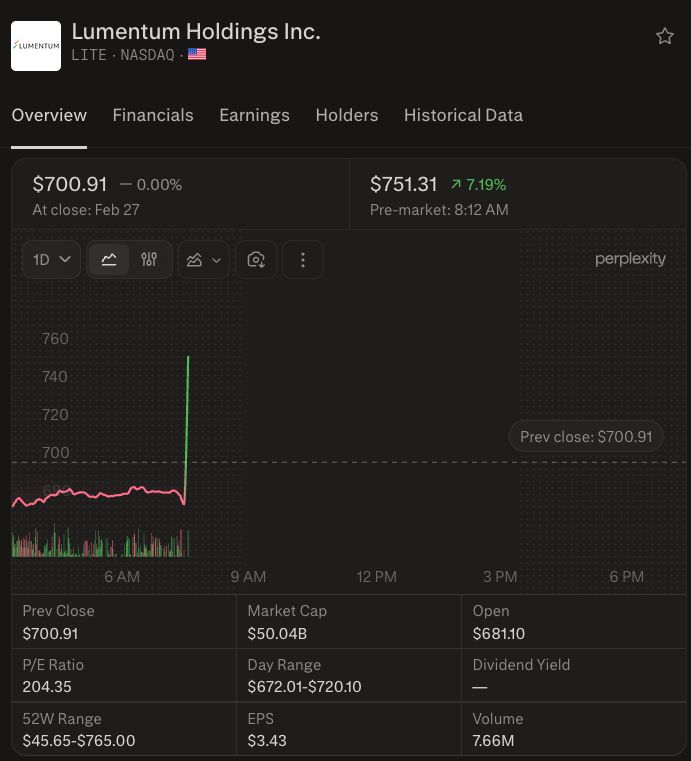
$NVDA is investing $2B into Lumentum $LITE and another $2B into Coherent $COHR under separate multiyear, nonexclusive optics deals.
Both include multibillion-dollar purchase commitments and give Nvidia future capacity/access rights for advanced laser and optical networking parts, while funding R&D and U.S. manufacturing expansion aimed at optical interconnects and advanced packaging for AI data centers.
COHERENT $COHR , LUMENTUM $LITE & APPLIED OPTOELECTRONICS $AAOI have more upside, says Raymond James:
"We update our proprietary A.I. and Optical transceiver model for strong A.I. capex investment (see our notes 2Q25 Web Scale Capex and Oracle), better Blackwell/Accelerator shipments, and the faster than expected progress from Taiwan Semiconductor on co-packaged optics (CPO) solution. Importantly, our new model now incorporates scale-up CPO, which massively expands our out-year estimates.
Our proprietary A.I. transceiver model now forecasts $15.2B in sales in 2025, representing +56% y/y growth over 2024, which itself had already doubled. Our 2030 estimate of $98B represents a 45% 5-year CAGR, but embeds a material acceleration in CY29 and CY30 as we believe Nvidia moves to embed COUPE into its Feynman architecture and beyond. Our pluggable transceiver forecast for CY25/C26 increased ~50% to $15.3B/$19.5B vs. our prior model, and our 2030 forecast rose to $37B from $26B previously.
The new inclusion of scale-up brought our CPO component assumptions to over $60B in 2030 from just $4B when we only modeled scale-out. As a result, we continue to see upside to datacom estimates for Coherent, Lumentum, and Applied OptoElectronics."
Bloomberg reports that $GOOGL, $AMZN, $META, and $MSFT plan to invest roughly $650 billion this year in data centers, chips, and infrastructure as the AI race accelerates.
A few random notes from claude coding quite a bit last few weeks.
Coding workflow. Given the latest lift in LLM coding capability, like many others I rapidly went from about 80% manual+autocomplete coding and 20% agents in November to 80% agent coding and 20% edits+touchups in December. i.e. I really am mostly programming in English now, a bit sheepishly telling the LLM what code to write... in words. It hurts the ego a bit but the power to operate over software in large "code actions" is just too net useful, especially once you adapt to it, configure it, learn to use it, and wrap your head around what it can and cannot do. This is easily the biggest change to my basic coding workflow in ~2 decades of programming and it happened over the course of a few weeks. I'd expect something similar to be happening to well into double digit percent of engineers out there, while the awareness of it in the general population feels well into low single digit percent.
IDEs/agent swarms/fallability. Both the "no need for IDE anymore" hype and the "agent swarm" hype is imo too much for right now. The models definitely still make mistakes and if you have any code you actually care about I would watch them like a hawk, in a nice large IDE on the side. The mistakes have changed a lot - they are not simple syntax errors anymore, they are subtle conceptual errors that a slightly sloppy, hasty junior dev might do. The most common category is that the models make wrong assumptions on your behalf and just run along with them without checking. They also don't manage their confusion, they don't seek clarifications, they don't surface inconsistencies, they don't present tradeoffs, they don't push back when they should, and they are still a little too sycophantic. Things get better in plan mode, but there is some need for a lightweight inline plan mode. They also really like to overcomplicate code and APIs, they bloat abstractions, they don't clean up dead code after themselves, etc. They will implement an inefficient, bloated, brittle construction over 1000 lines of code and it's up to you to be like "umm couldn't you just do this instead?" and they will be like "of course!" and immediately cut it down to 100 lines. They still sometimes change/remove comments and code they don't like or don't sufficiently understand as side effects, even if it is orthogonal to the task at hand. All of this happens despite a few simple attempts to fix it via instructions in CLAUDE . md. Despite all these issues, it is still a net huge improvement and it's very difficult to imagine going back to manual coding. TLDR everyone has their developing flow, my current is a small few CC sessions on the left in ghostty windows/tabs and an IDE on the right for viewing the code + manual edits.
Tenacity. It's so interesting to watch an agent relentlessly work at something. They never get tired, they never get demoralized, they just keep going and trying things where a person would have given up long ago to fight another day. It's a "feel the AGI" moment to watch it struggle with something for a long time just to come out victorious 30 minutes later. You realize that stamina is a core bottleneck to work and that with LLMs in hand it has been dramatically increased.
Speedups. It's not clear how to measure the "speedup" of LLM assistance. Certainly I feel net way faster at what I was going to do, but the main effect is that I do a lot more than I was going to do because 1) I can code up all kinds of things that just wouldn't have been worth coding before and 2) I can approach code that I couldn't work on before because of knowledge/skill issue. So certainly it's speedup, but it's possibly a lot more an expansion.
Leverage. LLMs are exceptionally good at looping until they meet specific goals and this is where most of the "feel the AGI" magic is to be found. Don't tell it what to do, give it success criteria and watch it go. Get it to write tests first and then pass them. Put it in the loop with a browser MCP. Write the naive algorithm that is very likely correct first, then ask it to optimize it while preserving correctness. Change your approach from imperative to declarative to get the agents looping longer and gain leverage.
Fun. I didn't anticipate that with agents programming feels *more* fun because a lot of the fill in the blanks drudgery is removed and what remains is the creative part. I also feel less blocked/stuck (which is not fun) and I experience a lot more courage because there's almost always a way to work hand in hand with it to make some positive progress. I have seen the opposite sentiment from other people too; LLM coding will split up engineers based on those who primarily liked coding and those who primarily liked building.
Atrophy. I've already noticed that I am slowly starting to atrophy my ability to write code manually. Generation (writing code) and discrimination (reading code) are different capabilities in the brain. Largely due to all the little mostly syntactic details involved in programming, you can review code just fine even if you struggle to write it.
Slopacolypse. I am bracing for 2026 as the year of the slopacolypse across all of github, substack, arxiv, X/instagram, and generally all digital media. We're also going to see a lot more AI hype productivity theater (is that even possible?), on the side of actual, real improvements.
Questions. A few of the questions on my mind:
- What happens to the "10X engineer" - the ratio of productivity between the mean and the max engineer? It's quite possible that this grows *a lot*.
- Armed with LLMs, do generalists increasingly outperform specialists? LLMs are a lot better at fill in the blanks (the micro) than grand strategy (the macro).
- What does LLM coding feel like in the future? Is it like playing StarCraft? Playing Factorio? Playing music?
- How much of society is bottlenecked by digital knowledge work?
TLDR Where does this leave us? LLM agent capabilities (Claude & Codex especially) have crossed some kind of threshold of coherence around December 2025 and caused a phase shift in software engineering and closely related. The intelligence part suddenly feels quite a bit ahead of all the rest of it - integrations (tools, knowledge), the necessity for new organizational workflows, processes, diffusion more generally. 2026 is going to be a high energy year as the industry metabolizes the new capability.
$META - 5 Reasons To Buy The Pullback - Jefferies Buy PT $910
We see 5 reasons to buy the pullback: 1) Attractive risk/reward at a 8-turn PE discount vs. GOOGL; 2) moderate downside to ests with stronger upside potential; 3) AI hires set to deliver in ’26; 4) Continued momentum from META’s Core Flywheel powered by AI; 5) accelerating activation of major incremental rev engines, w/ WhatsApp poised to grow from a $9B run rate today to $36B by FY29, plus add'l upside from Threads & Llama/AI. See 65 pg slide deck embedded.
META’s 18% drop since earnings vs AMZN (+4%) & GOOGL (+18%) leaves shares at an 8-turn NTM PE discount to GOOGL, well below historical norms. While this reflects concerns around margin pressure, capex ramp, and AI execution, it also creates meaningful upside if META addresses these headwinds - which we believe is likely.