A key goal of Virtual Cells is to provide as much data-driven context as possible to biological queries, linking large datasets and foundation models across the molecular, cellular and multicellular scales.
Check out our new foundation model PULSAR that spans three scales, creating powerful donor representations:https://t.co/ibKGinWOmq
@KKuanPang@jure@StanfordAILab@AllenInstitute
🥇Our relational foundation model RT-PluRel is the #1 system on RelArena-α!
👏Kudos to the Prior Labs team for this very meaningful contribution to the community, and for TabPFN-Rel being the #1 model.
🤗The RT-PluRel model: https://t.co/dcRZFelpXr
📰RT: https://t.co/epPVzstemz
📰PluRel: https://t.co/ey57Z3T7Q8 (shoutout to @kvignesh1420, @guestrin)
🙇I learnt a lot from this collaboration, especially thanks to @adrihayler and @LennartPurucker. The future of relational learning looks strong!
New paper from my group at @kochinstitute@MIT_IMES@MITBiology! I am thrilled to share that our paper describing scAmp, a new method for analyzing extrachromosomal DNA amplifications at single-cell resolution, has been published in @NatureComms. Thread below 👇
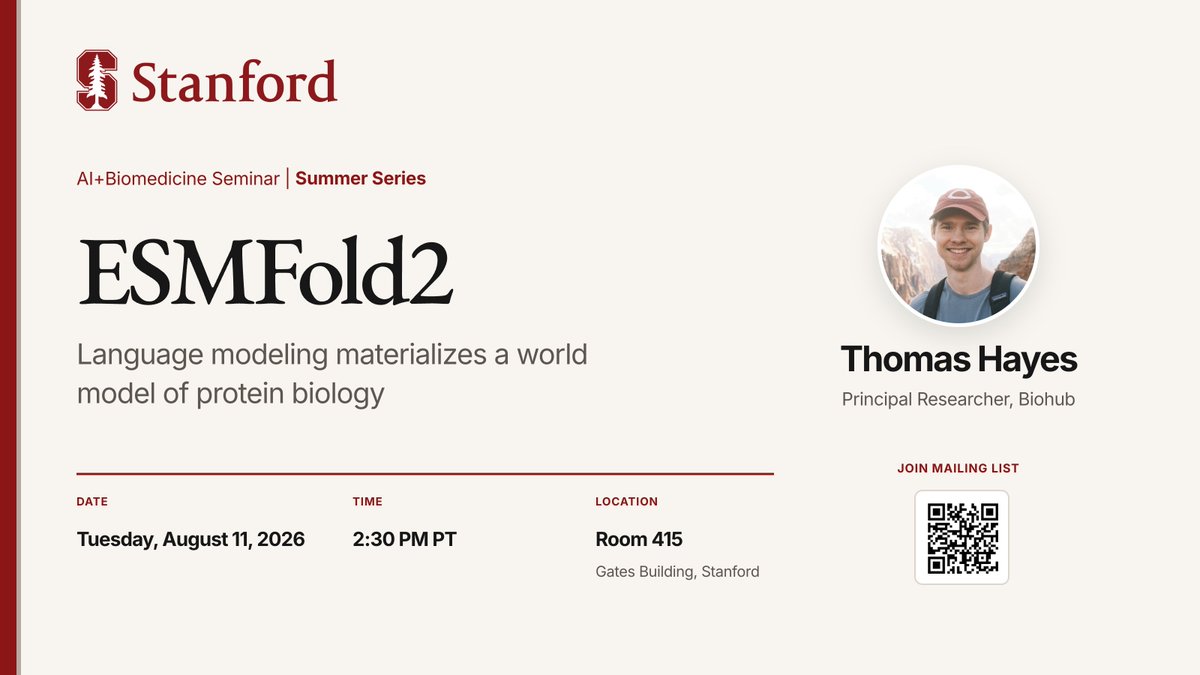
For our next seminar, we are thrilled to host @THayes427, Principal Researcher at @biohub.
He will present on ESMFold2 and how language models can serve as world models of protein biology to accelerate therapeutic design.
Join us @ Gates 415 | 8/11 @ 2:30pm | Stanford
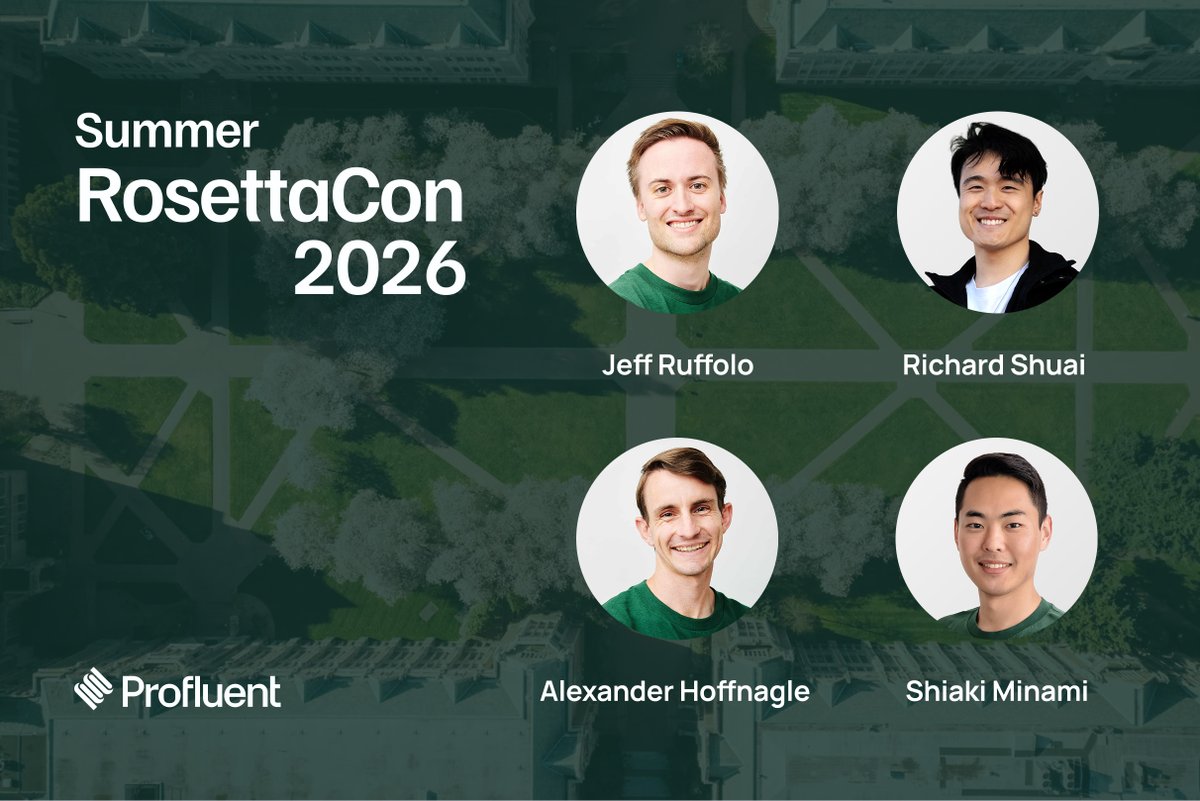
The Profluent team is heading to Summer RosettaCon next week! Find @jeffruffolo, @richardwshuai, @ShiakiMinami, and Alex Hoffnagle and say hi 👋
You can hear Richard talk about E1, our encoder model, on Thur at 1:30pm (“E1: Retrieval-Augmented Protein Encoders for Fitness and Structure Prediction”) and Alex share his work on our AI-designed base editors on Mon at 7:30pm (“Design of Programmable Base Editors with Protein Language Models”).
Biomni Lab is model-agnostic by design, giving scientist the best-performing model across a wide range of scientific research tasks while keeping costs in check. We just rolled out Kimi-K3, and it’s very capable on our eval:
I had a lot of fun finding these optimizations over the past year! Thanks to @mdbereket, @percyliang, @tatsu_hashimoto, @jure for feedback and supervision.
Check out Gigatoken on GitHub! https://t.co/IPme9IeFDv
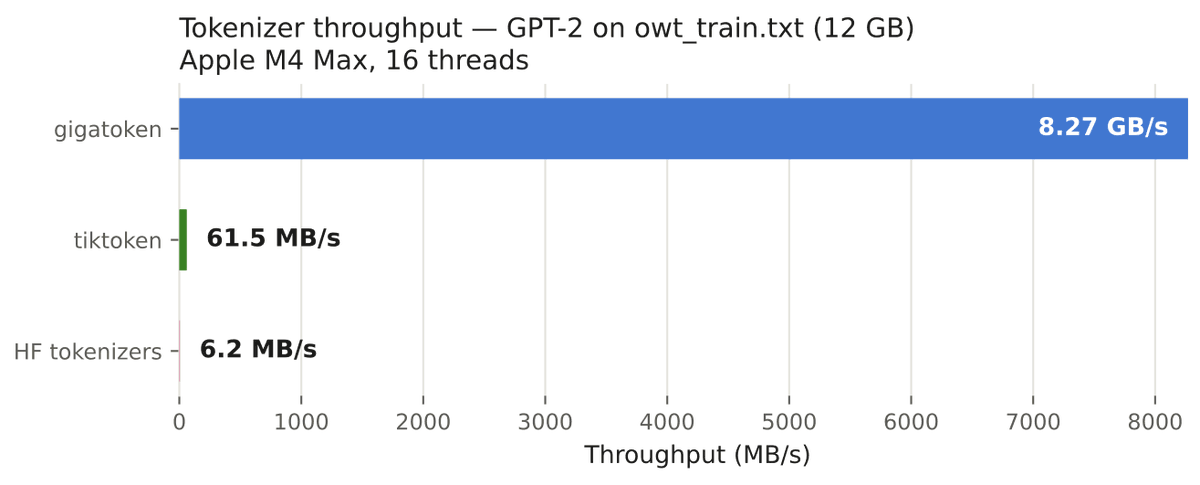
Introducing the world's fastest tokenizer implementation, Gigatoken!
Gigatoken is ~500-1000x faster than HuggingFace, and ~100x faster than OpenAI's tiktoken for most tokenizer definitions on most machines.
These baselines are already multithreaded Rust implementations! 🧵
Happy to share I'll speak on "Multimodal Agentic AI for Immunotherapy" at the ESH's 1st Scientific Workshop on AI in Haematology.
📍 Malahide (Dublin), Ireland
🗓 Sept 17-19, 2026
Registration open!
@ESHaematology#ESHAI2026
Excited to share that our Universal Cell Embedding (UCE) paper is published in @Nature ! Single-cell RNA sequencing data gives us an unprecedented look into the diversity of cell biology, but analysis has often been limited to the specific dataset or atlas that was collected.
https://t.co/FmH1WDd23F
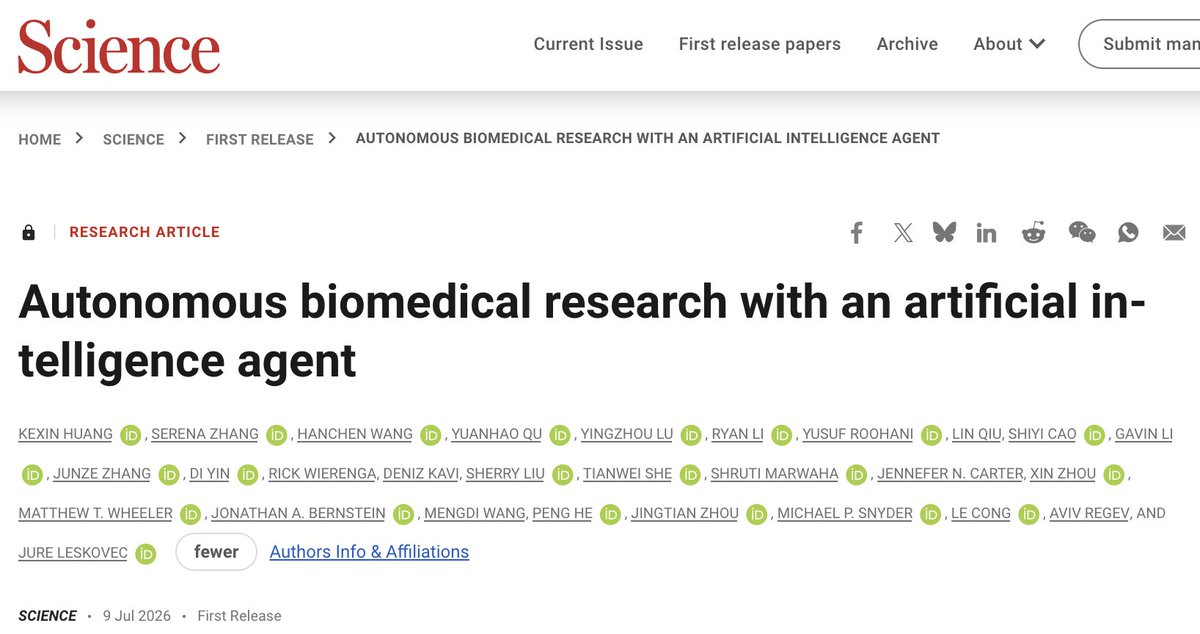
Today, we're excited to share that Biomni is published in @ScienceMagazine.
Biomedical research is still fragmented, manual, and difficult to scale. In this work, we introduce Biomni - the first general-purpose biomedical AI agent with an integrated biology environment that can reason, plan, and execute end-to-end scientific workflows.
We show that, with the right environment and harness, AI can automate large-scale omics analyses, orchestrate laboratory robotics, optimize molecular properties, and even train new AI models for biology.
We also introduce a reinforcement learning recipe for continually improving biomedical AI agents, enabling open-source models to achieve frontier-level performance.
It's surreal to look back. We started the Biomni project in early 2024, when agentic AI was still nascent. It is exciting to see tens of thousands of biologists collaborating with agents every day to accelerate science.
Try Biomni: https://t.co/Pzm8TVlkNA
Read more: https://t.co/pRstxzPKDi
This work is not possible without this truly inter-disciplinary team: @serena2z@hcwww_@YuanhaoQ Minta Lu, Ryan Li, @yusufroohani Lin Qiu @shiyi_c98 Gavin Junze Di @rickwierenga@kavi_deniz Sherry @TianweiShe Shruti Jennefer Xin Zhou @MWheelerMD Jon Bernstein @MengdiWang10@PengHeAtlas@zhou_jingtian@SnyderShot@lecong Aviv Regev @jure@StanfordAILab@genentech@phylo_bio@arcinstitute@UW@berkeley_ai@RetroBio_@tamarindbio@Princeton@UCSF
I'll present this work today 2:30pm at #ICML2026 (poster session 7: #510). Let's chat there!
If you happen not to be in Korea right now, check out the digest on our project website instead: https://t.co/jZIPOAYmSS 😉
Takeaway: As pathology models improve in gene expression prediction, SpatialWhisperer demonstrates how to translate this progress to cell-level semantics.
Amazing labs: @GoodZinaida@jure@BockLab
Amazing collaborators: @zoe_piran Nils Walter @Animesh0303
Cancer diagnosis is informed by cellular annotations of histopathology, but assays are expensive or rely on manual annotations.
At #ICML2026, we present SpatialWhisperer, a trimodal model that zero-shot annotates cell types in histopathology images. 🧵👇
For our next seminar, we look forward to hosting @Dominik1Klein, CTO & Co-founder of @valinordiscover.
Dominik will share how jointly modeling patient biology across modalities bridges high-res data & routine care.
📍 CoDa E201 | Tuesday 6/30 @ 2:30 PM | Stanford + Zoom
hello world.
Excited to launch the Ingelfinger Lab account! We’re a young lab in Germany’s Black Forest tackling key questions in immunology with innovative single-cell technologies.
Follow us for updates on systems immunology, machine learning & translational oncology.
fi
We are thrilled to welcome @peterpaohuang this Tuesday to present Flux Matching: Generative Modeling with Non-Conservative Vector Fields!
📍CoDa E160 | Tues. 6/9 2:30pm PT | Stanford + Zoom
Can reasoning models become overly reliant on chain-of-thought examples? 🤔
Our #ACL2026 work shows excessive CoT supervision is not always beneficial, and gives a recipe for tuning the CoT fraction to improve novel-task accuracy. 🧵
Website: https://t.co/hZmPCF6bue
Our 10th Single Cell Genomics Day is next Friday (6/12)!
Thanks to amazing speakers Aviv Regev @xinjin@anshulkundaje@junyue_cao and many more! Talks are live-streamed on YouTube and are free (no registration required) at https://t.co/G5Pq3EwyHF