This is a new paradigm for interacting with Claude that is significantly more "inline" with all the other human activity org-wide. Once you do all of the under the hood engineering work to make this "just work" (e.g. across tools, integrations, compute environments, memory, security, etc.), Claude basically joins the team in a seamless way - you can talk to it as you would talk to a person and it can help with a very large variety of workloads.
Imo this is the 3rd major redesign of LLM UIUX. The first paradigm was that the LLM is a website you go to, the second was that it is an app you download to your computer. This third one is that it is a self-contained, persistent, asynchronous entity with org-wide tools and context, working alongside teams of humans. It really takes a while to wrap your head around it, but it works and it is awesome.
Twenty-five experts from academia and industry put together this (monster, 150+-page) survey on the bidirectional impact of crypto and AI. Visit https://t.co/MPdy1bIoGw to read it, peruse the executive summary—or chat with a chatbot about it.
Building index-tracking assets on top of options instead of debt
https://t.co/gFNEvCbHct
What if the use options as the base of defi, instead of CDPs and liquidations? So instead of extreme price movements creating a sharp and global "you get liquidated" effect, instead your exposure to the index diverges quadratically from your preferred exposure in a smoother way?
A key benefit is getting rid of the need for instant oracles, and instead making everything work on top of "slow oracles" (ie. the type that prediction markets use)
This design has a significant downside - the need to do regular rebalancing - and an open question of whether and how this rebalancing can be made slippage-resistant enough. But it's worth considering and trying IMO. I would feel much safer holding algostables inside something like this, than in something that depends on an oracle that has to give real-time answers (and therefore could be tricked into giving wrong real-time answers with no time for human recourse).
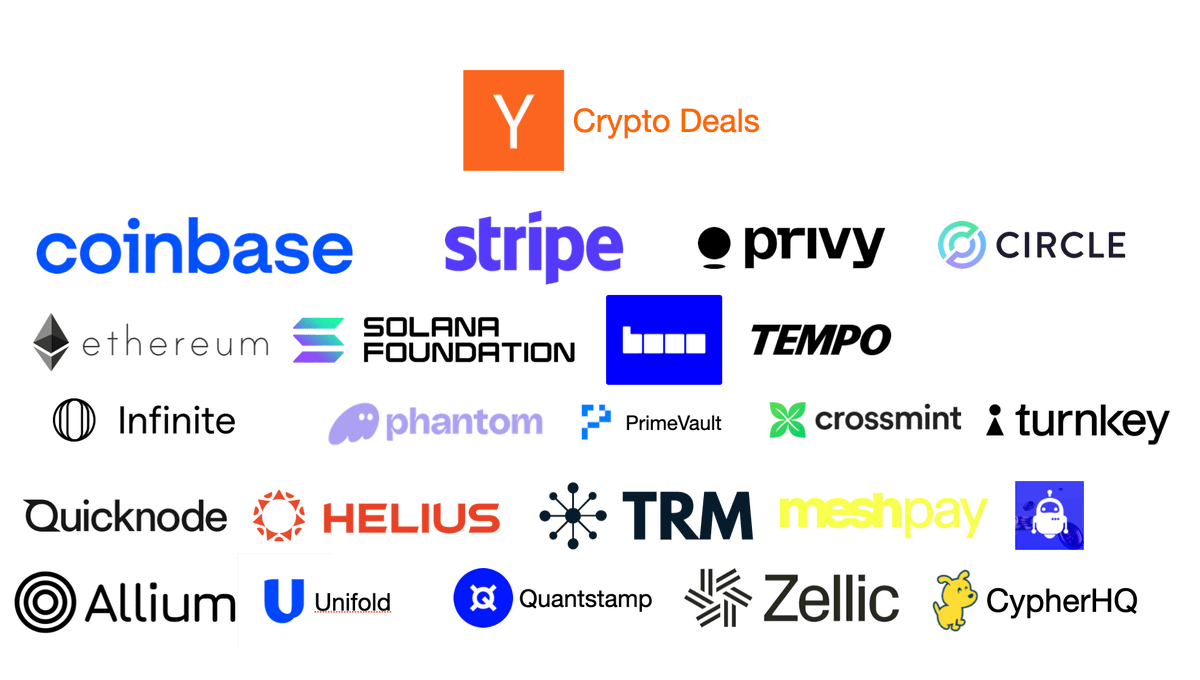
Announcing YC Crypto deals
We're now providing crypto deals to support fintech builders funded by YC: support on tools like wallets, onramps, audits, blockchains, onchain data.
Proud to see @pharos_network mainnet go live.
We’ve had the chance to see the team’s vision and execution up close well before this moment, which makes today even more meaningful.
Congrats on Pacific ERA Day. Excited to watch the next chapter unfold.
After a few weeks in SF, one thing stands out: AI people are more bullish on crypto than crypto people are on themselves.
There's this narrative forming in crypto that AI people think crypto is a joke. It's just not true. I keep hearing this over and over from AI people who remain bullish crypto. Hell, Sama, Jensen, Elon, Zuck, the biggest names in AI have all been publicly bullish on crypto and its convergence with AI.
Crypto's problem right now isn't that outsiders don't believe.
It's that insiders are playing scared.
Well written, but respectfully disagree on almost all its major points:
The article never actually defines agentic economy vs. agentic commerce outright - they're both "agents buying things". I can't help but think the overall point is a naming quirk/preference - a rose by any other name is just as sweet.
My best guess at what robbie means here is that "agentic economy" is broader "agents buying things", and "agentic commerce" is specifically macropurchases (doordash/amazon/expedia) that excludes (1) SaaS purchases, (2) crypto trading/DeFi execution.
Let's tackle this one by one:
> The arguments against this (narrow) version of agentic commerce seems to be - (1) humans want to make choices, the bots won't know us well enough, (2) i will click accept on everything that bots make, (3) this will just appear as a credit card line-item via stripe link.
(1) is a very weak point imo - you don't need that many datapoints to "reveal" a customer's preference. TikTok knows my user preferences after 1 minute of scrolling. I one-shotted qwen with my personal context from a single gpt-export prompt that created 10+ memories. it captures my personal preferences pretty well. As long as you have a chatbox where you can interact with the bot, that's enough "agency" for most tasks.
(2) this only describes one mode of authorization - sign per pay, which works for low-frequency, high $$$ tx. but design space is wide open (eg. pre-auth transactions, risk flagging, warning etc). Just like I hate getting spammed by Claude Code for every terminal command, I don't want to get spammed by OpenClaw for every $0.01 API query. You can very well imagine greenlit "safe" orders (eg. <$35 orders from Sweetgreen + Pacific Catch) that don't require sign-per-pay.
(3) i've written extensively about why stables can win over cards - even in a world where cards work and have their advantages in legacy compatibility. basically stables give you an expanded "trust backstop" beyond a bank-KYC. Not everyone has a card on Stripe link!
> To the point about "most agents will not transact, but only orchestrate." The transacting agent amount doesn't actually matter. What matters is volumes. And my base case is that ~25% of SaaS payment volume (~150B TAM) will be agent-driven within 18 month timeframe.
> Yes SaaS payments will likely occur through businesses. And maybe for existing vendors and large corporations, agentic spending will rack up as a single tab closed at the end of each month. But vibecoding tools open up the floodgate to many many new SaaS VENDORS that can charge cheaply for the same API services. And stablecoin wallets could be a cheap and easy way for these new-age SaaS vendors to receive payments.
> Of course, as with anything vibecoding, quality curation becomes paramount. I expect new "curated recipe" style marketplaces to emerge as go-to places for agents to do things. This is what I call the "agent app store wars"
> Finally, we need to move past the narrow notion that "agentic commerce" is purely about the movement of money itself. Things like identity, insurance, and security guardrails are long overdue for renovation. While of course some rests with the lawyers, things like TEEs/MPC/ZKIDs that have been noodled with in the past few years present off-the-shelf solutions here.
Agentic commerce today is like ecommerce in 1996 - so early, undefined, yet an extremely fast-moving space. Let's not miss the forest for the trees.
Flashcast Social live on private beta.
Tweet to create. Instant resolutions.
Comment "quest" below for your code → complete quests → join waitlist.
flashcast · social
Why TAO's Flywheel Makes It the Infrastructure Play for Decentralized AI🤖
1) Let's be honest — we're late. @AlgodTrading is back, TAO already completed its first halving, subnets exploded from 70 to 129 since dTAO launched, and Grayscale is preparing an ETF conversion —
but showing up late with a clear thesis beats not showing up at all.
2) Look at the AI x Crypto intersection. This isn't about "using AI on a blockchain." The only network where value structurally accrues to the token — is @bittensor .
3) AI Agents need money. They need to pay, get paid, and transact autonomously.
4) The settlement layer will be stablecoins like USDC — but the intelligence layer, where AI models compete, get evaluated, and get rewarded? That's $TAO
5) The substance of Bittensor is its subnets.
6) Each subnet is an independent competitive marketplace specialized in a specific AI task — text generation, image recognition, coding, prediction, data storage.
7) One Subnet = one AI business.
8) And these subnets sit on a Darwinian competition structure.
9) High-performing subnets receive more TAO emissions. Underperforming ones see their emissions shrink until they're eventually pruned. The only subnets that survive are the ones building genuinely useful AI.
10) Validation has already started. Chutes (SN64) is generating $1.3M in revenue.
https://t.co/truTyIaLiR
11) Ridges (SN62) outperformed Anthropic's Claude 4 on coding benchmarks.
12) Subnets aren't "projects" anymore — they're entering the real-revenue AI product stage.
13) TAO's core is a flywheel. Price goes up → mining rewards become worth more in dollar terms → top-tier AI talent floods in → subnet AI quality improves → network utility increases → TAO demand expands → price goes up again. Halving cuts new supply in half, accelerating this loop.
14) Why TAO is structurally different from other L1s — value doesn't leak out.
15) Subnet registration, AI service access, validator staking, governance — every economic activity in the network is gated by TAO.
16) dTAO's AMM pools lock capital into TAO reserves, and 70% of total supply is already staked. The actual circulating float is extremely limited.
17) When a subnet succeeds, people stake TAO into its AMM pool to buy Alpha tokens. TAO gets locked in the reserve, circulating supply shrinks, and price rises structurally.
So, Subnet success = TAO success.
18) It works in reverse too. When TAO price rises, the dollar value of block emissions goes up, pulling more capital and talent into subnets, driving up AI quality and revenue.
Therefore, TAO success = Subnet success.
19) This isn't a narrative. It's a mechanism. Self-reinforcing and recursive.
20) If you're bullish on Decentralized AI → you're bullish on TAO.
21) If you believe AI Agents need an intelligence marketplace → you're bullish on TAO.
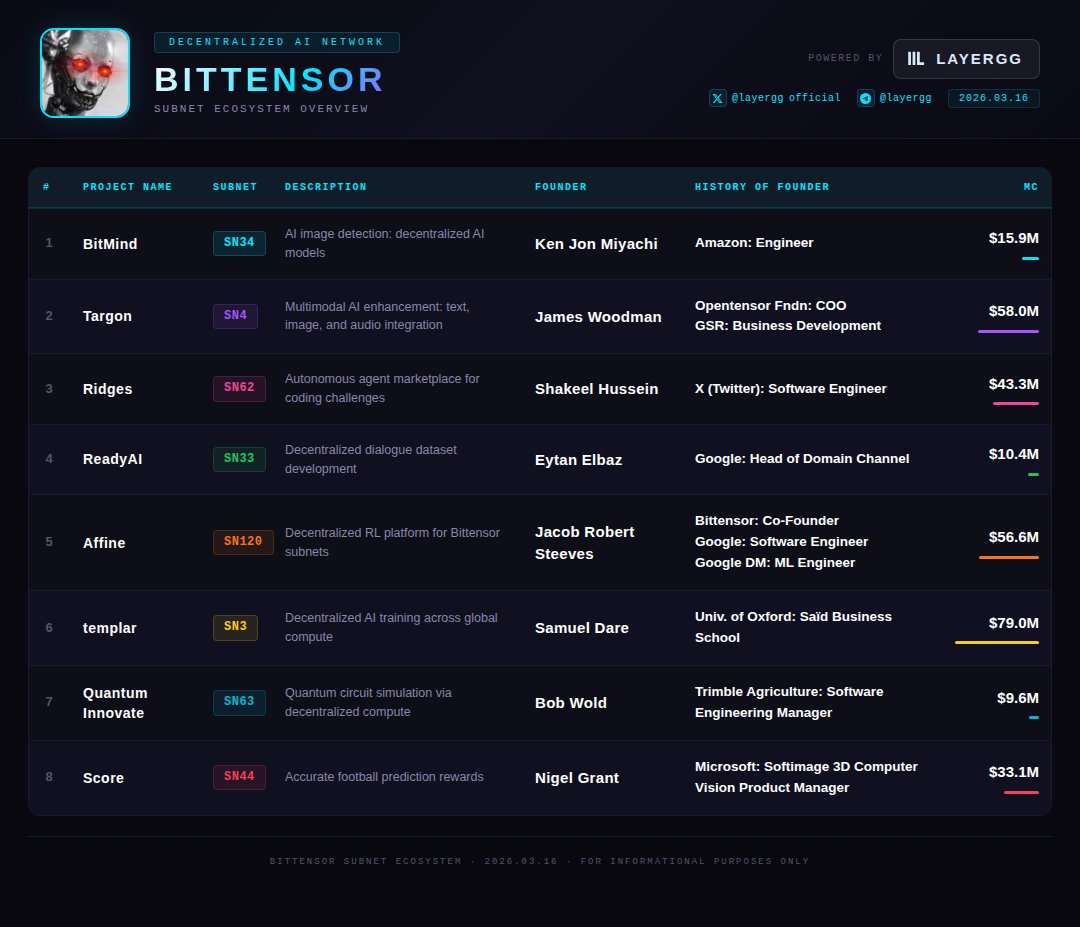
That's the structure. Now — which subnets are actually worth paying attention to? We've narrowed our focus to projects where the founders have credible track records: real engineering backgrounds, experience at top-tier tech companies, and proven execution. Here's our shortlist.
@bitmind@TargonCompute@ridges_ai@ReadyAI_@tplr_ai@qBitTensorLabs@webuildscore@chutes_ai
The Ethereum Foundation just published a new mandate defining its role.
It’s a good moment to revisit a broader question for crypto: what role should foundations play as networks mature?
@milesjennings explored this in “The End of the Foundation Era in Crypto,” including why some foundations (like EF) have played an important role in getting networks off the ground.
Here is a list of all startup accelerators you can apply to right now:
@ycombinator ($500k for ~7%)
@a16z ($750k-$1M for ~7-10%)
@pioneerdotapp ($20k for 1%)
@the_mint_vc ($500k for 10%)
@angelpad ($120k for 7%)
@techstars ($220k for ~5-7%)
@500GlobalVC ($112.5k for 6%)
@EFStartups ($250k for ~9%)
@southparkcommon ($400k for 7% + $600k guaranteed follow-on)
@sequoia ($1M)
@pearvc ($250k-$2M)
@greylock (SAFE note + $500k+ in credits)
@conviction ($150k uncapped MFN SAFE)
@openai ($1M equity investment)
@StartupWiseGuys (up to €65k for equity)
@apxaccel (up to €500k, typically €50k for 5%)
@southparkcommon ($150k for 5-10%)
@seedcamp (€100k-€200k for 7-7.5%)
@antlervc (€100k for 10% + stipend / $200k-$250k for 8-9%)
@googlestartups (up to $100k)
@accel (up to $500k-$1M)
@aigrant ($250k uncapped)
@aforecapital ($100k-$500k)
@BoostVC (up to $500k for 15%)