For my first post, I’m sharing a letter @NVIDIA signed on why open models matter.
AI will transform every industry, power every company, and be built by every country.
Open models strengthen safety and cybersecurity, accelerate innovation and diffusion, and enable sovereignty.
The world needs both frontier closed models and frontier open models.
https://t.co/AUKzoQ5Ikb
I’ve been asked several times whether Zhilin Yang, the founder of @Kimi_Moonshot was my PhD student. The answer is yes and he is absolutely brilliant.
But I’ve been incredibly fortunate to work with so many outstanding PhD students over the years. So I thought I’d brag a little about them and their career paths (of course there are also many MSc and undergraduate students, sorry if I missed anyone):
Founders / Founding Team Members
Devendra Chaplot @dchaplot PhD, Founding Member Thinking Machines / Mistral
Zhilin Yang PhD, Founder & CEO, Moonshot AI
Jimmy Ba @jimmybajimmyba MSc/PhD, Co-founder xAI
Hubert Tsai PhD, Co-founder Spuree, Apple
Nitish Srivastava @nitishsr PhD, Co-founder Perceptual Machines; Co-founder Vayu Robotics
Charlie Tang PhD, Co-founder Perceptual Machines, DE Shaw.
Professors
Paul Liang @pliang279 PhD, MIT
Ben Eysenbach @ben_eysenbach PhD, Princeton University
Ruosong Wang @RuosongW PhD, Peking University
Bhuwan Dhingra @bhuwandhingra PhD, Duke University
Roger Grosse @RogerGrosse Postdoc, University of Toronto
Alexander Schwing Postdoc, UIUC
Research Scientists
Shuyan Zhou @shuyanzh36, Postdoc, Meta Superintelligence Lab
Tiffany Min @SoYeonTiffMin PhD, Microsoft AI
Murtaza Dalal @mihdalal PhD, Tesla AI
Minji Yoon @MinjiYoon90 , PhD, Microsoft AI
Shrimai Prabhumoye PhD, NVIDIA AI, Mistral
Haitian Sun @sun_haitian PhD, Google DeepMind
Emilio Parisotto PhD, Google DeepMind
Lisa Lee PhD @rl_agent, Google DeepMind
Manzil Zaheer @ManzilZaheer PhD, Google DeepMind
Jamie Kiros PhD, Google Brain, OpenAI
Yuri Burda PhD, OpenAI, Anthropic
Cody Severinski PhD, Amazon
The video of my conversation with Bill Dally at GTC last week is up. I always enjoy talking to Bill, and we had a wide ranging discussion about computer architecture, model training, specialized inference hardware, custom interconnects, and more!
https://t.co/mEBhHasuC6
AMI Labs just raised $1.03B. World Labs raised $1B a few weeks earlier. Both are betting on world models.
But almost nobody means the same thing by that term.
Here are, in my view, five categories of world models.
---
1. Joint Embedding Predictive Architecture (JEPA)
Representatives: AMI Labs (@ylecun), V-JEPA 2
The central bet here is that pixel reconstruction alone is an inefficient objective for learning the abstractions needed for physical understanding. LeCun has been saying this for years — predicting every pixel of the future is intractable in any stochastic environment. JEPA sidesteps this by predicting in a learned latent space instead.
Concretely, JEPA trains an encoder that maps video patches to representations, then a predictor that forecasts masked regions in that representation space — not in pixel space.
This is a crucial design choice.
A generative model that reconstructs pixels is forced to commit to low-level details (exact texture, lighting, leaf position) that are inherently unpredictable. By operating on abstract embeddings, JEPA can capture "the ball will fall off the table" without having to hallucinate every frame of it falling.
V-JEPA 2 is the clearest large-scale proof point so far. It's a 1.2B-parameter model pre-trained on 1M+ hours of video via self-supervised masked prediction — no labels, no text. The second training stage is where it gets interesting: just 62 hours of robot data from the DROID dataset is enough to produce an action-conditioned world model that supports zero-shot planning. The robot generates candidate action sequences, rolls them forward through the world model, and picks the one whose predicted outcome best matches a goal image. This works on objects and environments never seen during training.
The data efficiency is the real technical headline. 62 hours is almost nothing. It suggests that self-supervised pre-training on diverse video can bootstrap enough physical prior knowledge that very little domain-specific data is needed downstream. That's a strong argument for the JEPA design — if your representations are good enough, you don't need to brute-force every task from scratch.
AMI Labs is LeCun's effort to push this beyond research. They're targeting healthcare and robotics first, which makes sense given JEPA's strength in physical reasoning with limited data. But this is a long-horizon bet — their CEO has openly said commercial products could be years away.
---
2. Spatial Intelligence (3D World Models)
Representative: World Labs (@drfeifei)
Where JEPA asks "what will happen next," Fei-Fei Li's approach asks "what does the world look like in 3D, and how can I build it?"
The thesis is that true understanding requires explicit spatial structure — geometry, depth, persistence, and the ability to re-observe a scene from novel viewpoints — not just temporal prediction.
This is a different bet from JEPA: rather than learning abstract dynamics, you learn a structured 3D representation of the environment that you can manipulate directly.
Their product Marble generates persistent 3D environments from images, text, video, or 3D layouts. "Persistent" is the key word — unlike a video generation model that produces a linear sequence of frames, Marble's outputs are actual 3D scenes with spatial coherence. You can orbit the camera, edit objects, export meshes. This puts it closer to a 3D creation tool than to a predictive model, which is deliberate.
For context, this builds on a lineage of neural 3D representation work (NeRFs, 3D Gaussian Splatting) but pushes toward generation rather than reconstruction. Instead of capturing a real scene from multi-view photos, Marble synthesizes plausible new scenes from sparse inputs. The challenge is maintaining physical plausibility — consistent geometry, reasonable lighting, sensible occlusion — across a generated world that never existed.
---
3. Learned Simulation (Generative Video + Latent-Space RL)
Representatives: Google DeepMind (Genie 3, Dreamer V3/V4), Runway GWM-1
This category groups two lineages that are rapidly converging: generative video models that learn to simulate interactive worlds, and RL agents that learn world models to train policies in imagination.
The video generation lineage. DeepMind's Genie 3 is the purest version — text prompt in, navigable environment out, 24 fps at 720p, with consistency for a few minutes. Rather than relying on an explicit hand-built simulator, it learns interactive dynamics from data. The key architectural property is autoregressive generation conditioned on user actions: each frame is generated based on all previous frames plus the current input (move left, look up, etc.). This means the model must maintain an implicit spatial memory — turn away from a tree and turn back, and it needs to still be there. DeepMind reports consistency up to about a minute, which is impressive but still far from what you'd need for sustained agent training.
Runway's GWM-1 takes a similar foundation — autoregressive frame prediction built on Gen-4.5 — but splits into three products: Worlds, Robotics, and Avatars. The split into Worlds / Avatars / Robotics suggests the practical generality problem is still being decomposed by action space and use case.
The RL lineage. The Dreamer series has the longer intellectual history. The core idea is clean: learn a latent dynamics model from observations, then roll out imagined trajectories in latent space and optimize a policy via backpropagation through the model's predictions. The agent never needs to interact with the real environment during policy learning.
Dreamer V3 was the first AI to get diamonds in Minecraft without human data. Dreamer 4 did the same purely offline — no environment interaction at all. Architecturally, Dreamer 4 moves from Dreamer’s earlier recurrent-style lineage to a more scalable transformer-based world-model recipe, and introduced "shortcut forcing" — a training objective that lets the model jump from noisy to clean predictions in just 4 steps instead of the 64 typical in diffusion models. This is what makes real-time inference on a single H100 possible.
These two sub-lineages used to feel distinct: video generation produces visual environments, while RL world models produce trained policies.
But Dreamer 4 blurred the line — humans can now play inside its world model interactively, and Genie 3 is being used to train DeepMind's SIMA agents.
The convergence point is that both need the same thing: a model that can accurately simulate how actions affect environments over extended horizons.
The open question for this whole category is one LeCun keeps raising: does learning to generate pixels that look physically correct actually mean the model understands physics? Or is it pattern-matching appearance? Dreamer 4's ability to get diamonds in Minecraft from pure imagination is a strong empirical counterpoint, but it's also a game with discrete, learnable mechanics — the real world is messier.
---
4. Physical AI Infrastructure (Simulation Platform)
Representative: NVIDIA Cosmos
NVIDIA's play is don't build the world model, build the platform everyone else uses to build theirs.
Cosmos launched at CES January 2025 and covers the full stack — data curation pipeline (process 20M hours of video in 14 days on Blackwell, vs. 3+ years on CPU), a visual tokenizer with 8x better compression than prior SOTA, model training via NeMo, and deployment through NIM microservices.
The pre-trained world foundation models are trained on 9,000 trillion tokens from 20M hours of real-world video spanning driving, industrial, robotics, and human activity data.
They come in two architecture families: diffusion-based (operating on continuous latent tokens) and autoregressive transformer-based (next-token prediction on discretized tokens). Both can be fine-tuned for specific domains.
Three model families sit on top of this.
Predict generates future video states from text, image, or video inputs — essentially video forecasting that can be post-trained for specific robot or driving scenarios.
Transfer handles sim-to-real domain adaptation, which is one of the persistent headaches in physical AI — your model works great in simulation but breaks in the real world due to visual and dynamics gaps.
Reason (added at GTC 2025) brings chain-of-thought reasoning over physical scenes — spatiotemporal awareness, causal understanding of interactions, video Q&A.
---
5. Active Inference
Representative: VERSES AI (Karl Friston)
This is the outlier on the list — not from the deep learning tradition at all, but from computational neuroscience.
Karl Friston's Free Energy Principle says intelligent systems continuously generate predictions about their environment and act to minimize surprise (technically: variational free energy, an upper bound on surprise).
Where standard RL is usually framed around reward maximization, active inference frames behavior as minimizing variational / expected free energy, which blends goal-directed preferences with epistemic value. This leads to natural exploration behavior: the agent is drawn to situations where it's uncertain, because resolving uncertainty reduces free energy.
VERSES built AXIOM (Active eXpanding Inference with Object-centric Models) on this foundation.
The architecture is fundamentally different from neural network world models. Instead of learning a monolithic function approximator, AXIOM maintains a structured generative model where each entity in the environment is a discrete object with typed attributes and relations.
Inference is Bayesian — beliefs are probability distributions that get updated via message passing, not gradient descent. This makes it interpretable (you can inspect what the agent believes about each object), compositional (add a new object type without retraining), and extremely data-efficient.
In their robotics work, they've shown a hierarchical multi-agent setup where each joint of a robot arm is its own active inference agent. The joint-level agents handle local motor control while higher-level agents handle task planning, all coordinating through shared beliefs in a hierarchy. The whole system adapts in real time to unfamiliar environments without retraining — you move the target object and the agent re-plans immediately, because it's doing online inference, not executing a fixed policy.
They shipped a commercial product (Genius) in April 2025, and the AXIOM benchmarks against RL baselines are competitive on standard control tasks while using orders of magnitude less data.
---
imo, these five categories aren't really competing — they're solving different sub-problems.
JEPA compresses physical understanding.
Spatial intelligence reconstructs 3D structure.
Learned simulation trains agents through generated experience.
NVIDIA provides the picks and shovels.
Active inference offers a fundamentally different computational theory of intelligence.
My guess is the lines between them blur fast.
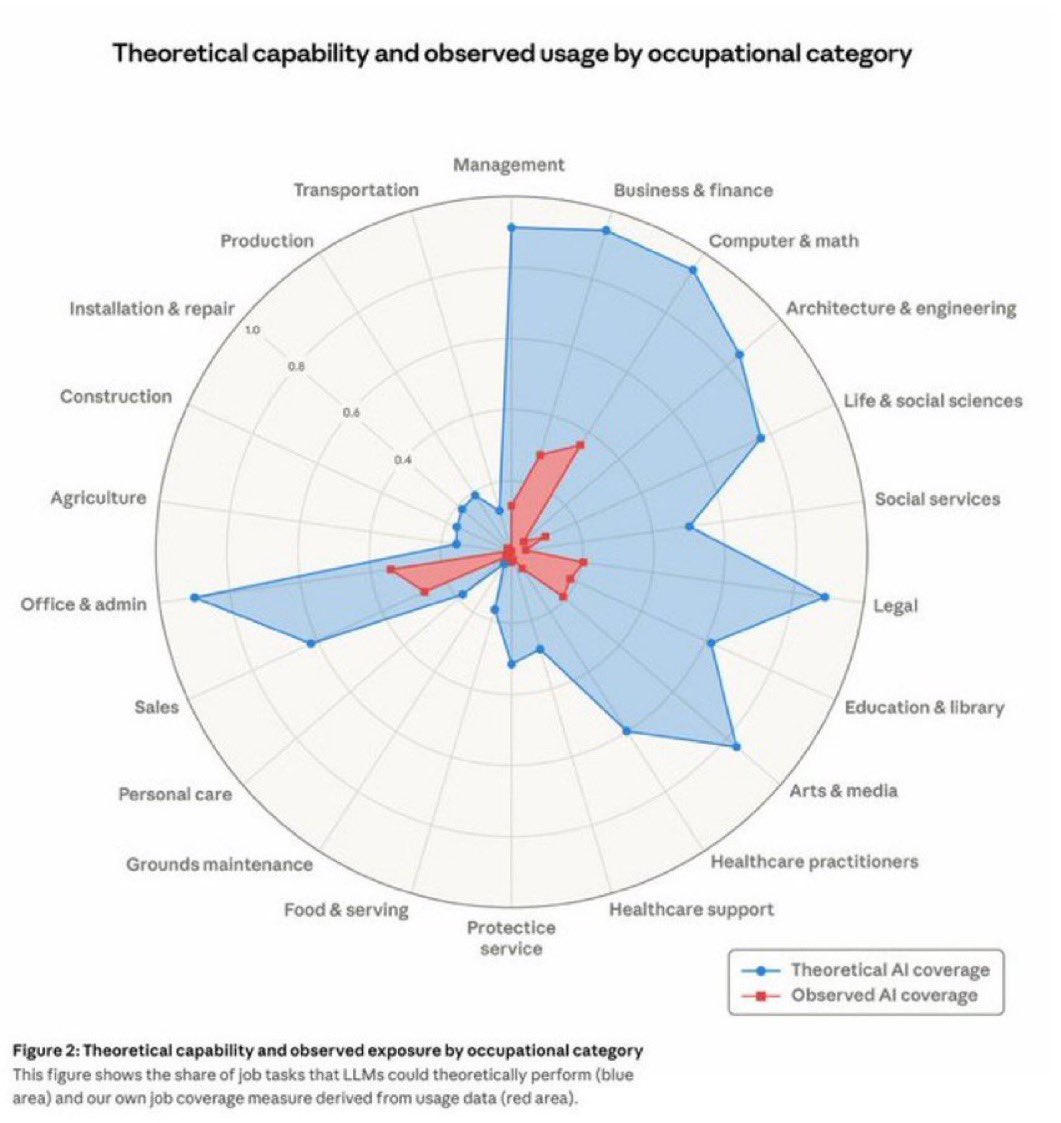
Anthropic's Revealing Chart on AI's Impact on Jobs
Anthropic has unveiled a pivotal chart that underscores the chasm between AI's capabilities and its real-world application in the workforce.
Derived from analyzing 2 million actual conversations with Claude, this radar chart, titled "Theoretical Capability and Observed Usage by Occupational Category," paints a stark picture of untapped automation potential across various job sectors.
At its core, the chart is a spider web diagram plotting occupational categories around a circular axis, with values ranging from 0 to 1.0 representing the share of job tasks.
The expansive blue area illustrates the theoretical coverage tasks that large language models (LLMs) like Claude could perform right now based on their inherent abilities. In contrast, the much smaller red area shows observed usage, drawn from real user interactions.
The visual disparity is immediate and profound: blue spikes outward significantly in fields like computer and math (reaching about 0.75), business and finance, and office administration, while red hugs close to the center, often below 0.2 across most categories.
This gap isn't just academic; it's a "career runway," as highlighted in discussions around the chart. For programmers, 75% of tasks are theoretically automatable, yet actual usage lags far behind.
Similar vulnerabilities appear in customer service, data entry, and financial analysis, roles traditionally seen as white-collar strongholds. Meanwhile, hands-on fields like construction, agriculture, and protective services show lower theoretical exposure, with blue areas dipping to around 0.1-0.3, suggesting AI's current limitations in physical or unpredictable environments.
Broader data amplifies the chart's message. As of early 2026, 49% of U.S. jobs expose at least 25% of tasks to AI, up from 36% a year prior. Yet, mass layoffs haven't materialized; unemployment in AI-vulnerable roles remains steady.
Instead, subtler shifts are underway: a 14% drop in hiring for 22-25-year-olds in exposed positions indicates companies are prioritizing experienced workers, shortening entry-level pathways for recent graduates.
The implications are clear: while AI's red footprint grows incrementally each month, the blue expanse signals accelerating change. College-educated, higher-earning professionals, once insulated are now most at risk, flipping the script on traditional labor disruptions.
Anthropic's chart isn't a doomsday prophecy but a wake-up call, urging workers and businesses to bridge the gap through adaptation, upskilling, and ethical integration of AI tools.
Please read the 5000 Days Series at https://t.co/tcKeuiQyql for answers on how you can thrive in the Interregnum.
Introducing our new work K-Search: LLM Kernel Generation via Co-Evolving Intrinsic World Model — a new paradigm for automated GPU kernel generation, achieving SoTA results.
🔍 Big insight:
Traditional methods treat LLMs as stochastic code generators inside heuristic loops — but this misses a key point: LLMs are powerful planners with rich domain priors.
🧠 Core idea:
K-Search uses the LLM itself as a co-evolving world model — one that plans + updates beliefs + guides search decisions based on experience.
📌 This decouples high-level strategy (intent) from low-level code implementation, allowing the optimizer to pursue multi-step transformations even when intermediate implementations don’t immediately improve performance.
📈 Key results:
🔥 Our discovered kernels are ~2.10× average speedup vs state-of-the-art evolutionary search across 4 FlashInfer kernels on H100/B200.
🔥 Up to 14.3× gain on complex Mixture-of-Experts (MoE) kernels.
🔥 State-of-the-art performance on GPUMode TriMul (H100) task — beating both automated and human solutions.
🙏 Acknowledgements
This work is developed in @BerkeleySky, w/ the amazing @ziming_mao, @profjoeyg, and @istoica05. We thank @DachengLi177, @MayankMish98, @randwalk0, @pgasawa, @fangz_zzu, and @tian_xia_ for helpful discussion and feedback.
We also thank the generous compute support from @databricks, @awscloud, @anyscalecompute, @nvidia, @Google, @LambdaAPI, and @MayfieldFund.
👨💻 GitHub: https://t.co/YJJ9SYvTvD
📄 arXiv: https://t.co/JtZDnZBkKM
Today, we announced more than $250 million in new funding, led by Innovation Industries with BlackRock and SiteGround Capital joining as new investors alongside many of our original backers doubling down. Total capital raised now exceeds $450 million, making this the largest investment ever in an EU AI semiconductor company.
This funding isn't the story. It's a signal that the problem we set out to solve is real, urgent, and large.
Most edge AI deployments today are still being built with hardware that wasn't designed for the job. Adapted datacenter chips, power budgets that don't survive procurement, thermal constraints that kill reliability in the field. The gap between what AI can do and what actually works in production is still enormous. That's the problem we set out to solve.
Shipping to our 500th customer across manufacturing, retail, defense, robotics, and agritech tells us we're on the right track. And we're just getting started.
Here's what comes next:
Metis continues to scale globally, giving customers the performance they need within the power and thermal budgets of physical AI.
Europa, our next-generation AIPU at 629 TOPS of INT8 performance, begins PCIe accelerator shipments in the first half of 2026. Workloads that were cloud-only are about to run at the edge.
Then, Titania, backed by the €61.6M EuroHPC DARE grant, will extend our architecture into HPC and data center environments.
And our Partner Accelerator Network keeps growing, because hardware alone doesn't win. The ecosystem around it does.
None of this happens without the partners, customers, investors, and employees who believed in what we were building before it was obvious. Thank you.
It's still day one, and we're just getting started.
#AxeleraAI #EdgeAI #AIInference #AIHardware #Semiconductors #EuropeanTech
https://t.co/PvXVhhW9w4
If you're a researcher in academia using Keras 3 (PhD student, postdoc, professor...) and you want to train on TPUs, you could receive compute awards from Google for your research. Google is running a new academic grant program, separate from the TPU research cloud.
You can contact me with a few words about your research and I can refer you -- [email protected]
Graphene just broke a fundamental law of physics.
Its electrons just did something physicists thought was impossible. For nearly 200 years, metals have obeyed the Wiedemann-Franz law – the rule that electrical conductivity and thermal conductivity always rise and fall together.
But in ultra-clean graphene, researchers at the Indian Institute of Science found the opposite. As electrical conductivity increased, thermal conductivity dropped, shattering a principle taught in every physics textbook.
The key lies at the “Dirac point,” a strange electronic tipping point where graphene is neither a metal nor an insulator. Here, electrons stop behaving like individual particles. Instead, they flow collectively as a nearly perfect fluid – a state called a “Dirac fluid.”
This discovery doesn’t just rewrite the rules for graphene. It provides a tabletop window into extreme physics usually reserved for black holes and high-energy colliders. Scientists say this behavior could help probe mysteries of quantum entanglement, black hole thermodynamics, and the very fabric of matter itself.
["Universality in quantum critical flow of charge and heat in ultraclean graphene." Nature Physics, 2025]
Berkeley Lab's report on data center cooling tells an important infrastructure story. Hyperscalers are still ~85% air-cooled. AI-specialized facilities are roughly half liquid cooling, direct-to-chip or full immersion, because GPU-dense racks generate too much heat per square foot for air. This is the physical divergence most people miss in the AI capex conversation. These are quite fundamentally different buildings with different plumbing, power density, and cooling architecture.
Our partnership with NVIDIA is foundational. NVIDIA is our most important partner for both training and inference, and our entire compute fleet runs on NVIDIA GPUs. This is not a vendor relationship. It is deep, ongoing co-design. We build systems together, and our frontier models are the product of multi-year hardware and model engineering done side by side.
We scaled available compute from 0.2 GW in 2023 to 0.6 GW in 2024 to roughly 1.9 GW in 2025, and that pace is accelerating. Inference demand is growing exponentially with more users, more agents, and more always-on workloads. NVIDIA continues to set the bar for performance, efficiency, and reliability for both training and inference.
The demand curve is unmistakable. The world needs orders of magnitude more compute.
That’s why we are anchoring on NVIDIA as the core of our training and inference stack, while deliberately expanding the ecosystem around it through partnerships with Cerebras, AMD and Broadcom. This approach lets us move faster, deploy more broadly, and support the explosion of real-world use cases without sacrificing performance or reliability. The outcome is simple and durable: infrastructure that can carry frontier capability all the way into production, at global scale.
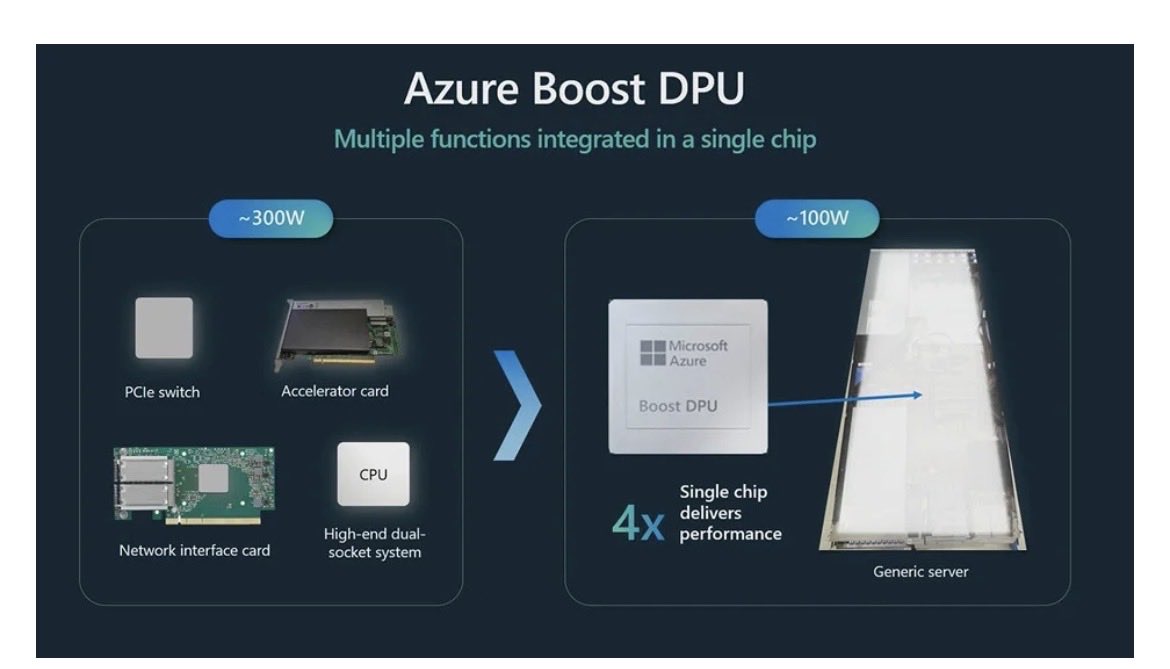
The integrated NIC already existed in Maia100. The one in Maia200 is likely the next generation with more features. The Fungible IP was turned into a separate DPU called Azure Boost DPU. A DPU is a big chip in itself and primarily used to connect NVMe and runs a different software stack. The integrated NIC in the Maia will be a much lighter block.
But it is very much possible that they deployed some of the fungible folks to work on the integrated NIC.
Want a chance to attend #NVIDIAGTC?
We're partnering with our GTC community to give away Golden Tickets 🎫 including:
✅GTC Conference pass
✅VIP seating at NVIDIA CEO Jensen Huang’s keynote
✅NVIDIA DGX Spark
✅Exclusive Happy Hour at NVIDIA Headquarters
✅GTC Training Lab pass
✅NVIDIA merchandise
Follow these accounts to be the first to know each giveaway's unique entry requirements 🔽
NVIDIA team: @ctnzr, @Baxate / @NaderLikeLadder
Partners: @ollama, @huggingface / @pollenrobotics
Get contest details: https://t.co/fkDOK3S6AI
Terms & conditions apply.











![Rainmaker1973's tweet photo. Graphene just broke a fundamental law of physics.
Its electrons just did something physicists thought was impossible. For nearly 200 years, metals have obeyed the Wiedemann-Franz law – the rule that electrical conductivity and thermal conductivity always rise and fall together.
But in ultra-clean graphene, researchers at the Indian Institute of Science found the opposite. As electrical conductivity increased, thermal conductivity dropped, shattering a principle taught in every physics textbook.
The key lies at the “Dirac point,” a strange electronic tipping point where graphene is neither a metal nor an insulator. Here, electrons stop behaving like individual particles. Instead, they flow collectively as a nearly perfect fluid – a state called a “Dirac fluid.”
This discovery doesn’t just rewrite the rules for graphene. It provides a tabletop window into extreme physics usually reserved for black holes and high-energy colliders. Scientists say this behavior could help probe mysteries of quantum entanglement, black hole thermodynamics, and the very fabric of matter itself.
["Universality in quantum critical flow of charge and heat in ultraclean graphene." Nature Physics, 2025]](https://pbs.twimg.com/media/HBGzrDeaAAAwrul.jpg)