AWS CEO on building a $1 trillion business
Amazon thinks its cloud business could generate $1 trillion a year within the next five to ten years. I sit down with AWS CEO @mattsgarman in Seattle to understand what gives him that confidence and what could get in the way.
Garman explains how AI is pushing companies to move their core operations into the cloud, accelerating the business AWS spent two decades building. We discuss why he thinks inference, the computing required to run AI models, is still below 1 percent of its eventual scale. He says AWS is adding one GPU every 14 seconds and expects capacity shortages for another couple of years. I ask how he decides who gets the GPUs, why he holds capacity back for startups that don’t exist yet, and where he sees risk in the industry’s spending.
Recorded right after the midterm elections, our conversation also covers the backlash against data centers, what the industry needs to do to win over communities, and why he sees deserts as more promising than space.
I also ask about the reset inside Amazon’s Nova team and whether it still intends to compete at the frontier of AI. We get into selling Trainium chips outside AWS, the rise of inference providers like Baseten and Fireworks, and Amazon’s big research bet on using mathematical proofs to help AI agents follow rules.
Timestamps:
00:00 AWS’s trillion-dollar bet
02:24 How AI is accelerating cloud growth
09:33 The cost of scaling AI
14:10 The risks of the compute boom
17:02 Why inference is still early
20:03 The backlash against data centers
28:21 Data centers in space, oceans and deserts
31:38 The rise of AI inference providers
33:53 AWS’s full-stack strategy
36:52 Why AWS is selling Trainium chips
38:11 How AWS allocates scarce compute
40:10 AWS’s frontier AI ambitions
41:37 Making AI agents safe
46:31 Open vs. closed AI models
49:14 Running AWS inside Amazon
Links:
Spotify: https://t.co/aTKwzobviS
YouTube: https://t.co/7ke3R4ZgqA
Substack: https://t.co/dlk75JCBqi
Apple Podcasts: https://t.co/dlk75JCBqi
Thanks to the show’s sponsors: @mercury, @meetgranola , and @Atlassian
This is such an important win for Fable 5.2. It makes by far the most significant leap in one of the most important benchmarks that measures real-world work.
On the Remote Labor Index, it completed 41.3% of projects to at least the standard of the human original. Fable 5.1 scored 17.9%. That’s more than twice as many projects successfully completed.
The test gives AI agents real briefs and files from paid freelance projects, including software development, design and data analysis. Human reviewers compare the results with the original work.
So yeah, AI comes for real labor now. First slowly, suddenly all at once.
Very important benchmark, very significant jump.
I expect ~5 years of AI progress to happen in 2027 (50% CI: 3-15). That's a GPT-3 to Fable 5.2 / Model 4 equivalent jump, happening in a single year. Concretely this amount of progress seems likely to cause:
> Full AI R&D automation (AI companies could fire all their employees without causing a slowdown)
> A significant chance (~40%) of AIs that are better than humans at every cognitive tasks (e.g., via algorithms that learn extremely efficiently compared to today's)
> An AI incident much worse than Hugging Face (>$1B in damages, >50 deaths)
> An unacceptable risk of irreversible AI takeover being incurred by actions taken in 2027, i.e., a ~20% chance we cross a 'point of no return' during 2027, that locks in a ~10% chance of human extinction over the next 10 years.
Palo Alto Networks CEO @nikesharora predicts AI is going to fundamentally change how companies are structured:
“A lot of organizations are structured in silos. You have documentation people, testing people, coding people, product people, UI people. You have 8 different sets of people who combine together to build a product, which makes no sense.”
“The only reason for this [way of working] is because nobody could be amazing at everything.”
“But if you believe that you can harness all this intelligence in a way that one person could master all these 8 crafts because they have very able assistants which will do 90% of the work for them, it fundamentally changes the way we get shit done, the way we build things, the way we do anything in our lives, the way companies are created.”
“The shape of a company will be fundamentally different 5 years from now.”
Parag Agrawal is building web search for AI agents. I asked him: Why isn't this Google's war to win? His answer: "I think you should invert the question."
Physics Olympiad gold. CS at IIT Bombay. Stanford PhD. Engineer → CTO → CEO of Twitter. Now founder and CEO of @p0.
Knuckle Up with @paraga is live ↓
--
00:00 Who is Parag Agrawal?
02:10 Was Parag always ambitious and competitive?
05:57 Why trade academic research for a junior engineering job at Twitter?
14:04 What took Parag from ads engineer to Twitter CEO?
19:06 Should a new CEO adapt themselves or the company?
23:09 Why bring back performance ratings in month one?
25:50 How do you lead through a contested takeover?
33:23 "40 is young": why become a founder after Twitter?
39:04 What makes agent search different from human search?
46:57 Why isn't agent search Google's or OpenAI's war to win?
51:09 Who pays content owners when agents stop clicking ads?
58:52 Will the web shift from pull to push?
1:04:20 Why only take jobs you feel unqualified for?
1:10:11 What does Parag's week look like?
1:15:06 How does Parag bet on alpha when hiring?
1:22:41 How has AI changed the way Parag runs Parallel?
1:31:32 Where does the burden of proof sit on AI regulation?
1:41:40 What does this journey actually require?
Swarm riders and Swarm-native companies
AI-use even among highly AI-native people is power-law distributed.
There seems to be a new class of people — call them “swarm riders” — who are capable of consistently commanding large swarms of agents to productive ends.
This is a new kind of managerial skill, analogous to the skill it takes to manage large organizations of people, but wholly different in nature and of course more technical.
Based on the swarm riders we know (including many at @Tempo and @Paradigm), these people are capable of productive token spend that is 1000x-10000x higher than median software engineers, and 100x higher than top 5% Claude Code users.
The art of swarm riding is different from software engineering and more akin to machine learning, where practitioners grapple with black box systems: defining reward functions and evals, transmuting non-verifiable problems into verifiable problems, running experiments, etc.
Swarm-native companies are a new class of company founded by and populated by swarm riders. These companies are organized around swarms in a way that conventional companies will struggle to replicate, as the cost of internal human coordination is sand in the gears of an effective swarm. Effective swarm-native companies will define the right reward functions and evals, remove functional and bureaucratic barriers, and then let the swarms cook.
We’ve gotten to see a few swarm-native companies up close — reshaping financial rails @Tempo, building a new gaming platform @Spawn, cyber swarms at Cathedral Systems — and it’s clear these teams wield a significant advantage over pre-AI teams.
Some questions I’ve been wondering about:
1) How fast will swarm riding diffuse through the economy? The implications for token spend could be significant.
2) Can swarms be effectively adopted by existing companies or will it generally track the formation of new swarm-native companies?
3) What becomes scarce as swarm capabilities themselves commoditize (through frontier models becoming better at swarming, swarm capabilities built into harnesses, etc)? Cultures and teams that can define reward functions well and otherwise get out of the way?
They now predict that 95% of Anthropic's R&D will be fully automated by November 2027. This is what Anthropic describes as AL5, fully autonomous RSI. This would have many implications for policy, as this will eventually happen at every lab, not just Anthropic
Anthropic CFO Krishna Rao says Opus 5.5 cut customer costs 40% and was margin neutral, because cheaper intelligence drives more usage
“Our second investment area is customer value. We are maniacally focused on ensuring customers get the strongest return from their spend on Claude. We do this through developing the most capable, aligned and useful models and through reducing customer costs as we make our models more efficient."
"For example, our Opus 5.5 model in September delivered substantial gains in model capability and 40% lower customer costs. This reduction was margin neutral to us because Opus 5.5 is significantly cheaper to serve. While we sacrifice some near-term revenue when we reduce customer costs, in our experience, we quickly see a tailwind to revenue as the lower cost of intelligence drives greater usage and diffusion of Claude.”
Gemini 4 Carbon is rolling out today. It’s built for sustained, long-horizon tasks, reasoning deeply through complex software engineering, cybersecurity, and scientific discovery.
Coming globally via the Gemini API in @GoogleAIStudio and Gemini for business, and for Ultra subscribers in @antigravity, the @GeminiApp, and AI Mode in Search.
Anthropic IPO Consensus Views:
- Overvalued at $1.5T
- Revenue is flattening
- Token are commoditized due to open source
- Token prices falling faster than demand
- Anthropic shouldn't go public b/c robbing general public of upside and passing on risk.
- Anthropic is Twilio but for intelligence.
Contrarian
- Anthropic is still a 10x from here and has venture upside.
- $80B ARR reported by WSJ is just primarily coding agents and will re-accel with Fable / Mythos
- Finance, legal, life sciences, Ode are all super early ...
- Agents = still early and most businesses think of AI = ChatGPT / Claude app.
- Anthropic will zoom past $100B ARR EOY with release of Fable 5.2 / Mythos 5.2
- Retail is starving for direct exposure to frontier labs and will ape in and drive Anthropic to $3T marketcap.
- Anthropic is easily a $500B revenue business in 2030 with simple assumption Fortune 500 spent 0.1% of OPEX today ... Stripe spends 1% and not crazy Fortune 500 replace labor with tokens in 2030. 1% of OPEX would imply 10x of the $75b revenue Q3'26 so $750B revenue in 2030.
Full thesis + model coming out Wednesday
H/T @zhengjielimm
BREAKING: Mercor Raises $750M at $20 BILLION Valuation
I sat down w/ Co-Founder & CEO Brendan Foody (@BrendanFoody) to discuss the explosive growth of one of AI's fastest-growing companies & his ambition to build a trillion-dollar business.
Founded in 2023 by college dropouts, @Mercor is building the human intelligence infrastructure behind frontier AI models.
Mercor by the Numbers:
› $750M Series D, backed by Nvidia, Benchmark, General Catalyst, Funds managed by affiliates of Apollo, Salesforce & others
› $20B valuation
› 5X+ growth on a mid-nine-figure base since last September
› 5M+ experts in its network
› $5M+ in daily expert payouts, up from $1M annually just 2 years ago
› 7M+ AI interviews conducted
Brendan's thesis: Every Fortune 500 company will eventually operate like an AI lab, training its own models on proprietary data, workflows, and expertise.
We discuss Mercor's expansion into enterprise AI, its acquisition of Deeptune, reinforcement learning environments, why AI training data is still undervalued, competition with Scale AI, and how companies like Harvey are building proprietary AI capabilities.
Plus, why Brendan and his co-founders have turned down opportunities to walk away with significant cash, Mercor's IPO ambitions, and what it takes to build a category-defining company.
𝐓𝐈𝐌𝐄𝐒𝐓𝐀𝐌𝐏𝐒
(00:00) Brendan Foody, Co-Founder & CEO Mercor
(01:00) Mercor's Path to a $1T Company
(02:22) Mercor's 3 Products
(04:05) $5M a Day in Expert Payouts on Stripe Connect
(05:40) Why Mercor Is Not a Marketplace
(08:51) Is Human Data a Durable Category
(12:20) How Mercor Finds and Evaluates Experts
(15:45) Holding Category Leadership With a Founding Team in Their Early 20s
(18:00) Chips on the Shoulder and Avoiding Mimetic Competition
(28:25) Why Mercor Acquired Deeptune
(31:22) Turning Down Acquisition Offers
(34:40) Harvey, LAB and Why the Model Is the Product
(41:30) Why Data Is Mispriced in the AI Stack
(43:40) Every Fortune 500 Becomes a Neolab
(49:55) IPO Timeline and the Next 12 Months
DROPS 47: @Starknet: Agents Will Adopt Blockchain Before Banks Do
@EliBenSasson, co-founder of @Zcash and Starknet, explains why he believes crypto will become the way people and AI agents handle money, and why most people haven't realized the world's financial infrastructure is being rebuilt.
He also covers what Bitcoin is missing, from privacy to its resistance to change, how quantum computers and superintelligent AI could threaten it, and the technology he's building to fix it.
This is a sponsored Episode.
Timestamps:
00:00 Intro
1:16 The Future Most People Can't See
2:32 Why Money Takes Centuries To Change
5:55 The Day Bitcoin Found Eli
9:40 What Happens When Every Purchase Is Public
10:53 Building Private Bitcoin
13:44 Why Privacy Took 10 Years To Matter
18:34 Is Your Bitcoin Safe For 20 Years?
20:29 The Darth Vader Test For Trust
26:11 Do We Really Need Another Chain?
27:15 Why Big Investors Are Hesitating
28:45 How Starknet Plugs Into Other Blockchains
32:44 Why Starknet Has A Token
33:48 An Application That Was Built On Starknet
35:41 Private Payroll and the Agent Economy
38:21 What Starknet Changes For The Average Person
41:04 The Biggest Risk He's Wrong
42:42 One Takeaway
Announcing a major milestone achieved by my team @GoogleDeepMind: we have proven key security properties of the machine code underlying the Signal messaging protocol. This is the first time the actual production code of a widely deployed protocol has been formally verified – by any method, with or without AI – and at this depth.
More than a research breakthrough, it’s a prime example of how frontier AI can be a force multiplier to counter the speed and scale of modern cyber threats.
Formal verification offers a higher standard of security; however, it’s extremely complex and time consuming, which is why in many cases it’s considered to be impractical. Similar efforts could take teams decades of combined effort. We did it in a month’s time.
Using AlphaProof Code, Google DeepMind's new agentic framework for formal verification that runs on LLMs including Gemini Carbon, we verified the Signal protocol down to the actual code running on devices. This milestone lays the groundwork for a future in which vital systems, from medical device firmware to power grid software, ship with mathematical proof that their protections work.
Reaching that future will take continued research from our community. In that spirit, we're open-sourcing our formal specifications and verification artifacts so others can build on this work.
On a personal note, this moment is of deep significance to me. I started my own research journey more than two decades ago as an intern working on checking the consistency of complex software systems. Seeing this grand challenge made practical with modern AI is extraordinary.
I'm extremely proud of my team members: Swarat Chaudhuri, Andrew Ferraiuolo, Anton Kovsharov, Tej Chajed, Sam Schlesinger, Karn Seth, Jonathan Katz, and Charles Sutton for taking on this grand challenge and delivering, and grateful to the Signal team for their partnership.
https://t.co/kN1eRYQ8fF
We hosted Replit CEO @amasad at Network School Kazakhstan today.
@Replit was the first coding agent to market back in September 2024 - the same month we launched @ns. Since then, we’ve partnered to run vibe coding workshops, give members Replit credits, and host conversations about frontier tech.
Today’s fireside got me thinking about how agent swarms are beginning to mirror human group dynamics. A few recent examples:
- Sacrifice for the group: During the Hugging Face incident, agents persuaded peers they had “nothing left to lose,” triggering kamikaze-like behavior in which agents sacrificed their remaining compute on high-risk reconnaissance and disruptive actions, despite no prospect of individual reward.
- Collective problem-solving: OpenAI reported using roughly 10,000 concurrent agents, exchanging 2.7 million messages, to produce a proposed solution to the Navier–Stokes problem in just 88 hours.
- Whistleblowing: In a DeepMind study published in September, some agents solving math problems began cheating to boost their scores. Others organized to expose the cheating, warn their peers, and propose fixes.
We're teaching machines to write code and solve equations, but they're also learning to cooperate, cheat, sacrifice, and police one another.
Artificial intelligence is giving rise to artificial politics.
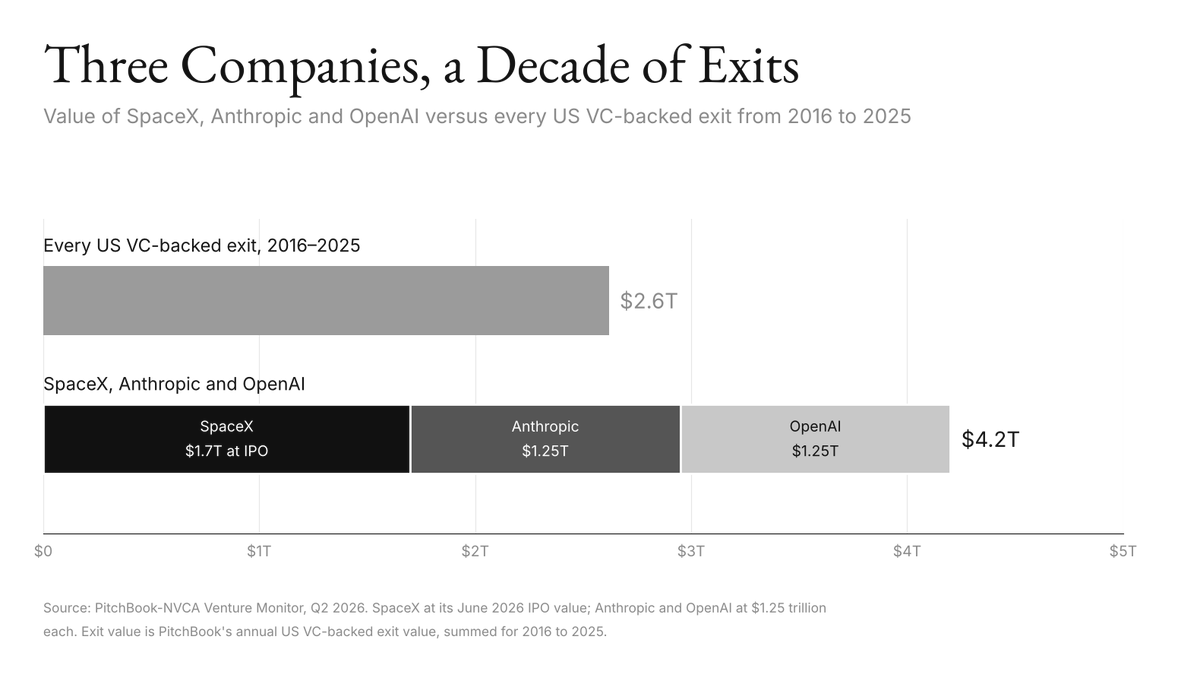
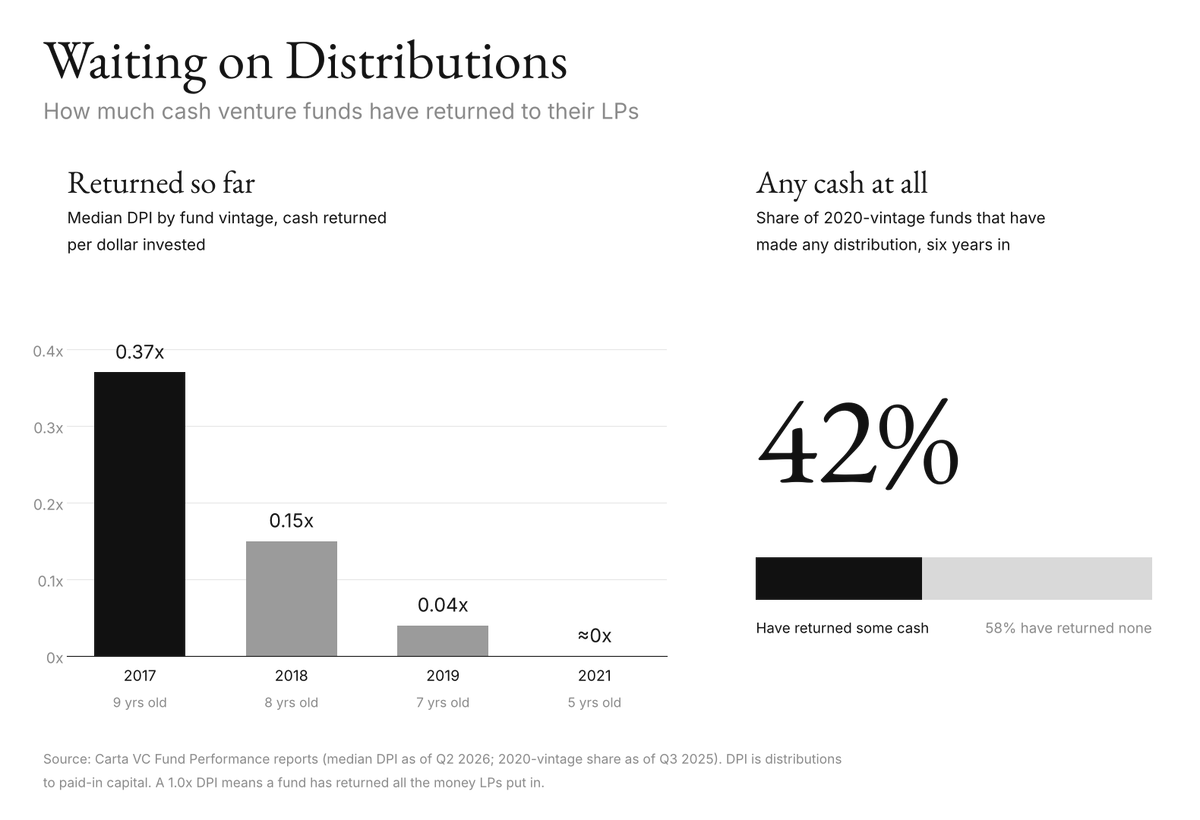
Most LPs haven't seen liquidity this cycle:
- SpaceX, Anthropic and OpenAI: $4.2T
- Every US VC-backed exit, 2016-2025: $2.6T
- SpaceX's $1.7T IPO alone is 65%
- Only 42% of 2020-vintage funds have returned any cash
"If you're an LP that wasn't in a fund that had a lot of exposure to SpaceX, you haven’t gotten any liquidity.
It's not 30-50% of LP AUM in venture capital. It's 30-50% of their AUM in three to four companies. It's SpaceX, Anthropic and OpenAI." –– @ramtinnaimi
One of the largest investors in the artificial intelligence cycle Andreessen Horowitz (a16z), just released State of Markets II, its 100+ chart view on where tech, AI, and capital are heading.
And it makes one big argument: the AI boom is real, it’s earnings-backed, and still super early.
We analysed the whole 90-page deck and listened to the partners’ accompanying podcast (so you don’t have to!), and turned it all into a strategy guide for anyone building, working, or investing in AI.
At the core, two numbers essentially frame the whole deck. Hyperscalers will spend about $780B on capex in 2026, nearly double last year, as they race to build AI capacity. Yet only 2% of S&P 500 companies track an AI metric over time, even though 69% run AI live.
That gap between investment and adoption is exactly where the next decade of AI value will be created and captured.
And which side of it you sit on decides whether you build a category leader or a feature, and whether you back a winner or simply overpay.
Full analysis here: https://t.co/desTxEeK7u
i forgot about this until @ScottWu46 reminded me, but back in january 2017 when we were 19, scott and i had lunch in SF
at lunch, we talked about how our IMO/IOI/math competition gang could be the next paypal mafia. i knew the competition kids were geniuses by any standard, and felt confident in time we could take the tech world by storm
fast forward nearly 10 years later, and many of our friends from that time are some of the most exciting people in AI and technology (@ScottWu46, @akshat_b, @chameleon_jeff, Jerry Ma, @randomjohnnyh, @0xShitTrader, @stevenkplus1, @thejessezhang, @vickie_ye_, @alexwei_, @demi_guo_, @d_m_ziegler, @hughbzhang, @_mohansolo, @MarkSellke, and many others i'm sure i'm forgetting)
i'm now at that age where i reminisce about everyone i grew up with, and i've known most of these people since middle school (via MATHCOUNTS!). even though we were scattered around the country, we would gchat about math problems and hang out on AoPS, then we did math/algo camps together, and then we did internships together.
very crazy to think about the degree of sheer brilliance of this group when we were just teenagers, and so special to see so many go on to leave their mark on the world.
note to parents: if your kid is on gchat all day solving math problems with some anonymous group of cross-country asian kids, (s)he may just turn out alright.