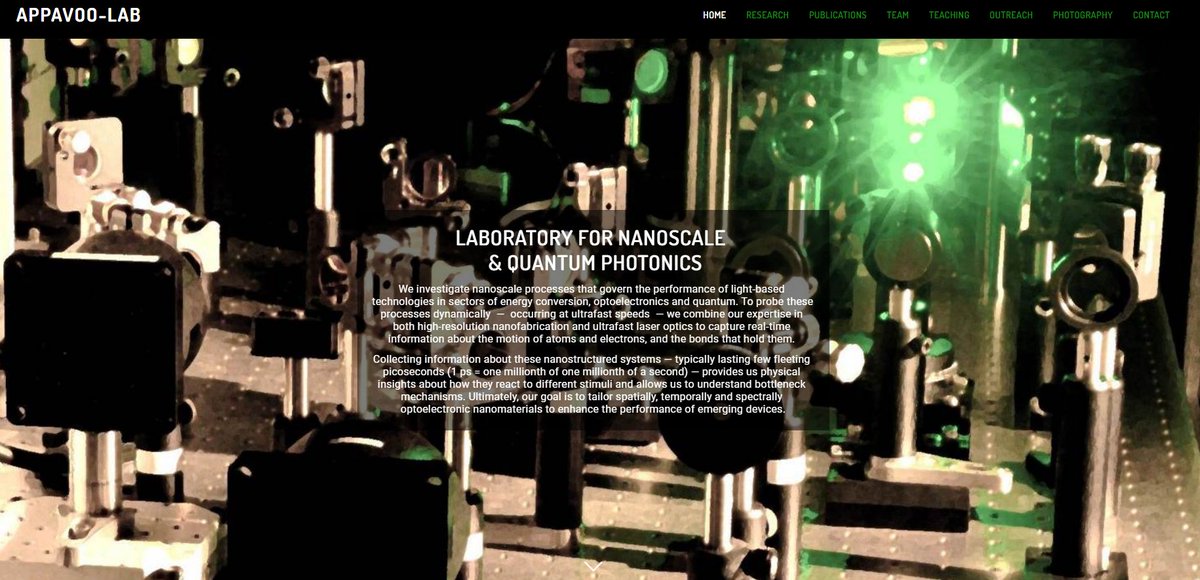
Excited for the major overhaul of our research group website. Check out our team, and their recent work in #metamaterials, #quantum and #energy nanostructured systems! 🔬
https://t.co/g7F5RTGjT4
I'm excited to announce a Postdoc position in my group at @IMPvienna!
If you're all about instrumentation, software dev, super-resolution and single molecule studies and you're driven by innovation in optics and biology, I'd love to see your application!
https://t.co/lsgOv2G56Z
Physics teachers. The light ray puzzle below is absolutely fantastic. Have a go yourself! The Ss will love it 🙂 (Hint: Go West from the Star to start) Pls RT! 🙂 Will post solution in a bit!
Writing is an absolutely critical skill… and one that can be improved dramatically. Doing so requires not just repetitions, but deliberate efforts to improve. Some tips here: https://t.co/dYtFtBCOpi
Illustrating common defects in #2dmaterials (mono-vacancies/substitutions in TMDCs) using Blender:
https://t.co/eiWrOUsnAE
Been moving house, so just a quick video this week...🫠
#blender#science#scientificillustration
I've now completed 45 of the 68 Python notebooks that accompany my forthcoming book "Understanding Deep Learning". They will really help if you are learning (or teaching) deep learning.
Notebooks and book pdf at: https://t.co/hqRA1xUPkk
Book published Dec. 5th by @mitpress.
Machine Learning and Machine Doing!
I developed a #MachineLearning model that was then combined with a high-throughput robotic system to efficiently explore the vast compositional space of 2D Perovskites for solar cells.
Adv. Energy Mater. link: https://t.co/TOuS3ofi6l
In 1975, the Japanese physicist Yoshiki Kuramoto introduced a mathematical model that describes how synchronization occurs in collective systems. The Kuramoto model has proved useful for modeling synchronization in networks from brains to power grids. https://t.co/SM4cUWupJf
You can use Blender's geometry nodes to solve physics and electromagnetic equations such as Biot-Savart law. You can calculate the magnetic field of a coil anywhere in 3D space and visualise the magnetic fields. Additionally, you can see in real-time how the magnetic field lines change as the coil gets deformed and twisted! #geometrynodes #b3d #blender3d #electronics #Engineering #Science #physics #kicad #circuits
Simulation nodes are official in Blender 3.6!
This opens opportunities for running physics sims with geometry nodes 💪
Here's me messing with a basic 2D Ising model with a metropolis algorithm.
Tbh it isn't fully working but you see what I mean... 😅
#b3d#ScienceTwitter
I am looking for a postdoctoral associate to join my group. Prior experience in the field of nonlinear optics, metasurfaces, integrated nanophotonics, and nanofabrication is a plus. If interested, please reach out to me at: [email protected]
Landed in Vancouver! If you are at #CVPR23, let's chat about topology🍩 & geometry🌐?
At 9am at the @TAGinDS workshop tomorrow (East 16), I'll present our survey of topological neural nets w/ @mathildepapillo@naturecomputes@HajijMustafa to show how to process relational data🖇️
🎉🎉🎉
"Mathematics for machine learning" (CUP, 2020).
Free PDF from https://t.co/mbzGgyoAVP 😊
A must-read masterpiece, nicely structured and richly color-illustrated!
Time-series feature engineering for XGBoost, 101:
• Lag features
• Rolling aggregations (usually std, var)
• Differences between lags/rolling features
• Group-level aggregations
• Rolling group-level aggregations
• Calendar features (dayofweek, month, etc)
• Rolling features by dayofweek, month, etc.
• Rolling features by group and calendar
• Expanding window features
• Expanding window by group and calendar
• Normalized features (i.e. % of greatest observed value)
• Predictions from stats models, like ETS
• Any external variables, like price
And many, many more (depending on your data)
Time-series prediction with XGBoost💡
→ You CAN use XGBoost for time-series prediction.
→ However, you first need to slice your time-series data into (features, target) pairs.
→ Set a window length (aka feature vector size) and step size (to control granularity) and iterate
I made a tool to calculate annual 📅 direct sunlight at any location on Earth. Unlike traditional sun charts, this one accounts for shadows cast by buildings and terrain. It also doubles as a Rorschach Inkblot generator 😅 Link in replies. #solar#solarpower#renewables
Use the Kalman Filter, even if you don't know the theory! Join me for a free mini-lecture series
▶️ https://t.co/Vgh2BHPK8p
Our approach is simple and intuitive, starting with recursive filters like the moving average and low-pass filter, with code and numerical examples.
Kalman Filter for Beginners with MATLAB Examples
▶️ Part 1 - Recursive Filters https://t.co/Z5tVs1pYCQ
▶️ Part 2 - Estimation & Prediction Processes https://t.co/B0LXbsWYkX
▶️ Part 3- Attitude Estimation, Gyro, Accelerometer, Velocity from Position https://t.co/NOztI1dwyb





![Rainmaker1973's tweet photo. How a book written in 1910 could teach you calculus better than several books of today
[Full text: https://t.co/55dkZAfec3] https://t.co/1kgmnklGjK](https://pbs.twimg.com/media/F9NqCTUakAEb7sg.jpg)


