🕯 The Verso Didn’t Lie: A 1944 Seizure Record and the Painting That Named Its Owner
An official Hungarian archival inventory records the forced transfer of artworks from the Herzog Palace at Andrássy út 93, Budapest, to the Szépművészeti Múzeum — the property of widow Sváb Sándorné. The eleventh entry reads:
“11./ Glatz O.: Erdélyi falu, olaj, vászon, 65 × 92 cm.”
Erdélyi falu — Transylvanian Village. Oil on canvas. 65 × 92 cm.
🎨 The Artist
Oszkár Glatz (1872–1958) was a leading figure of the Nagybánya artists’ colony — trained under Simon Hollósy, active in the circle that transformed Hungarian painting in the early 20th century. His Transylvanian landscapes and genre scenes, combining Impressionist light with strong compositional structure, were among the most sought-after works of their generation. The Magyar Nemzeti Galéria included this painting in its 1996 centenary exhibition of Nagybánya art.
🔍 The Match — and the Verso
A painting documented at Kieselbach Aukciósház corresponds closely to this inventory entry:
Glatz Oszkár, Hegyi tanya (Erdély határán, Tanya a Törcsvári szorosban), c. 1906
Oil on canvas, 64 × 90 cm
Kieselbach 64th Autumn Auction, Lot 79, 18 September 2020
Starting price: 15,000,000 HUF / Estimated: 20–40 million HUF
https://t.co/f5Fcjfjfa7
The artist, medium, and subject are exact matches. The dimensions — 65 × 92 cm in the 1944 inventory versus 64 × 90 cm in the auction record — differ by a single centimeter in each direction, within normal variance for wartime handwritten measurements.
What distinguishes this case is the physical evidence on the painting itself. The verso bears a handwritten inscription: “Sváb Sándorné tulajdona Andrássy út 93” — Property of Mrs. Sándor Sváb, Andrássy út 93. The auction catalogue confirms the Herzog/Sváb provenance explicitly. The inventory document records the seizure from that same address. These are not inferences — they are the same address, the same owner, the same painting. The work was sold at auction in September 2020 and is now in private hands.
🧾 The Victim
Irén Herzog — widow Sváb Sándorné — came from one of Hungary’s most prominent Jewish industrial and cultural families. The Herzog collection assembled at Andrássy út 93 was among the most significant private art collections in Hungary. In 1944 it was seized, catalogued, and transferred to state museum custody under Decree 1830/1944.
⚖️ Wider Context
The broader Herzog collection remains one of the largest partially unresolved Holocaust-era restitution cases in Hungary, with formal claims across U.S. and Hungarian courts spanning decades. This painting does not appear among the 40 works named in the Herzog family’s landmark De Csepel v. Republic of Hungary lawsuit — which reached the U.S. Supreme Court. Whether it was recovered by the family, held privately, or has been circulating unrecognized outside formal restitution proceedings is not established in any public record.
📢 A Call for Transparency
We ask the Szépművészeti Múzeum to publish the full 1944 Herzog/Sváb intake ledger for this inventory page, including any internal museum records, depot notations, and chain-of-custody documentation for all items on this reel.
Under the Washington Principles on Nazi-Confiscated Art and the HEAR Act, full disclosure of wartime intake records is not optional — it is the foundation of just and fair resolution.
The painting named its owner eighty years ago. What remains is not a question of evidence — it is a question of will.
#HEARAct #WashingtonPrinciples
@WJRORestitution@ClaimsCon@nytimesarts@CathyHickley@WorldJewishCong@SCOTUSblog@neal_katyal@danabrams@USAmbHungary@brand_arthur@raydowd@NicholasMOD@jerrysaltz@AmbHerzog@AJCGlobal
🏛 The Herzog-Sváb Ledger: A Florentine Relief Match Candidate at the Museum of Fine Arts
An official 1944 Hungarian archival inventory records the forced transfer of artworks from the Herzog Palace at Andrássy út 93 to the Szépművészeti Múzeum (Museum of Fine Arts, Budapest). The seized items are listed as the property of "widow Sváb Sándorné" — the legal married name of Baroness Irén Herzog.
The second entry reads:
“2./ Német szobrász XV. szd. vége. Madánna a gyermekkel, fálalak, fa, 46.5 cm magas.”
German sculptor, late 15th century. Madonna with Child. Wooden figure. 46.5 cm high.
That is how a wartime clerk described it. Today, a compelling candidate in the museum’s collection mirrors these exact specifications.
🎨 The Object
The Szépművészeti Múzeum/Museum of Fine Arts, Budapest holds a painted terracotta relief — Virgin and Child — attributed to a Florentine sculptor active in the second half of the 15th century, 46.5 × 46.5 × 8 cm, 14 kg. Inventory no. 1183. Not on display.
👉 https://t.co/03j2gIsW9y
The dimensions are exact. The subject identical. The medium — painted terracotta — explains the clerk’s “fa” (wood): heavily polychromed Florentine devotional reliefs of this period were routinely misidentified by non-specialist eyes. The attribution shift from “German sculptor” to Florentine school is the kind of postwar scholarly refinement documented across this entire reel.
⚠️ An Important Note
No publicly available documentation directly links inv. 1183 to the 1944 seizure. The postwar provenance window has not been disclosed. This object does not appear among the 40 works named in De Csepel v. Republic of Hungary — the Herzog family lawsuit that reached the U.S. Supreme Court.
📢 A Call for Transparency
We ask the Szépművészeti Múzeum to publish the full provenance file for inventory no. 1183 — including 1944 intake documentation and the complete chain of custody from Andrássy út 93 to the present.
Under the Washington Principles on Nazi-Confiscated Art and the HEAR Act, institutions holding such material bear a responsibility to identify, disclose, and facilitate just and fair resolution.
The 1944 record details an artwork seized from Andrássy út 93. The Museum of Fine Arts holds a piece matching those exact specifications, yet its listing omits this potential origin. This historical gap demands answers.
#HEARAct #WashingtonPrinciples #ArtRestitution #ProvenanceResearch
@WJRORestitution@ClaimsCon@nytimesarts@artnet@SCOTUSblog@cnni@guardian@artdetective@CathyHickley@Pontifex@AndrewRCasper1@cagliotileg@artlossregister@HolocaustMI
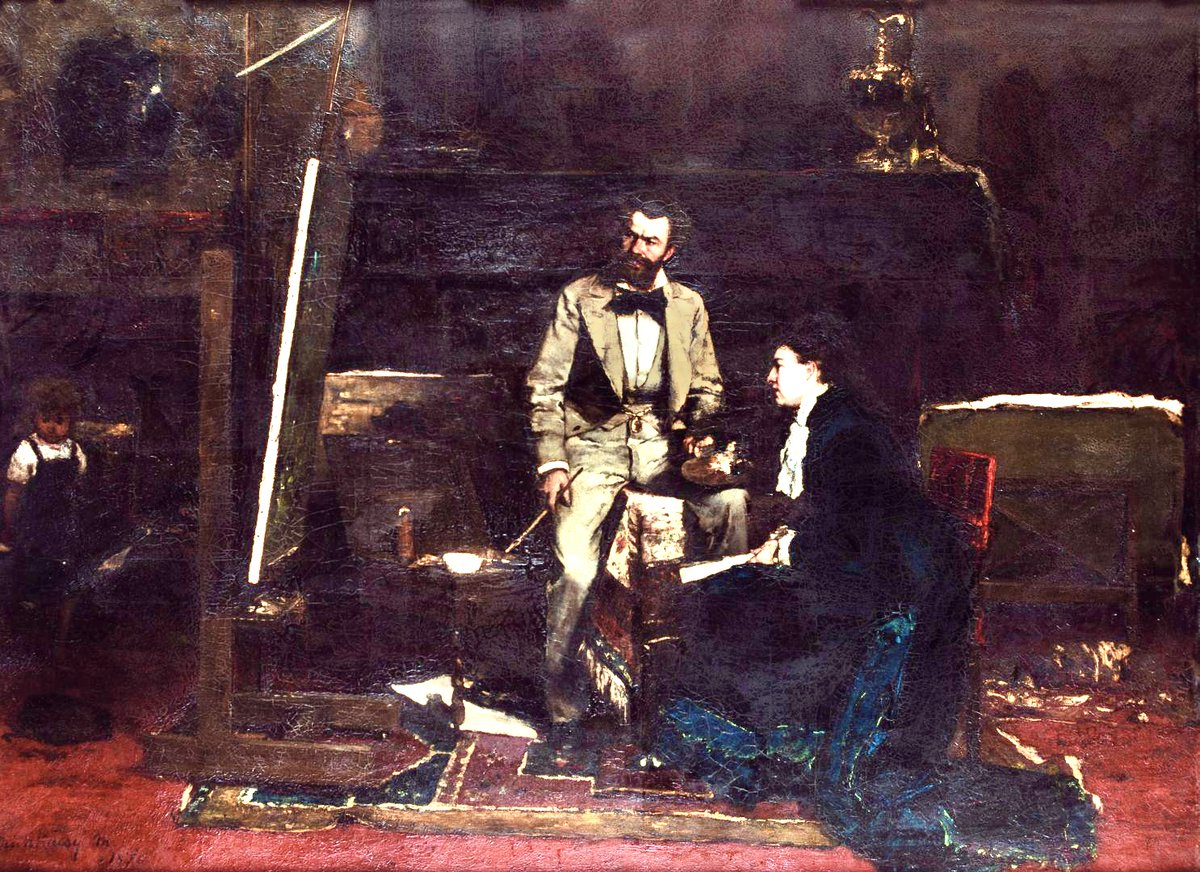
🧾🖼️Munkácsy’s In the Studio: A Herzog Palace Inventory Entry Hiding in Plain Sight?
Reel 145, Slide 514 records artworks from the Herzog Palace, Andrássy út 93, delivered to the Szépművészeti Múzeum/Museum of Fine Arts, Budapest during Hungary’s 1944 wartime seizure process.
Among the entries is a major work by Hungary’s most celebrated 19th-century painter:
Entry #5 — Munkácsy Mihály: Műteremben
Medium: oil on wood panel
Dimensions: 96 × 130 cm
Note: marked as “vázlat” — sketch/study
In English: Mihály Munkácsy, In the Studio, oil on panel, 96 × 130 cm, sketch/study.
This is not a vague description. It is a named Munkácsy studio scene, with title, support, dimensions, and object type.
🔎 The public artwork match
A closely corresponding work is publicly known today:
Mihály Munkácsy — Műteremben/In the Studio
Date: 1876
Medium: oil on wood panel
Dimensions: 96 × 131 cm
Collection: Hungarian National Gallery, Budapest
The overlap is striking: same artist, same title, same medium, same support, same subject, near-identical dimensions, and the same wartime museum destination. This is exactly the kind of match provenance researchers take seriously.
📜 Why the Herzog context matters
The Herzog Collection was one of Europe’s great private art collections. After Baron Mór Lipót Herzog died, the collection passed to his heirs, including Erzsébet Herzog. In 1944, as Hungary’s anti-Jewish persecution escalated under Nazi occupation and Hungarian collaboration, Herzog-family artworks were inventoried, sealed, moved, and absorbed into wartime custody systems.
Munkácsy’s In the Studio is not merely a strong research lead. It has been expressly discussed in the Herzog restitution litigation. U.S. court records identify Mihály Munkácsy’s In the Studio as a work that belonged to Erzsébet Herzog and was among the contested Herzog works in de Csepel v. Hungary.
Those records also describe the painting’s complicated postwar status. The 1944 inventory places the work in the wartime museum-custody pipeline. Later records discussed in the litigation indicate that In the Studio remained under Hungarian cultural control as a museum deposit for decades. A 1966 Hungarian government letter asked whether it and other Herzog works were in the museum’s possession; a 1973 Ministry of Culture letter treated the painting as having passed to the Hungarian state; and U.S. courts later analyzed whether claims involving this work could proceed in American court.
In January 2026, the D.C. Circuit affirmed dismissal on jurisdictional grounds. Press reporting later indicated that the Herzog heirs sought rehearing en banc. Whatever the final procedural posture, however, a jurisdictional ruling is not a provenance record.
That is the point. Legal procedure does not erase archival evidence. A court’s jurisdictional ruling does not substitute for full public disclosure of the museum file. The 1944 inventory, the postwar deposit history, and the museum’s current custody all need to be reconciled in public.
🏛️ The provenance question
For a work matching a Herzog Palace inventory entry this closely — and already discussed in major restitution litigation — the public should be able to see the complete chain of custody from 1944 onward.
That means:
• the 1944 intake and delivery documentation;
• the Museum of Fine Arts custody ledger;
• postwar re-inventory or transfer records;
• documentation of movement to the Hungarian National Gallery;
• deposit, restitution, settlement, compensation, or ownership determinations;
• verso photographs showing labels, stamps, and historic inventory marks; and
• all records explaining how the work was treated after seizure, after the war, and after later claims proceedings.
This is not a marginal object. It is a major Munkácsy work, tied to a major Jewish collection, listed in a wartime inventory from the Herzog Palace, and discussed in major restitution litigation.
⚖️ What transparency requires
HARI calls on the Magyar Nemzeti Galéria/Hungarian National Gallery, the Szépművészeti Múzeum/Museum of Fine Arts, Budapest, and the relevant Hungarian authorities to publish the full provenance file for Munkácsy Mihály’s Műteremben/In the Studio.
If the publicly known 1876 painting is the same work listed as Entry #5 on Reel 145, Slide 514, the public record should say so plainly. If Hungary maintains that it is not the same work, the museum should publish the documents proving the distinction.
Either way, the files exist. The public record should match them.
🧾 The question
In 1944, the Herzog Palace inventory listed Munkácsy Mihály: Műteremben, oil on wood panel, 96 × 130 cm, marked as a sketch/study. Today, a Munkácsy In the Studio is publicly known in the Hungarian National Gallery as oil on wood panel, 96 × 131 cm.
That creates a direct, document-answerable question: is this the same painting? If yes, the public provenance record should say so clearly and include the full file. If no, the museum should publish the documentation distinguishing the two works.
The history of the Herzog Collection cannot be resolved through closed files, partial catalogue entries, or jurisdictional rulings. Every object taken in 1944 deserves a transparent chain of custody, especially one tied this closely to a named inventory entry, a major Jewish collection, and decades of restitution litigation.
A legal ruling is not a provenance record. The museum file must be opened.
#HolocaustArtRecovery #HerzogCollection #MunkácsyMihály #Műteremben #HungarianNationalGallery #SzépművészetiMúzeum #ProvenanceResearch #art #Restitution #WashingtonPrinciples #HEARAct @WJRORestitution@nytimesarts@SCOTUSblog@WorldJewishCong@artlaw@brand_arthur@raydowd@Telexhu@HolocaustMuseum@USAmbHungary@marcorubio@CathyHickley@artnet@cnni@guardian@444hu
🖼️🔎 Tracing the Boy with a Pipe: From a Jewish Widow’s Home to a Modern-Day Auction Candidate
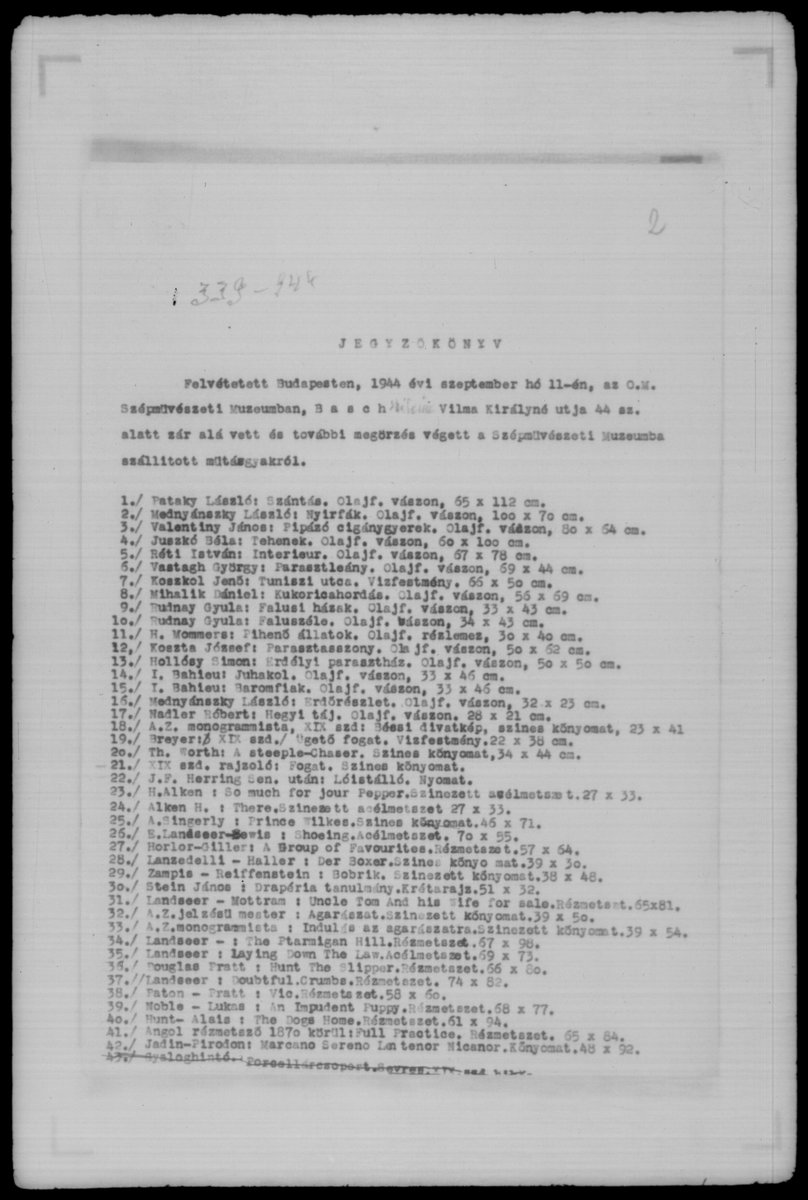
In June 1944, Hungarian authorities inventoried artworks taken from the Budapest apartment of Mrs. Béla Basch at Vilma királynő út 44. The resulting record — Szépművészeti Múzeum File 339/1944 — is part of the wartime paper trail showing how Jewish-owned cultural property was seized, catalogued, and moved into state-controlled custody under the language of “safekeeping.”
Among the works listed is Inventory #3:
Valentiny János: Pipás cigánygyerek
Oil on canvas, 80 × 64 cm
In English, the title means roughly “Romani Boy with a Pipe” or “Gypsy Boy with a Pipe.” The historical title uses a period ethnographic term. The subject — a young Romani figure — fits Valentiny’s "folk realist" genre-painting practice, which often depicted rural and Romani subjects with close attention to expression, costume, and everyday life.
🖼️ The Modern Market Candidate
A public Hungarian auction record shows a strikingly similar work:
Valentiny János — Pipázó fiú / “Boy Smoking a Pipe”
Oil on canvas, 80 × 64 cm
Signed lower left: “Valentiny J.”
The painting was offered by Nagyházi Galéria és Aukciósház in Auction 216 on 31 May – 1 June 2016, with a starting price of 480,000 HUF. Public market databases also preserve later references to a Valentiny Pipázó fiú with the same medium and dimensions.
2016 Nagyházi catalogue:
https://t.co/Ib5KUuYIP8
Műtárgy lot page:
https://t.co/h0zzg0vL5W
MutualArt reference:
https://t.co/6fe7ZMjQZa
🔎 Why This Candidate Matters
The overlap is unusually strong:
• Artist: Valentiny János — direct match
• Medium: oil on canvas — direct match
• Dimensions: 80 × 64 cm — exact match
• Subject: boy with a pipe — direct subject match
• Title drift: Pipás cigánygyerek → Pipázó fiú is entirely plausible
The wartime title is more specific: “Romani/Gypsy boy with a pipe.” The market title is shorter and more neutral: “Boy Smoking a Pipe.” That kind of title softening is common in later auction catalogues, especially where older descriptive titles used ethnic or socially charged terminology.
This is not yet final proof of identity. But it is a serious, document-based provenance lead. The match factors are too specific to ignore.
📜 The Gravity of File 339/1944
File 339/1944 is not a benign household list. It records the removal of artworks from a Jewish home in Budapest during the same period when Hungarian authorities were inventorying, sealing, and redirecting Jewish-owned cultural property into state-supervised channels.
That matters because restitution research is not limited to famous museum masterpieces. A modest genre scene can carry the history of a destroyed household. A painting does not need to be monumental to be stolen. It only needs to have been taken.
Here, the Basch file provides the wartime starting point. The 2016 auction record provides a possible modern market appearance. What remains missing is the chain between them.
⚖️ The Provenance Questions
@ArtRecoveryInit calls on Nagyházi Galéria és Aukciósház, later market participants, and any current holder of Valentiny János’s Pipázó fiú to disclose the full provenance for the work, including:
• pre-1944 ownership records;
• any reference to Mrs. Béla Basch, Vilma királynő út 44, or File 339/1944;
• postwar custody, transfer, sale, inheritance, export, or restitution documentation;
• auction-house intake records and consignor-provided provenance;
• high-resolution front and verso photographs;
• frame labels, stretcher markings, stamps, inventory numbers, or export notations; and
• any institutional correspondence involving the Szépművészeti Múzeum/Museum of Fine Arts, Budapest.
The public auction record does not appear to provide a complete wartime and postwar provenance. That gap matters because the 1944 Basch inventory identifies a Valentiny painting with the same artist, same subject, same medium, and same dimensions.
🧾 Restoring the Broken Chain
The question is direct:
Is the Pipázó fiú that appeared in the Hungarian market the same canvas listed as Inventory #3 in the 1944 Basch seizure file?
If no, the records showing a separate lawful provenance should be made public.
If yes, the painting’s history must be corrected, and the Basch family’s ownership must no longer be erased.
Every inventory line represents a life interrupted. Every recovered link in the chain brings history one step closer to justice.
#HolocaustArtRecovery #ProvenanceResearch #BaschCollection #ValentinyJános #Hungary #Restitution #WashingtonPrinciples #HEARAct
@WJRORestitution@nytimesarts@News24Arts@WorldJewishCong@hyperallergic@ProvenanceThe@HolocaustMI@schuhmacher@brand_arthur@raydowd@ncph@cnni@bbcarts@guardian@Adam_FineArt@LordFredericLe1@Jerusalem_Post
A 1944 SEIZURE RECORD, A 174 CM PAINTING, AND AN UNANSWERED QUESTION IN BUDAPEST 🕯️
📜 Sometimes the most important evidence is not a painting.
Sometimes it is a single sheet of paper.
On 5 October 1944, Hungarian authorities created File 308/1944, a record concerning artworks found in the apartment of photographer, educator, and collector József Pécsi and transported to the Museum of Fine Arts in Budapest.
The document’s operative language is significant:
📝 “Record concerning artworks found in the apartment of József Pécsi and transported to the Museum of Fine Arts.”
This is not merely an inventory.
It is documentary evidence linking specific objects to a transfer into the Hungarian museum system during the Holocaust era.
👤 WHO WAS JÓZSEF PÉCSI?
📸 József Pécsi (1889–1956) was one of Hungary’s pioneering photographers, teachers, and visual innovators. His studio on Dorottya Street helped shape generations of artists and photographers, while his collection reflected a deep engagement with European art and culture.
The surviving record provides direct evidence that artworks from his collection were removed and placed into state custody.
🔍 ITEM #5
Among the listed objects is an entry that appears to describe:
🎨 An oil painting
🧍 A composition featuring slender or standing figures (“karcsú alakos”)
📏 A principal measurement of approximately 174 cm
As with many wartime inventories, portions of the handwriting remain difficult to decipher and remain subject to further review.
🖼️ A POSSIBLE CANDIDATE
Following a review of publicly accessible museum records, one painting warrants further investigation:
Gillis Coignet (I) / Circle of Anthonie Blocklandt van Montfoort
“Diana Discovering Callisto’s Pregnancy”
Oil on canvas
103 × 174 cm
Museum of Fine Arts, Budapest
Inventory No. 59.2
The painting contains multiple standing and kneeling figures and shares the exact 174 cm dimension recorded in the inventory.
⚖️ IMPORTANT
This is not a confirmed identification.
At present, it is best understood as a research lead requiring further archival investigation.
The crucial question is not whether the dimensions align.
The crucial question is whether surviving museum records can establish where inventory no. 59.2 was located before, during, and immediately after 1944.
📂 THE MISSING PAPER TRAIL
To answer that question, researchers need access to:
• Museum accession files
• Wartime transfer records
• Ministry correspondence
• Internal inventory ledgers
• Conservation and provenance files
🏛️ A CALL FOR TRANSPARENCY
The Museum of Fine Arts, Budapest should review and publish archival materials relating to inventory no. 59.2 and to cross-reference the object against File 308/1944.
The record survived. The museum survived. Closing this gap isn't a matter of luck anymore—it’s a matter of transparency. ⚖️
#HolocaustArtRecovery #PécsiJózsef #ProvenanceResearch #WashingtonPrinciples #Restitution #MuseumTransparency #ArtLaw #CulturalHeritage #HEARAct
@WJRORestitution@nytimesarts
🏛️ A WINTER PASTEL, A 1944 DEPOSIT RECEIPT, AND AN UNRESOLVED PROVENANCE QUESTION
On 31 March 1944, shortly after the German occupation of Hungary, museum officials issued a receipt acknowledging the transfer of twelve artworks belonging to Dr. Béla Lázár into state custody.
Dr. Lázár was one of Hungary’s leading art historians, critics, museum professionals, and collectors. His scholarship helped shape the understanding of modern Hungarian art, yet his own collection became caught up in the machinery of wartime dispossession.
The receipt states:
“We have received the following 12 paintings belonging to Dr. Béla Lázár as a temporary deposit for exhibition purposes, without liability.”
Listed first on the document is:
🎨 Bernáth Aurél — Télitáj (Winter Landscape) — Pastel
After reviewing publicly available museum records, catalogues, exhibition histories, and known Bernáth works, the strongest currently identifiable candidate appears to be:
🖼️ Bernáth Aurél, Tél (Winter), 1929
🖍️ Pastel on cardboard
📏 70 × 100 cm
🏛️ Hungarian National Gallery (Magyar Nemzeti Galéria)
📋 Inventory No. 63.80 T
Hungarian National Gallery:
https://t.co/0vqjdHipSU
English version:
https://t.co/FxwtVNTNS3
🔍 WHY THIS CANDIDATE STANDS OUT
• Artist & Medium: The 1944 receipt identifies a Bernáth pastel. The National Gallery work is a Bernáth pastel.
• Title Alignment: Télitáj (“Winter Landscape”) and Tél (“Winter”) are closely related titles, consistent with the abbreviated cataloguing often seen when works moved from private collections into institutional records.
• Chronology: The work dates to 1929, during the period when Dr. Lázár was actively collecting major examples of modern Hungarian art.
• Institutional Pathway: The receipt documents transfer into the Hungarian museum system in 1944. Today, the strongest known candidate remains within Hungary’s national collection.
⚖️ THE PROVENANCE QUESTION
This is a strong candidate correspondence, not a confirmed identification.
Published National Gallery documentation indicates that inventory 63.80 T entered the collection through a 1963 purchase from Oszkár Köves.
That disclosure answers one question but raises several others:
• Was this pastel previously part of Dr. Lázár’s collection?
• If so, how did it move from wartime museum custody into private hands before the 1963 acquisition?
• Was restitution ever attempted after the war?
• What ownership history exists between the 1944 deposit receipt and the 1963 purchase?
• Do museum archives contain references to Dr. Béla Lázár, his heirs, or related wartime transfer records?
At present, publicly available records do not answer these questions.
📂 A CALL FOR TRANSPARENCY
The Holocaust Art Recovery Initiative calls upon the Hungarian National Gallery to publish the complete provenance history for inventory 63.80 T, including:
• Pre-1944 ownership documentation
• Wartime deposit records
• Postwar custody and restitution files
• Documentation relating to the 1963 acquisition from Oszkár Köves
• Any archival references to Dr. Béla Lázár or his heirs
Historical truth, scholarly integrity, and meaningful remembrance depend on transparent provenance research.
#HolocaustArtRecovery #BernáthAurél #LázárBéla #ProvenanceResearch #ArtRestitution #WashingtonPrinciples #HEARAct #MuseumTransparency #ArtLaw #CulturalHeritage
@WJRORestitution@nytimesarts@Telexhu
🏛️ THE HERZOG PALACE MADONNA
📜 A 1944 Holocaust Seizure Traceable to the Museum of Fine Arts, Budapest
In the summer of 1944, as Hungary’s Jewish families were being dispossessed, deported, and destroyed, Hungarian state authorities systematically confiscated the contents of the Herzog Palace at Andrássy út 93 in Budapest — one of Central Europe’s greatest private art collections.
A surviving wartime inventory from the collection of Mrs. Sándor Sváb (Irén Herzog) records 23 artworks removed from the palace and transferred to the Museum of Fine Arts “for safekeeping.”
🧾 Item #1 reads:
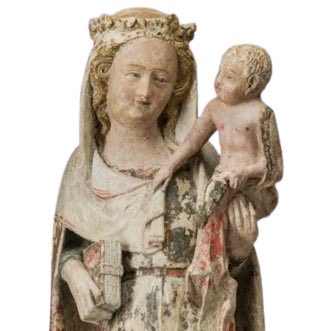
“French master, first half of the 14th century — Virgin and Child — limestone — 109 cm.”
Today, a strikingly corresponding object remains in the Szépművészeti Múzeum (Museum of Fine Arts, Budapest), Old Sculpture Collection:
🕊️ SCULPTOR FROM CHAMPAGNE (MARNE REGION)
Virgin and Child
c. 1350–1360
Limestone with traces of original polychromy
Museum inv. no. 61.5
Dimensions: 110 × 40 × 30 cm
Museum record:
https://t.co/jqYAKh12WN
🔎 ARCHIVAL ↔ MUSEUM CORRESPONDENCE
• Attribution
1944 inventory: “French master, first half of the 14th century”
Museum attribution: “Sculptor from Champagne (Marne region), c. 1350–1360”
• Material
Limestone ↔ limestone
• Dimensions
109 cm ↔ 110 cm
(an almost exact correspondence and entirely consistent with historical inventory measurement variance)
• Subject
Virgin and Child ↔ Virgin and Child
• Provenance chain
The museum’s own 2020 restoration documentation states that the sculpture entered the Herzog collection following the 1931 Marcell Nemes sale before later entering museum custody.
That provenance detail is critical.
The 1944 inventory originates directly from the Herzog/Sváb palace seizure. The museum’s own restoration research independently confirms the object’s Herzog collection history.
Together, the records create an exceptionally strong match candidate.
⚖️ THE PROVENANCE GAP
Despite this internal provenance evidence, the museum’s public-facing object page omits:
• the Herzog/Sváb ownership history
• the 1944 wartime seizure
• the transfer into state custody during the Holocaust era
• the provenance findings referenced in the restoration research
As of May 2026, the sculpture also remains officially categorized as “not on display.”
Under Principles II and III of the Washington Principles on Nazi-Confiscated Art — discovery and publication of relevant records and provenance information — these omissions matter.
🕯️ WHY THIS CASE MATTERS
This is not simply an attribution question.
It is a documented example of Holocaust-era cultural dispossession entering a state museum collection while the public provenance record remains incomplete.
The Herzog collection — together with the related Sváb, Weiss, Mautner, and Kornfeld holdings — represented one of the most important private collections in Europe. In 1944, those collections were systematically inventoried, sealed, crated, and dispersed under Hungarian state authority during the Holocaust.
Some objects disappeared abroad.
Others quietly remained in museum storage.
This limestone Madonna appears to be one of them.
📂 CALL FOR TRANSPARENCY
@ArtRecoveryInit calls upon the Museum of Fine Arts Budapest to:
• publish the complete provenance and accession history for inv. 61.5
• release all related wartime and postwar transfer documentation
• publicly acknowledge the Herzog/Sváb provenance history
• open the associated archival and restoration records connected to the 1944 seizure inventories
Transparency is not optional.
It is a scholarly, historical, and moral obligation.
#HolocaustArtRecovery #HerzogCollection #WashingtonPrinciples #Restitution #ProvenanceResearch #Hungary1944 #HEARAct
@nytimesarts@artnet
🧾🖼️ THE GRÜNWALD INVENTORY MATCH
A 1944 seizure record. A near-exact museum match. A provenance gap that must be answered.
On 22 August 1944, officials of the Kormánybiztosság — the Hungarian Government Commissariat administering so-called “abandoned” Jewish property — recorded artworks and objects from the collection of Róza Grünwald at:
III., Áfonya utca 3, Budapest
The document is not vague. It is a wartime inventory, typed and then corrected by hand. Item #1 identifies a Flemish battle painting that the document records as sent to the Szépművészeti Múzeum — the Museum of Fine Arts, Budapest.
🕯️ THE VICTIM: RÓZA GRÜNWALD
Róza Grünwald was a Jewish resident of Budapest whose private property was taken during the German occupation of Hungary and the Hungarian state’s systematic confiscation of Jewish assets.
Her name appears here not as an abstraction, but as the owner whose collection was inventoried, selected, and transferred.
These records are not just art-historical documents. They are records of dispossession.
🧾 THE 1944 INVENTORY ENTRY
Item #1 identifies:
Jan Pieter van Bredael the Younger
Csatajelenet — Battle Scene
Oil on canvas
59.5 × 75 cm in the handwritten correction
The same inventory page records that the listed objects were sent to the Szépművészeti Múzeum for safekeeping.
🏛️ THE MUSEUM RECORD TODAY
Today, the Szépművészeti Múzeum lists:
Jan Peeter van Bredael the Younger
Csatajelenet
Oil on canvas
59 × 75 cm
Inventory no. 4262
Monogrammed “JPB” on the stumbling white horse, lower left
Current status: not on public display
Museum record: https://t.co/qD0IEm37TC
The Szépművészeti Múzeum’s catalogue page provides no pre-1944 provenance and does not explain how the painting entered the museum collection.
🧩 WHY THE MATCH MATTERS
The match is not subtle.
The artist matches.
The title matches.
The medium matches.
The institutional path matches.
And the dimensions are a near-exact match: 59.5 × 75 cm in the 1944 handwritten correction; 59 × 75 cm in the museum record. A half-centimeter difference is exactly the kind of rounding or measuring variation expected between a wartime inventory and a modern museum catalogue.
The handwritten measurement is worth a close look. On the inventory page, the ink appears to fade through the 9 and the decimal point, while the writer used a harder, darker stroke for the following “5 ×”. Read against the other handwritten numerals on the same page, the first dimension reads as 59.5, not 54.5 — making the museum dimensions a near-exact match.
The museum record also adds another key identifying detail: the work is monogrammed “JPB” on the stumbling white horse, lower left — a detail consistent with the identified artist and the specific painting now listed as inventory no. 4262.
Just as important, the museum’s public collection search does not show another work by Jan Peeter van Bredael the Younger that could plausibly correspond to item #1. The public candidate set appears to be one painting: Csatajelenet, inventory no. 4262.
📍 THE INSTITUTIONAL PATH
The 1944 document says the painting was sent to the Szépművészeti Múzeum.
The museum still lists a matching painting today as inventory no. 4262 in its Old Masters collection.
That is the point modern provenance research is supposed to confront.
The paper trail did not vanish.
It survived.
And here, that paper trail leads from a 1944 seizure inventory to a named painting in Hungary’s national museum collection.
⚖️ THE PROVENANCE GAP
The museum’s public catalogue identifies the artist, title, medium, dimensions, inventory number, signature detail, and current display status.
What it does not publicly provide is the ownership history explaining how a painting recorded in the Grünwald seizure inventory became inventory no. 4262 in the Old Masters collection.
That gap matters historically, legally, and morally.
🌍 THE STANDARD
Under the Washington Conference Principles, museums and governments are expected to identify Nazi-confiscated art, open relevant archives, publicize what they find, and work toward just and fair solutions.
That is all this case requires:
Transparency. Records. Accountability.
📚 THE DOCUMENT REQUEST
The Szépművészeti Múzeum should publish the full provenance file for this painting, including:
• the 1944 intake or deposit record;
• internal inventory and movement entries;
• postwar custody documentation;
• accession, retention, or transfer paperwork;
• any correspondence or restitution review concerning the Grünwald collection; and
• any verso, frame, label, stamp, conservation, or photographic documentation connecting inventory no. 4262 to wartime custody.
This is a document-answerable case.
The 1944 record exists.
The museum object exists.
The history between them should be public.
🕯️ For Róza Grünwald, and for every family whose property was taken into archives, storerooms, and museum collections without a public accounting, the work of restitution begins with the truth.
#HolocaustArt #Restitution #ProvenanceResearch #Szepmuveszeti #HEARAct #WashingtonPrinciples
@WJRORestitution@nytimesarts@artnet@raydowd@ArtHistoryProf@artcrime2@UNESCO@Israel@brand_arthur@CathyHickley@jerrysaltz@DanaArschin@NicholasMOD@artrecovery@vaudetar@SenBlumenthal@RepLaurelLee@Telexhu@CombatLooting@menachemkaiser@GeertJanJansen@jaredkushner@magyarpeterMP@USAmbUN@USAmbHungary@CarolineGlick@bariweiss
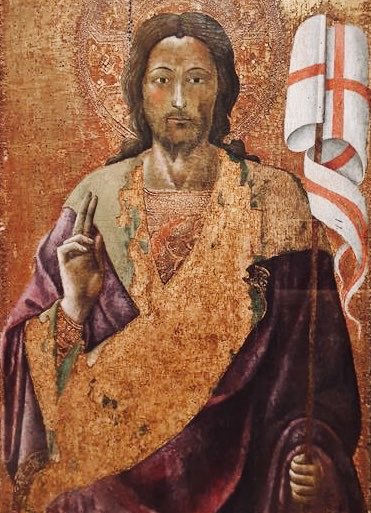
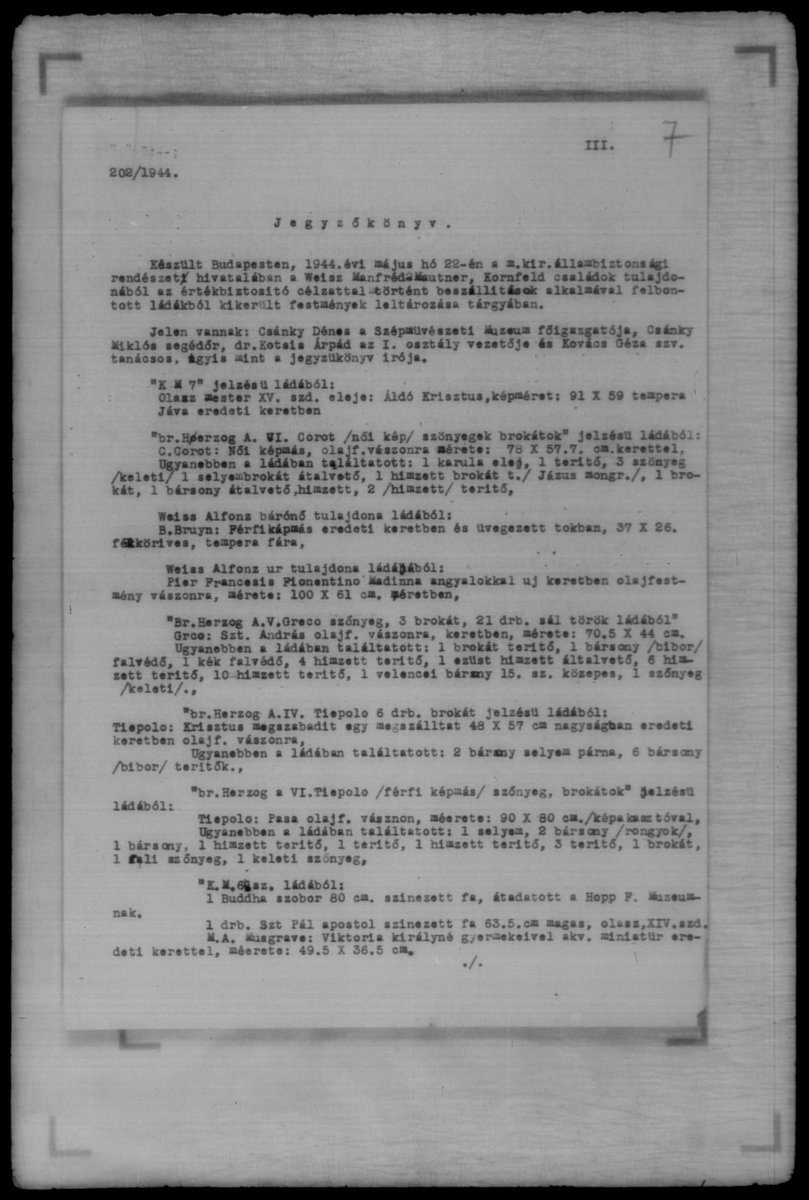
🏛️ THE “BLESSING CHRIST” CASE FILE — FROM A 1944 HOLOCAUST SEIZURE CRATE TO BUDAPEST’S MUSEUM OF FINE ARTS
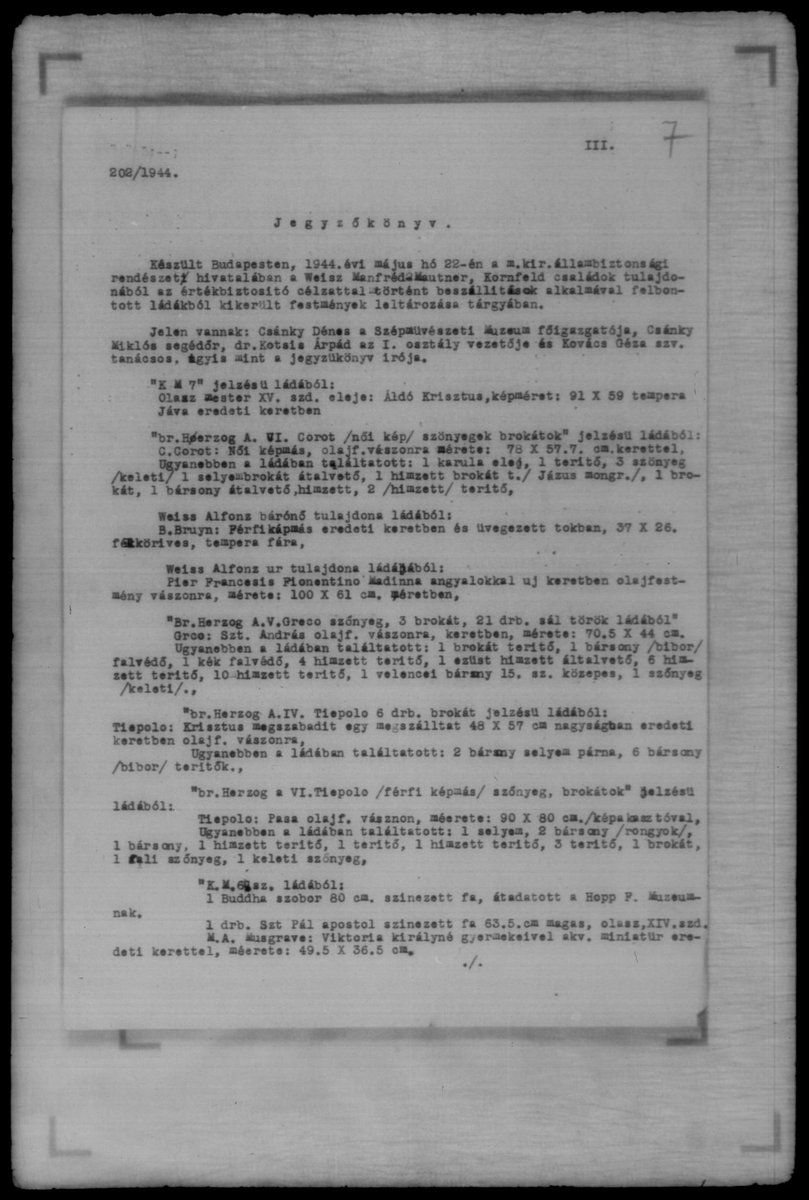
📜 On May 22, 1944, amid the systematic dispossession and destruction of Hungary’s Jewish community, the Budapest State Security Police compiled protocol 202/1944 K.B. — a bureaucratic inventory documenting artworks removed from the interconnected Herzog, Weiss, Mautner, and Kornfeld collections, among the most important private art holdings in Central Europe.
Within the inventory for crate “K M 7” appears the following entry:
“Olasz Mester XV. szd. eleje: Áldó Krisztus, képméret: 91 × 59, tempera, jó eredeti keretben.”
(“Italian Master, early 15th century: Blessing Christ. Painted surface: 91 × 59 cm. Tempera, in good original frame.”)
Eighty years later, a strikingly corresponding Renaissance panel remains in the collection of the Szépművészeti Múzeum (Museum of Fine Arts, Budapest).
🖼️ THE MODERN MUSEUM OBJECT
Alvaro Pirez d’Évora
(Portuguese-born painter active in Italy, ca. 1410–1434)
Title: A feltámadt Krisztus (“The Risen Christ” / “Risen Christ Blessing”)
Inventory no.: 51.801
Date: ca. 1430–1435
Medium: Tempera and gold on ash wood panel
Painted surface: 90.5 × 59.6 cm
Museum records:
Hungarian: https://t.co/WhBhA9Hbnn
English: https://t.co/rUpgQJtKum
📊 THE EVIDENCE OF CORRESPONDENCE
This is not simply a general thematic similarity. Multiple archival and physical identifiers converge with unusual precision:
• Dimensions:
1944 protocol: 91 × 59 cm
Museum painted surface: 90.5 × 59.6 cm
(a variance of millimeters consistent with wartime handwritten inventories versus modern cataloguing standards)
• Subject & iconography:
1944 inventory: “Áldó Krisztus” (“Blessing Christ”)
Museum title: “The Risen Christ” depicted in blessing gesture before a gold ground
• Medium & format:
Both records describe an early Renaissance tempera devotional panel
• Chronology & attribution:
1944 protocol: “Italian Master, early 15th century”
Museum attribution: Alvaro Pirez d’Évora, active in Italy ca. 1410–1434
• Collection context:
Published museum scholarship references prior association with the Sammlung Moritz Kornfeld (Budapest) — directly overlapping the same confiscation network documented in protocol 202/1944 K.B.
Taken together, these factors create one of the strongest unresolved correspondence profiles yet identified within the surviving 1944 seizure archives.
👤 THE FAMILIES BEHIND THE COLLECTION
The Herzog, Weiss, Mautner, and Kornfeld families stood at the center of Hungary’s cultural and industrial life before the Holocaust. Their collections contained Renaissance panels, Old Masters, sculpture, decorative arts, and major modern works.
In 1944, these collections were systematically inventoried, sealed, transferred, and absorbed into state-controlled custody under the euphemistic language of “protective safeguarding.”
Protocol 202/1944 K.B. survives as evidence of that cultural destruction.
🕯️ THE PAINTING
Alvaro Pirez d’Évora — also known as Álvaro di Pietro — was a Portuguese-born painter active in Tuscany during the early Renaissance.
The painting depicts the standing Christ in blessing posture against a luminous gold background and may once have formed part of a larger devotional ensemble or altarpiece.
Museum curator Dóra Sallay has published research on the work in the 2020 exhibition catalogue Alvaro Pirez d’Évora: A Portuguese Painter in Italy on the Eve of the Renaissance.
⚖️ THE PROVENANCE GAP
The Szépművészeti Múzeum’s public entry for inv. 51.801 currently omits:
• the 1944 confiscation protocol
• Holocaust-era seizure and ownership history
• wartime custody records
• the object’s transfer pathway into museum holdings
No public record has yet been identified naming this specific work in the ongoing Herzog restitution litigation.
The convergence of match factors makes this one of the most significant unresolved cases identified to date from protocol 202/1944 K.B.
🖼️ A RENAISSANCE MADONNA, A 1944 SEIZURE RECORD, AND THE HERZOG COLLECTION
📜 Newly reviewed archival protocol 202/1944 K.B. (Budapest State Security Police, dated 22 May 1944) documents artworks removed from the Weiss, Kornfeld, and Herzog family properties during the Holocaust in Hungary.
The evidence — preserved at the @HolocaustMI — inventories paintings and objects transferred under the bureaucratic framework of wartime “safekeeping” and state control.
Among the recorded entries appears:
“Pier Francesis Fiorentino Madonna angyalokkal…”
(“Pier Francesco Fiorentino — Madonna with Angels”)
Oil on canvas, 100 × 61 cm
The entry is associated with the Weiss/Herzog collection network connected to the Andrássy út palace holdings in Budapest.
🖼️ CORRESPONDING MUSEUM OBJECT
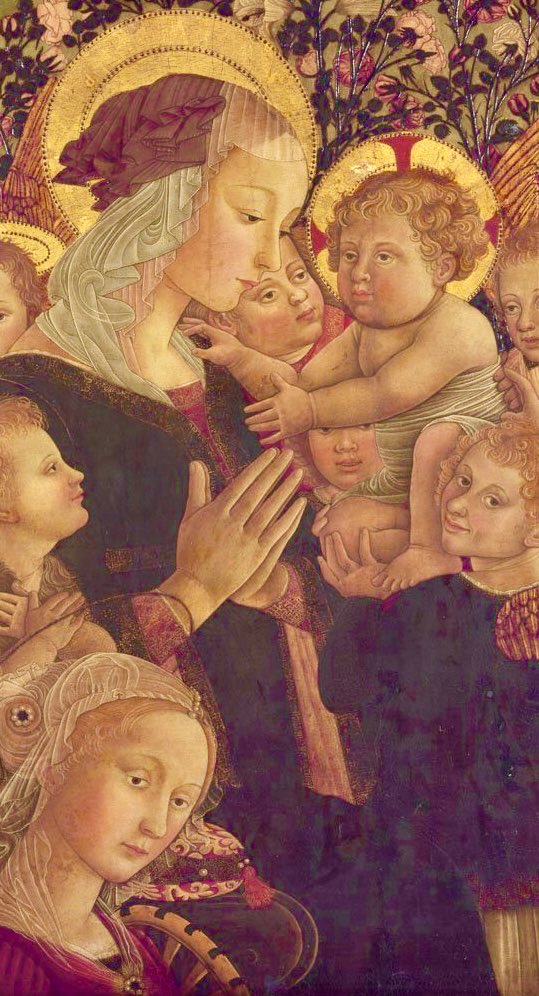
A closely corresponding painting is currently held by the Szépművészeti Múzeum (Museum of Fine Arts, Budapest):
Title: Madonna and Child with Saint Catherine of Alexandria, the Infant Saint John the Baptist and Five Angels
Artist designation: Lippi-Pesellino Imitator (Pseudo-Pier Francesco Fiorentino)
Date: Second half of the 15th century, Florence
Medium: Tempera, gold, and oil on canvas (transferred from wood panel)
Dimensions: 99 × 60.5 cm
Museum inventory no.: SzM. 50.752
Museum record:
https://t.co/Vos8hAynFH
📊 OBSERVED CORRESPONDENCE
• Protocol entry attribution: “Pier Francesco Fiorentino”
• Museum attribution: Pseudo-Pier Francesco Fiorentino / Lippi-Pesellino Imitator
• Subject matter: Madonna with angels / Renaissance devotional composition
• Dimensions:
Protocol: 100 × 61 cm
Museum object: 99 × 60.5 cm
• Institutional context: consistent with 1944 wartime transfers into Hungarian museum custody
The dimensional variance falls within the range commonly encountered between wartime handwritten inventories and modern museum cataloguing precision.
Taken together, these identifiers support a strongly corresponding object profile warranting full provenance clarification and archival review.
👤 THE HERZOG AND WEISS FAMILIES
The Herzog Collection — assembled by Baron Mór Lipót Herzog and connected through family relationships to the Weiss and Kornfeld families — was among the most significant private art collections in Central Europe.
During the Holocaust in Hungary, artworks from these collections were systematically inventoried, seized, and transferred into state-controlled repositories and museums under anti-Jewish wartime policies.
🕯️ THE PAINTING
The “Lippi-Pesellino Imitator” designation is used by art historians for an anonymous Florentine painter or workshop working in the stylistic tradition of Fra Filippo Lippi and Francesco Pesellino.
The composition depicts the Virgin Mary with the Christ Child, Saint Catherine of Alexandria, the infant Saint John the Baptist, angels, and attendant saints within a devotional Renaissance landscape.
The museum notes that the work was transferred from wood panel to canvas — a conservation process often undertaken with older Renaissance paintings.
⚖️ LITIGATION AND PROVENANCE STATUS
This painting was included within the broader de Csepel v. Republic of Hungary litigation concerning Holocaust-era seizures from the Herzog collection and works presently held in Hungarian state museums.
At present, the museum’s public object record does not identify:
• the 1944 seizure protocol
• Holocaust-era confiscation history
• postwar transfer pathway
• accession circumstances following wartime seizure
The protocol page also references additional objects linked to the same confiscation process, including works attributed to Corot, Tiepolo, Bruyn, and objects transferred to other Hungarian institutions.
🧾 WHY THIS CASE MATTERS
Protocol 202/1944 K.B. directly connects Holocaust-era confiscation records to present-day museum holdings. Reconstructing these provenance histories is essential for transparency, historical accuracy, and meaningful restitution.
#HEARAct
🖼️ HATVANY COLLECTION — 1944 SEIZURE INVENTORY #63 AND A CORRESPONDING PANEL IN THE MUSEUM OF FINE ARTS, BUDAPEST
📜 Entry #63 from the 1944 Hatvany Ferenc seizure inventory (Budapest villa list, page 2) records:
“Ismeretlen festő 1500 körül. Szűz Mária halála. Fa, olaj, 93 × 71.”
(English: Unknown painter, circa 1500 — Death of the Virgin Mary. Oil on wood panel, 93 × 71 cm.)
The work was inventoried during the systematic wartime seizure of Baron Ferenc Hatvany’s collection following the German occupation of Hungary in 1944.
🖼️ CORRESPONDING MUSEUM OBJECT
A closely corresponding panel currently held by the Szépművészeti Múzeum (Museum of Fine Arts, Budapest — Old Masters’ Gallery) appears under the title:
“Mária halála” (“Death of the Virgin”)
Anonymous master, South Tyrolean school, c. 1480–1490
Museum record:
https://t.co/TPHBhGfNUJ
Collection inventory no.: 82.5
Museum status: not currently on public display.
📊 OBSERVED CORRESPONDENCE
• Subject/title: Death of the Virgin / Mária halála — direct thematic correspondence
• Attribution: “Unknown painter around 1500” aligns with anonymous South Tyrolean school attribution, c. 1480–1490
• Medium/support: oil on wood panel (fa, olaj / olaj, fenyőfa — oil on pine wood) — consistent
• Dimensions:
1944 inventory: 93 × 71 cm
Museum object: 92.9 × 70.4 cm
The sub-centimeter variance is consistent with differences between wartime inventory rounding and modern museum cataloguing precision, particularly for historic wood panels with edge and frame measurement variation.
Taken together, these identifiers form a highly corresponding object profile warranting full provenance clarification and archival review.
👤 BARON FERENC HATVANY
Baron Ferenc Hatvany was one of Hungary’s most important Jewish collectors and patrons of the arts. His Budapest residence on Andrássy út contained Old Masters, modern Hungarian paintings, and works from major European schools.
During the Holocaust-era confiscations of 1944, the collection was systematically inventoried and transferred into state-controlled custody. Significant portions of the collection were later dispersed, transferred, or absorbed into museum holdings during and after the war.
🕯️ THE PANEL
The museum attributes the work to an anonymous South Tyrolean master active in the late 15th century. The composition depicts the Dormition / Death of the Virgin Mary, surrounded by mourning Apostles while Christ receives the Virgin’s soul — a devotional theme characteristic of late Gothic Central European painting.
The work is catalogued in the museum’s Old Masters’ Gallery Summary Catalogue, Vol. III.
⚖️ PROVENANCE STATUS — OPEN QUESTIONS
The museum’s public object page does not presently provide:
• acquisition date
• wartime transfer history
• accession pathway
• post-1944 custody history
• reference to the Hatvany seizure inventory
The museum website further notes that information relating to the object may change as research continues.
No public litigation or restitution claim specifically tied to SzM inventory no. 82.5 has been identified in currently available records, although broader restitution efforts involving the Hatvany collection and Hungarian state institutions are well documented.
🧾 WHY THIS ENTRY MATTERS
Inventory #63 demonstrates how wartime seizure records, museum collections, and surviving objects can be connected through converging physical and descriptive identifiers across time.
Cases of this kind underscore the continuing importance of transparent provenance research, institutional disclosure, and archival access in reconstructing Holocaust-era ownership histories.
#HolocaustArtRecovery #HatvanyCollection #ProvenanceResearch #Restitution #WashingtonPrinciples #HungarianArt #SzépművészetiMúzeum #NaziLootedArt #HEARAct
@WJRORestitution@NaziLootedArt@brand_arthur@marcorubio@JohnCornyn@RepLaurelLee@RepJerryNadler@nytimesarts@raydowd@NicholasMOD
🖼️ RADÓCZY FAMILY INVENTORY — MAGYAR-MANNHEIMER “KOLDUSBARÁT” AND LATER AUCTION RECORD
📜 On November 25, 1944, Hungarian police transferred 143 items from the Radóczy family residence at Budapest II., Pálffy tér (Pálffy Square) to the Szépművészeti Múzeum (Museum of Fine Arts, Budapest).
📂 The associated inventory, preserved on Reel 145 of the Hungarian Holocaust-era microfilm collection (Zekelman Holocaust Center), documents the systematic confiscation and state processing of Jewish-owned cultural property.
Among the entries appears:
No. 131 — Magyar Mannheimer: Koldusbarát (“Friend of the Beggar” / “Begging Friar”). Oil on paperboard, 19 × 39 cm.
🖼️ RELATED AUCTION RECORD (2018)
https://t.co/s2ewlJ1qjL
A painting by Gusztáv Magyar-Mannheimer titled Koldus barát was offered as Lot 338 in Nagyházi Galéria’s auction “Régi mesterek, 19. századi művészek” (Budapest, 28 May 2018):
• Oil on cardboard (olaj, karton)
• 19 × 38.5 cm
• Signed lower left: “Magyar Mannheimer G.”
• Includes Nemzeti Szalon (National Salon) exhibition label No. 152, with additional historic label fragments
📊 OBSERVED CORRESPONDENCE (ARCHIVAL SUMMARY)
• Inventory No. 131 corresponds to Koldusbarát entry
• Title: consistent across archival and auction records
• Medium: oil on cardboard/paperboard — consistent
• Dimensions: 19 × 39 cm (1944 inventory) vs. 19 × 38.5 cm (2018 auction listing), a minor variance consistent with historical measurement rounding and cataloging practices
• Attribution: consistent to Gusztáv Magyar-Mannheimer in both records
• Exhibition label reference (Nemzeti Szalon No. 152): present in auction documentation
Taken together, these identifiers form a strongly corresponding object profile based on multiple converging characteristics, pending full provenance reconstruction.
🧑🎨 THE ARTIST
Gusztáv Magyar-Mannheimer (1859–1937), born in Pest to a Jewish family, studied in Budapest, Vienna, and Munich. He exhibited at the National Salon and became known for sensitive genre scenes and depictions of everyday life in late 19th–early 20th century Hungary.
👪 THE RADÓCZY FAMILY
The Radóczy family were Jewish residents of Budapest’s II. district. Their documented collection was seized in late 1944 under Arrow Cross-era administrative authority. Reel 145 reflects the structured inventorying and transfer of confiscated cultural property into state custody during the final phase of wartime administration.
⚖️ PROVENANCE STATUS — OPEN QUESTIONS
Based on currently available documentation, several areas remain to be clarified:
• Full post-1944 chain of custody following transfer into museum holdings
• Whether and when the work left institutional custody
• Context of the Nemzeti Szalon (National Salon) label (No. 152) within pre-war exhibition history
• Degree of Holocaust-era provenance disclosure in later auction catalog descriptions
This case represents a high-probability correspondence between a 1944 confiscation entry and a later market appearance, with remaining gaps in postwar custody history requiring further archival verification.
🧾 SIGNIFICANCE
Reel 145 illustrates how wartime inventories and later auction records can intersect through shared identifying features across time.
This entry underscores the importance of complete provenance chains in confirming object identity with institutional certainty, and the continuing need for transparent reconstruction of wartime-era ownership histories.
#HolocaustArtRecovery #ProvenanceResearch #RadóczyFamily #MagyarMannheimer #Restitution #ArtHistory #HEARAct
@WJRORestitution@HolocaustMI@NaziLootedArt@nytimesarts@USAmbHungary@marcorubio
🕯️ PROVENANCE QUESTION: Dr. Ágai Béla’s 1944-Looted Michelangelo Kunstwart Portfolios
📌 The case at a glance: Dr. Ágai Béla, a Budapest physician, writer, and art collector, was deported to Auschwitz in 1944 and murdered there. His apartment at Kmetty utca 31 was sealed by the Hungarian Government Commissioner for Jewish Affairs. Among the cultural property removed from his home was a rare two-part Michelangelo portfolio set connected to Der Kunstwart, the influential German arts and culture publication.
What happened to Ágai’s library was not vague wartime “loss.” It was documented state seizure. Hungarian authorities catalogued his books and portfolios, signed for them, and transferred them into national institutions through official paperwork that survives today.
📜 The 1944 Archival Record
Reel 144, Slide 685, Entry 393 at @HolocaustMI records:
“Michelangelo Mappe des Kunstwarts. I. Die Hauptbilder der Sixtinadecke, II. Die Propheten und Sibyllen. Papirmappában 2 db.”
In English: Michelangelo, Kunstwart portfolios. Vol. I: The principal images of the Sistine ceiling. Vol. II: The Prophets and Sibyls. In paper portfolios/folders. Two items.
The 1944 inventory identifies the object with unusual precision: owner, title, subject, two-part structure, Sistine Chapel contents, and physical format. This is exactly the kind of specificity provenance researchers look for.
🖼️ Where are the Ágai portfolios now?
Independent research has identified only two known Hungarian public-collection copies matching this specific Michelangelo Kunstwart portfolio set, including copies held by:
National Széchényi Library, Budapest (Országos Széchényi Könyvtár) — Hungary’s national library.
Museum of Fine Arts, Budapest Library (Szépművészeti Múzeum Könyvtára) — the library of Hungary’s major state fine-arts museum.
That creates a direct provenance question for both institutions:
Are the Michelangelo Kunstwart portfolios now held in your collections the same portfolios seized from Dr. Ágai Béla’s apartment in 1944?
🔎 The burden is on the holding institutions
The surviving records establish that Dr. Ágai owned this specific two-part Michelangelo Kunstwart portfolio set and that it was removed through the wartime state-seizure process. Under the Washington Principles on Nazi-Confiscated Art, museums and public institutions are expected to identify Nazi-confiscated art, research gaps in provenance, and pursue just and fair solutions. That responsibility cannot depend on heirs or outside researchers doing all the work.
The burden now falls on the holding institutions to publish full acquisition documentation showing that their copies were acquired through legitimate prewar or postwar channels — and are not the Ágai portfolios.
A vague notation of “old collection,” “prewar holdings,” “unknown acquisition,” or “no information available” is not enough. Full transparency requires disclosure of accession records, shelf records, transfer documentation, wartime intake files, institutional correspondence, ownership markings, stamps, ex libris evidence, and post-1944 cataloguing notes connected to these copies.
⚖️ Why this matters
These are not anonymous art books sitting quietly in library stacks. They are potentially documented stolen cultural property from a Holocaust victim whose library was inventoried, removed, and absorbed into the Hungarian state system in 1944.
The pattern is familiar across these reels: named Jewish owners, exact inventories, official signatures, institutional transfers, and cultural property disappearing into state collections. Dr. Ágai Béla’s Michelangelo portfolios give us a precise test case. The archival record names the owner. It names the object. It identifies the two parts and the subject matter. It shows the state seizure process at work.
Now the holding institutions must answer the provenance question plainly:
Are these the Ágai portfolios?
If not, publish the records proving it.
Transparency is not optional in Holocaust-era provenance research. It is the minimum obligation owed to victims whose collections were taken, catalogued, and redistributed under color of law.
The archive has already spoken clearly. It is time for the institutions to do the same.
#HolocaustArtRecovery #ProvenanceResearch #LootedArt #Restitution #Michelangelo #Kunstwart #HungarianMuseums #WashingtonPrinciples #HEARAct
@WJRORestitution@ClaimsCon@yadvashem@HolocaustMuseum@USAmbHungary@nytimesarts@artnet@WorldJewishCong@SenBlumenthal@RepLaurelLee@marcorubio@UNESCO@nytimesbooks@ahistoryinart@brand_arthur@raydowd@mediciproject@JewishCurrents@JewishJournal@AuschwitzMuseum@RepJerryNadler
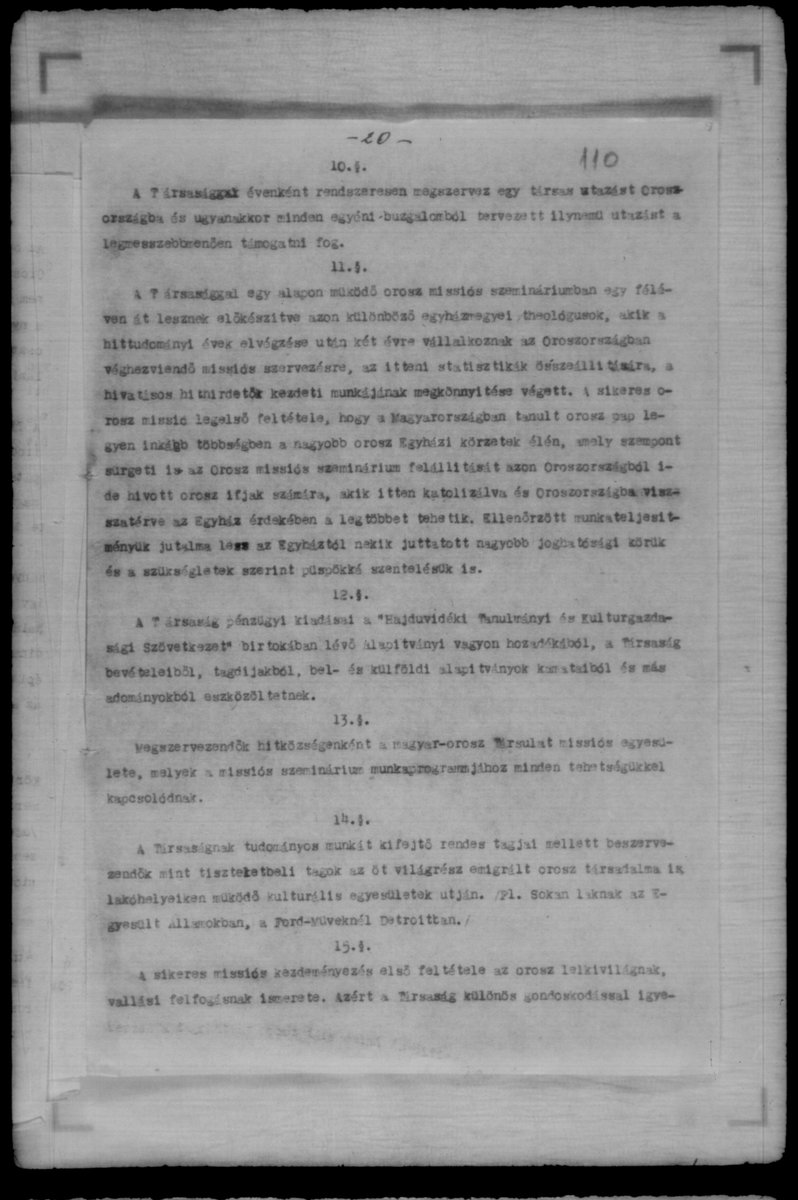
🚗🏭 Detroit, Ford, and the Ideology Behind the Inventories
Not a Missing Painting — Something More Disturbing
Reel 144, slides 530–556 do not list a missing painting. They reveal something else: the ideological machinery surrounding Hungary’s 1944 seizure bureaucracy.
The document proposes a “Hungarian General Cultural-Economic Association” named after P. Bíró Ferenc S.J., a major Hungarian Jesuit organizer. His ideas are invoked to argue that Catholics must enter — and reshape — business, finance, factories, banks, hotels, schools, shops, publishing, and public economic life. On the surface, it sounds like economic renewal. The reality is much darker.
⚠️ Economic “Renewal” as Replacement
Earlier pages in the same file portray Jews as controlling Hungarian wealth, commerce, the press, art, literature, fashion, entertainment, and culture. The proposed solution was not coexistence. It was replacement: a Christian-national economic order designed to push Jews out of public, commercial, and cultural life.
That is why these pages matter for Holocaust art recovery. Before there were inventories, there was ideology. Before Jewish artworks were reported, sealed, removed, and stolen, Jewish property had already been recast as a “national problem.” Once that lie became official state policy, mass theft could be disguised as administration.
🌍 The Unexpected Detroit Line
Then the file takes an unexpected turn. The author proposes a Hungarian-Russian Scientific Society to study Russian language, psychology, church history, and émigré networks for future Catholic mission work.
And in §14, one sentence jumps off the page: many Russian émigrés, the document says, lived in the United States — specifically, “at the Ford works in Detroit.” 🚗🏭🇺🇸
This does not make it a Ford art-looting file. It does something subtler: it places Detroit and Ford’s industrial world inside the imagination of a wartime Hungarian Catholic-national network.
🏛️ The Michigan Irony
And here lies the historical irony. Eighty years later, the truth hidden in these Hungarian records is being brought to light in Michigan.
Clara Garbon-Radnoti — a Hungarian Holocaust survivor, archivist, translator, and co-founder of the Holocaust Art Recovery Initiative — made her life in Michigan. She spent years analyzing these wartime Hungarian microfilms at what is now the @HolocaustMI in Farmington Hills.
The wartime document looked toward Detroit’s Ford works as part of a global network of influence. Today, HARI works from Michigan ito expose the paper trail, restore memory, and recover the truth.
🔍 The Real Michigan Connection
🗺️ Detroit appears unexpectedly in wartime Hungarian files.
🚗 Ford’s factories appear as a point of reference in a 1944 transnational plan.
🕯️ Clara Garbon-Radnoti survived the Holocaust and built her life in Michigan.
🏛️ The Zekelman Holocaust Center preserved the microfilm reels.
📜 HARI was founded in Michigan to expose what the 1944 bureaucracy tried to bury.
The art-seizure files are not just about objects. They are about the worldview that made seizure possible — and the survivors, archivists, and advocates who refuse to let that worldview have the last word.
Theft was preceded by theory. Restitution begins by exposing both.
#HolocaustArtRecovery #ProvenanceResearch #ArtRestitution #Detroit #WWIIHistory #ArchivalDiscoveries #HARI #HEARAct #HenryFord
@WJRORestitution@HolocaustMuseum@USAmbHungary@CohnHaddow@hnlupovitch@jfederations@WorldJewishCong@Pontifex@BCCAntisemitism@antisemitism@StandWithUs@NYCCTaskForce@HolocaustUK@UNHOP@NaziLootedArt@NewsHourArts@nytimesarts@artnet@_Auto_History_@edbolian@Yair_Rosenberg@skestenbaum@pawel_sawicki@AuschwitzMuseum@yadvashem@HistoricDetroit@DHSDetroit@SHDetroit@DrHelenFry@aroberts_andrew@SpitfireFilly@authordlewis@RealTimeWWII@HardcoreHistory@WW2Facts@DavidKertzer@geraldposner@yahadinunum@ncph
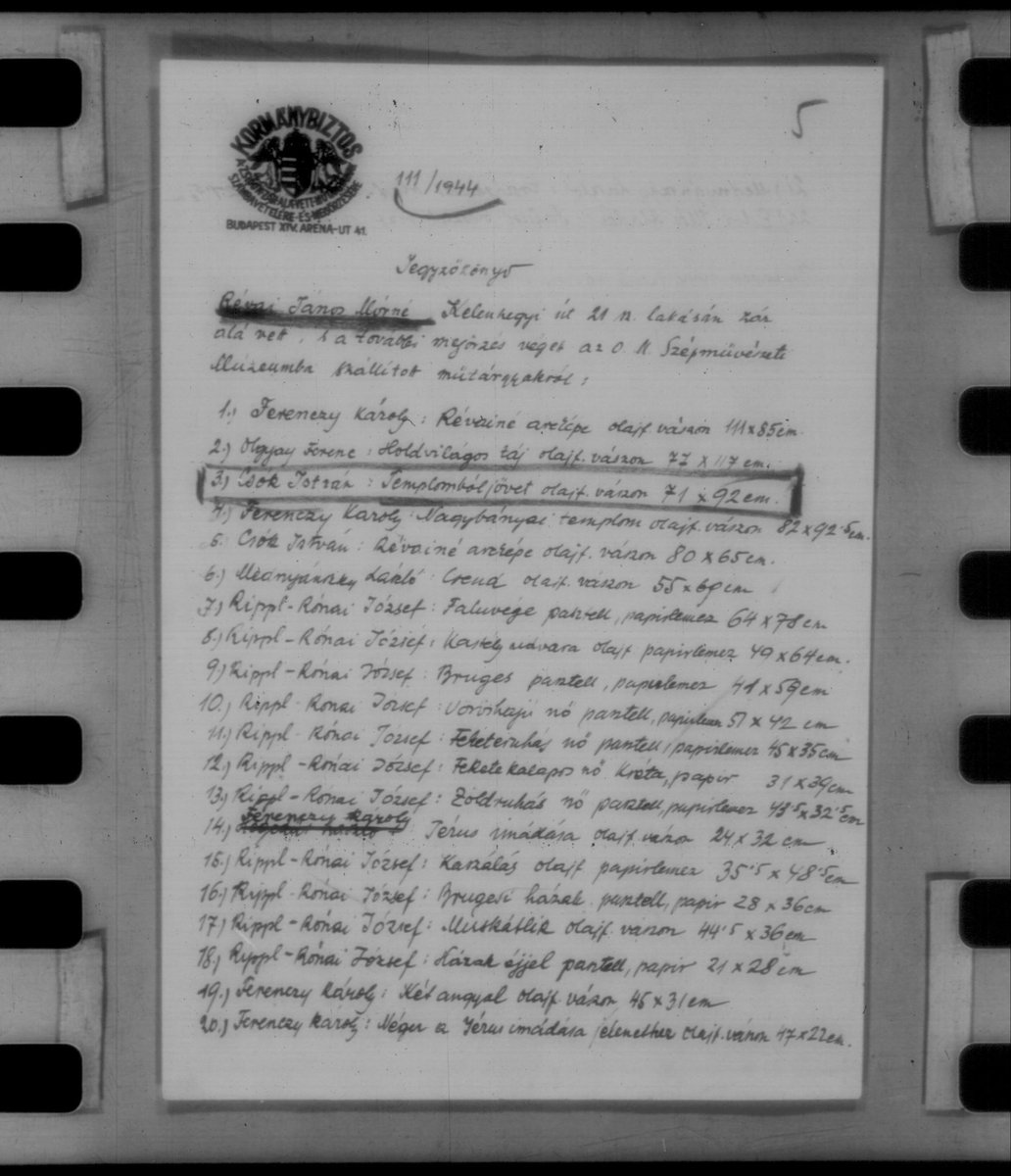
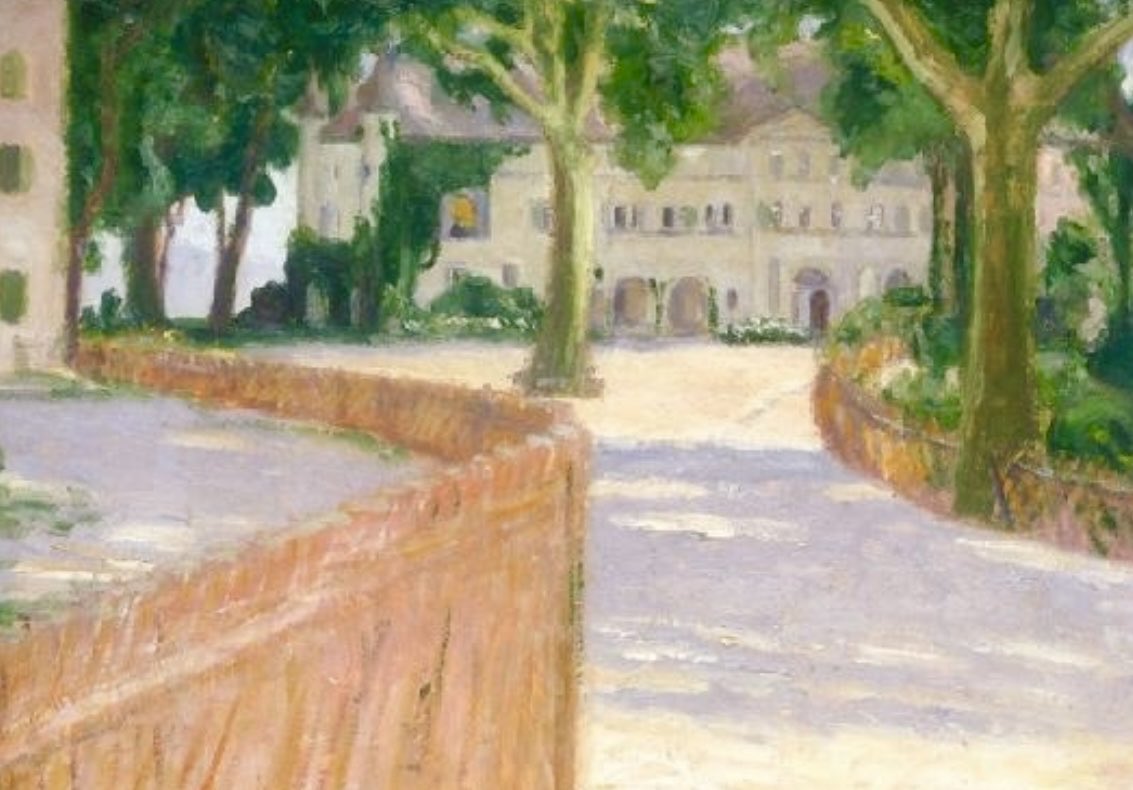
🏛️ EVIDENCE IDENTIFIED: 1944 RÉVAI SEIZURE — RIPPL-RÓNAI “KASTÉLY UDVARA”
In July 1944, under decree 1830/1944 M.E., Hungarian authorities seized the art collection of Révai Mór Jánosné from her residence at Kelenhegyi út 21, Budapest. The official inventory (Hungarian National Archives / Magyar Országos Levéltár, K643-1944-111) lists each object in detail.
Item #8 is recorded as:
Rippl-Rónai József: Kastély udvara (Castle Courtyard). Oil on paperboard, 49 × 64 cm.
🔍 POTENTIAL MATCH: 1944 INVENTORY ↔ CURRENTLY OFFERED WORK
A painting offered by Virág Judit Galéria (Lot 225, 25th auction) is described as:
• Title: Kastély udvara (also listed as Kastélyudvar / Régi kastély)
• Medium: Oil on paperboard (karton)
• Dimensions: 49 × 63.5 cm
• Signature: “Rónai” (lower right)
The gallery listing references “1944-111, 8. tétel”, which corresponds to the archival inventory entry cited above.
🔗 https://t.co/AIoXZCZubZ
📋 OBSERVED CORRESPONDENCES
• Title: closely aligned variant forms (Kastély udvara / Kastélyudvar)
• Medium: oil on paperboard — consistent
• Dimensions: near match (49 × 64 cm vs. 49 × 63.5 cm)
• Archival reference: explicit linkage to Item #8 of the 1944 inventory
Taken together, these elements suggest a strong prima facie correspondence warranting further provenance verification, rather than a fully confirmed identity.
📜 ARCHIVAL CONTEXT
The Révai inventory contains 20+ recorded works seized under wartime administrative authority. Published scholarship, including the Magyar Nemzeti Galéria Évkönyve (1997–2001, pp. 220–221), documents that multiple works from related seizure groups later entered Hungarian institutional collections after 1945.
This places the present work within a documented historical framework of wartime seizure and postwar redistribution.
⚖️ PROVENANCE CLARIFICATION REQUEST
The 1944 inventory establishes ownership, description, and seizure context. However, the post-1944 chain of custody for this specific work is not publicly documented in full.
We call for transparency from:
• Virág Judit Galéria
• Magyar Nemzeti Galéria (Hungarian National Gallery)
• Szépművészeti Múzeum (Museum of Fine Arts, Budapest)
Specifically:
• Full published provenance (pre-1944 to present)
• Any institutional transfer or inventory records between 1944–1950
• Clarification of whether the work passed through state custody following seizure
Full provenance disclosure is necessary to resolve the historical record with integrity.
#HolocaustArtRecovery #ProvenanceResearch #RipplRónai #RévaiCollection #Restitution #WashingtonPrinciples #HungarianArt #LootedArt #HEARAct
@WJRORestitution@marcorubio@nytimesarts@ahistoryinart
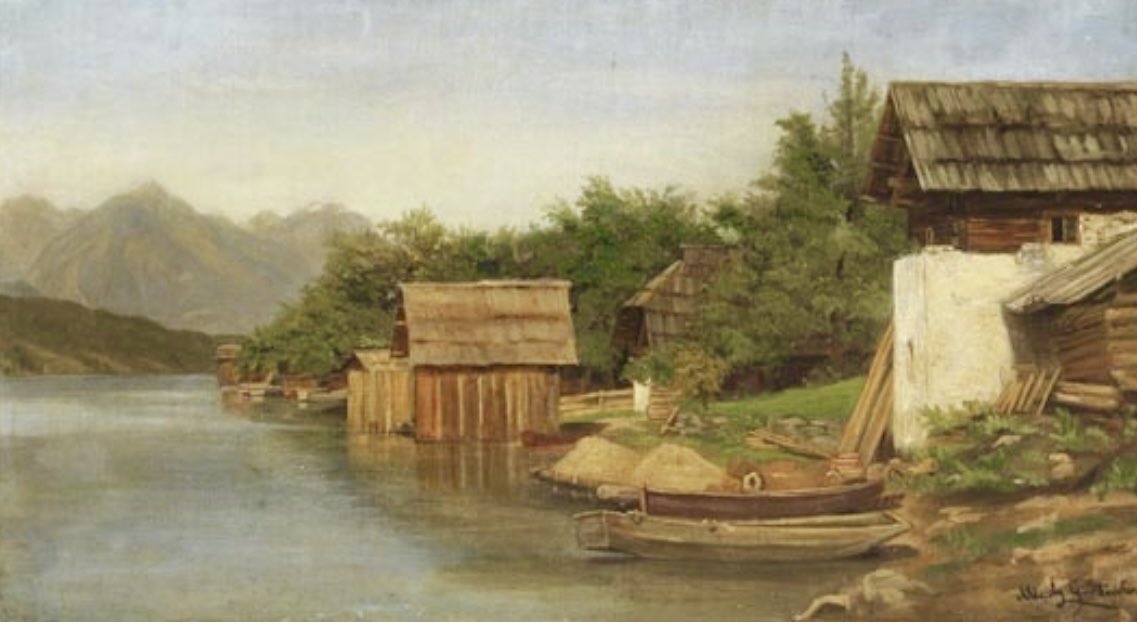
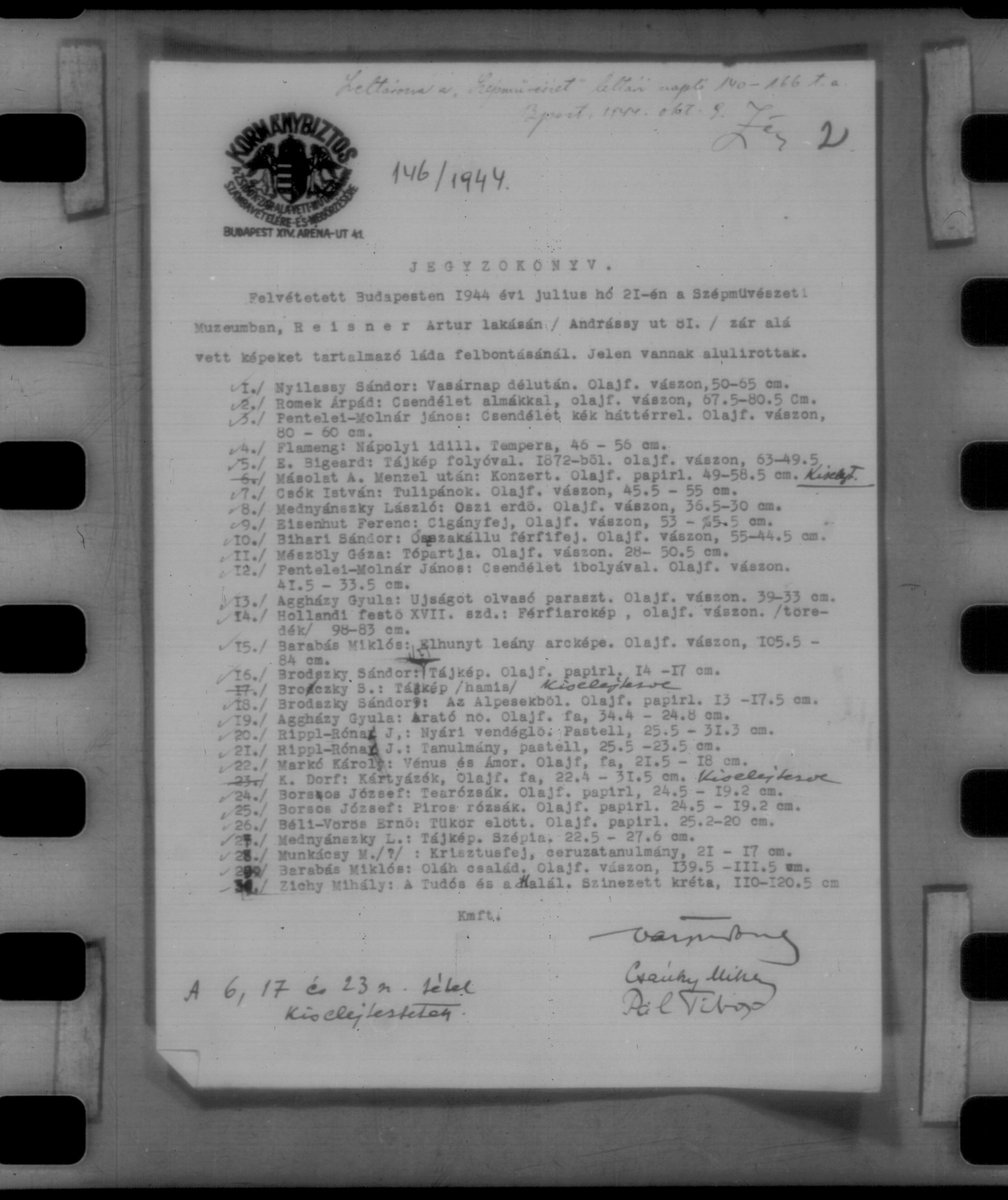
🔎 EVIDENCE IDENTIFIED: 1944 REISNER SEIZURE — MÉSZÖLY “TÓPARTJA” (LAKESIDE)
From the official July 21, 1944 Hungarian government inventory (file 146/1944), documenting the seizure of artworks from Artur Reisner (Andrássy út 81, Budapest):
11./ Mészöly Géza: Tópartja. Olajf. vászon, 28–50.5 cm.
This is not a general reference. It is a specific, documented object—named, measured, and seized.
MATCH CANDIDATE: MÉSZÖLY “TÓPARTJA” (1944 ↔ 2023 AUCTION)
Géza Mészöly (1844–1887) — one of Hungary’s leading 19th-century landscape painters, known for atmospheric lakeside scenes, particularly around Lake Balaton.
Title: Tópart (Lakeside)
Medium: Oil on canvas
Dimensions: 28 × 50.5 cm
Signature: “Mészöly G. München” (front and reverse)
THE CORRESPONDENCE
1944 Inventory: 28 × 50.5 cm
Current listing: 28 × 50.5 cm
Title: Tópartja → Tópart
Medium: Exact
Artist: Exact
Result: High-probability match candidate based on full alignment of core identifiers.
RECENT MARKET APPEARANCE
Recently listed at Virág Judit Galéria (Auction 33, December 2023)
Starting price: 3,200,000 HUF
The public listing contains no reference to:
• Artur Reisner
• The July 1944 seizure
• Transfer to the Museum of Fine Arts, Budapest (Szépművészeti Múzeum)
PROVENANCE STATUS: UNACCOUNTED FOR
The 1944 record establishes:
• Named owner
• Exact object
• Date of seizure
• Receiving institution
What is not publicly documented is the post-1944 chain of custody.
CALL FOR DISCLOSURE ⚖️
We call upon the Museum of Fine Arts, Budapest (Szépművészeti Múzeum) and the Hungarian Ministry of Culture to produce the full provenance record for this work, including:
• 1944–1946 transfer documentation
• Accession or deaccession records
• Any subsequent sale, release, or reclassification
The archival record is precise.
The object is identifiable.
The provenance gap remains.
#HolocaustArtRecovery #ProvenanceResearch #NaziLootedArt #Restitution #Hungary #MészölyGéza #HEARAct
@WJRORestitution@nytimesarts@444hu@USAmbHungary@IsraelPresident@WorldJewishCong@marcorubio@JohnCornyn@RepJerryNadler@jaredkushner@elonmusk@grok
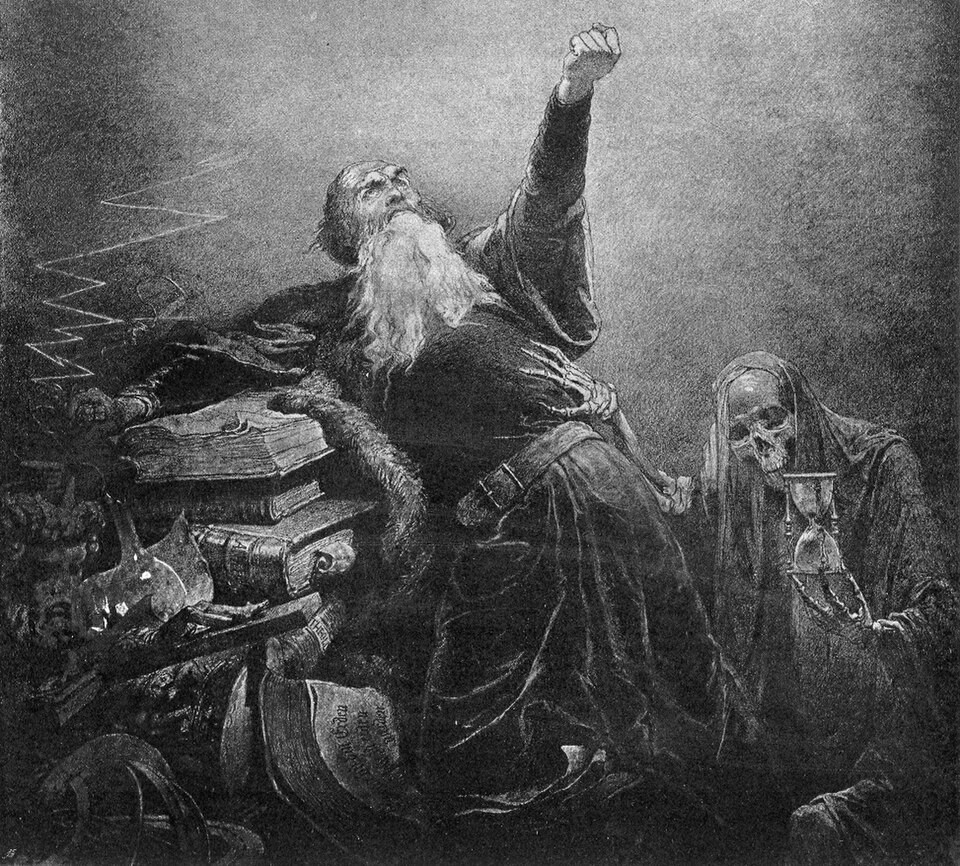
☠️📜 A 1944 Reisner Inventory Entry Points to Zichy’s Faust’s Last Hour
The 1944 Seizure Entry
On 21 July 1944, Hungarian officials opened a sealed crate of artworks taken from Artur Reisner’s residence at Andrássy út 81 in Budapest and processed through the Szépművészeti Múzeum — the Museum of Fine Arts, Budapest.
Inventory Image: https://t.co/584hrqeRhG
The final entry on the page records a major Hungarian artist and a dramatic subject:
“Zichy Mihály: A Tudós és a Halál. Színezett kréta, 110–120.5 cm.”
In English: Mihály Zichy — The Scholar and Death. Colored chalk, 110 × 120.5 cm.
This is not a vague wartime description. It is a named artist, a specific deathbed subject, a colored-chalk medium, and a large-scale measurement with an exact width of 120.5 cm.
The Public Match Candidate
The work that now demands comparison is Mihály Zichy’s Faust végórája — Faust’s Last Hour — also known as Az emberi tehetetlenség.
In 2009, it appeared in the Axioart archive for Nagyházi Galéria és Aukciósház, 154th auction, Régi mesterek és 19–20. századi festmények, held 12 May 2009, Lot 192/256.
The auction record lists:
Zichy Mihály — Faust végórája, 1870
109.5 × 120.5 cm
VÉDETT - NO EXPORT
Inscribed: “Zichy a Son ami Atachof le 13. oct. 1870”
🔗https://t.co/nVtxla8AbH
Why the Match Matters
Artist: The 1944 Reisner inventory names Zichy Mihály. The 2009 auction record also names Zichy Mihály.
Subject: The 1944 title is A Tudós és a Halál — The Scholar and Death. The auction title is Faust végórája — Faust’s Last Hour. Faust is the scholar, and the scene centers on death overtaking him.
Medium: The 1944 entry says színezett kréta — colored chalk. The auction record presents a large Zichy drawing, not an oil painting.
Dimensions: The 1944 record gives 110 × 120.5 cm. The auction record gives 109.5 × 120.5 cm. The width is identical; the height differs by only half a centimeter.
Public status: The auction record marks the work “VÉDETT - NO EXPORT” — protected cultural property. That means the work was important enough to be formally restricted from export and should have a protection file.
Taken together, these are not casual similarities. They are match factors that require the underlying records: the 1944 museum custody file, the later protection file, and the 2009 auction provenance file.
The Title Question
“A Tudós és a Halál” is not a competing title so much as a plain description of the image: the scholar and death.
“Faust végórája” gives the literary identity of the same kind of scene: Faust at the hour of death.
That kind of title movement is exactly why Holocaust-era inventories have to be read against later catalogues, auction records, and protected-object files. The same work can become harder to trace when a descriptive seizure title is later replaced by a literary or art-historical title.
The Reisner Context
Artur Reisner’s collection entered the 1944 record through seizure, sealing, and museum processing — not through a voluntary sale or ordinary loan.
That matters because the comparison does not end with the 2009 auction description. The real question is what happened after the Reisner crate was opened at the Szépművészeti Múzeum — whether the drawing was retained, returned, transferred, released, or otherwise cleared from the wartime custody chain before it later appeared on the Hungarian market.
The Missing Paper Trail
A work this specific should not have a vague postwar history.
The necessary records are concrete: the 1944–1945 custody file, any postwar return, release, transfer, sale, or deaccession documents, the protected-object file, and the provenance materials supplied for the 2009 Nagyházi auction.
Those records should answer the central question: whether the 2009 Zichy drawing is unrelated to Reisner item #30, or whether it passed through the 1944 Reisner seizure chain before later resurfacing on the Hungarian market.
The Ask
We call on the Szépművészeti Múzeum, the relevant Hungarian cultural authorities, and any current custodian of the drawing to publish the provenance record for Zichy Mihály’s Faust végórája / Az emberi tehetetlenség, including any comparison with the 21 July 1944 Reisner inventory.
If these are different works, transparency will resolve the question. If they are the same work, then the postwar custody trail must be disclosed and the Reisner history must be confronted.
Justice in Holocaust-era art cases begins with the truth. The right thing is to publish the records, acknowledge what happened, and let the history be seen.
@WJRORestitution@ClaimsCon@nytimesarts@artnet@JohnCornyn@RepLaurelLee@RepJerryNadler@marcorubio@USAmbHungary@UNESCO@WorldJewishCong@brand_arthur@NicholasMOD@AlexandraSoro@SandraInParis1@ArtorOtherThing
#HolocaustArtRecovery #ProvenanceResearch #LootedArt #ArtRestitution #ZichyMihaly #ZichyMihály #FaustVegoraja #ReisnerCollection #Budapest1944 #WashingtonPrinciples #HEARAct
🔵🏺 Is a 1944 Seizure File the Missing Link to a Painting in a Private Hungarian Collection?
21 July 1944. Andrássy út 81, Budapest.
At the Szépművészeti Múzeum — the Museum of Fine Arts, Budapest — officials opened a sealed crate of paintings taken from the residence of Artur Reisner.
Item #3 in the official Jegyzőkönyv reads:
“Pentelei-Molnár János: Csendélet kék háttérrel. Olajf. vászon, 80 × 60 cm.”
Translation:
János Pentelei-Molnár — Still Life with Blue Background. Oil on canvas, 80 × 60 cm.
That is a remarkably specific lead: artist, subject, blue-background description, medium, and exact dimensions.
The strongest public candidate @ArtRecoveryInit has found is:
Pentelei-Molnár János — Fehér porcelánok kék háttérrel
White Porcelains with Blue Background
1910s
Oil on canvas
80 × 60 cm
Listed publicly in the Boda József Collection
The match profile:
Artist: János Pentelei-Molnár — exact match
Dimensions: 80 × 60 cm — exact match
Medium: oil on canvas — exact match
Subject: blue-background still life — direct correlation
The title shift is not a contradiction.
A clerk in 1944 wrote the plain identifying phrase: still life with blue background.
A later title gives the more specific subject: white porcelains with blue background.
That may be ordinary cataloguing refinement. It may also make a 1944 seizure trail harder to see unless the records are placed side by side.
That is why the file matters.
Artur Reisner was not making an ordinary museum deposit. His paintings were taken from his Andrássy út residence, placed under seal, and processed during the 1944 confiscation of Jewish property in Hungary.
And because this crate was opened at the Museum of Fine Arts, the museum is the logical place to begin the custody trail.
If this is the same painting, the public issue is straightforward: how did a work recorded in a sealed wartime crate at the Museum of Fine Arts later appear in a private Hungarian collection? Was it returned, released, sold, transferred, deaccessioned, or otherwise separated from the Reisner seizure file?
We ask the Szépművészeti Múzeum, relevant Hungarian cultural authorities, and any current custodian of the painting to publish the provenance file for Fehér porcelánok kék háttérrel, including:
1️⃣ the 1944–1945 custody trail for Reisner inventory item #3;
2️⃣ any postwar return, release, sale, transfer, or deaccession records;
3️⃣ any documentation showing how the painting entered the Boda József Collection; and
4️⃣ any internal comparison with the 21 July 1944 Reisner protocol.
If there is a separate provenance chain, publish it. If not, the 1944 Reisner inventory remains a serious lead. Either way, the file should answer the question.
#Holocaust #ProvenanceResearch #NaziLootedArt #ArtRestitution #PenteleiMolnár #Hungary1944 #WashingtonPrinciples #HEARAct
@nytimesarts@WJRORestitution@USAmbHungary@raydowd@ahistoryinart@Telexhu@UNESCO
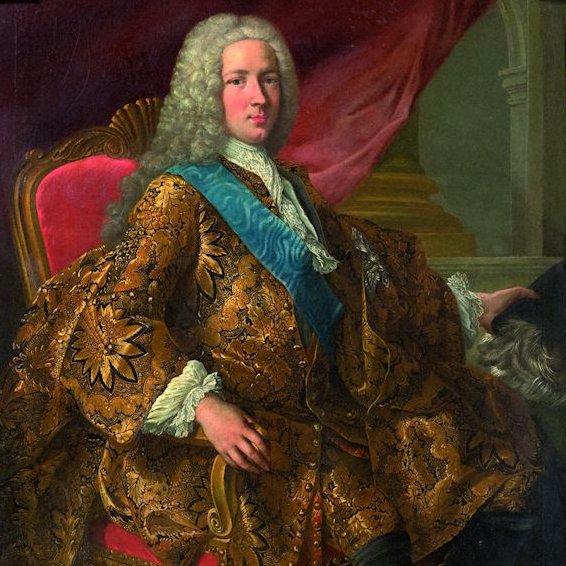
🧾🎨 A Van Loo Portrait on the Budapest Market — and a 1944 Herzog Seizure Record That Demands Answers
1944 Seizure Record
On 24 June 1944, Hungarian authorities recorded the following item from the residence of Baron István Herzog (Szemlőhegy utca 29/b):
“12./ Van Loo: Fejedelem képmása. Olajf. vászon, 137 – 111,5 cm.”
(Portrait of a Prince/Ruler, oil on canvas)
Market Record (2017)
Kieselbach Gallery (Budapest), 56th Autumn Auction, 8 Oct 2017, Lot 195:
Attributed to Louis-Michel van Loo (1707–1771)
Portrait of a Spanish Aristocrat
Oil on canvas, 137.5 × 111.5 cm
🔗 https://t.co/2pixvmJdoM
Why This Deserves Scrutiny
• Dimensions: 137 × 111.5 cm (1944) vs. 137.5 × 111.5 cm (2017) — effectively identical.
• Title drift: “Fejedelem képmása” → aristocratic or royal portrait; consistent with Bourbon court subjects painted by van Loo.
• Attribution: “Van Loo” in the 1944 record → later refined to Louis-Michel van Loo.
• Provenance signal: The 2017 auction record notes prior Herzog Collection ownership and references the 1944 seizure under the Zsidó Kormánybiztosság.
This is a document-based provenance lead tied directly to a Holocaust-era seizure record.
The Transparency Question
The 2017 auction record acknowledges the Herzog connection and expressly references the 1944 seizure. But acknowledgment is not the same as provenance resolution.
The public record still does not show how a painting documented in a Holocaust-era seizure record moved from wartime state-controlled custody back into the private market. This leads to the fundamental question that remains unanswered:
By what specific legal mechanism did this painting exit the Hungarian State’s custody?
Unless there is a documented record of the painting being formally released or restituted to the Herzog family, its appearance on the auction block is a sign of a broken chain of title. The records must answer whether this was a legal restitution to the heirs, an unauthorized "leak" from a state repository, or a de facto sale of a stolen asset by the state itself.
Records Request
We respectfully call on the Szépművészeti Múzeum (Museum of Fine Arts, Budapest) and relevant Hungarian authorities to publish:
1️⃣ Intake Documentation: All 1944–1945 transfer, custody, and accession records documenting the painting's entry into state repositories from the Herzog residence.
2️⃣ Authorization of Exit: Any postwar documentation justifying the work's exit from state control, including formal restitution receipts, museum deaccession logs, or records of state-authorized sales.
3️⃣ Chain of Title: The complete provenance file and internal "history of ownership" that supported the painting’s reappearance on the Budapest market in 2017.
The documents exist. The object has resurfaced. The full history in between should be public.
#HolocaustArtRecovery #HerzogCollection #ProvenanceResearch #NaziLootedArt #VanLoo #ArtRestitution #SzépművészetiMúzeum #HEARAct
@nytimesarts@JohnCornyn@SenBlumenthal@RepLaurelLee@RepJerryNadler@WJRORestitution@artnet@brand_arthur@raydowd@NicholasMOD@ArtHistoryProf@artlawalex@Telexhu@444hu@USAmbHungary@magyarpeterMP@marcorubio@tedcruz@WorldJewishCong@SCOTUSblog@jacobkornbluh@AlbertBaram@sara_lustig@CathyHickley@reporterfield@yivoinstitute
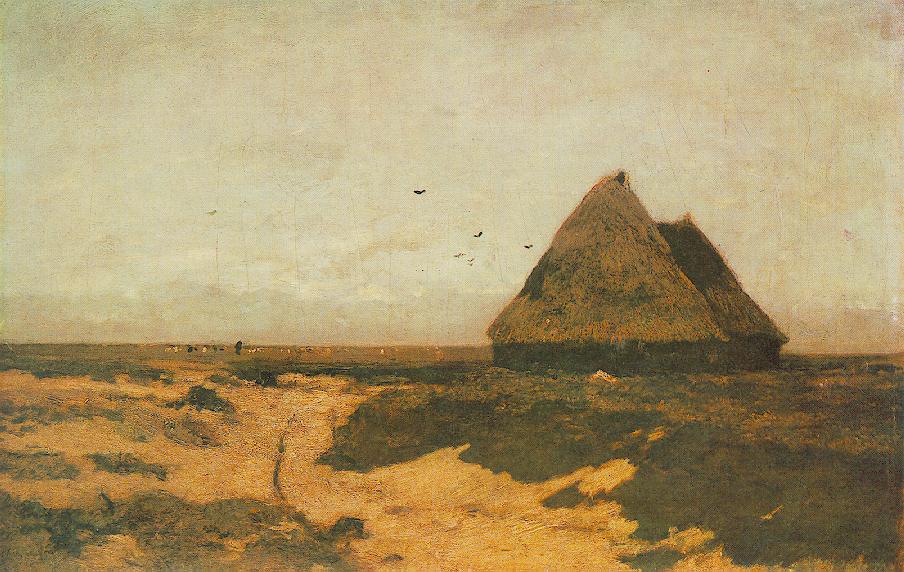
🐑🧾 Herzog Inventory #8 and László Paál’s Sheepfolds in the Hungarian National Gallery
1944 Record:
On 24 July 1944, Hungarian authorities recorded the seizure from Baron István Herzog’s residence of:
“8./ Paál László: Alföldi táj. Olajf. vászon, 58 – 95 cm.”
“Alföldi táj” is a generic inventory label: a landscape of the Great Hungarian Plain.
Museum Candidate Today:
Magyar Nemzeti Galéria (Hungarian National Gallery), Budapest:
László Paál – Sheepfolds (Juhaklok), 1872
Oil on canvas
Object no. 60.138T
The painting shows sheep dispersed across an open plain. 🔗https://t.co/U554lrMqHb
Why This Deserves Scrutiny:
• Artist: exact match.
• Format: horizontal landscape.
• Title drift: the 1944 protocol uses a generic descriptor; the modern title identifies the specific motif.
• Dimensions: the 1944 record gives 58 × 95 cm. Current public references vary slightly between 58 × 95.4 cm and 58.5 × 94.5 cm — both very close.
• Medium/support: oil on canvas.
This is not a vague resemblance. It is a precise archival lead that demands explanation.
The Transparency Question:
The published museum record identifies the painting, but it does not publicly account for the work’s documented Holocaust-era seizure and wartime transfer.
Records Request:
We ask the Hungarian National Gallery and the Szépművészeti Múzeum (Museum of Fine Arts, Budapest) to publish:
1️⃣ All accession, deposit, transfer, and deaccession records tied to this work.
2️⃣ Its wartime and immediate postwar location history.
3️⃣ Any internal provenance research or cross-reference to the 24 July 1944 Herzog protocol.
The documents exist. The match is clear enough to investigate. The history in between should be made public.
#HolocaustArtRecovery #HerzogCollection #NaziLootedArt #ProvenanceResearch #MagyarNemzetiGaleria #LaszloPaal #WashingtonPrinciples
@WJRORestitution@USAmbHungary@444hu@UNESCO@Mazsihisz@WorldJewishCong@JohnCornyn@RepLaurelLee@RepJerryNadler@tedcruz