New #JITC article: Immune and genomic biomarkers of immunotherapy response in cancer of unknown primary https://t.co/WaJBSI8Msb @AtaraPosner@LindaMileshkin
Available for one Honours student: Join @RadioLab and A/Prof @rtothill in a biomarker study to collect clinically annotated biospecimens from >100 MCC patients, including blood and tissue samples taken before and during treatment. https://t.co/3gaF56KCKZ
An exciting opportunity to join one of our fantastic labs! You can play a part in improving outcomes in one of the most challenging to treat cancers.
Get in quick, applications close this Sunday >>
https://t.co/zpgkbafe4C
Huge thanks to co-first authors Nick Gherardin, Kelly Waldeck and Alex Caneborg and many others who generously collaborated on this study. γδ T cells in Merkel cell carcinomas have a proinflammatory profile prognostic of patient survival https://t.co/M9sX15MNP4
4th highlight from our Nov issue: The teams of @shengli_jax, @gjoshy from @jacksonlab in collaboration with @UMCCR @UMCCR_RADIO_Lab present a new tool for inferring #cancer tissue origin using #RNA expression data and #AI.
Read🔓https://t.co/1hJb6GCaMK
#UMCCRSeminar: Welcome @AtaraPosner of @rtothill's @UMCCR_RADIO_Lab. The lab focuses on translational research of rare and less common cancers, using advanced genomic and histology methods to comprehensively analyse samples from cancer patients >> https://t.co/J2Vr737QDP
#UMCCRSeminar: Join @AtaraPosner of @UMCCR_RADIO_Lab discussing the use of DNA and RNA sequencing methods to guide diagnosis and identify contemporary treatment options for cancer of unknown primary patients. Register >> https://t.co/ixpSPmSz94
Excited to have the opportunity to receive MRFF funding to study a new type of PET scan to help improve diagnosis and treatment for patients with Cancer of Unknown Primary (CUP) together with fantastic team incl @UMCCR @rtothill@BowtellLab
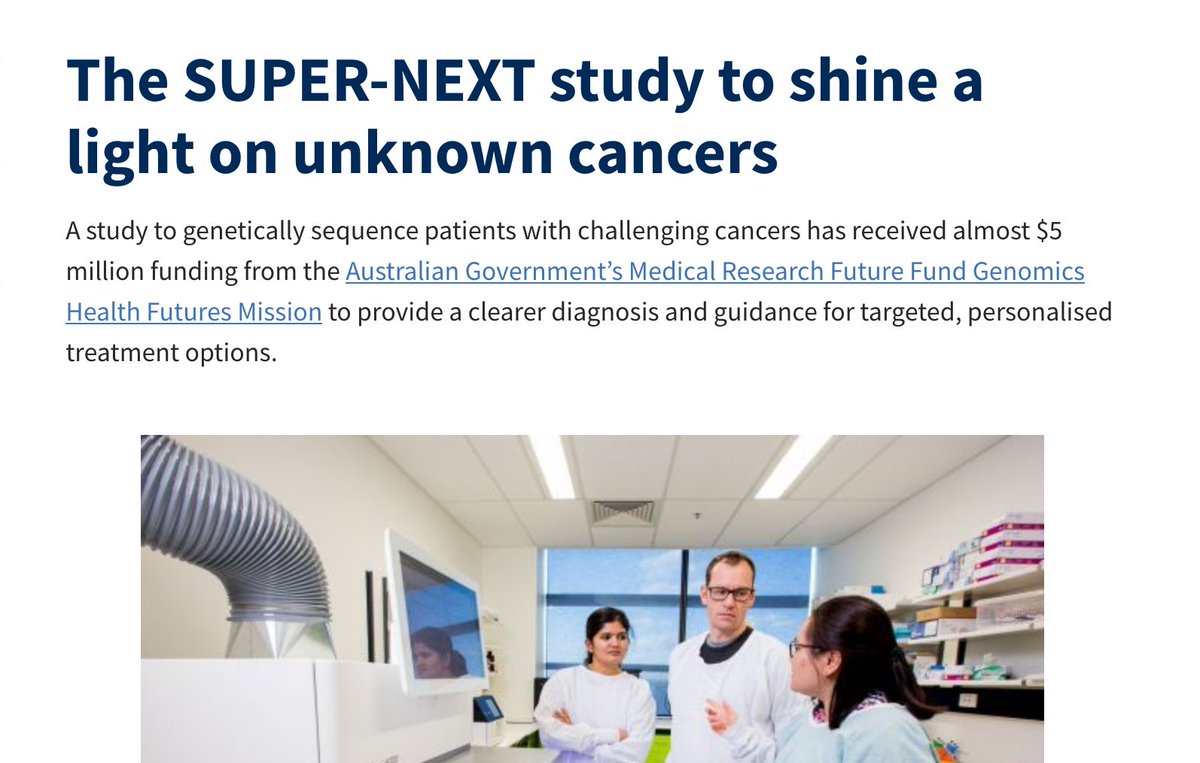
The SUPER-NEXT study to genetically sequence patients w/ cancers of unmet need—providing clearer diagnosis & targeted, personalised treatment options—has received almost $5m MRFF funding, led by @rtothill in collab w/ @LindaMileshkin@PeterMacCC >> https://t.co/hMqpnBz8rU
#coronavirus#COVID19#COVID2019#scRNAseq
We have developed a new and exciting tool (#ViralTrack) to detect viruses in scRNA-seq data.
**We are looking for SARS-COV2 scRNA-seq patient data**
If you have such data and wish to collaborate, please contact us ASAP! Please RT!
#UMCCRSeminar: The @UMCCR_RADIO_Lab is investigating an understudied type of T cell infiltrating Merkel cell carcinoma—a rare but aggressive #skincancer—with likely prognostic and therapeutic significance for patients.
Register >> https://t.co/3BgzGdHfNW
Dr @rtothill's @UMCCR_RADIO_Lab is working to improve outcomes in rare and less common cancers through development of better diagnostic and prognostic clinical tests, targeted treatments, ad predictive markers of therapeutic response. #LorneCancer https://t.co/COXRpwI2ES
“Every cancer is a results of genetic scars, which is damage that occurs to DNA over time. By combining sequencing of the whole #cancer#genome with a suite of analysis tools, we can characterise every genetic change found in a cancer." Prof @seangrimmond
https://t.co/uiJ8KbHmed
Asking all the #cancer#organoid growers out there: is there a magic growth factor I can use to get slow growers to grow before they die out. Currently using pancreatic cancer media for #rarecancer organoids.🙏
Cancers of unmet need, such as pancreatic, are hard to tackle as they don’t respond to standard therapies, there are few cases to use as comparison, and are difficult to diagnose with potentially little information to track their origin @seangrimmond#monlunchlive