The U.S. economy has tremendous underlying strength: markets are performing well, business investment is rising, and productivity growth is creating room for wages to rise without corresponding inflationary pressure.
Over the weekend, I discussed the prospects for durable, noninflationary growth—and how that strength translates into gains for American households—with @larry_kudlow on @FoxBusiness and on @NewsNation Live.
Expanding the economy’s productive capacity is the durable path to greater prosperity for the American people.
This morning I joined @Varneyco to discuss the Fed's rate decision.
Markets expect a 25bps hike. Do I think it is necessary to restore price stability? No. By some measures, inflation is moving in the right direction, and monetary policy remains somewhat restrictive. But a hike is understandable as a cautious, one-time recalibration—insurance against the risk that higher oil prices spread into broader inflation.
A single quarter-point hike is unlikely to derail this economy’s remarkable growth and resilience. A hiking cycle would be a different story: it would restrain growth, and the current data do not support that path.
President Trump is creating the conditions for lower borrowing costs over time. His administration’s pro-growth policies are designed to expand the economy’s productive capacity and will provide a durable path to lower inflation and sustainably lower rates.
So while today’s expected hike may not be necessary, it is defensible—provided it is a one-and-done recalibration, not the beginning of a new hiking cycle.
https://t.co/aIYilvSKIn
Congratulations to @federalreserve, @USOCC, and @FDICgov, on today’s Basel Capital Proposal.
Today’s outdated capital requirements are needlessly complex and misaligned with their actual objective. Rather than solving for safety and soundness, they are pushing lending out of the regulated banking system while simultaneously impeding economic growth.
The last Administration aimed to hijack the Basel modernization effort to reverse-engineer ever-higher capital requirements without rhyme or reason. Under President Trump’s leadership, we have taken a principled and calibrated approach that simplifies capital requirements and fosters a level playing field for banks of all sizes.
If finalized, this proposal would advance those goals, fostering economic growth through our regulatory regime.
Today is an important step in the regulatory reset our Administration is working towards, marking meaningful progress toward a financial system that builds Parallel Prosperity for Main Street and Wall Street.
Applications are live for the one-day virtual #WhartonBizJourn on Thursday, April 11 featuring @Wharton Professors @Susan_Wachter, @CParaSkinner, David Musto and Michael Roberts.
Apply by April 3: https://t.co/EsuEgTMfhg
#LiveNow: @RepAndyBarr convenes the Financial Institutions and Monetary Policy Subcommittee for a hearing entitled: "The Tangled Web of Global Governance: How the Biden Administration is Ceding Authority Over American Financial Regulation"
📺 Tune in 🔗
https://t.co/O1D0fv5NOY
What role should the Federal Reserve play in the economy?
@Wharton's @CParaSkinner demystifies the Fed and explains its unique role in tracking both interest rates and unemployment to conclude our Ripple Effect podcast's series, "The Economy & You."
🎙️: https://t.co/C9ZmRxLOwJ
Our Governing Council has decided to move to the next phase of the digital euro project.
In November 2023 we will start laying the foundation for the possible issuance of a digital euro. A decision on issuing a digital euro will come at a later stage.
https://t.co/xuKklame0U
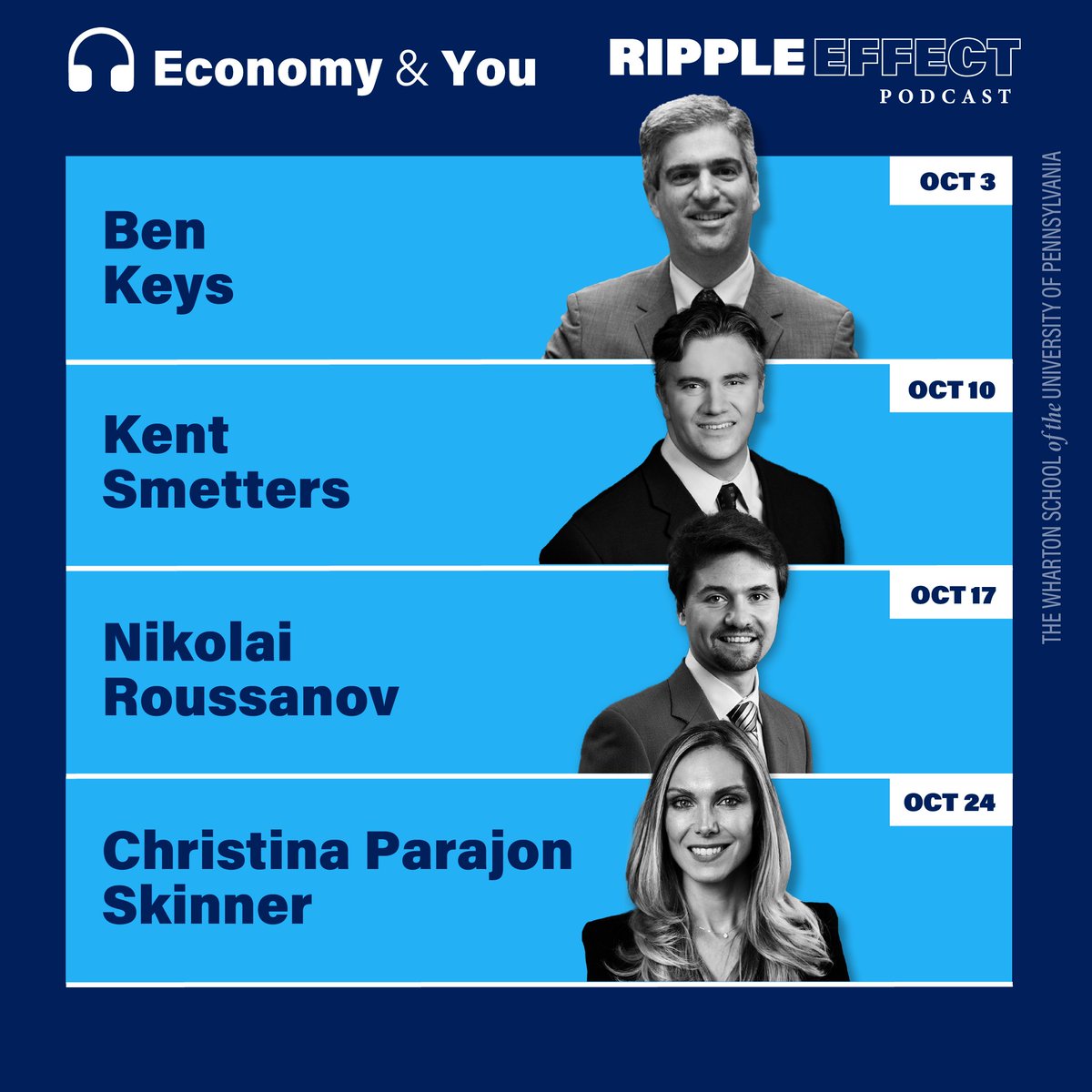
What should you know about today's economy? The next series of our Ripple Effect podcast features episodes on:
🎧 Real estate – @Key_Z_E
🎧 Economic modeling – @KentOnMoney
🎧 Signs of a recession – @NickRoussanov
🎧 The Fed – @CParaSkinner
Stay tuned: https://t.co/DB6ZHzm5mr
#LiveNow: @RepFrenchHill convenes the Digital Assets, Financial Technology and Inclusion Subcommittee for a hearing entitled: "Digital Dollar Dilemma: The Implications of a Central Bank Digital Currency and Private Sector Alternatives."
📺 Tune in 🔗
https://t.co/ImzipE3se0