I just learned from my son that the word "hongbao" is already included in the Oxford English Dictionary!!! 🧧🧧🧧🧧🧧
Happy Lunar New Year to everyone who celebrates it! Year of Dragon will be very exciting!
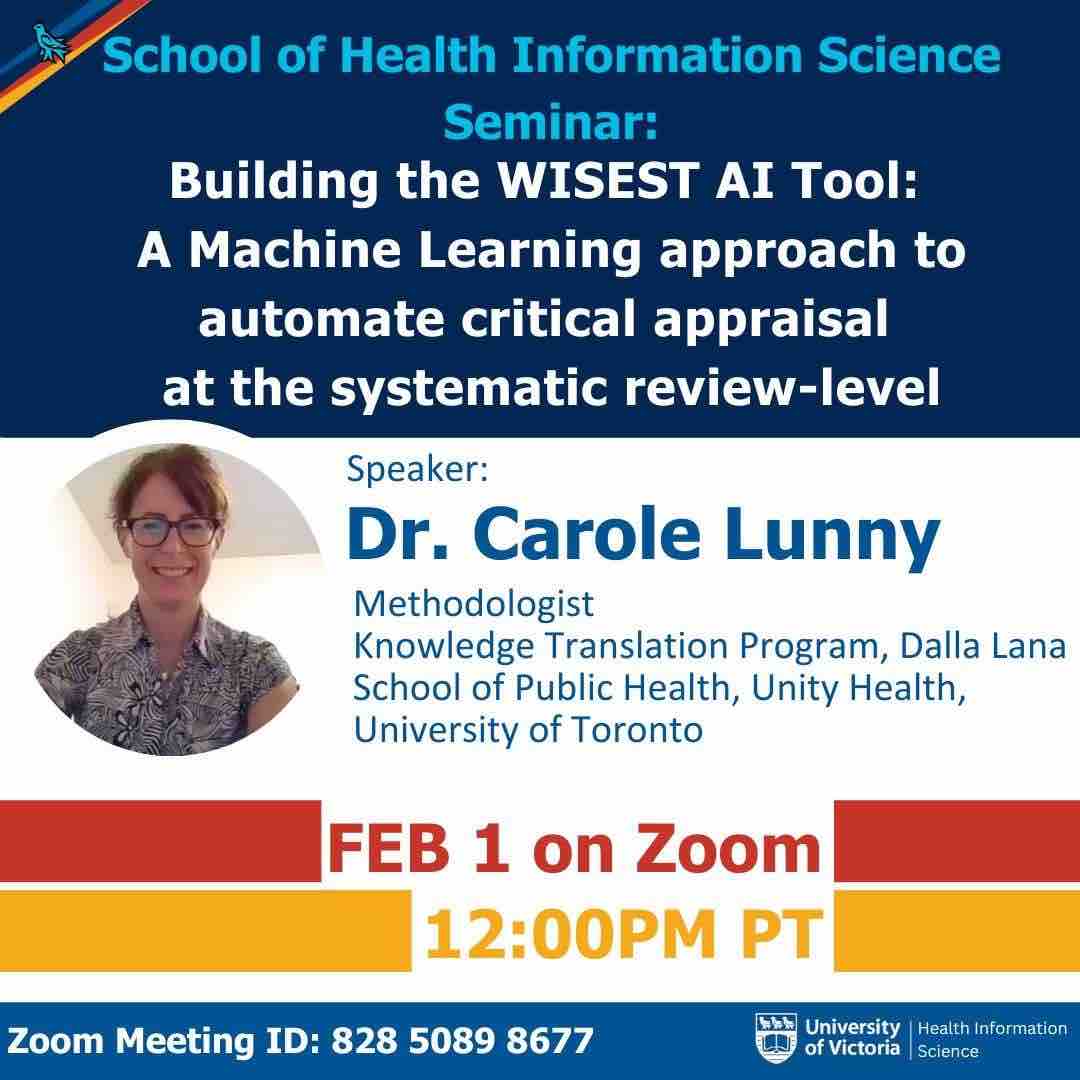
Save the date! This Thursday, February 1st, at 12pm, our Health Information Science 2024 Seminar Series kicks off! Delve into Health Informatics with Dr. Carole Lunny discussing ‘Building the WISEST AI Tool.’ A must-attend event! @uvic_healthinfo@uvicresearch#healthtech#AI
I am looking for 4 speakers in 2024 (one per 3 months) for our @ImmunitasTx internal 1-hour seminar + 30 mins Q&A. Any topics on immuno-oncology, single-cell, or spatial data are welcome! Of course, we will pay you! Hit me up in DM or reply if you want to chat about it.
📊 Diving into the world of data reduction techniques! Let's compare two popular methods: Factor Analysis (FA) and Principal Component Analysis (PCA). A thread! 🧵
#DataScience
🚨comp bio folks: update your priors & add a new algorithm to your toolbox!
You can now reliably call somatic mutations in scRNAseq/scATACseq data without a refernce, thanks to a new great tool just out.
Why does this matter?
How does it work?
When/where can you use it?
👇
0. For interested non-experts
single cell RNA sequencing data (scRNAseq) is everywhere by now. To understand cancer evolution for example, lots of different tumor types (e.g. pre-malignant/primary/metastasis) and conditions (s.a. pre/mid/post treatment, and others) have been profiled. scRNAseq offers information primarily on the gene expression state of the cell (its transcriptome). In addition to mRNA abundance, scRNAseq also contains the actual sequence of the transcriptome, making it appealing to also identify point mutations (mismatches compared to reference). But technical limitations make this important task quite difficult, and essentially only possible when matched DNA (bulk or single cell) for the sample sample exist.
1. Why is this so relevant?
Inferring point mutations from scRNAseq/scATACseq is appealing from at least 2 main reasons:
- single cell point mutations are extremely relevant for understanding the phylogeny and evolution of both normal tissue (e.g. during development) and cancers
- the inferred point mutations would offer a second mode of omics information in the same single cells for which expression information is also available. This essentially mimics multi-omics single cell data for free 🤯.
2. About the new tool
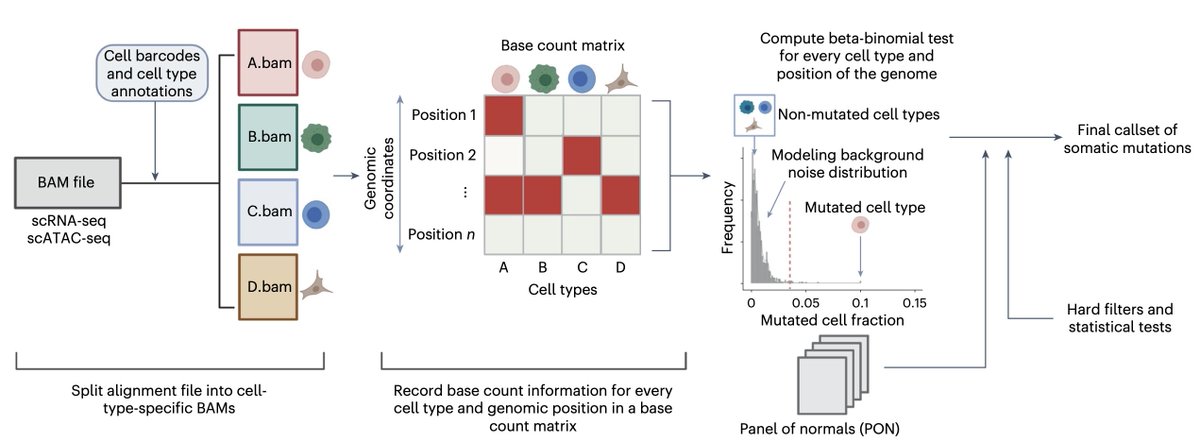
SComatic computes base counts for every position of the genome across (a priori-identified) cell types from the same individual, using the assumption that somatic mutations are only present in cell types from the same differentiation clade, whereas germline mutations are widespread. More specifically, the tool follows these steps:
2.1. Annotate cell types with e.g. markers (or your favorite method)
2.2. Split alignment (BAM) files into cell-type specific BAMs
2.3. Structure base count information per split cell type-specific BAM into a matrix
2.4. Compute beta-binomial tests for every cell type and position in genome, parameterized using non-cancerous samples
2.5. Further filter mutations to retain only the somatic ones, using: i) the frequency of the mutation, ii) a panel of normals (PONs), and iii) a-priori information on the bases themselves.
3. Validation and performance
Tested on 10X scRNAseq & matched WES data, the new method shows high concordance between the mutations detected in scRNA-seq by SComatic and WES. Interestingly (and expected), in a sample with high genetic heterogeneity, both WES and scRNAseq alone identify mutations that the other data types doesn't find.
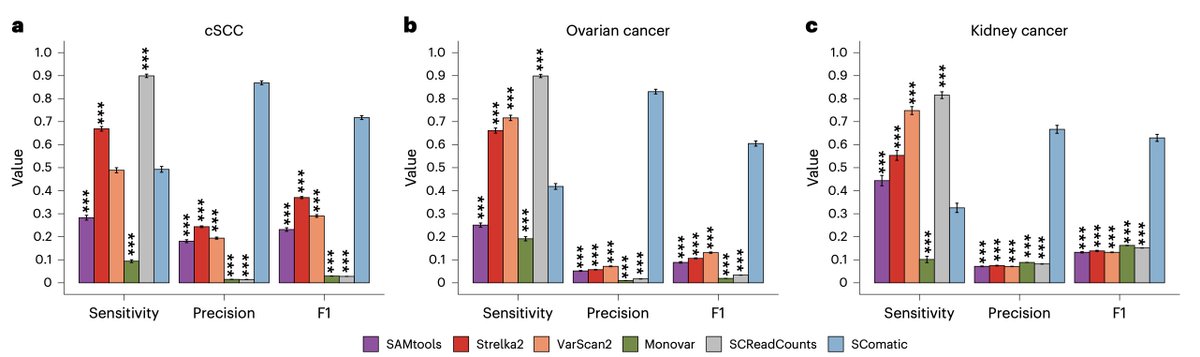
SComatic shows much higher precision & F1 scores than alternative pipelines for calling scRNAseq point mutations. Other methods do have better sensitivity, which is important to note, as different tools might be different for other applications.
Mapping the identified mutations in cancerous samples to mutational signatures highlights cancer-related processes, further increasing the confidence in SComatic's mutation calls.
On hypermutated samples (MMR-deficient tumors), SComatic's mutation calls are more biologically-relevant than those of alternative methods, as assessed by the distribution of the identified mutational signatures.
4. Non-cancerous tissues
SComatic has also been tested on samples with low mutational burden: myeloproliferative neoplasms, as well as normal tissues with high expected genetic heterogeneity (e.g. polyclonal tissues): 78 scRNAseq samples from 6 heart regions across 14 donors. The mutational burdens in cardiomyocytes estimated by SComatic were comparable to those estimated using single cell whole genome sequencing (WGS).
Another interesting application on non-neoplastic tissue used scATACseq data: 500.000 cells from 66 samples from 24 tissues. The distribution of called single cell mutations in scATACseq was quite different from scRNAseq, and most mutations mapped to intergenic (32%), promoter (19%) and intronic regions (18%). Quite interestingly, ductal cells showing the highest mutational rates.
In line with previous reports on mutations in normal tissues, this paper does find mutations in non-neoplastic cell types from both cancer and non-neoplastic samples, but with overall low (<0.2) mutant cell fractions.
This research direction is exciting and very relevant, as it allows diving deeper into the clonal landscape of normal tissues of different cell types, using the wealth of existing scRNAseq/scATACseq data. This has implications for cancer prevention and early detection and management.
5. Cancer heterogeneity
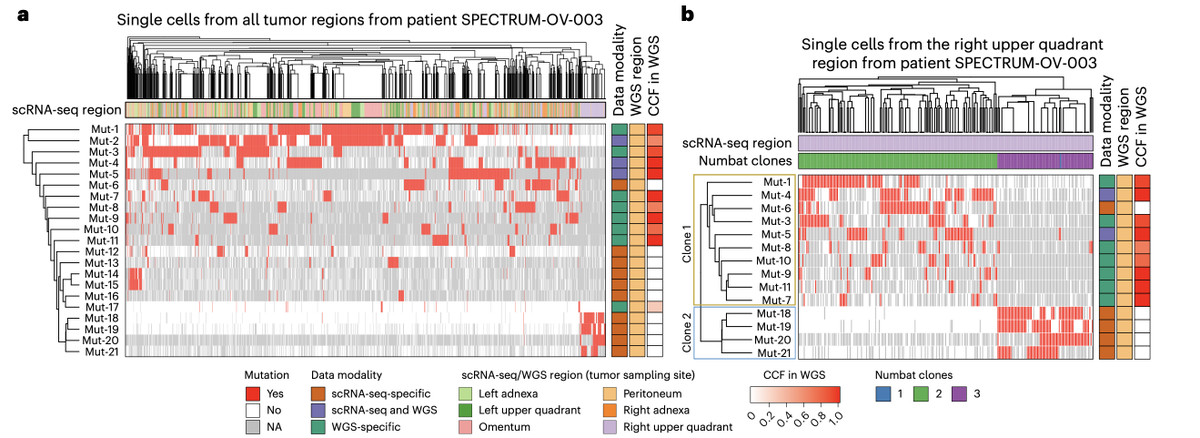
Lastly, SComatic was used to reconstruct the clonal heterogeneity in multi-region scRNAseq data from ovarian cancers (with clones identified using copy number alterations). Clonal assignments based on somatic mutations and somatic copy number data were highly concordant. This is quite impressive, showing that mutual exclusivity and co-occurrence analysis of mutations at the single-cell level is now possible, combined with inferred transcriptomic states in the same single cells.
That's a wrap!
Here is the link to the paper, out in @NatureBiotech:
https://t.co/VkShZfOzMA
And here's the link to the tool
https://t.co/Jq6TmR4115
Congrats & thanks to all the authors led by @isidrolauscher
👏👏👏
4/ I am on my way to helping 1 million people to learn computational biology, Follow me
@tangming2005 join my newsletter https://t.co/aYaLVUjyym , and subscribe to chatomics my youtube channel! https://t.co/tsQRpAmu6k
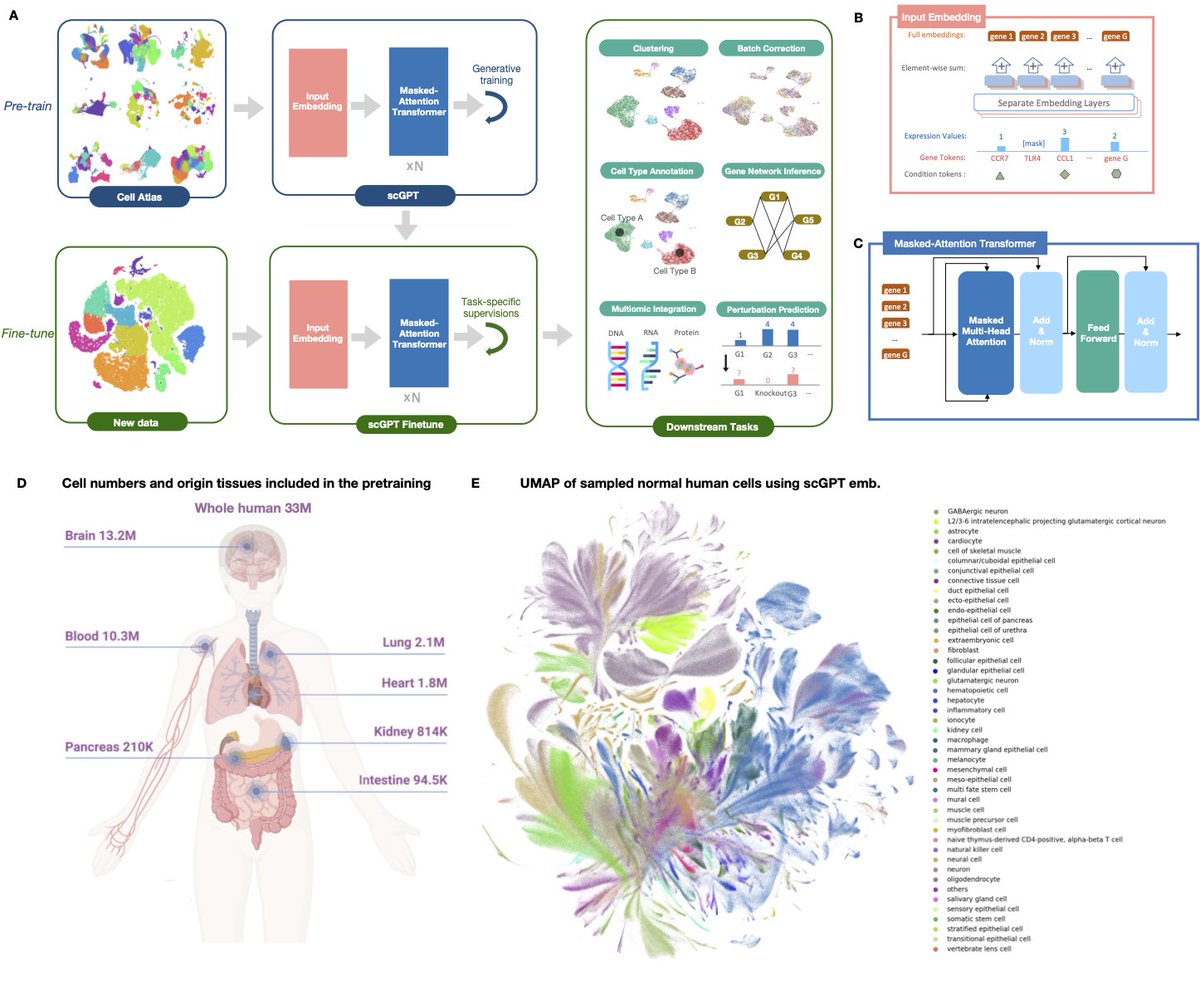
🎉Exciting Update of scGPT 🎉: After receiving significant attention from the community since our April release, we're thrilled to announce the first major update for scGPT - a foundation model for single-cell multi-omic data.
This update integrates community feedback and leverages the latest data release from @cellxgene. It boasts larger pretraining data, and more robust models, and expands the range of application tasks.
Pre-print (V2) available: https://t.co/4aB2c4ZgJy
Access our open-source code and models here: https://t.co/13n0bJvgT2
Detailed tutorials: https://t.co/enNqXqXkdY
Highlights of this update include:
🔬 Introducing the first GPT-style foundation model for single-cell multi-omic data, pretrained on over 33M human cell atlas data.
💡 Our generalist approach enables one model to accomplish multiple tasks in single-cell analysis, including multi-omic integrative analysis and perturbation prediction.
🧬 Discovering gene-gene interactions specific to various conditions using learned attention weights and gene embeddings.
🚀 Uncovered a scaling law showcasing continuous model performance enhancement as data volume increases.
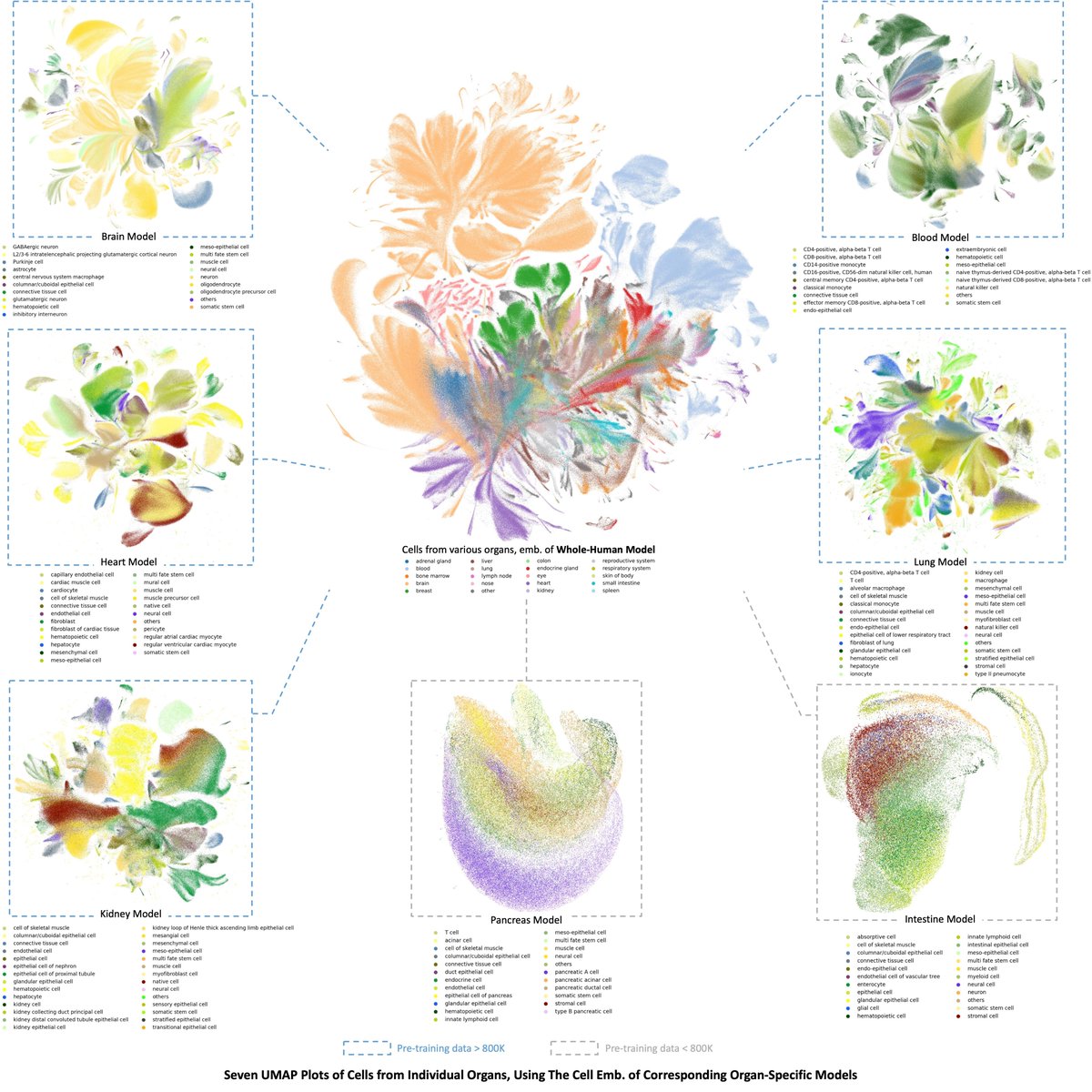
🐾 scGPT model zoo (see github) now offers multiple pre-trained foundation models for various solid organs and a comprehensive pan-cancer model. Begin exploring your data with the most fitting foundation model.
We welcome your thoughts on specialist vs generalist approaches in single-cell studies. Many thanks for the following technical analyses of scGPT:
1. Excellent twittorial by @simocristea: https://t.co/ICq3V78oxG
2. Comprehensive review on LLM in cell biology by @s_batzoglou: https://t.co/xtl5WCXijC
3. Insightful blog by @SalvatoreRaieli: https://t.co/7v8PRv9NNc
Kudos to Haotian (@HAOTIANCUI1) & Chloe (@chloexwang1) for their exemplary work on this project. @VectorInst@pmcc_ai@UHNAIHUB@bradwouters@drbarryrubin@UofT_TCAIREM@UofT_LMP@UofTCompSci@uoftmedicine
Although not in academia anymore, a co-authored publication still makes me excited.
PDF: https://t.co/UVQZdWAkH7. Great work led by Yang Liu, @XShirleyLiu
https://t.co/i5JpXy7adF
Thrilled to announce for the first time our @MDAndersonNews#IBC algorithm includes not just how to treat IBC but how to work up and diagnose it including pregnancy related. https://t.co/8trw3O2wHx
Huge thanks @anthonylucci1 @drmediget Dr. Le-Petross, Dr. Layman, and more!!
Congratulations to @TheodorisLab on the recent study, demonstrating the power of AI learning from big data to make meaningful predictions on limited data.
We have just completed & published a large set of 8 focussed reviews looking at the design/methods, reporting, risk of bias and spin/overinterpretation of #machinelearning based prediction model studies in healthcare.
The findings don’t paint a good picture. A little summary 🧵
@michaelhoffman Avoiding the need to create, maintain, and attempt to get people to use ontologies. And optimistically the opportunity to summarize complex data in text. https://t.co/m0LMBz04x1