A big thank you to @UNAIDSRwanda for the technical and financial support and advocacy that strengthen civil society's voice in Rwanda's HIV response.
#UNAIDS#CivilSociety
Putting Communities First: Transforming HIV and SRHR Through Partnership in Rwanda
Rwanda’s HIV response is a global reference point, having reached remarkable milestones with adult targets now standing at 96-98-98. However, national averages can sometimes hide the people the system still misses.
In this compelling article, we highlight the impactful power of collaboration and partnership between the @RwandaNGOForum and @UNAIDSRwanda in putting key and priority populations, including FSW, MSM, transgender people, PWID/PWUD, people with disabilities, and AGYW, at the center of the HIV and SRHR response through Community-Led Monitoring (CLM), data-driven advocacy, and policy transformation.
Read the full article here: https://t.co/Lx4IsHu3ot
How can we better leverage community-led monitoring (CLM) and SRHR initiatives to reach the last mile and ensure no one is left behind in our health responses? Share your thoughts in the comments below and keep the conversation going.
#LetCommunityLead #EndAIDS2030 #KeyPopulations #HealthyAdolescentRw #HealthEquity
@RwandaHealth@RBCRwanda@nsanzimanasabin@JNdayizigiye@UNAIDS@WHORwanda@BrianChirombo@CMuvunyi@UNAIDS_ESA@RichardAmenyah@AndrewGasoziNtw@Knooliet@J_Umuhire@HDIRwanda@ImroRwanda@Sfrwanda1@FXBRwanda@TuyishimeAlbert@Rwanda_CCM@mwanaimable@DMbituyumuremyi@aflodiskagaba
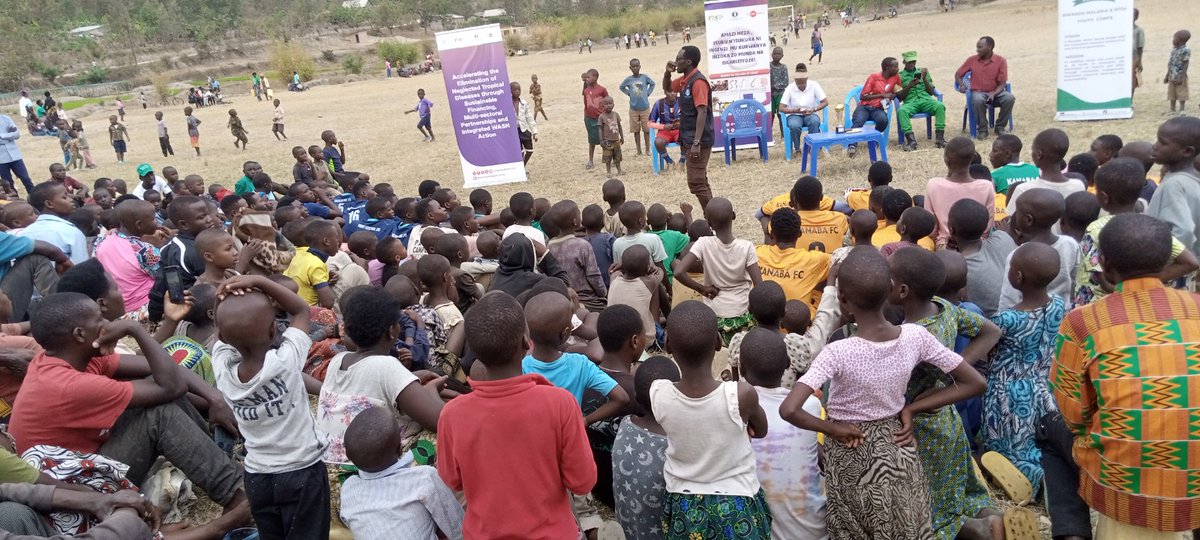
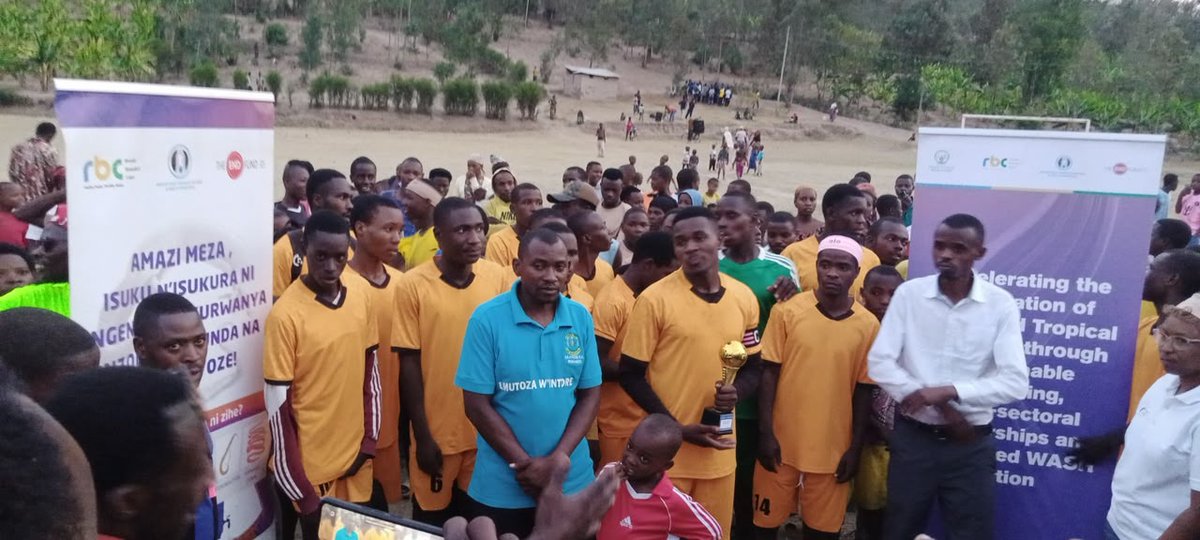
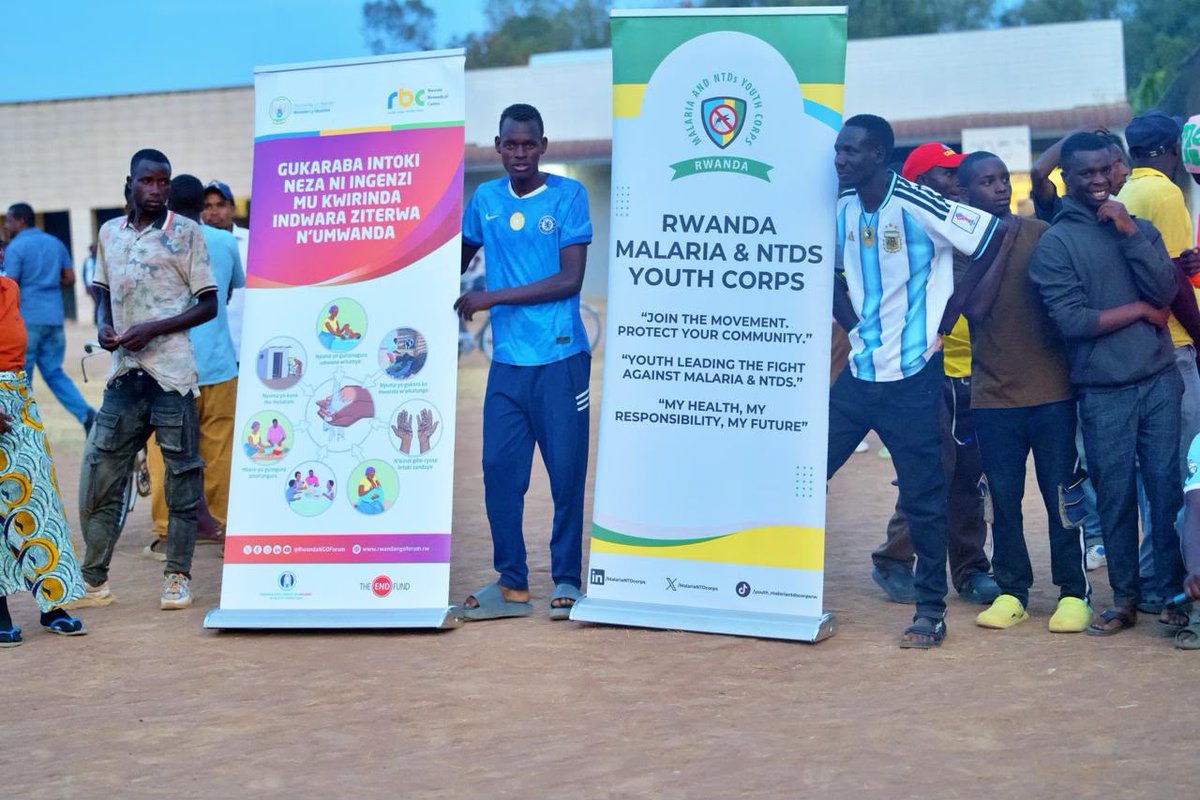
Turning Sports and Entertainment into Action Against NTDs ⚽
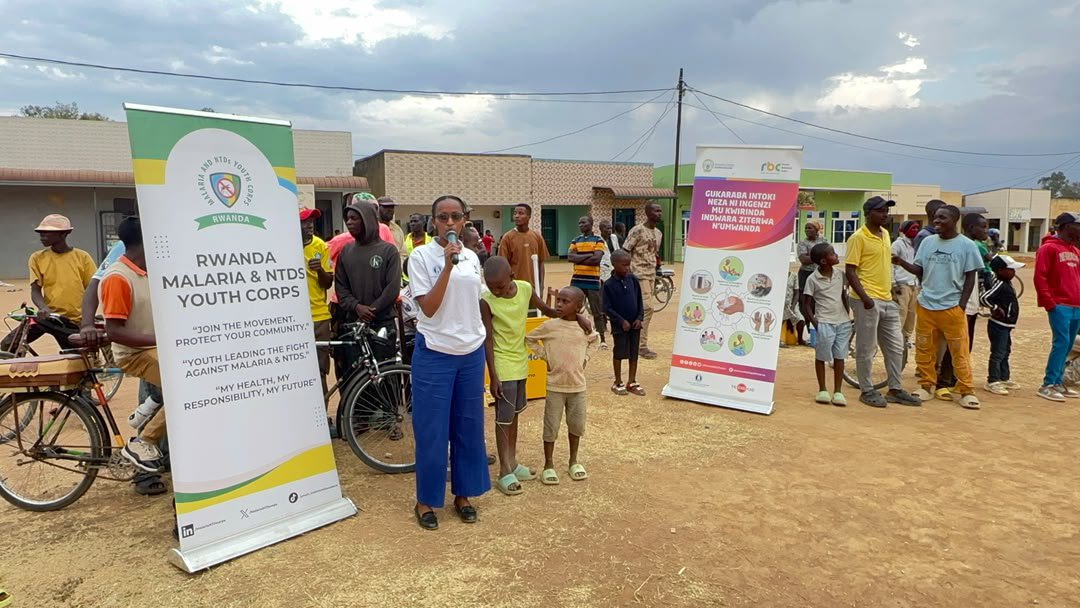
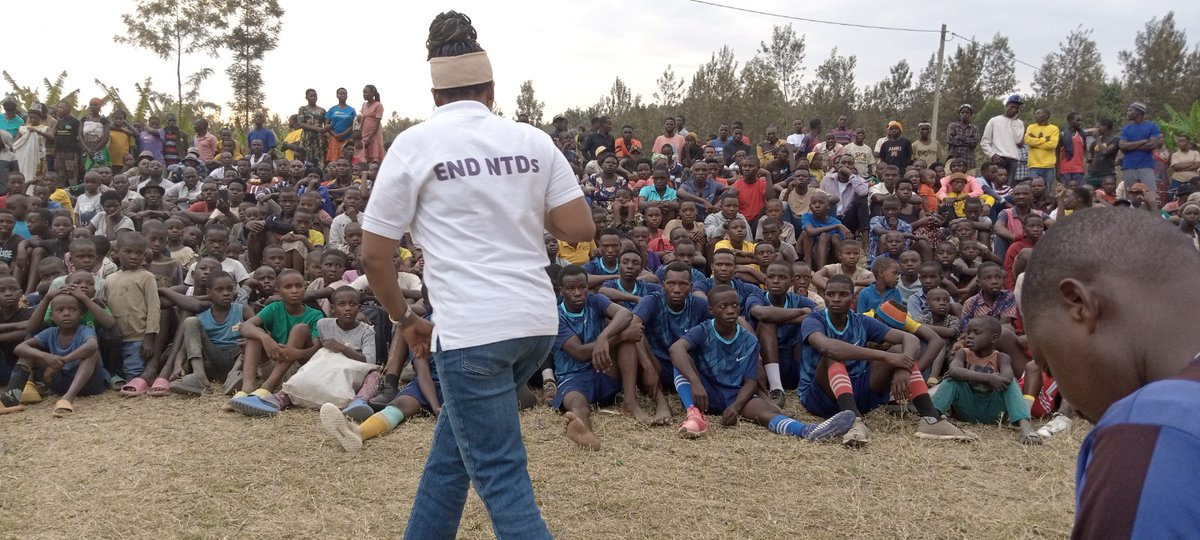
With support from @TheENDFund and in close collaboration with @BugeseraDistr and @RuhangoDistrict , @RwandaNGOForum is empowering @MalariaNTDcorps to conduct community mobilization across both districts to prevent Neglected Tropical Diseases (NTDs), specifically Soil-Transmitted Helminths (STH) and Schistosomiasis, while promoting protective behaviours and good Water, Sanitation and Hygiene (WASH) practices.
Through sports and entertainment activities, including football matches that bring communities together, key prevention messages are reaching people in more engaging and memorable ways:
✅Washing hands with soap,
✅Wearing shoes,
✅Avoiding contact with marshland water,
✅ Ending open defecation,
✅Using latrines properly,
✅Seeking treatment early when symptoms occur.
Rolling out across all sectors of Bugesera and Ruhango districts, each community reached represents another step towards interrupting transmission. These campaigns advance Rwanda’s commitment to bring prevalence below 2% in focus areas by 2027, a goal anchored in the National NTD Strategic Plan 2026-2030, and our shared promise under the Kigali Declaration on NTDs and the @WHO NTD Roadmap.
Together, we can turn awareness into action and communities into champions for a healthier, NTD free Rwanda.
#BeatNTDs #EndNTDs
Reaching Those Most at Risk, Right Where They Work
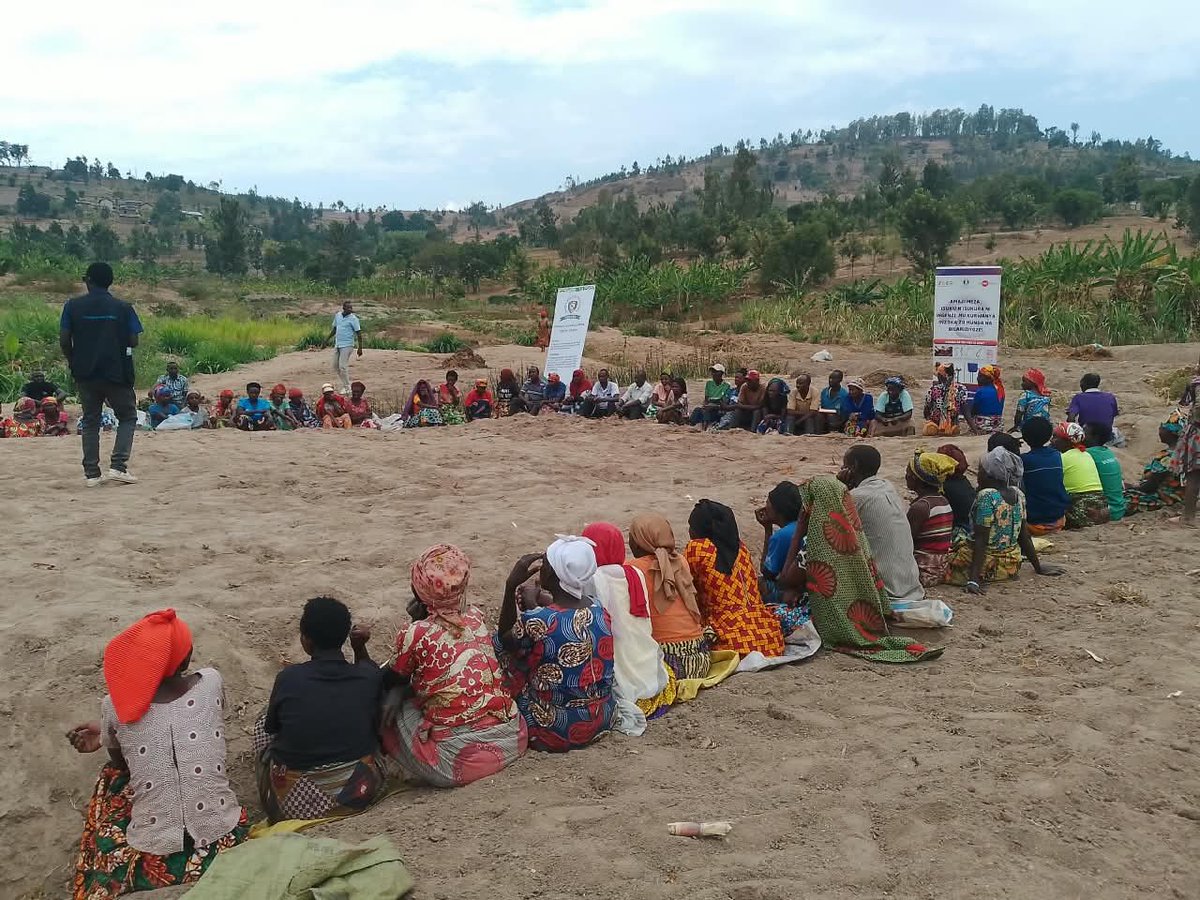
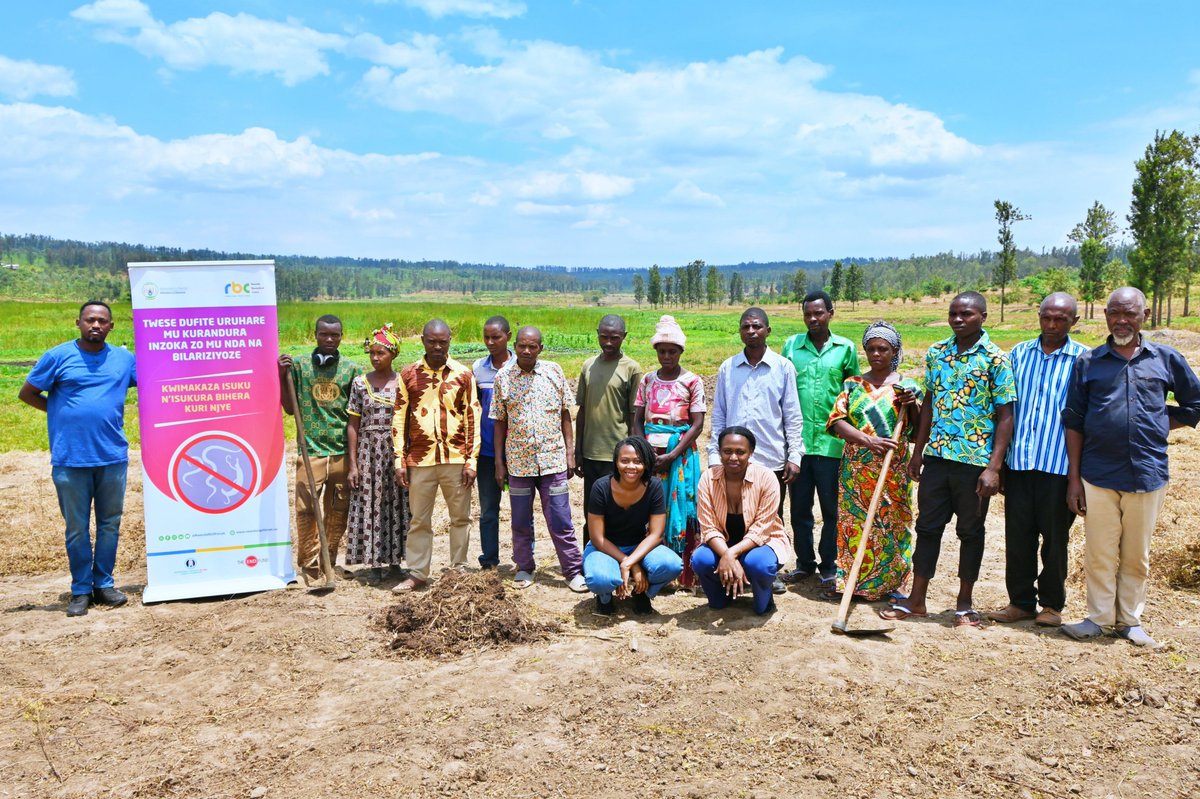
This week, @RwandaNGOForum conducted targeted Interpersonal Communication (IPC) sessions and supervision visits on Schistosomiasis and Soil-transmitted Helminths with high-risk groups, including marshland farmers and fishermen in @BugeseraDistr and @RuhangoDistrict because of their daily contact with freshwater, which is the main route of schistosomiasis transmission, these high-risk groups daily exposure to both SCH and STH.
Alongside @RBCRwanda, @BugeseraDistr & @RuhangoDistrict teams, these sessions emphasised SCH/STH transmission, proper use of protective equipment, WASH practices (latrine use, ending open defecation near water bodies, handwashing with soap) as well as seeking early treatment.
All this is in support of the Interruption of Transmission (IoT) target of below 2% prevalence in focus areas by 2027 and aligned with the National NTD Strategic Plan 2026–2030, the @WHO NTD Roadmap and the Kigali Declaration on NTDs.
#BeatNTDs #EndNTDs
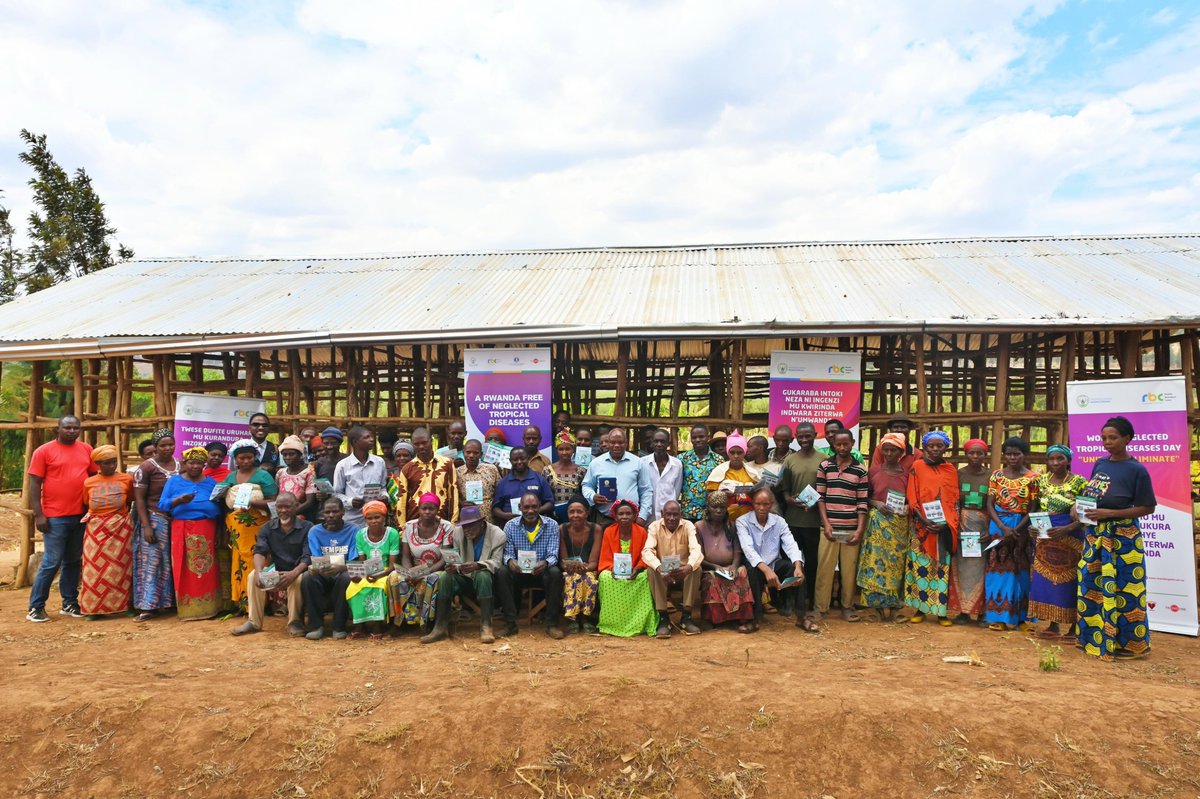
When communities work together, health outcomes improve for everyone. Discover the impact unfolding across Rwanda in our latest newsletter.
#EndNTDsRw#NeglectNoMoreRw
🚨📖 Before You Scroll… Read the Stories Changing Rwanda’s Health Future.
What if the fight against Neglected Tropical Diseases (NTDs) isn’t being won only in hospitals, but also in villages, schools, wetlands, and by ordinary people doing extraordinary things?
Discover how communities across Rwanda are leading the fight against NTDs, transforming lives and accelerating the country’s journey toward the 2030 elimination target. From community-led interventions and innovative solutions to inspiring stories of resilience, partnership, and local leadership, this edition showcases how collective action is driving real, measurable impact.
Whether you’re a policymaker, health professional, development partner, student, or community advocate, you’ll find valuable insights into what works, and why empowering communities remains essential to building a healthier Rwanda.
📢Read it. Share it. Be inspired. Together, let’s ensure no one is left behind in the fight against NTDs.
📖 Scan the QR code or access the newsletter here: 👇👇👇
https://t.co/JjVDVWeELk
#NeglectNoMoreRw
#EndNTDsRw
📢 DID YOU KNOW?
The new NGO Law recognizes the importance of collaboration and collective action among civil society organizations. Article 22 of Law No. 058/2024 provides a legal framework for the establishment of Umbrella Organizations and Forums of Umbrellas, creating stronger platforms for coordination, advocacy, representation, and partnership within the NGO sector.
Under the law, NGOs carrying out related activities may come together to establish an umbrella organization, while umbrella organizations themselves may establish forums of umbrellas to further strengthen cooperation and collective engagement. To obtain legal personality, an umbrella organization must be composed of at least ten organizations and, like any other legal entity, must obtain its own Certificate of Legal Personality.
The law also promotes effective representation while ensuring balanced participation by providing that a National NGO may belong to a maximum of three umbrella organizations. These provisions are intended to strengthen coordination, reduce fragmentation, amplify the collective voice of civil society, and enhance the contribution of NGOs to Rwanda’s development.
📚 Collaboration is not just a strategy, it is recognized and supported by law.
#KnowYourLawRw
#RwandaNGOsLaw2024
#ComplianceMattersRw
@RwandaLocalGov@GovernanceRw@RwandaParliamnt@Rwanda_Justice@RwandaOmbudsman@CivilSocietyRW@NINGORwanda@Imbuto@SCIRwanda@asdo_rwanda@Sfrwanda1@NARwanda@RWN_WomenNet@soscvrwanda@actionaidrwanda@NUDOR_Rw@uphls@ReseauP29968@ReseauFemmesRw@GlobalFundWomen
📢 DID YOU KNOW?
The new NGO Law does not only establish the requirements for obtaining a Certificate of Legal Personality or a Certificate of Registration, it also guarantees clear administrative procedures and timelines that protect applicants throughout the registration process.
Under Article 6 of Law No. 058/2024 Governing Non-Governmental Organisations, the @GovernanceRw (RGB) is required to issue a Certificate of Legal Personality or a Certificate of Registration within sixty (60) days from the date an organization fulfills all legal requirements. This provision promotes efficiency, predictability, and accountability in the processing of applications submitted by NGOs.
🔔Importantly, the law also safeguards the rights of applicants. Where RGB decides not to grant a certificate, it must communicate its decision in writing and clearly state the reasons for refusal within the same sixty-day period. This ensures transparency and enables organizations to understand any gaps that may need to be addressed.
The law further provides a mechanism for administrative review. An organization whose application has been refused may request RGB to reconsider its application. Upon receiving such a request, RGB is required to review the matter and communicate its decision within thirty (30) days.
📚 Understanding these legal timelines is essential for NGOs seeking legal recognition, as it enables organizations to effectively follow up on their applications, exercise their rights under the law, and navigate the registration process with confidence.
A strong civil society is built not only on compliance, but also on awareness of the rights and protections provided by the law.
#KnowYourLawRw
#RwandaNGOsLaw2024
#ComplianceMattersRw
@RwandaLocalGov@GovernanceRw@RwandaParliamnt@Rwanda_Justice@RwandaOmbudsman@CivilSocietyRW@NINGORwanda@Imbuto@SCIRwanda@asdo_rwanda@Sfrwanda1@NARwanda@RWN_WomenNet@soscvrwanda@actionaidrwanda@NUDOR_Rw@uphls@rrpplus@ReseauP29968@ReseauFemmesRw@GlobalFundWomen
📢 DID YOU KNOW?
Under Articles 19 and 20 of Law No. 058/2024 Governing Non-Governmental Organisations, a National Non-Governmental Organisation wishing to operate in Rwanda must obtain a Certificate of Legal Personality granted by the @GovernanceRw (RGB).
To be granted legal personality, an applicant is required to electronically submit a complete application dossier, including:
🟠 notarized statutes, notarized minutes of the meeting establishing the organization, a collaboration letter from District authorities, identification documents of the organization's leadership, criminal record certificates of the legal representative and deputy legal representative, declarations of acceptance of responsibilities, the annual action plan, budget, sources of funding, organizational structure, and proof of payment of the prescribed service fee.
📌A national non-governmental organization of sports, games and sports-based entertainment, that applies for a certificate of legal personality, must also submit to the Board a collaboration letter from the Ministry responsible for sports.
📌Regulations of the Board may determine additional requirements for application for a certificate of legal personality of a national non-governmental organisation.
These requirements are intended to promote transparency, accountability, sound governance, and institutional credibility within the NGO sector. Legal personality is not merely a registration requirement; it is the legal foundation that enables an organization to operate, establish partnerships, mobilize resources, and contribute effectively to national development.
📚 Before submitting your application, ensure that all required documents are complete, accurate, and compliant with the provisions of the law to avoid unnecessary delays in the review process.
A compliant NGO is a credible NGO. A credible NGO is a stronger partner for development.
#KnowYourLawRw
#RwandaNGOsLaw2024
#ComplianceMattersRw
@RwandaLocalGov@GovernanceRw@RwandaParliamnt@Rwanda_Justice@RwandaOmbudsman@CivilSocietyRW@NINGORwanda@Imbuto@SCIRwanda@asdo_rwanda@Sfrwanda1@NARwanda@RWN_WomenNet@soscvrwanda@actionaidrwanda@NUDOR_Rw@uphls@rrpplus@ReseauP29968@ReseauFemmesRw@GlobalFundWomen
🌟Know the Law. Own Your Health.
Did You Know You Can You Make Your Own Health Decisions?🤔
Understanding your rights is the first step toward protecting your health. Rwanda’s new law regulating healthcare services introduces important changes that directly affect adolescents, especially when it comes to making decisions about their own health. This campaign aims to break down these provisions in a simple and relatable way so that young people are informed, confident, and empowered.
One of the key highlights of the law is the age of consent for accessing healthcare services. Adolescents aged 15 and above can now access healthcare services, including sexual and reproductive health services, without needing parental consent. This provision recognizes that young people need timely, confidential, and safe access to healthcare, and it removes barriers that previously prevented many from seeking the services they need.
Knowing this right is essential for every young person. It means you have a voice in your health decisions and the ability to seek care without fear or stigma. As we start this campaign, we invite you to learn, and share this information, because when you know the law, you can truly own your health.
#KnowTheLawOwnYourHealthRw #HealthyAdolescentsRw
Communities are agents of change. Their leadership ensures that health strategies remain responsive, inclusive, and impactful. #LetCommunityLeadRw#PeopleCenteredResponse
Nothing About Us Without Us: Community Leadership is the Foundation
Effective #HIV, #TB, and #Malaria responses depend on #communities owning the #data, #discussion, and #decisions.
At the #Rwanda#CSOs and #Communities’ Stakeholder Consultative Workshop on #iCLM Priority Setting, convened by @RwandaNGOForum to shape the NSP 2027–2030 and the @GlobalFund GC8 Funding Request, this principle was evident.
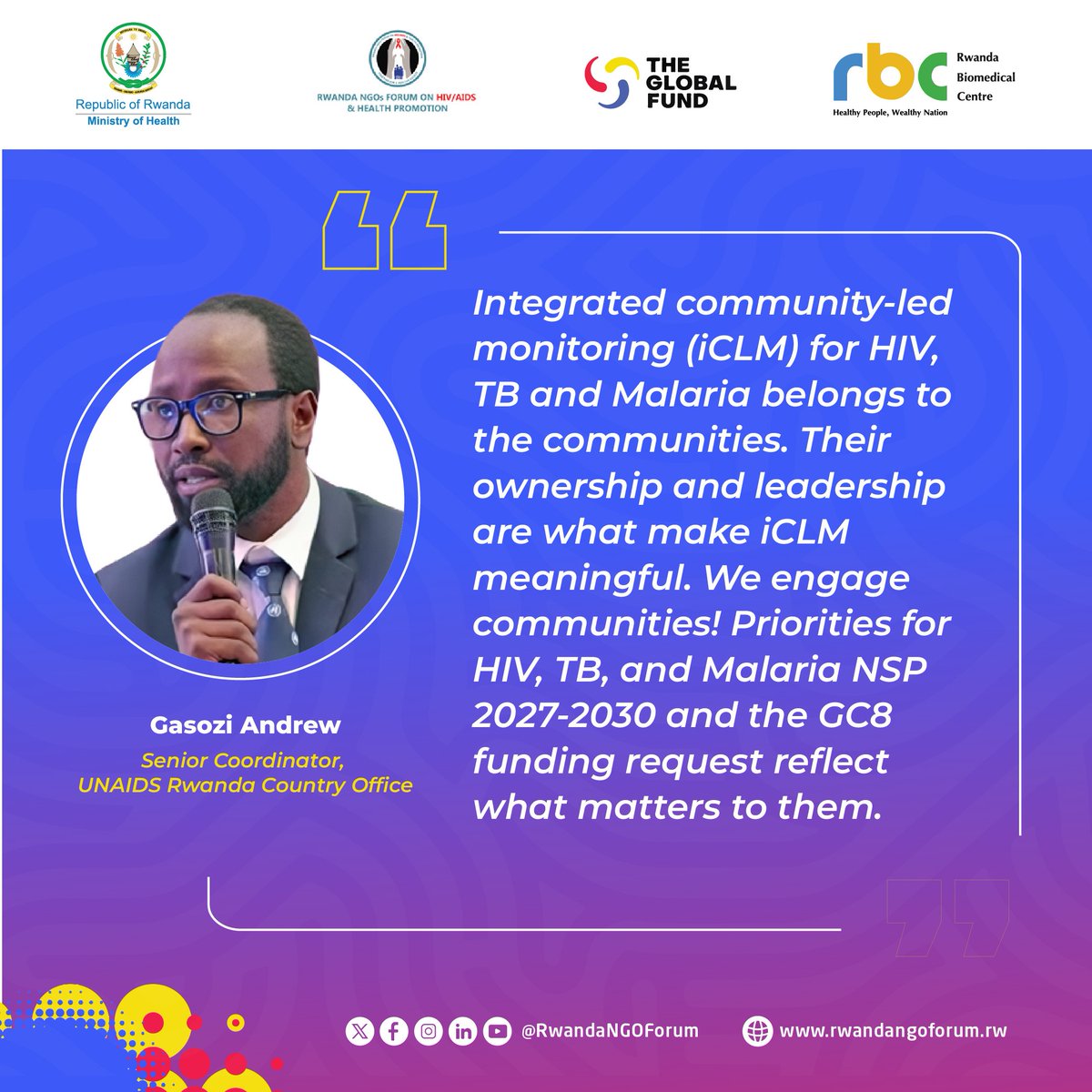
We were inspired by @AndrewGasoziNtw, Senior Coordinator at the @UNAIDSRwanda Country Office, whose words capture the essence of the conversation:
"Integrated community-led monitoring (#iCLM) for #HIV, #TB, and #Malaria belongs to the #communities. Their ownership and leadership make #iCLM meaningful. We engage #communities! Priorities for #HIV, #TB, and #Malaria NSP 2027-2030 and the GC8 funding request reflect what matters to them."
Why is this important?
Because programs only work when #communities shape them, monitor them, and speak for themselves. The principle is non-negotiable: Everything for #communities, without #communities, works against them.
We must move people from the periphery to the high-level decision-making table. #Communities should participate not as beneficiaries, but as leaders and equal contributors.
✅Ownership: #iCLM isn’t just a data collection tool; it is the #community’s voice. #Community-owned data reflects reality, not assumptions.
✅Leadership: When those at risk, living with, or affected by the diseases, and fighting them daily, set priorities, resources are allocated effectively and equitably.
✅Accountability: We cannot design solutions in a vacuum and expect them to work on the ground. True accountability means #communities drive the response.
The upcoming #HIV, #TB, and #Malaria NSP 2027–2030 and the @GlobalFund GC8 funding request must continue to boldly reflect #communities’ priorities. #Community voice must drive better policies, stronger accountability, and responses that save lives.
Civil society leaders and #communities will continue to shape these critical documents through consultative and development workshops, sharing #community priorities, and providing feedback on drafts. This active involvement ensures that both #HIV, #TB, and #Malaria NSP2027-2030 and @GlobalFund GC8 funding request are grounded in real experience and drive change where it matters most.
Thank you to @AndrewGasoziNtw, @RwandaNGOForum, and all civil society organizations and #community leaders for driving this agenda forward. The path to ending #HIV, #TB, and #Malaria is paved with #community-led evidence. #LetCommunityLeadRw #PeopleCenteredResponse #HealthIntegration #CommunityData #HealthForAll
@nsanzimanasabin@JNdayizigiye@HindHassan_@CMuvunyi@BrianChirombo@CDCRwanda @ambafrancerw @expertisefrance@unwomenrwanda@unicefrw@PIH_Rwanda@ITPCglobal@ICAP_ColumbiaU@GFAN_Africa@ahfrwanda@PEPFAR@Avega_Agahozo_@dreamvillage6@AmahoroR@Imbuto@ASOFERWA2@PSF_Rwanda@CaritasRwanda@sfhRwanda@ALMA_2030@HAImedicines@EUinRW@NLinRwanda@InterfaithRda@rrpplus@uphls@ASOFERWA2@ABASIRWA2@ambafrancerwa@PeterASands@DMbituyumuremyi@Knooliet@BernardMuramira@CrescenceMUKAN1
From Recipients to Decision‑Makers, Communities Lead Rwanda’s Health Priorities
During the #Rwanda CSOs and Communities’ Stakeholder Consultative Workshop on iCLM Priority Setting to inform #HIV, #TB, and #Malaria#NSP 2027–2030 and @GlobalFund GC8 Funding Request, organized by @RwandaNGOForum, we witnessed a shift in how health responses are shaped in #Rwanda. Community voices are not just heard but actively direct the setting of health priorities.
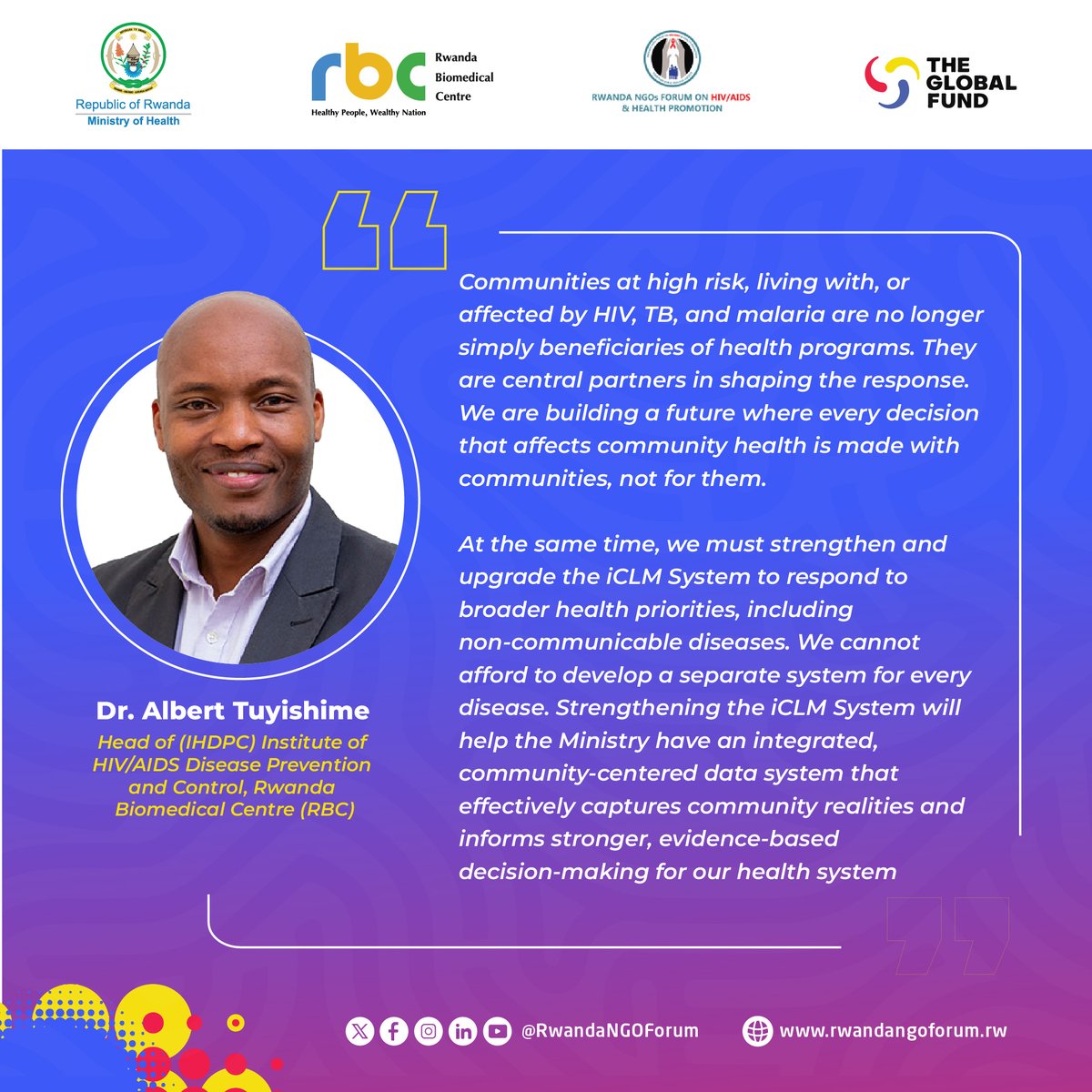
Representing @RwandaHealth and @RBC_Rwanda, Dr. Albert Tuyishime (@TuyishimeAlbert), Head of Diseases Prevention and Control Department (HDPC), delivered a people-centred call to action that expands our vision for the future: Communities are no longer just recipients; they are leaders, partners, and decision-makers. Those closest to the challenges are also closest to shaping the solutions too.
✅ When communities lead, responses are more effective and sustainable.
✅ When communities lead, no one is left behind.
✅ When communities lead, we move closer to ending HIV, TB, Malaria, and other public health threats.
When we talk about fighting #HIV, #TB, and #malaria, and increasingly, the rising tide of non-communicable diseases (#NCDs), we must acknowledge that data is our compass. However, the most accurate data does not come just from labs and hospitals; it comes from the community at high risk, living with, or affected by diseases and conditions.
For too long, the global health architecture has suffered from “vertical syndrome,” building separate data-collection systems and monitoring tools for every disease priority. This is not only inefficient; it is unsustainable. It fragments the service users’ experience and creates a massive burden on those at the front lines.
The strategic move to strengthen and upgrade the #iCLM System is a must-do in health system strengthening. By strengthening the #iCLM System to respond to broader health priorities, including #NCDs, we are doing two critical things:
1. We respect the community’s time and save resources: The #iCLM System streamlines data collection, allowing a peer educator or community monitor to collect information for multiple diseases at once, eliminating the need for three separate appointments. This saves the community time, speeds up responses, and conserves resources.
2. We are democratizing data: The #iCLM System captures the realities of the community. It ensures that when the Ministry makes a decision, whether about resource allocation or policy change, it is informed by evidence that reflects the ground truth.
This is the essence of building a resilient health system. It’s a recognition that community expertise is just as critical as boardroom expertise, and a commitment to making decisions with communities, not just for them.
@RwandaNGOForumcommends this forward-thinking approach from @RBCRwanda and @RwandaHealth. This is how we build a future that is sustainable, equitable, and truly healthy for all. Rwanda’s integrated, community-led model can offer valuable lessons for other countries and organizations aspiring to strengthen their own health systems.
This is the future we are building. A future led by community. #LetCommunityLeadRw #PeopleCenteredResponse #HealthIntegration #CommunityData #HealthForAll
@nsanzimanasabin@JNdayizigiye@HindHassan_@CMuvunyi@AndrewGasoziNtw@BrianChirombo@CDCRwanda@ambafrancerwa@expertisefrance@unwomenrwanda@unicefrw@PIH_Rwanda@ITPCglobal@ICAP_ColumbiaU@GFAN_Africa@ahfrwanda@PEPFAR@Avega_Agahozo_@dreamvillage6@AmahoroR@Imbuto@ASOFERWA2@PSF_Rwanda@CaritasRwanda@sfhRwanda@ALMA_2030@HAImedicines@EUinRW@NLinRwanda@ncdalliance@RwandaNCDA@InterfaithRda@rrpplus@uphls@ASOFERWA2@ambafrancerwa@PeterASands@DMbituyumuremyi@Knooliet@BernardMuramira@CrescenceMUKAN1
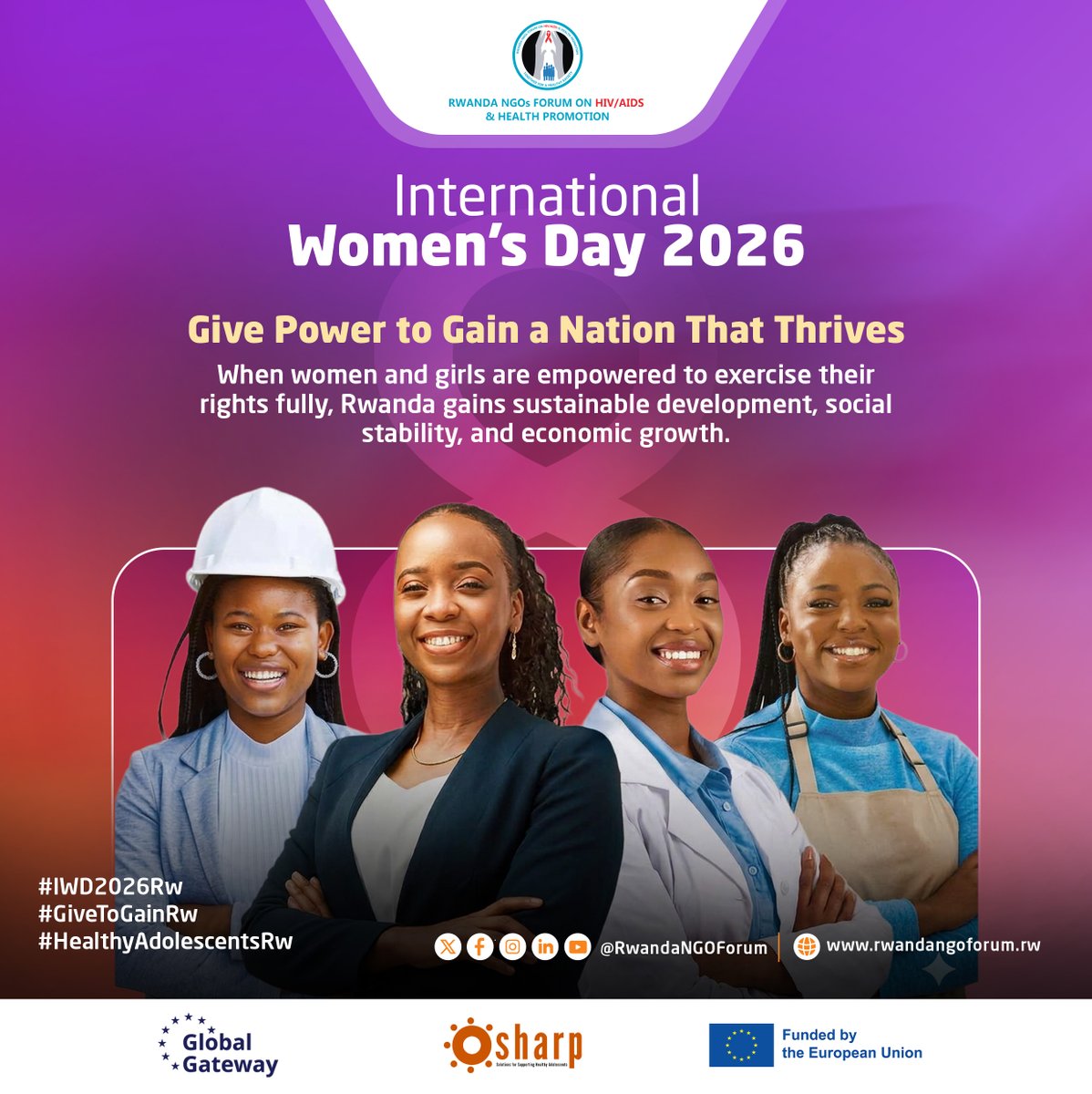
Happy Women’s Day 2026
Give Power to Gain a Nation That Thrives
On this #InternationalWomensDay , we are reminded that empowering women and girls is not only about advancing individual rights, it is about strengthening entire nations. When women and girls have the power to access opportunities, make decisions, and exercise their rights fully, societies become more resilient and inclusive. Their leadership, ideas, and contributions drive progress in every sector, from education and health to governance and the economy.
In #Rwanda , the empowerment of women and girls has proven to be a powerful driver of national development. When girls are supported to learn, lead, and participate fully in society, communities become stronger and more stable. Protecting their rights and expanding their opportunities helps build a generation that is healthier, more confident, and ready to shape the future.
Giving power to women and girls means giving power to a nation that thrives. As we mark #InternationalWomensDay2026 , let us continue to champion equality, invest in the potential of women and girls, and create spaces where their voices are heard and valued. When women rise, communities prosper, and nations move closer to a future of sustainable development, social stability, and shared prosperity.
#IWD2026Rw
#GiveToGainRw
#HealthyAdolescentsRw
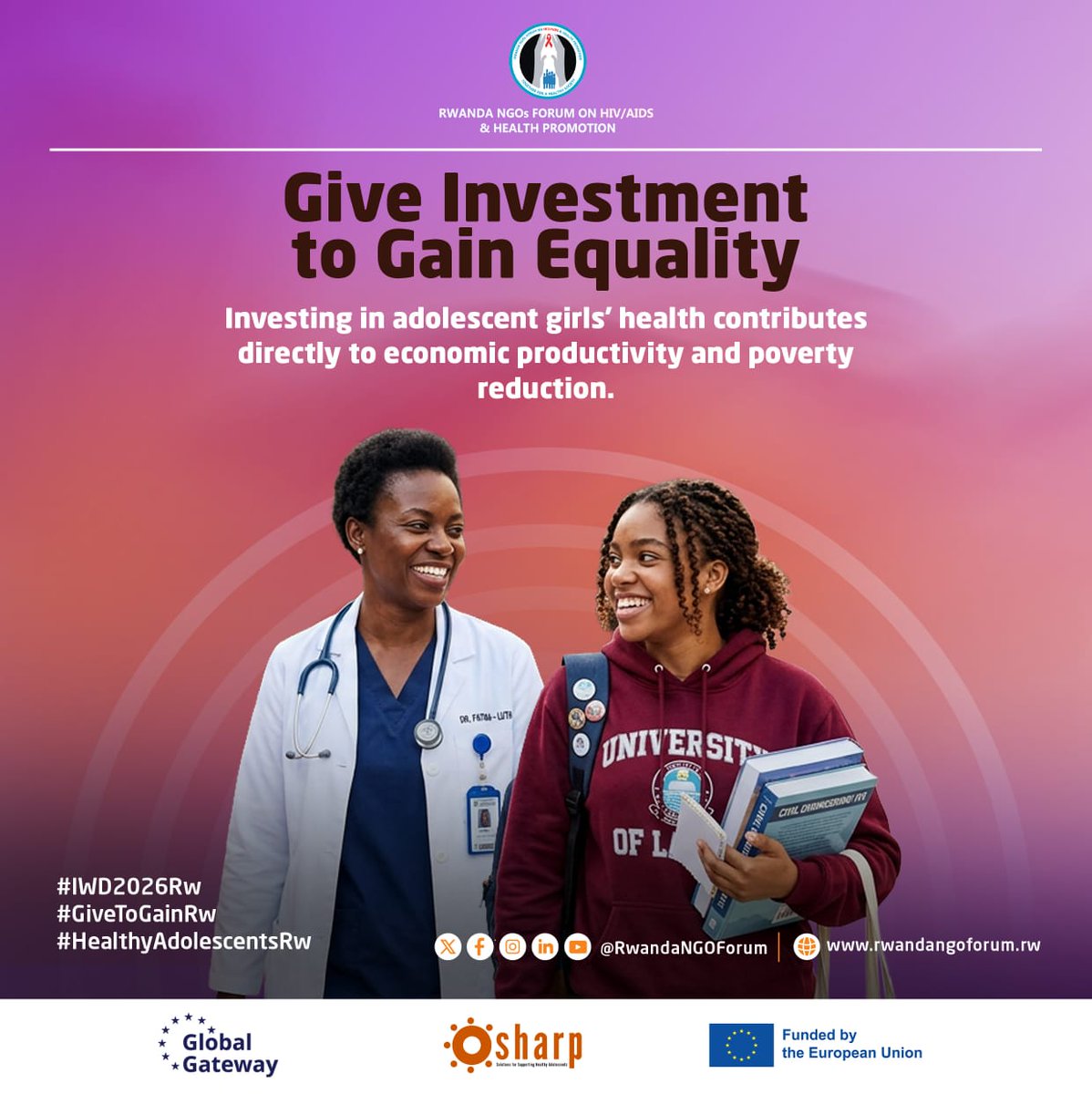
Give Investment To Gain Equality
Investing in adolescent girls’ health is one of the most powerful ways to build a more equal and prosperous society. When girls have access to quality healthcare, accurate information, and supportive environments, they are better able to stay in school, make informed decisions, and pursue their ambitions. Protecting their health today strengthens their opportunities tomorrow.
Yet too many adolescent girls still face barriers that limit their ability to reach their full potential. Limited access to health services, harmful norms, and economic challenges continue to place girls at greater risk of poor health outcomes and missed opportunities. Prioritizing investments in adolescent girls’ health is not only a health issue, it is a critical step toward reducing poverty and advancing gender equality.
When we invest in girls, we invest in stronger families, resilient communities, and sustainable economic growth. Empowered and healthy girls grow into empowered women who contribute meaningfully to their communities and economies. Investing in adolescent girls’ health today is an investment in equality, dignity, and a more prosperous future for all.
#IWD2026Rw
#GiveToGainRw
#HealthyAdolescentsRw
Youth-friendly healthcare services create opportunities for adolescents to learn and grow. Access today means healthier futures tomorrow.
#IWD2026Rw#GiveToGainRw#HealthyAdolescentsRw