Co-founder, Recursive. Professor, CS, U. British Columbia. CIFAR AI Chair, Vector Institute. | ML, AI, deep RL, deep learning, AI-Generating Algorithms (AI-GAs)
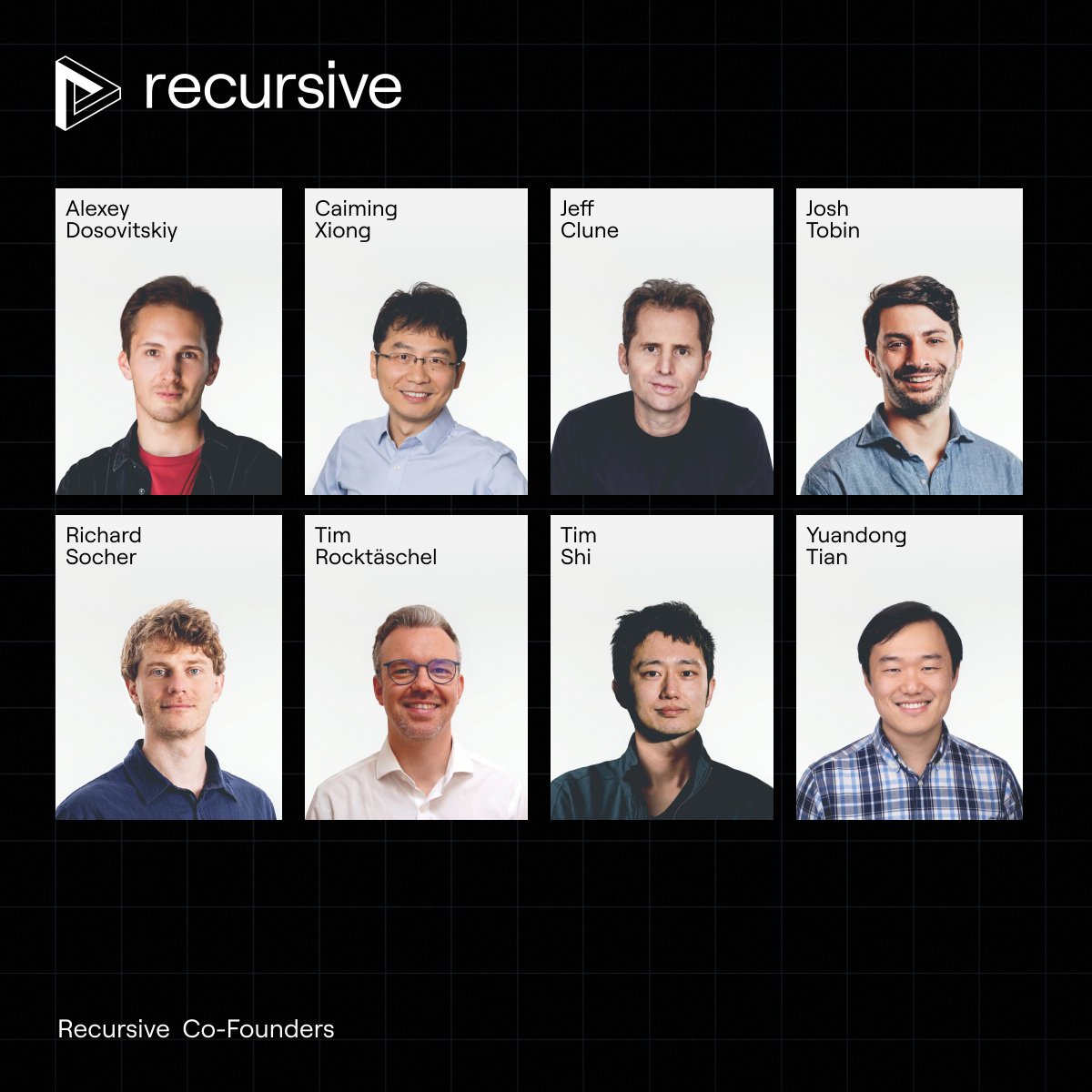
Thrilled to share that we founded Recursive to create AI that safely conducts experiments on how to improve itself in an open-ended process of endless, automated scientific discovery. As I wrote in my 2019 AI-generating algorithms paper, this will likely be the fastest path to superintelligence. Our work since has shown the power of this approach. Excited to scale up and improve upon ideas like the Darwin Gödel Machine, HyperAgents, ADAS, OMNI, ALMA, The AI Scientist, PromptBreeder, Rainbow Teaming, Automated Capability Discovery, and other work on open-ended and AI-generating algorithms. We’ve assembled a dream team of researchers and significant resources to pursue this vision. My amazing co-founders are pictured here, and we have an all-star team of founding members (we’re over 25 and growing).
Please join us if you are interested! Follow our progress @Recursive_SI
Confession: I always click "steer", consequences be damned! Dear labs: can we just make the AI ok to take my comments/new input whenever I like, instead of creating anxiety about whether I am derailing AI? Let's make the AI handle it gracefully!
@zhengyaojiang “The first experimental evidence of recursive self-improvement (RSI).” 🤔
What about the Darwin Gödel Machine, HyperAgents, and our work at Recursive on First Steps Toward Automated AI Research, among lots of other work?
The system is The AI Scientist – published in @Nature, co-authored by Vector Faculty Member @JeffClune alongside researchers from @SakanaAILabs, @UBC and @UniofOxford.
Starting from a broad research direction, it autonomously:
– Reviews existing literature
– Generates novel hypotheses
– Writes, executes, and debugs experimental code
– Analyzes results and produces figures
– Writes and self-reviews the complete manuscript
Most people follow AI through a few big names.
Useful. But that’s like following a company through press releases: you see what’s announced and miss what’s forming underneath.
I went one layer down.
10 to start. 20 more.
Not a ranking. Just where I’d look for signal. ↓
Nice to see Automated Design of Agentic Systems (ADAS), the Darwin Gödel Machine, DGM-HyperAgents, and The AI Scientist all covered in this nice review of the growing field of ADAS by @lilianweng
new post on harness engineering for AI self-improvement: https://t.co/ZYvGfVs61k
It is hard to forecast how much the future of RSI will rely on harnesses. Likely harness engineering will evolve in the direction of self-improvement and enable auto-research, and, in turn, smarter models keeps harnesses simple.
Even when many harness improvement get eventually internalized into core model, the need to specify goals and context will not disappear.
Nice to see The Darwin Gödel Machine and HyperAgents on @skdh's Science News. We continue to pursue these ideas @Recursive_SI in case you want to follow along and/or join.
Loved @RichardSocher’s demo for his new AutoResearch platform crushing becharks on ML training speed, accuracy, and kernel writing. Very cool SoTA results in kernel writing:
Today, we give robots a /skills library that self-evolves and compounds indefinitely! Introducing ASPIRE: a robot solving its 100th task is no longer as clueless as solving its first. Coding agents observe multimodal sensory traces from simulation and real robots, launch an evolutionary search over control programs, and distill the best know-how into an ever-expanding library.
ASPIRE is a new type of continual learning: "training" is skill refinement instead of gradient descent.
"Trained model" is a repo of sensorimotor skills instead of floating weights.
“Distributed training” is a panel of agents each practicing a different skill instead of sharded minibatches.
Here's the beauty: ASPIRE gives the tired terms "sim2real transfer" and "cross-embodiment transfer" a whole new meaning. Bridging the sim-to-real gap is notoriously brutal. An end-to-end policy has to swallow both the visual shift (sim looks toyish next to a real camera) and the subtle contact physics it never quite gets right. ASPIRE sidesteps the mess, because it doesn't ship pixels or weights across the gap, but ships the know-how. The robot still has to practice in the real world, not zero-shot, but it gets there way faster because it isn't rediscovering the strategy from scratch. Same for going single-arm to bimanual hardware, which usually requires new data and retraining from zero. ASPIRE achieves up to ~10x cut in "transfer learning” tokens (yes, tokens are the new unit of *training* compute ;)
Check out our gallery of 150+ tasks and 90+ skills the robots taught themselves, all on the website! Kind of wild that we can ship the "learned weights" as an HTML page rather than a GGUF. We'll open-source the full stack so your own robot library starts compounding from ours!
Deep dive in thread:
👥 🙌 Execution Agents (Coding Agents) should co-evolve with the Judge/Verifier Agents (Agent-as-a-Judge):
“We begin by showing that even on verifiable coding tasks, the RQGM improves test pass rate over the prior SOTA by adding a complementary agent-as-a-judge code-review signal.”
🧑💻The Red Queen Gödel Machine:
https://t.co/eAFTo1ikgA
🧑⚖️ Agent-as-a-Judge:
https://t.co/vVufIoBX03
Amazing to see the arc from Genie being an early research idea and prototype to a major Google product to a Cannes Gran Prix no less! Working in AI is full of surprises. Almost like living in a dream. Congrats to the entire Genie team!
Huge congratulations to the Project Genie team on taking home the Cannes Lions Grand Prix for AI Craft! 🎉 Thank you @Cannes_Lions for recognizing how Genie pushes beyond conventional creative limitations to achieve outcomes unattainable without frontier AI… Another unexpected consequence of scaling world models :)
Try it yourself here: https://t.co/rPwpsC2VHp
It has been an absolute privilege and pleasure to build up @UCL_DARK with @egrefen, @robertarail and @jparkerholder over the past eight years. Yesterday, the UK government announced not just one but two national academic fundamental AI research labs. I am extremely excited to announce that @UCL_DARK will be sunsetted and merge with @FLAIR_Ox, @whi_rl, @UCL_LASP and AIRL, to form the British Open-ended Learning and Discovery (BOLD) Lab — @BOLD_Lab_AI.
This is a huge moment for academic AI research in the UK. Backed with £30m by @UKRI_News and @EPSRC, it provides a unique opportunity to attract leading international academic talent to the UK, and equip them with the computational resources to do groundbreaking exploratory AI research (more on the computational resources soon). It also creates a mentorship network of academics, industry leaders and entrepreneurs to educate young talent on how to translate fundamental AI research into real world impact.
I want to thank all the students who made @UCL_DARK successful, in particular our PhD alumni @MinqiJiang, @_samvelyan, @zhengyaojiang, @_robertkirk, @akbirkhan, @LauraRuis, @YingchenX, @PaglieriDavide, and the work of our honorary faculty @egrefen, @robertarail and @jparkerholder who were generously contributing to mentorship and research in their free time.
Very excited to launch BOLD 🚀
BOLD is a national shot at ambitious bluesky fundamental AI research in an academic setting, fully committed to open-source and open-science.
BOLD's mission are research bets that would reshuffle the deck in AI if true. It will also be a launchpad for fast-tracking the British and European tech scene.
Oh - and @FLAIR_Ox is no more.
Alife was my co-first home conference (along with GECCO). Intellectually, it is my childhood home. It is a tremendous honor to be invited back to give a keynote! I very much look forward to it.
We're excited to start unveiling the keynote speakers for #ALIFE2026!
First up: @jeffclune (@UBC), presenting:
"Open-Ended, Quality Diversity, and AI-Generating Algorithms in the Era of Foundation Models"
Join us in Waterloo, Canada, 17–21 Aug, 2026.
https://t.co/1tGM17DQXk
We're excited to start unveiling the keynote speakers for #ALIFE2026!
First up: @jeffclune (@UBC), presenting:
"Open-Ended, Quality Diversity, and AI-Generating Algorithms in the Era of Foundation Models"
Join us in Waterloo, Canada, 17–21 Aug, 2026.
https://t.co/1tGM17DQXk
😃🚀✨
"Recursive's automated AI research system achieved state-of-the-art across three of the most demanding ML systems benchmarks: ...
Hitting one of these alone would be a commendable achievement. To hit three benchmarks that operate at fundamentally different levels of the stack (training algorithms, optimization loops, and GPU kernel efficiency) suggests something qualitatively different from prior approaches, and something powerful. " - Katie Lockwood, (source: https://t.co/8HfeRgLEAM)