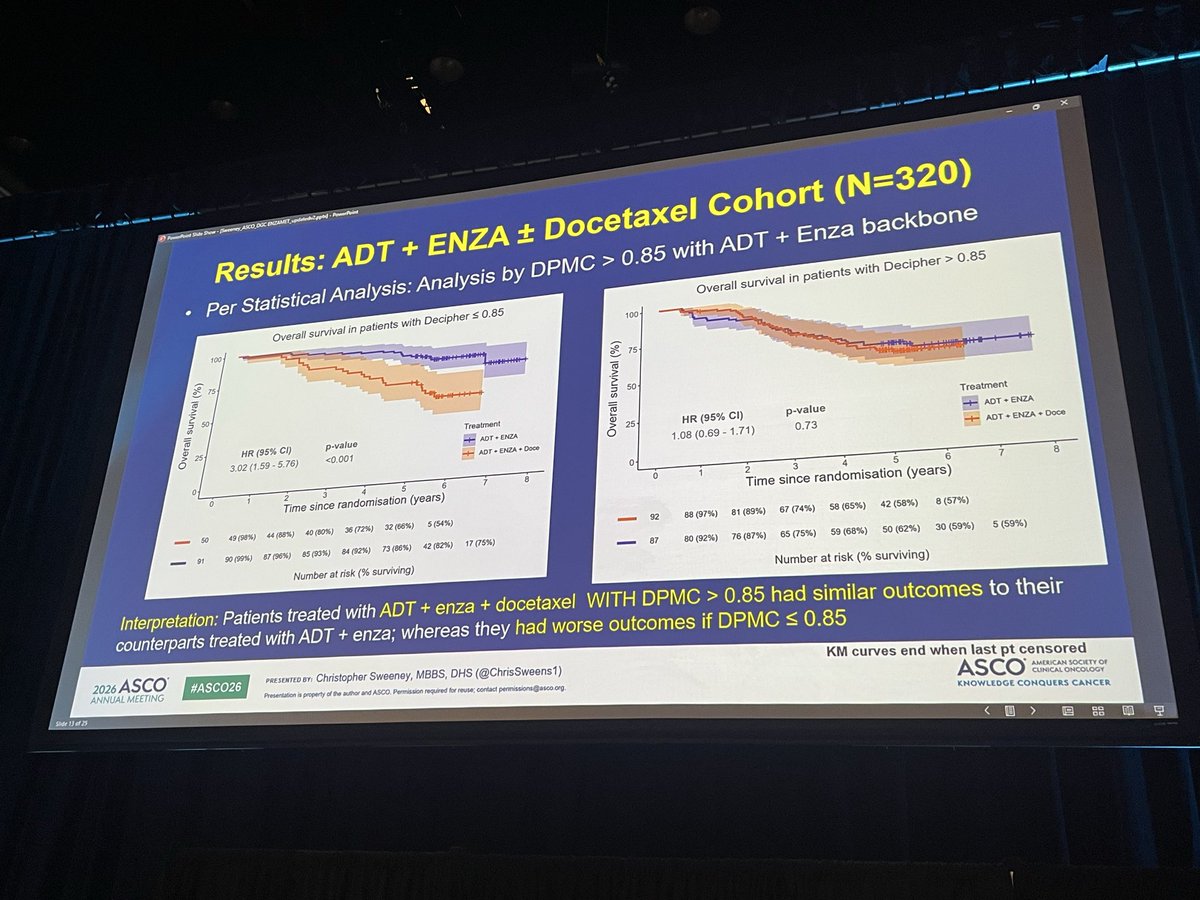
Predicting docetaxel benefit with a genomic classifier in #mHSPC. @ChrisSweens1@SAiGENCI joins @TDorffOnc@cityofhope presenting a Decipher® genomic classifier analysis of the ENZAMET trial, applying the 22-gene assay to determine which patients with metastatic hormone-sensitive prostate cancer benefit from adding docetaxel to ADT + enzalutamide. #WatchNow > https://t.co/oGMYWZkC84 @Decipher_VCYT@Veracyte
This weekend's #ASCO26 sessions put a spotlight on key advances in urologic cancers. Here's a recap from a session, where Christopher Sweeney, M.B.B.S., Adelaide University, presented new data from the #ENZAMET phase 3 trial.
The talk explored whether the Decipher® Prostate Genomic Classifier can identify which patients with metastatic prostate cancer may benefit from adding the chemotherapy docetaxel to androgen deprivation therapy (ADT) plus enzalutamide (also known as triplet therapy), and which may safely avoid it.
| Primary Takeaway |
🔹 The #DecipherProstateTest identifies which metastatic prostate cancer patients may benefit from treatment intensification, and which can be safely spared chemotherapy, giving clinicians an actionable, evidence-based answer.
🔹 The ENZAMET findings build on prior validation in the STAMPEDE and CHAARTED trials, where Decipher Prostate identified patients most likely to benefit from adding docetaxel to ADT alone.
🔹 ENZAMET advances that evidence with the first demonstration that the test predicts chemotherapy benefit when added to doublet therapy (ADT plus an androgen receptor pathway inhibitor, like enzalutamide).
| Some Thank You's |
💙 We're grateful to Dr. Sweeney for sharing these important findings with the oncology community and for an ongoing commitment to improving care for the millions of men living with prostate cancer worldwide, including about 30,000 in the US who present with metastatic disease at diagnosis.(1,2)
💙 Thank you to everyone who joined the session and to the investigators, site teams, and participants whose contributions made this research possible.
| Additional Resources |
Learn more about the Decipher Prostate Genomic Classifier - https://t.co/6VCW4sx9ni
ENZAMET Trial Information - https://t.co/lNVWqagngG
STAMPEDE Trial Information - https://t.co/L8BeRIGLwU
CHAARTED Trial Information - https://t.co/iLkF5W8YOM
| References |
(1) https://t.co/Q5XE5pcH6e; https://t.co/IiAknUacvv
(2) https://t.co/XdMlZgAoet
Note: This article contains forward-looking statements, which involve risks and uncertainties. For more information visit: https://t.co/fQcKkGFugi
#DecipherUrologicCancers #ProstateCancer #PrecisionMedicine #ClinicalTrials #TeamVeracyte
Genomic risk refinement may capture biology beyond conventional clinicopathologic risk groups. #DanielKeizman reports on Decipher testing, which led to NCCN risk reclassification in 57% of cases and identified distinct molecular phenotypes associated with tumor aggressiveness.
#ASCO26 #ProstateCancer #GUOnc @ASCO
#ASCO26 GU Oncology Spotlight 🚨
@OncoAlert
🔬 Abstract 5013
Genomic classifier–driven NCCN risk reclassification in early prostate cancer
Presented by Daniel Keizman, MD
@ASCO
Clinical risk in early prostate cancer does not always equal biologic risk.
This real-world analysis evaluated Decipher genomic classifier testing in 1,272 men with early prostate cancer.
🔵 Key finding
Decipher meaningfully reclassified NCCN risk:
➡️ Up-classified: 38%
➡️ Down-classified: 19%
➡️ Unchanged: 43%
And this was not just a “label change.”
Up-classified tumors showed a more aggressive transcriptomic pattern:
🔹 higher proliferation
🔹 DNA-repair / immune pathway enrichment
🔹 Luminal B enrichment
🔹 reduced AR signaling
🔹 lower TP53/PTEN activity
Down-classified tumors showed the opposite pattern, with preserved AR signaling and PTEN activity.
🔵 Why it matters
This supports the idea that genomic classifiers may refine NCCN risk beyond conventional clinicopathologic variables.
The clinical question becomes:
➡️ Who needs intensification?
➡️ Who can avoid overtreatment?
➡️ When does genomic risk justify changing the plan?
🟠 Caveats
Retrospective real-world analysis.
Clinical outcome validation and implementation remain key.
Also important: access and cost matter — especially if genomic testing requires out-of-pocket payment.
🔵 My take
Decipher-driven reclassification may help identify biologically higher-risk disease that clinical NCCN grouping alone can miss.
But the value of any biomarker depends on whether it changes a real decision:
surveillance, radiation, ADT, intensification, or de-escalation.
@DrChoueiri 🇺🇸@hoperugo 🇺🇸 @matteolambe 🇮🇹 @TiansterZhang 🇺🇸 @CathyEngMD 🇺🇸 @stolaney1 🇺🇸 @montypal 🇺🇸 @tompowles1 🇬🇧 @brian_rini 🇺🇸 @cdanicas 🇪🇸 @NiuSanford 🇺🇸 @amerseburger 🇩🇪 @GlopesMd 🇺🇸 @Icro_Meattini 🇮🇹 @PGrivasMDPhD 🇺🇸 @DrYukselUrun 🇹🇷 @nataliagandur 🇦🇷 @ElisaAgostinett 🇧🇪 @HHorinouchi 🇯🇵 @realbowtiedoc 🇺🇸 @to_be_elizabeth 🇮🇹 @UOzkerim 🇹🇷 @p_ciracimd 🇮🇹 @DrVilmaPBarcia 🇪🇸 @DraMartinezLago 🇪🇸 @DrMirallas 🇺🇸 @GaiaGriguolo 🇮🇹 @MarioBalsaMD 🇪🇸 @scocmem 🇬🇧 @AmandaNizamMD 🇺🇸
#ASCO26 #GUOnc #ProstateCancer #PrecisionOncology #Biomarkers #Decipher #ClinicalAlgorithms #PatientSelection
@OncoAlert@WeOncologists
@chrissweens1 presents level 1B evidence from ENZAMET suggesting Decipher GC >0.85 may identify pts deriving benefit from docetaxel intensification alongside ADT + enzalutamide, while no clear benefit signal was observed for GC ≤0.85.
#ASCO26 #ProstateCancer
@O@OncoAlert@ASCO@OncBrothers
Interesting biomarker-driven analysis from pooled NRG/RTOG trials by @Krishnan_Patel : integrating a genomic risk classifier with NCCN clinical features may help refine selection for abiraterone intensification in high-risk localized prostate cancer.
#ASCO26#ProstateCancer@OncoAlert@ASCO@OncBrothers
Can genomic data, not just PSA or MRI, guide your next prostate cancer treatment plan? Dr. Ruchika Talwar and Dr. Udit Singhal discuss biomarker tests and how they can supplement traditional testing strategies to reveal hidden molecular heterogeneity, inform prognosis, and predict treatment response in real-world practice.
Watch the full episode here:
https://t.co/nR1WgrGbIM
This podcast is supported by Veracyte.
#URO301 #ProstateCancer #Biomarkers #GenomicTesting
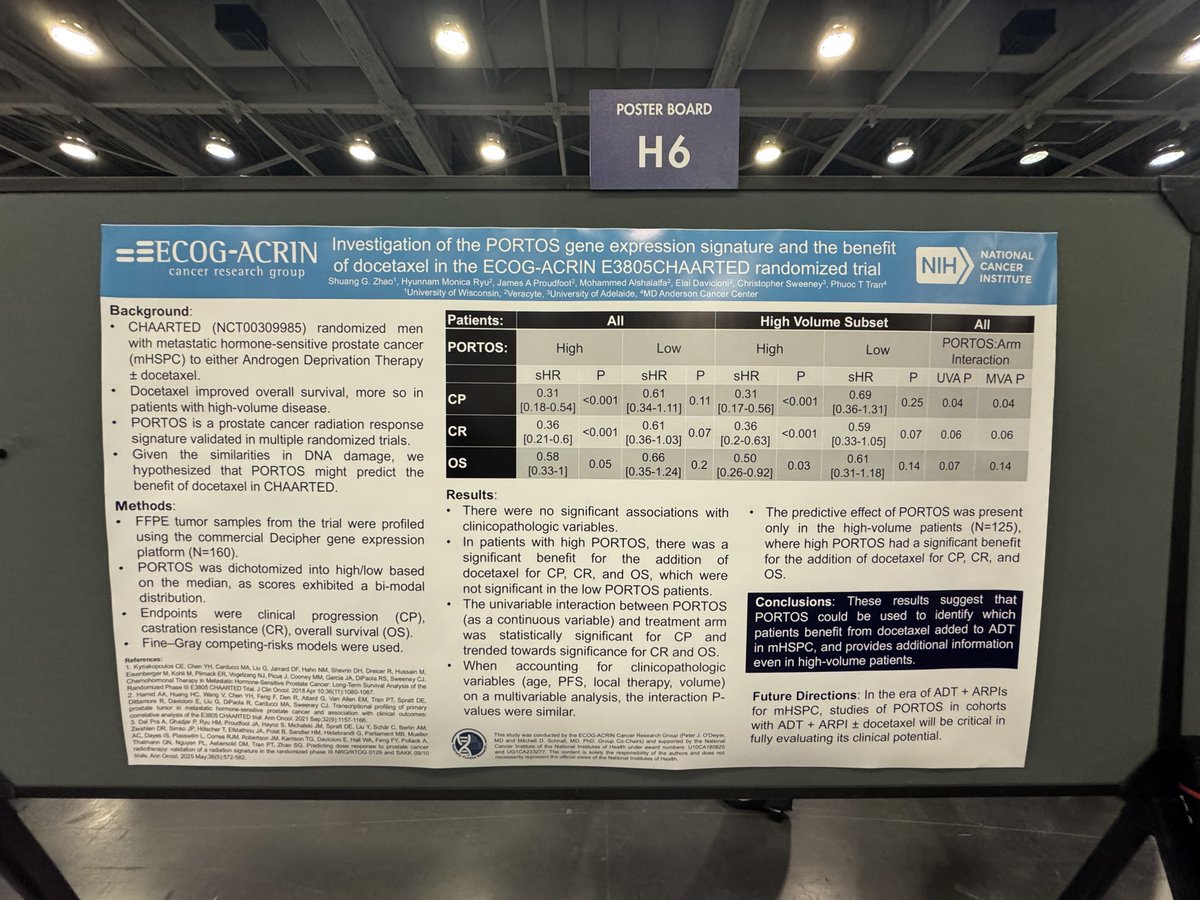
PORTOS: not just for radiation! Also may have prognostic benefit in setting of docetaxel for #prostatecancer. Q is how to consistently integrate it with Decipher, PAM50, the the growing "etc" list @Decipher_VCYT#gu26
🎉 Congrats to @NRGonc & PIs @ndesai2005 and @aleberlin2 on hitting accrual target for NRG-GU010 (GUIDANCE)!
Thank you both for partnering with us to create the 3-part video series—trusting PRIMR to produce patient-centric educational content.
#ProstateCancer#ClinicalTrials
📢 The primary clinical and biomarker results of #SURE02 are released today in @TheLancetOncol simultaneously with the poster presentation #GU26@ASCO
Is was a huge effort. Key observations:
- first trial of ADC+IO approach in a perioperative setting of #MIBC within a bladder-sparing strategy
- clinical cCR use is consistent with Milan consensus definition BUT was not the biomarker used for bladder preservation
- reTURBT vs RC was an informed patient decision
- cCR rate 39%
- 12-month EFS in ITT 71% raising to 90% in CR pts
- no metastases events in the reTURBT group, indicating that delaying RC can be safe within a maintenance therapy design
- cCR enriched in Luminal subtype tumors pointing to the contribution of SG over pembro
- Sacituzumab dose was 7.5 mg/kg with GCSF support resulting in no G4 events and very manageable tolerability
TROP2 targeting can be effective in newer flexible strategies for pts with MIBC
@BrigidaMaiorano@vale_tateo@Anto_cigliola@CMercinelli@JoepJdeJong@Davicioni@SanRaffaeleMI@MyUniSR
https://t.co/CJ9bjlDFTj
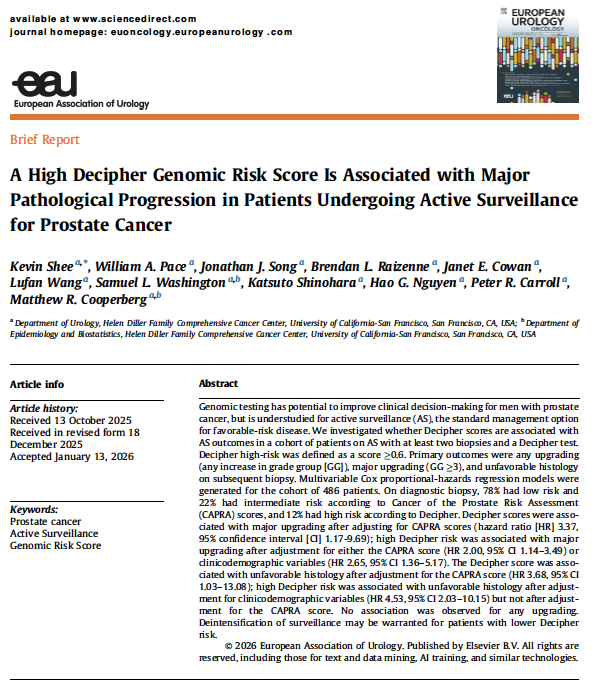
#GU26 Dr. Tward: PAM50 × Decipher in BCR after RP
🧬 Luminal B tumors had the highest Decipher scores (median 0.80)
🔺 41.5% Luminal B were GC 0.85–1.00
⚡ ADT with salvage RT strongly ↓ metastasis in Luminal B (SHR 0.10)
❗ No significant subtype–ADT interaction
Take-home: Don’t withhold ADT based on non–Luminal B alone, genomic risk still matters!
@ASCO@UroToday
#GU26 Dr Moningi examined Decipher in de novo mPCa:
🧬 Largest real-world linkage of transcriptomic + clinical data (n=135K)
🔎 509 de novo metastatic vs 10,689 matched localized
🔺 Higher Decipher scores (0.94 vs 0.75)
🔺 ↑ Luminal B (65%) & PTEN inactivity (25%)
🔺 More NCCN high/very high risk
Biology matches the phenotype — genomically aggressive from the start.
@ASCO@UroToday
📝#PURE01 trial continues to strike.
Updated 5y OS from PURE-01, a Phase 2 Study of Neoadjuvant Pembrolizumab Followed by Radical Cystectomy in Patients with MIBC (N=155):
- 5y EFS 68%
- 5y OS 77%
- claudin low subtype tumors confirming outstanding benefit
Pembro monotherapy remains the unsolved comparator arm of perioperative trials
https://t.co/YIuQlk4oSG @vale_tateo@CMercinelli@BrigidaMaiorano@Anto_cigliola@giannatempopatr@urotoday@OncoAlert@EUplatinum
Analysis of genomic drivers of discordant risk classifications in #ProstateCancer. Michael Zelefsky, MD @nyulangone joins @DrSpratticus@caseccc discussing an extensive genomic profiling analysis, examining over 200,000 prostate biopsies to illuminate discordances between traditional NCCN risk groups and #Decipher genomic classifier scores. #WatchNow > https://t.co/5uZEYkSSJB @Decipher_VCYT
NRG-GU006 trial for post-prostatectomy radiation therapy. @DrSpratticus@caseccc joins @jmmrad@WashUMedRadOnc to present the NRG GU006/BALANCE trial results, demonstrating PAM50 molecular subtypes as the first prospectively validated predictive biomarker guiding hormone therapy decisions in recurrent #ProstateCancer. #WatchNow on UroToday > https://t.co/s0VyiZcKy3 @Decipher_VCYT@NRGOncology