Surprise 1: Anthropic acquired a one-person biotech
.
.
.
Surprise 2: that person is me
Surprise 3: I’m here to tell you all about it
Yes, this is what you think it is; after 6 yrs of increasingly loose anonymity: the Professor Oak reveal post
…and yes, it has gotten so boring around here that I’m literally doxxing myself to spice up the timeline
-------
Ok, allow me to introduce myself. My name is Cody Tranbarger. I mostly tweet, but occasionally find time to dabble in drug dev & starting/building biotechs. My past lives span the VC, crossover, startup continuum; Prof Oak has been my way of keeping a digital foot in those worlds, despite having my physical feet planted elsewhere.
The past 18 mo, ‘elsewhere’ was Mithril Medicine, a co. I founded to develop bsAbs for LAMA2-CMD & other ECM-related genetic diseases.
Mithril was born out of hands-on building with @MikeNGladstone, @JasonPaulRhodes, @LifeSciVC, & team @atlasventure. Somehow, I made enough half-decent calls along the way (even a broken clock is right twice a day, eh?) to convince them Mithril/I warranted a small seed. While I can hardly rationalize such an outrageously cavalier bet, I’m grateful for it, & I'd partner with Atlas again in a heartbeat.
In typical AV fashion, Mithril’s primordial form was virtual, decentralized, & ultra-lean. This stage tends to be short-lived, but for Mithril, it worked surprisingly well, for surprisingly long, thanks in part to the rapid maturation of the AI tools I used liberally.
Eventually, Mithril became a bit of an experiment itself - to find the upper bound of how far it could scale as a single operator + a bunch of Claude (+ a stellar bench of part-time consultants).
In parallel, I started spending time with @nc_frey, @an1lam, & @CoefficientBio team; and promptly experienced, for the 1st time, AI at the frontier. Soon thereafter, Mithril stopped looking like an experiment, & started looking like a preview of an entirely new operating model.
From that spark came “Pipeline-in-a-Person.” The idea immediately resonated when we shared it here back in April; and it was central to the shared vision that led to Anthropic’s acquisition of Mithril, & my joining the team.
Why join Anthropic? Three reasons.
(1) For Mithril, the programs continue, with more resources & infrastructure behind them, and as much Claude as I can put to work.
(2) For me, the chance to start several more programs, & find out how many one person can actually run in parallel - an almost unprecedented luxury for a curious drug hunter.
(3) For our mission, a path to institutionalize & scale this new way of working, then put it in the hands of all of biopharma, all over the world - which, candidly, I find the most energizing.
Will AI x Bio cure diseases? Unequivocally yes, imo… but not by the route that gets the most airtime. Rather than timeline acceleration & compression, I see orchestration & parallelization as today's low-hanging fruit.
Most drug hunters see a handful of go/no-go calls in a career, & spend entirely too much of the rest trading emails (my inbox can attest).
Give them the bandwidth to run several programs at once, and the time to focus on scientific judgment, and I’m willing to bet they’ll make better calls. And at scale, better calls translate to more drugs, higher hit rates, broader patient impact, & likely, a disease or 10 or 100 cured. I couldn't be more excited to build toward that future @AnthropicAI.
Finally, a heartfelt thank you to BioTwitter/X. The end of anonymity is bittersweet, but if anyone’s earned a proper introduction, you all have.
It’s difficult to overstate how much this app has done for me: a decade of education, plenty of friends, many job opportunities, several mentors, a few investors, even a co-founder (fmr). It was the generosity of this community that inspired me to start posting 6 years ago, after just as many years lurking. I hope I’ve been able to pay it forward, in my own small way.
But, to be clear, Prof Oak isn’t going anywhere. Same beat, same themes, and now, a front-row seat to drug development at the frontier. Stay tuned for dispatches from the trenches; and remember...
Gotta Cure 'Em All
Big news: Kimi-K3 by @Kimi_Moonshot is now #1 in the Frontend Code Arena with 1679 pts, surpassing Claude Fable 5.
This is a 17-place jump from Kimi-k2.6 (#18 -> #1).
In Frontend, Kimi-K3 ranked #1 in 6 of 7 domains: Brand & Marketing, Reference-Based Design, Data & Analytics, Consumer Product, Simulations, and Content Creation Tools, landing #2 only in Gaming behind Fable 5.
The full model weights will be released by July 27.
Congrats to the @Kimi_Moonshot team on this major milestone!
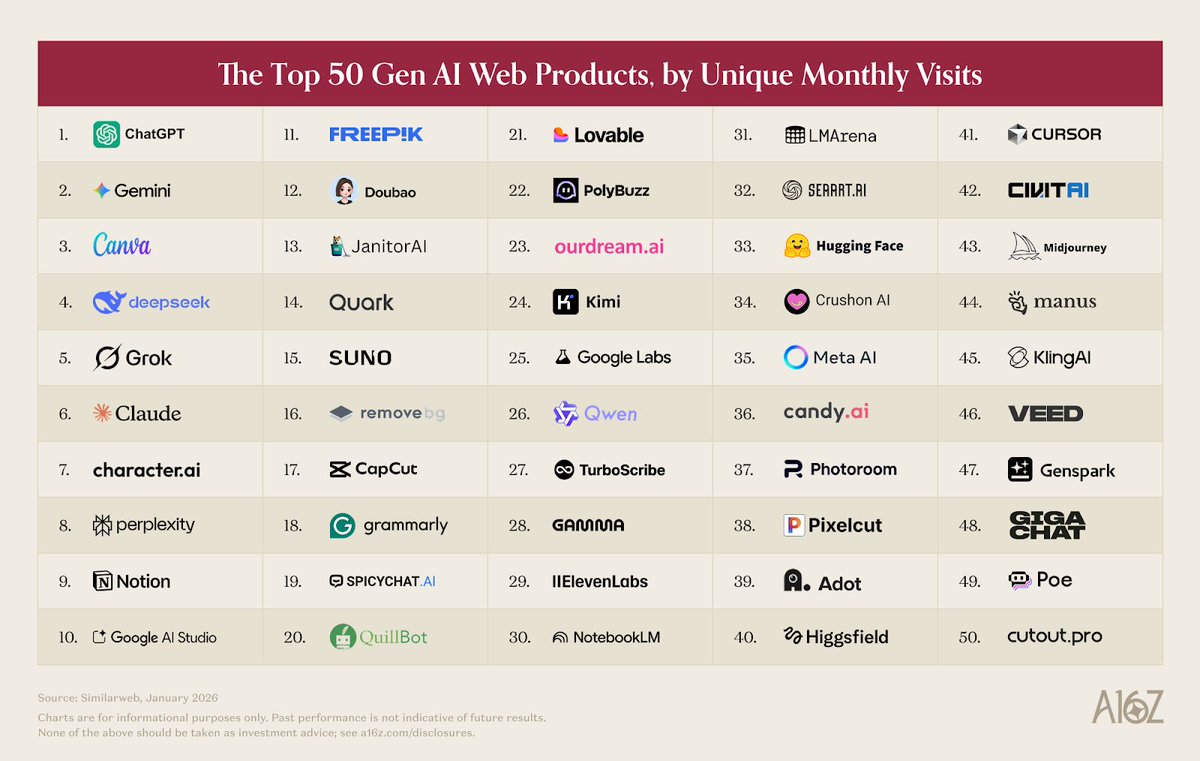
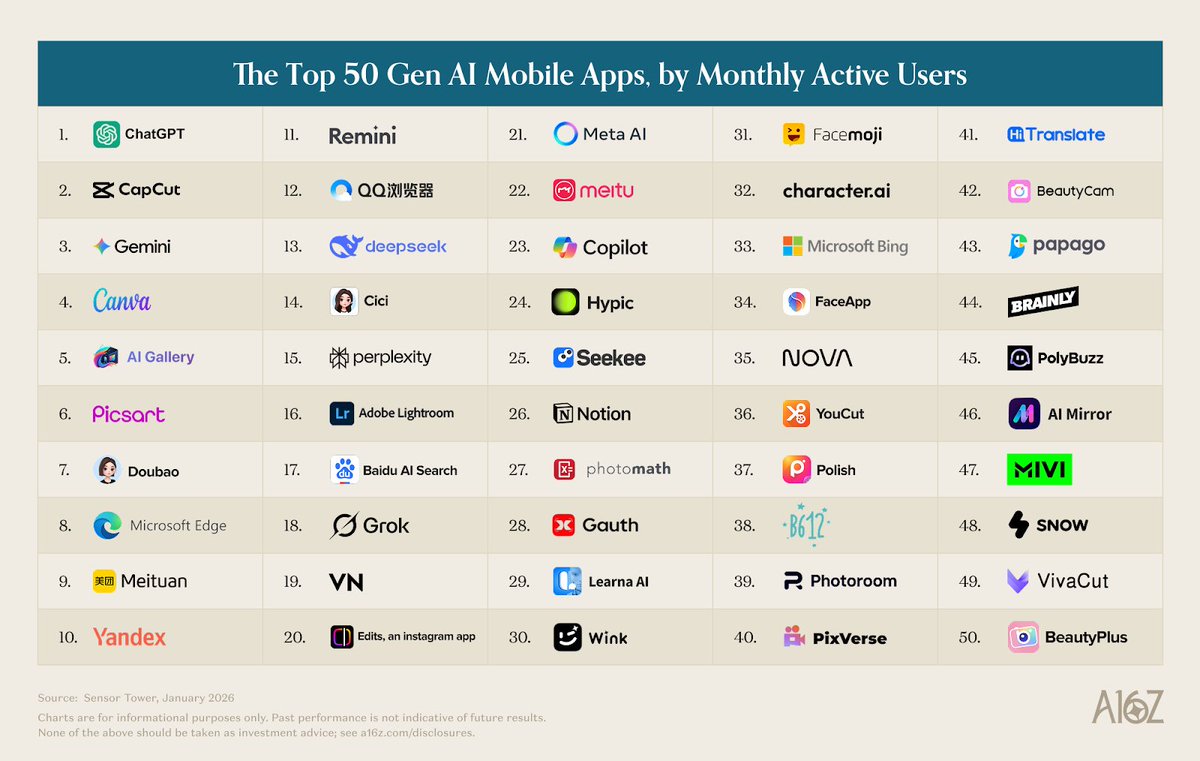
🚨 The @a16z consumer AI Top 100 is back!
For the sixth time, we ranked consumer AI websites and mobile apps by usage (monthly unique visits and MAUs).
This edition, we changed the rules. Here's why - and what the new list says about where consumer AI is heading 👇
Congrats to @maxhodak_ and the @ScienceCorp_ team on their $230M Series C!
Their PRIMA implant is letting blind people see again: improved vision in 26 of 32 trial patients with advanced macular degeneration. They're on track to be the first BCI company to bring a vision restoration product to market.
https://t.co/mX0cdpt5LV
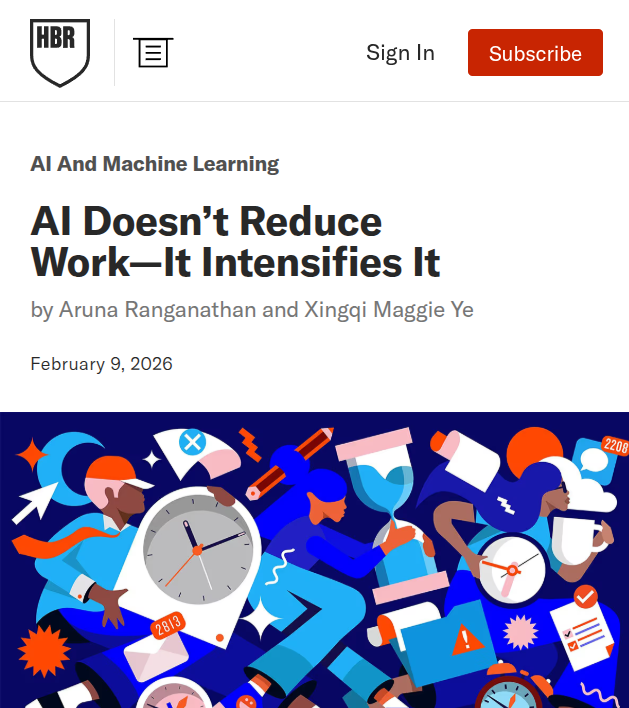
Powerful new Harvard Business Review study.
"AI does not reduce work. It intensifies it. "
A 8-month field study at a US tech company with about 200 employees found that AI use did not shrink work, it intensified it, and made employees busier.
Task expansion happened because AI filled in gaps in knowledge, so people started doing work that used to belong to other roles or would have been outsourced or deferred.
That shift created extra coordination and review work for specialists, including fixing AI-assisted drafts and coaching colleagues whose work was only partly correct or complete.
Boundaries blurred because starting became as easy as writing a prompt, so work slipped into lunch, meetings, and the minutes right before stepping away.
Multitasking rose because people ran multiple AI threads at once and kept checking outputs, which increased attention switching and mental load.
Over time, this faster rhythm raised expectations for speed through what became visible and normal, even without explicit pressure from managers.
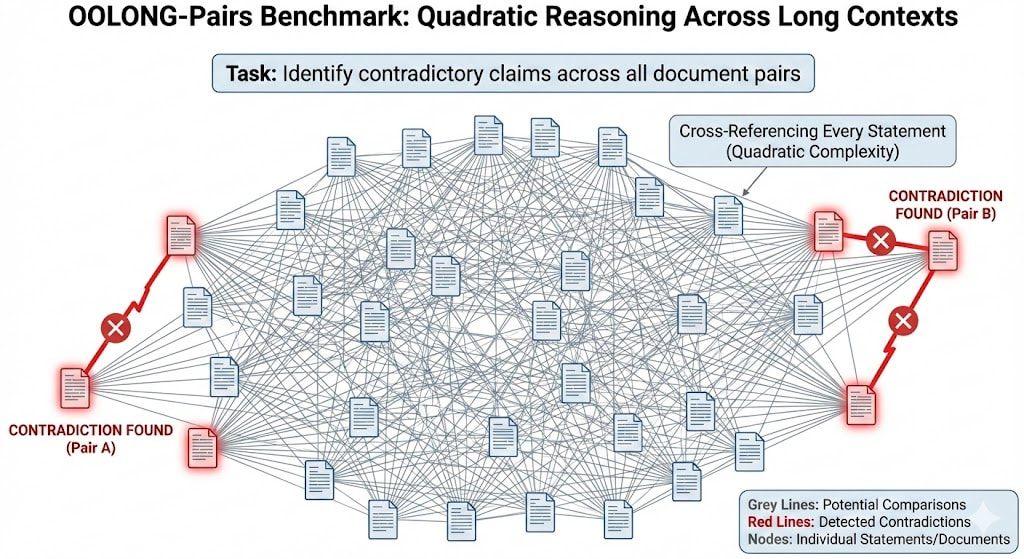
Recursive Language Models (RLMs) let agents manage 10M+ tokens by delegating tasks recursively.
This Google Cloud Community Article explains why ADK was the perfect choice for re-implementing the original RLM codebase in a more enterprise-ready format →https://t.co/p3MsNtLVJL
Holy fucking shit is right! This is not DoorDash, and I would fire anyone who promoted or tolerated the kind of culture described in this Reddit post. There’s so much wrong with this post.
- Dashers are not “human assets.”
- Having a metric like a "Desperation Score” is an abomination.
- We’ve never had a “Driver Benefit Fee”.
- Why would you charge for faster delivery but not make it faster??
We’re not perfect by *any* stretch of the imagination, but we work every day to make our platform better for everyone who comes to it. What’s described here is appalling, and if true, whoever is operating in this manner should be ashamed.
What comes after Transformers? Neural Memory and Test-Time Training! @GoogleResearch presented 2 new papers during NeurIPS with an architecture that actively learns and update their own parameters during inference, acting as a "long-term neural memory" rather than a static context window.
Implementation
1️⃣ Titans replaces the fixed-state memory of linear RNNs with a deep Multi-Layer Perceptron (MLP) memory module.
2️⃣ The model updates this memory at test-time by calculating a "surprise metric" based on the gradient of the input data.
3️⃣ MIRAS framework generalizes this by treating memory as an optimization problem with customizable loss functions and regularization.
4️⃣ Training is parallelized by chunking sequences, using linear operations within chunks and non-linear updates across chunks.
5️⃣ Models incorporate "Persistent Memory" (fixed learnable weights) alongside the dynamic "Contextual Memory" to store task-specific knowledge.
Insights
💡 Attention mechanisms excellent at short-term memory but fails at efficient long-term storage due to quadratic costs.
📈 Deep memory structures (MLPs) significantly outperform vector/matrix-based compression used in Mamba and other linear RNNs.
🛠️ Memory updates are effective when driven by "surprise", high gradients indicate unexpected, memorable data.
📚 Forgetting mechanisms in recurrent models are mathematically equivalent to retention regularization (weight decay).
📉 Standard L2 (Mean Squared Error) objectives make memory sensitive to outliers; L1 or Huber loss provides better stability.
🧠 Titans outperforms GPT-4 on "Needle in a Haystack" tasks with 2M+ token contexts despite having fewer parameters.
⚡ Deep memory modules exhibit a trade-off where increased depth improves perplexity but slightly reduces training throughput.
Titans and MIRAS show potential to replace, or at least augment, pure Transformer architectures. The hybrid approach (using attention for the immediate context and Neural Memory for the deep history) suggests the future might be a convergence of RNN efficiency and Transformer performance.
Before we all break for Thanksgiving, I have an idea I wanted to share, after spending most of today thinking about @MSollender and @Sports_bios. (Hudson)
It would be wonderful for all of us to gather virtually to celebrate them and the impact they had on our BioX community.
I’ll organize a Spaces event, maybe in mid December before we all break for the holidays. It’ll be open to everyone and anyone who wants to say a few words about Molly and Hudson.
Stay tuned for details.
Happy Thanksgiving. Hug your loved ones.
@MSollender RIP Molly, always provided such sage perspective. She didn’t tweet as often as other folks, but when she did, I placed a lot of weight on what she said. So sorry for your loss Andrew.
Biotech Idea of the Day; Alector Therapeutics ($ALEC). There is a fair amount of risk with this name, but I don’t think the market has assigned the right probability of success for their lead asset latozinemab treating FTD-GRN. I will outline why I think sentiment is overly negative in a long form post accessible here.
Honestly insane how many of these tier 1 backed VC companies have the same story:
-cofounders from some prestige background sell VCs on some pie-in-the-sky concept that no one wants
-raise $100m+
-hire random roles like a chief AI officer for a non-AI startup
-have 0 users
-exit via OTC deals becoming a multi-millionaire
-“step back” right before vesting renews
IP protocol made $24 in revenue yesterday.
The pitch has also never made sense to anyone who has actually worked with IP licensing.
Meanwhile founders who know their industry inside and out, aren’t flash in the pan and spent decades in their field get passed over for the next Stanford kid with buzzwords who puts on a show.
I’ve tried to always have my angel checks go to actual experienced operators, with all the pros and cons that go with it.
But it’s so disheartening that even the “top VCs” just seem stuck on this loop of rewarding flash over substance.
How the hell do we advance as an industry, if you throw money at smoke, mirrors and grift?