Much Ado About Zone 2 https://t.co/FEguHuVt7b
Influencers can’t get enough of Zone 2 training. So why did @gibalam publish a research paper challenging Zone 2 for the general public? In this episode, we go through a critical examination of Zone 2.
https://t.co/K9DWIYUh4S
@Jason Training : @Garmin
Sleep: @ouraring
Biomarkers: @function
Health and Wellness Chat: @ChatGPTapp
Coverage gap: quick and easy access to an MD if something is off
🚨 New paper in @JPhysiol
🧠💪 The contribution of age and sex hormones to female neuromuscular function across the adult lifespan
📉 Accelerated declines in #strength and intrinsic muscle function around #menopause onset related to sex #hormone changes
👉 https://t.co/BUissBKJz9
Muscle acidosis is real and it decreases performance significantly. However, Lactate is NOTthe reason for muscle acidosis.
Free thread depicting the role of lactate during hgh intensity exercise: 🧵😉 👇
@chamath Small changes in those metrics mainly matter for athletes whose performance is strongly tied to them.
For others, trading them can actually lead to feeling and functioning better.
A new review digs into the science of "lactic acidosis" and muscle fatigue. Key points:
- we don't have "lactic acid" in the body, we have lactate and hydrogen ions, which have separate (and sometimes opposite) effects
- lactate is a useful fuel and doesn't cause fatigue
[...]
A fine run from Eliud Kipchoge in London 🙌
The double Olympic marathon champion and four-time winner in London clocks 2:05:25 ⚡️
The 40-year-old places sixth overall at the London Marathon 🇰🇪
“Eliud remains a big believer.”
Beet juice was big. Then it faded away. A new meta-analysis pools the evidence and concludes that there's probably a real endurance boost if you get the dose and timing (~400g of nitrate for at least 3 days) right.
https://t.co/cvGhB2Q7kV
Maximal aerobic capacity is limited by cardiac output.
But what limits cardiac output?
When we train, stroke volume increases, but maximal heart rate doesn’t. In fact, endurance training often results in a lower maximal heart rate.
In an new review, @ileximius introduces an intriguing hypothesis: nerves that communicate from the heart to the rest of the body (cardiac afferent sensory nerves) may serve a protective mechanism by limiting maximal heart rate to prevent myocardial ischemia.
These nerves, sensitive to metabolic, mechanical, and oxygen states within the heart muscle, potentially function as a regulatory “ceiling,” preventing the heart from reaching detrimental metabolic states. This protective mechanism explains why elite athletes do not simply develop progressively faster heart rates but instead benefit from structural adaptations that optimize stroke volume.
DOI: 10.1113/EP091594
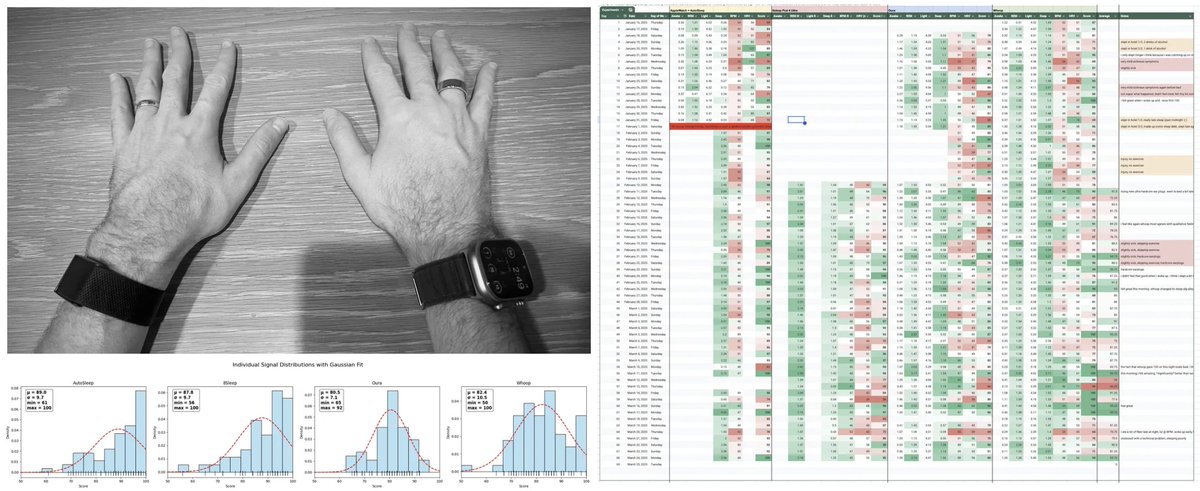
"Finding the Best Sleep Tracker"
Results of an experiment where I wore 4 sleep trackers every night for 2 months. TLDR Whoop >= Oura > 8Sleep >> Apple Watch + AutoSleep. Link simply right here instead of in a reply because ¯\(ツ)/¯
https://t.co/3kGg4mKAaL
Evidence-based fitness doesn't mean relying on research to tell you how to train. Rather, it uses research to guide decision-making and individualizes program design using expertise in combo w/a person’s goals/abilities/lifestyle. See our paper @HeWaHippo
https://t.co/738ErWreID
How to improve fatigue resistance (i.e. how much VO2max, running economy, etc. worsen during a run)? One new study finds heavy strength training and plyometrics work; another paper suggests cumulative training volume plus a shortcut: supershoes.
https://t.co/AOt4CJOOs8
Faith Kipyegon's mile WR is ~3% from 4:00. That's about as far as the men's marathon WR was from 2:00 when Eliud Kipchoge started his sub-2 quest.
Are women ready for Sub4 Project? A new paper argues that they are, and that drafting can get them there.
https://t.co/UMJWY5jhXT