@NatureUnedited As I have been saying, I am pro-Orca. They are highly intelligent. AI will allow us to communicate with them soon. I support first contact efforts to make a species to species alliance with the Orcas. Porpoises too. We want these allies in the ocean.
@RyanDetrick I do think there will be an opportunity in the first year to buy Space X below its IPO price. This chart seems to support that. Certainly exceptions though.
@sean_a_mcclure I’m my world, we call this : The Smart, Dumb Guy. They can be great.
The opposite: The Dumb, Smart Guy can be ok, but has a lot of blind spots.
@agingroy I’ve done all these tests for a very long time. The only one that stands out right now is my ferritin has been stubbornly low for a long time. How do I raise it?
@hpfounder I don’t think this is very instructive. Men with cardiovascular disease are more likely to have trouble finding sexual partners. And, they have less desire. The cause / effect is probably reversed.
@chamath This is why I always tell the young guys : Never marry a liberal woman. It is too risky. Not only is mental illness dramatically higher, divorce rates are higher too.
@johnthenoticer That’s why I always tell the young guys: Never marry a liberal woman. The risks are too high relative to mental illness. Divorce rates are higher too for liberals.
@davidasinclair I have been doing a once a week dose for about 4 years now. Pretty profound benefit to my immune system. I grew up with a germ freak mother, so my system was never great. Used to get sick a lot. That has reduced by like 80%.
@SophieAu This is not enough to live to 120 or it would have happened a lot more. You need to be more aggressive. There are a lot of advanced therapies to pursue.
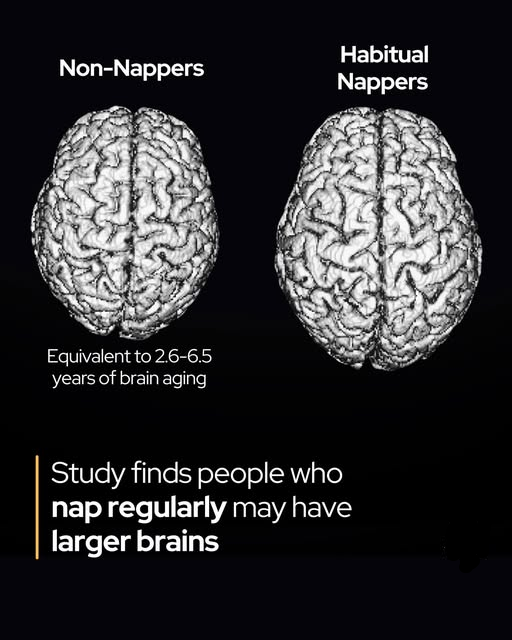
Skip your daily nap, shrink your brain.
A study by researchers from University College London and the University of the Republic in Uruguay has found that people who habitually take daytime naps tend to have significantly larger total brain volume—a key indicator of brain health that typically declines with age and is associated with reduced dementia risk.
The team used Mendelian randomization, a method that leverages genetic variants (present from birth) that make people more likely to nap regularly. By analyzing brain MRI scans and health records from more than 35,000 participants in the UK Biobank, they discovered that those genetically inclined to nap had brain volumes corresponding to 2.6 to 6.5 fewer years of aging.
While this doesn’t definitively prove that napping itself enlarges the brain, the genetic approach helps rule out many lifestyle-related confounding factors, providing stronger evidence of a potential causal relationship than traditional observational studies.
Notably, the researchers found no link between napping predisposition and performance on tests of reaction time, memory, or visual processing. However, previous studies have shown that short naps can deliver immediate cognitive benefits.
The study lacked specific data on nap duration, but prior research suggests naps of 30 minutes or less provide the greatest advantages while minimizing disruption to nighttime sleep.
This is the largest study to date linking regular napping with brain structure. Although further research is needed in more diverse populations, the findings bolster the idea that a brief daytime rest may help preserve brain volume and support long-term cognitive health.