Andrej Karpathy spent 8 years at OpenAI and Tesla
Last week, he packed everything he knows into one free 2-hour lecture
Agents → Loops → Graphs → Self-Improving Systems
People pay $15K for bootcamps that teach less than this
This lecture is better than most paid AI engineering courses
You probably don't have 2 hours right now
Don't let this disappear from your feed
Watch it
Then read the guide below
Google Brain founder, Andrew Ng:
"Prompting will be dead in 6 months, graphs are what's replacing it."
In 2 hours at Stanford he shows how to build agents that work and improve entirely on their own.
The first 10 minutes cover what most $500 courses never do.
Watch the lecture first, then read the guide below on how to build a system that improves itself.
Instead of watching an hour of Netflix, watch this 2-hour Stanford lecture, which will teach you more about how LLMs like ChatGPT and Claude are built than most people working at top AI companies learn in their entire careers.
In 2023, Stanford professor Graham Weaver gave his last lecture on how to destroy fear & live a wildly ambitious life.
His frameworks:
- Suffering is inevitable
- Signup for "10 years" test
- "Not me" & "Not now" traps
13 lessons on how to build an asymmetric life:
15 AI related accounts you should follow on Twitter:
1. @karpathy
His tweets already create LLMs narratives that you later see on linkedin in 2 months.
2. @fchollet
posts thoughtful research on intelligence, benchmarks, and AI limitations. Keras creator + ARC-AGI
3. @ylecun
Yann LeCun is Deep learning pioneer & Meta Chief AI Scientist; big-picture research takes and critiques (and drama).
4. @AndrewYNg
Andrew Ng is AI education legend; practical ML advice, courses, and real-world implementation. creator of deeplearning ai
5 @rasbt
Sebastian Raschka posts on Practical ML/LLM implementations, "build from scratch" tutorials, and books.
6. @dair_ai
Weekly ML/AI paper threads and accessible research explainers (high-signal for staying current).
7. @lilianweng
Lilian Weng is ex-OpenAI and her Lil'Log-style threads are good. has In-depth LLM research breakdowns
8. @jeremyphoward
posts interesting takes on AI/crypto news, and works on democratizing practical deep learning and accessible education.
9. @simonw
Simon post Practical LLM tools, takes, experiments, prompting, and engineering breakdowns. django co-founder
10. @_akhaliq
Curates the latest arXiv papers, model releases, and open-source AI drops.
11. @ID_AA_Carmack
AGI/low-level optimization takes that makes you think about the problem.
12. @gwern
Really high-quality long-form AI research notes and essays.
13. @goodside
LLM evaluation, prompting research, and real capabilities testing
14 @drfeifei
Computer vision pioneer; human-centered AI and spatial intelligence research
15 @demishassabis
Been following his work for 9 years. Demmis is my hope against google usurpating their power with AI. Demmis is google DeepMind's CEO
Let me know who I missed guys
This 2 hour Stanford lecture shows exactly how Stanford trains it's engineers to build AI systems. It's more practical than every Claude tutorial & prompting threads you've seen.
Bookmark & give it 2 hours, no matter what. It'll be the most productive thing you do this weekend.
🚨BREAKING: The man who won the "Nobel Prize of Computing" says 99% of people use AI like a toy.
Yann LeCun invented the technology inside every AI tool you touch. He's Meta's Chief AI Scientist. Turing Award winner.
And he says your prompts are embarrassingly shallow.
Here are 9 Claude prompts built on LeCun's cognitive architecture that turn shallow AI into expert-level reasoning:
🚨EXPOSED: 109s of Premium AI Agents.
If you missed it before, I'll give it again.
Worth $3K+ per build — now FREE for the first 2000.
Inside the file:
→ Booking & outreach automations
→ Scrapers, support agents & more
→ Cold email engines
→ Social listening dashboards
→ Lead gen bots
→ Content pipelines
→ Auto-scheduling assistants
→ AI copywriters
→ Form-to-CRM connectors
→ Data enrichment bots
→ Chatbot funnels
→ Review aggregators
→ Auto-reporting scripts
→ AI-powered survey analysers
Built-for-speed systems trusted by top agencies to land $7K+ clients.
Fill it up & GET:
- Comment "File"
- Like & Retweet
- Follow me @ai_uncovered to get DM Fast.
- No Comment = No DM, Move fast.
She predicted:
• The Deep Learning revolution (2012)
• AI's blindness to the physical world (2018)
• The shift to world models (2024)
Now Fei-Fei Li revealed the 5 next AI waves reshaping every physical industry.
Here's what you should know (& how to position yourself): 🧵
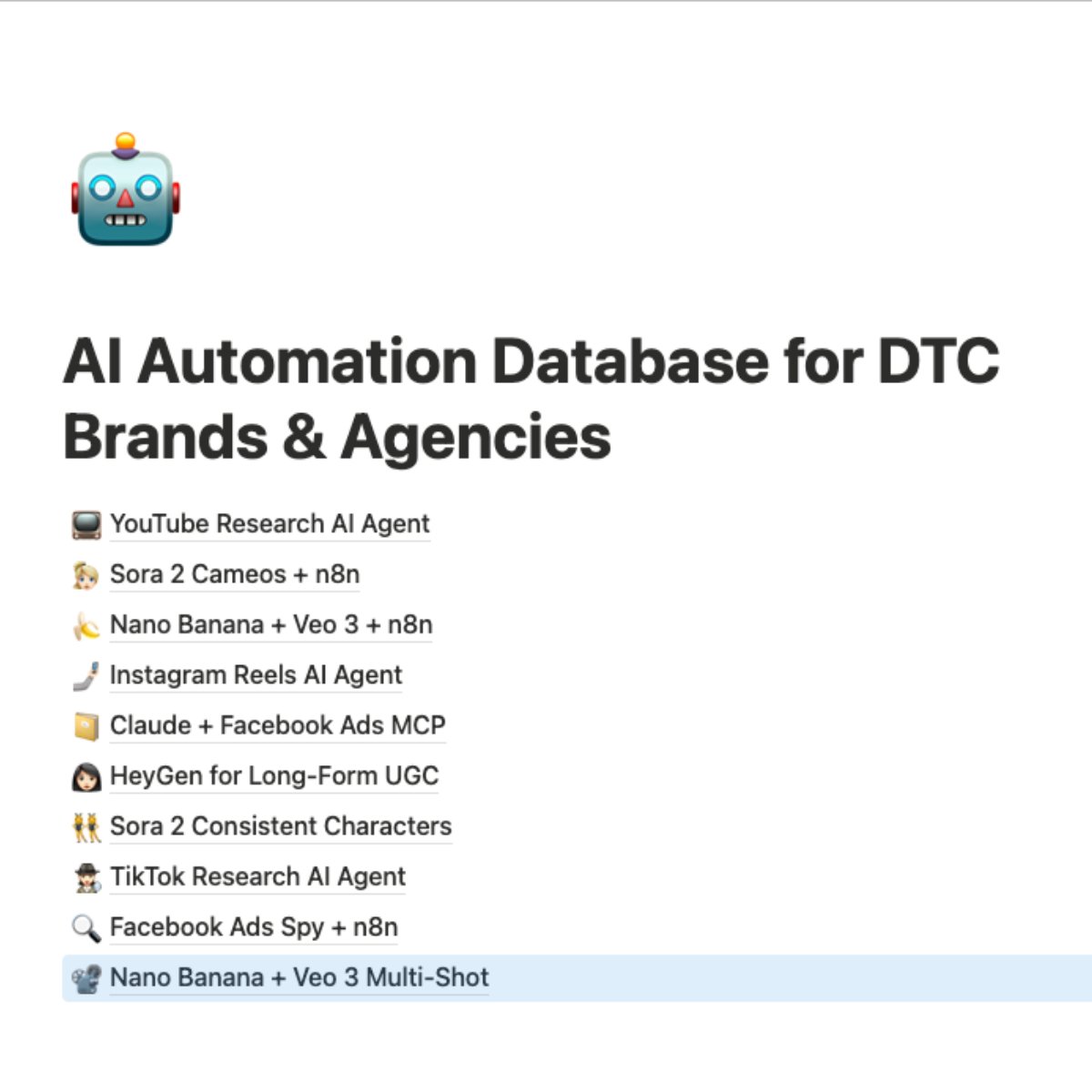
I just packaged up 10 of my best AI automation workflows into one database 🤯
(honestly I should probably be charging for this)
Most DTC brands & agencies waste months building AI automations from scratch.
Wrong prompts. Wrong tools. Wrong setup.
I've created 10 plug-and-play AI automations that handle the heavy lifting for you.
All in one convenient database for easy access.
Here's what's inside:
YouTube Research AI Agent
→ Scrapes trending videos by keyword
→ AI extracts hooks, angles, themes
→ Auto-organized in Airtable
Instagram Reels AI Agent
→ Scrapes trending Reels in your niche
→ Gemini analyzes creative insights
→ Comment analysis included
Sora 2 Cameos + n8n
→ Consistent AI characters across videos
→ Automated UGC campaign generation
→ Airtable tracking dashboard
Nano Banana + Veo 3 + n8n
→ Bulk UGC video generation
→ One product photo → 50+ videos
→ Auto-stored and organized
Claude + Facebook Ads MCP
→ AI ads analyst
→ Generates full performance reports
→ Natural language queries
Facebook Ads Spy + n8n
→ Daily competitor ad monitoring
→ AI analysis of hooks, CTAs, offers
→ Slack digest delivery
Sora 2 Consistent Characters
→ Multi-video campaigns, same creator
→ Brand consistency at scale
→ Step-by-step Loom walkthrough
TikTok Research AI Agent
→ Trending content analysis
→ Hook and angle extraction
→ Performance metrics tracking
HeyGen Long-Form UGC
→ 1-minute+ AI creator videos
→ Talking-head testimonials
→ Product demos at scale
Nano Banana Static Ads
→ 1,000+ ad variations automated
→ Bulk image generation
→ Perfect for testing creative
Each workflow includes the exact n8n templates + Airtable bases to get started FAST.
This is the exact stack DTC brands & agencies are using to scale creative production 10x.
Want the database?
> Comment "DATABASE"
> Like this post
And I'll send the complete collection over (must be following so I can DM)
Putting AGI and foundation models aside, there are four ways companies are applying AI (mostly LLMs and conversational models) to products and business problems.
1) Exactly replicate an existing work flow with AI.
This is 90% of what people ask me about. It make sense right -- we have this flow that creates value and AI could do it. The problem is that exact replication is difficult and does not take advantage of what computers do well. AI beat humans at chess or poker by not thinking like a human. Many of the work flows with AI are possible, but either can be done without AI, or are not worth the expense / customization. There are still many processes that can be done this way I'm sure -- and agents are a big talking point for a reason -- but the valuable "AI automations" form a thin slice between job where AI can't do it yet, at least not well enough or economically... or jobs where less advanced automation is all you really need. But that narrow slice will keep moving as models improve and costs (hopefully) drop. There's a lot of things agents "could" do -- but should they?
This is not my favorite category of AI products, but it's the biggest one people think about -- especially those outside the industry. And not always without reason.
2) Build an AI-based process for a critical component (but leave the high value decision making to the humans).
You choose which stocks to buy, and AI executes the trades. Or you choose which cars to buy (if you are Carvana) and AI finds the best deals at auction, or even negotiates with the owners.
There are non-trading examples but this makes the most sense in trading, buying and selling, squeezing out alpha. Much of the time is spent executing transactions, but the value accrues to those who look at models (or intuition) and make the right choices about current and future value.
Perhaps the AI can even give you "good deals" or propose trades, then the human chooses the ones they like best. It's tempting to fully automate this process, but even then you need constant expert human feedback to properly align the model. At core you're empowering high-alpha humans by making the execution of their ideas faster and less reliant on human labor.
You can also likely afford a very expensive model for these tasks.
AI tools for visual ads generation (and for text generation) -- somewhat fall in to this category also -- you can't fully automate Ads creative yet, but you can rapidly execute on good ideas.
3) Build a new product with AI assumptions in mind.
This one is the smallest but the most exciting category. Going from 0 to 1000 over the next few years.
At DeepNewz we built an AI-written newspaper, that sources most of its information in realtime from X -- writing better, faster and with less bias than the New York Times. We write 10x the number of unique stories, with a high quality bar. We cover more topics. We have better international news. We give you personalized news feeds and notifications in our iOS app. All with a four-person tech team and zero editorial staff.
We do this not by copying a journalist's process, or by "summarizing" or "aggregating" news articles, but with a bottom-up AI-native writing process. It can't write 1000-word editorials well, so we don't bother. We don't have famous authors with famous personalities like New York Times. But we can do other things. It's not just a matter of scale and speed and personalization -- although those are nice features that the New York Times with their 1,000 head editorial staff can't do.
But launching new products is hard and takes time.
Consider Perplexity -- they are well known (in "our" circles) and their search results are sometimes better than Google. But are they taking meaningful search traffic in the US? Not really.
Still my favorite category. Leading us to...
4) Use AI to enhance an existing great product -- without making it worse!
Google uses AI to make search results better -- not just better ranking, but generating AI "answers" and sometimes automated Q&A of followup questions. In part I'd imagine to counter the Perplexity threat. When researching health questions, I find the Google notes useful. As as result I had less reason to go somewhere else. I still wish Google summarized and linked to the best Reddit posts better, but it's 10x what it used to be!
In another obvious case, Grok is being "integrated" into X. This is hard since the key is making Grok useful without making the regular scrolling and replying experience of X worse with unnecessary Grok injections and "suggestions."
But even without a smooth "integration" I love seeing the Grok button and using it as my default knowledge LLM. Why go to ChatGPT or Perplexity when Grok is already right here. And better at pulling up recent information...
I think the most lucrative AI applications in the near future will be category four!
This category applies to smaller companies too but mostly to the biggest ones. Category 4 is I suppose a "sustaining innovation" though a pretty impactful one. As people continue using a small number of apps most of the time, Google and X are smart to integrate AI products into places where we already live. Although doing well will take some time. So far I don't find Meta's AI integrations into Instagram useful. But they are cautious not to "make it worse" while I suspect Google and X are willing to be more aggressive.
So there we have it:
1. AI to automate and replace human workflows [small and moving slice of work is worth AI doing -- but an obvious one to think about]
2. domain specific intelligent tools to execute your trades so you can focus on finding the alpha
3. new products with AI assumptions in mind [will take time but 0 to 1000]
4. big companies (mostly) figuring out how to launch AI-based products that enhance their existing product without making it worse
I think this is a good framework for thinking about AI products and AI companies.
Which one are you building?
Generally speaking I'd stay away from number one -- fine for a personal project and can be fun to get your feet wet with AI, but most of these won't be good businesses. In high value markets the number two (smart tools for high value users) will be big, although ultimately nobody will pay you a % of their profits for an AI tool -- only a fixed monthly price. Hence these tend to be built internally (like at a hedge fund) or in an industry where you can charge a high seat licenses (like tools for class action lawyers). Number three is what most seed stage startups should be doing. Show you can build a competitive product with AI assumptions and a ludicrously lower human cost at scale. Then doing things that non-AI businesses in your space can't do at all.
That said most of you will end up working on number four for big companies. It's where most of the value lies -- over the next couple of years until the AI-native products mature from seed stage to real competitors.
Big companies won't really be able to avoid disruption from AI in all cases. Since they need to *not make their product worse* by adding AI. But they will also end up buying a lot of the number three type companies gaining traction. Although I imagine some will not be bought and we will have new winners. I don't think that Perplexity (or ChatGPT) will replace Google. Grok has a better chance to carve out a devoted 5-10% share of the market in my opinion.
Thank you for reading.
I just joined the waitlist for the new Crunchbase — predictive private company intelligence that’s redefining how we uncover private market opportunities! 🚀 Want early access too?
https://t.co/8fpLYmV4sJ