@TheDryhtscipe@HarmonyPartyUK Yes, it would still allow you to continue as a Fiscal Host :)
I'd recommend reviewing the attached letter, which details who's currently covering the platform costs. Every organization using Open Collective is helping people. Supporting upstream is just as important.
@TheDryhtscipe@HarmonyPartyUK Hey John! Shannon here, please check your inbox! I personally reached out in March to provide you with an update on our new nonprofit ownership and subsequent pricing updates. There is an option that would cost $30 USD a month. Please get back to me :)
open source is dying. @theo is right.
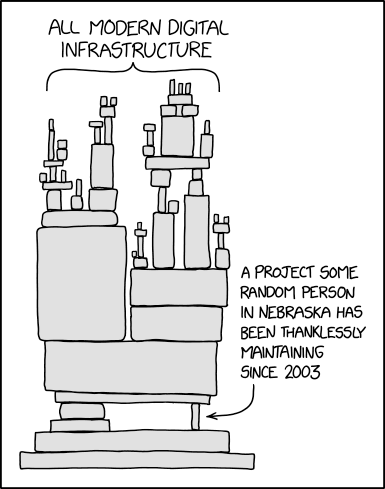
all of our code depends on who knows how many libraries and packages created at some point and maintained by some random guy
this job has always been incredibly hard and mostly uncompensated (kudos to open source public goods funding @opencollect@MolochDAO@ProtocolGuild@gitcoin@ethereumfndn@thedaofund)
there have always been issues, PRs to review, and some idiot to deal with
but never this many
the amount of code, commits and PRs everywhere has been growing exponentially since vibe coding became a thing. and it's not slowing down
great that more people are building and shipping. harder to tell signal from noise.
and a lot of times, the person who doesn't know what they're doing is also the one asking, insisting and tagging maintainers in comments and issues
btw not long ago there was zero spam protection. p*rn sites would exploit github's SEO and spam issues everywhere to trick google's algorithm
maintaining open source has never been this hard or this annoying
and all of our code depends on those people
we should be more intentional about funding and incentivizing open source public goods
let's hope they don't give up before that
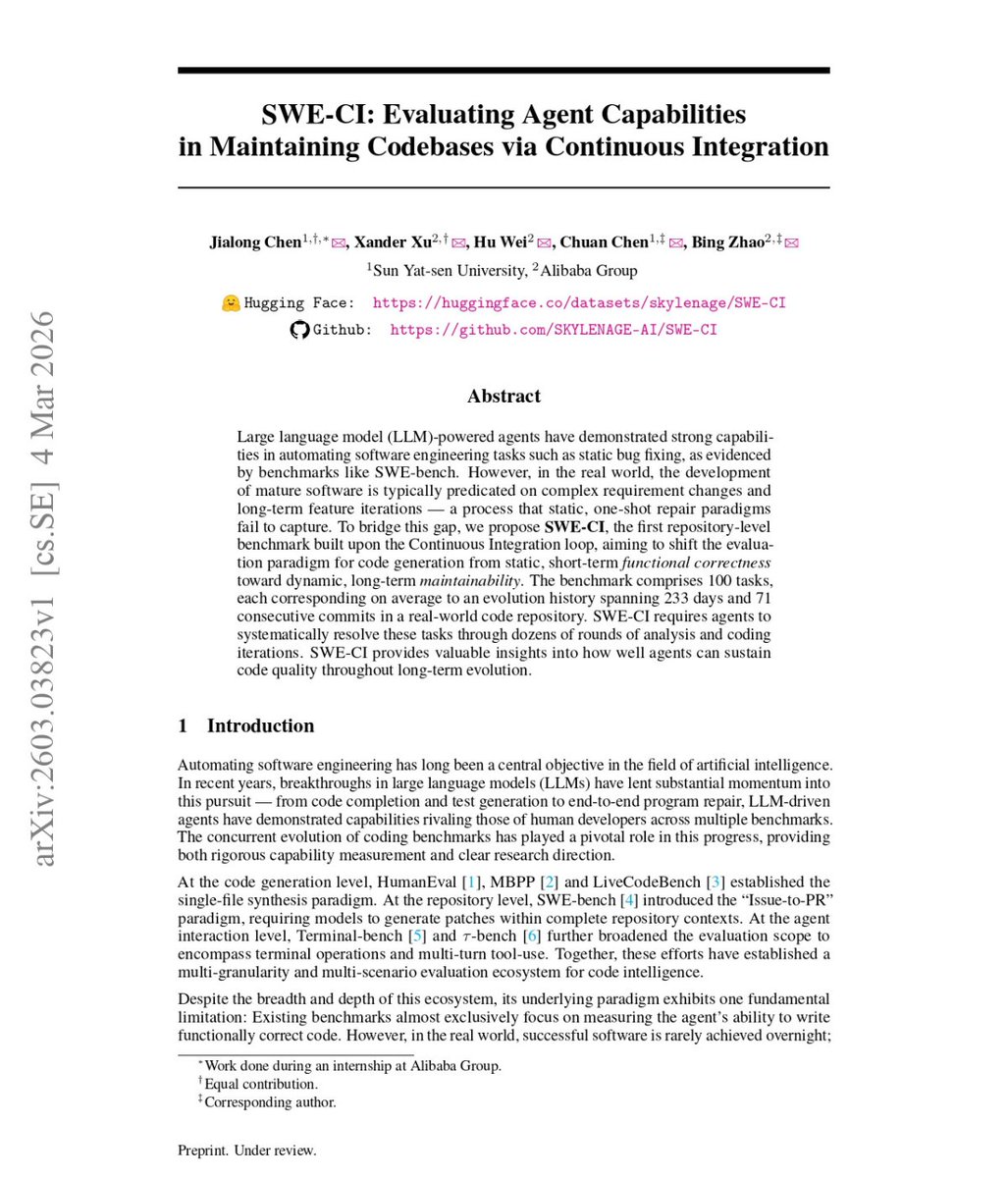
🤯BREAKING: Alibaba just proved that AI Coding isn't taking your job, it's just writing the legacy code that will keep you employed fixing it for the next decade. 🤣
Passing a coding test once is easy. Maintaining that code for 8 months without it exploding? Apparently, it’s nearly impossible for AI.
Alibaba tested 18 AI agents on 100 real codebases over 233-day cycles. They didn't just look for "quick fixes"—they looked for long-term survival.
The results were a bloodbath:
75% of models broke previously working code during maintenance.
Only Claude Opus 4.5/4.6 maintained a >50% zero-regression rate.
Every other model accumulated technical debt that compounded until the codebase collapsed.
We’ve been using "snapshot" benchmarks like HumanEval that only ask "Does it work right now?"
The new SWE-CI benchmark asks: "Does it still work after 8 months of evolution?"
Most AI agents are "Quick-Fix Artists." They write brittle code that passes tests today but becomes a maintenance nightmare tomorrow. They aren't building software; they're building a house of cards.
The narrative just got honest: Most models can write code. Almost none can maintain it.
We’re launching Codex for Open Source to support the contributors who keep open-source software running.
Maintainers can use Codex to review code, understand large codebases, and strengthen security coverage without taking on even more invisible work.
https://t.co/ulWYlf7zhz
Excited to announce Claude for Open Source ❤️
We're giving 6 months of free Claude Max 20x to open source maintainers and core contributors.
If you maintain a popular project or contribute across open source, please apply!
https://t.co/inuh0hxREA
@mikehostetler Hey Mike, I'm not able to reproduce this. Could you please send us through an email to [email protected] if you are still experiencing this issue. Please include your browser versions etc :) Thanks, Shannon
Europe needs digital sovereignty, and Open Source is the most direct path to it. But it requires more contribution-based procurement. More public money must flow upstream to Open Source maintainers, not just to integrators and resellers.
https://t.co/G0YIEZmXS0
We just hit $1,000 all-time total contributions on our @opencollect 🎉
Can you support NativePHP? We'd love to make Mobile open source sooner. With your support, we can!
https://t.co/tTGAjEk6Pg
Tickets to the village are €121. If you can expense or afford them, please support this initiative.
Otherwise, we have secured a couple of passes for people that have contributed in 2025 to open source communities on Open Collective. Apply to attend: https://t.co/iyZnT6x31q
Coming to Brussels a couple of days before and/or after? We have you covered!
We are sponsoring the https://t.co/QBJKig2qZ9, a Pop-Up Village for open source contributors. The perfect place to land, cowork, offer or attend workshops
I was having this EXACT conversation over the Christmas break.
It's not just finances, but AI kills the DESIRE to contribute. The joy of OSS was the human aspect. Knowing a human on the other end needed your solution. When the consumer becomes an agent, that feedback loop is broken.
If the consumer is a bot and the 'small details' are abstracted away, why would anyone want to dedicate time to something that takes so much effort when it is already not being paid for said contribution? Why would anyone want to sacrifice time on a Saturday Night to solve an issue for an OSS project?
There is no reason to do so.
We aren't just losing potential clients or users.
We are losing the next generation of maintainers.
All my new code will be closed-source from now on. I've contributed millions of lines of carefully written OSS code over the past decade, spent thousands of hours helping other people. If you want to use my libraries (1M+ downloads/month) in the future, you have to pay.
I made good money funneling people through my OSS and being recognized as expert in several fields. This was entirely based on HUMANS knowing and seeing me by USING and INTERACTING with my code. No humans will ever read my docs again when coding agents do it in seconds. Nobody will even know it's me who built it.
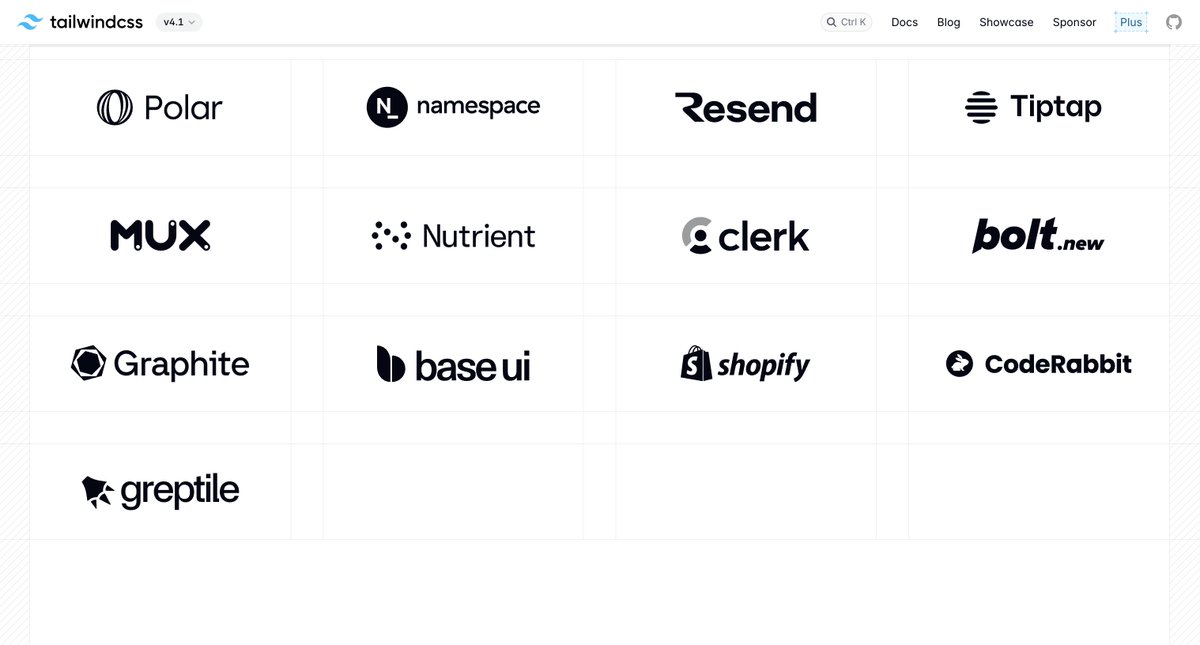
Look at Tailwind: 75 million downloads/month, more popular than ever, revenue down 80%, docs traffic down 40%, 75% of engineering team laid off. Someone submitted a PR to add LLM-optimized docs and Wathan had to decline - optimizing for agents accelerates his business's death. He's being asked to build the infrastructure for his own obsolescence.
Two of the most common OSS business models:
- Open Core: Give away the library, sell premium once you reach critical mass (Tailwind UI, Prisma Accelerate, Supabase Cloud...)
- Expertise Moat: Be THE expert in your library - consulting gigs, speaking, higher salary
Tailwind just proved the first one is dying. Agents bypass the documentation funnel. They don't see your premium tier. Every project relying on docs-to-premium conversion will face the same pressure: Prisma, Drizzle, MikroORM, Strapi, and many more.
The core insight: OSS monetization was always about attention. Human eyeballs on your docs, brand, expertise. That attention has literally moved into attention layers. Your docs trained the models that now make visiting you unnecessary. Human attention paid. Artificial attention doesn't.
Some OSS will keep going - wealthy devs doing it for fun or education. That's not a system, that's charity. Most popular OSS runs on economic incentives. Destroy them, they stop playing.
Why go closed-source? When the monetization funnel is broken, you move payment to the only point that still exists: access. OSS gave away access hoping to monetize attention downstream. Agents broke downstream. Closed-source gates access directly.
The final irony: OSS trained the models now killing it. We built our own replacement.
My prediction: a new marketplace emerges, built for agents. Want your agent to use Tailwind? Prisma? Pay per access. Libraries become APIs with meters. The old model: free code -> human attention -> monetization. The new model: pay at the gate or your agent doesn't get in.
Before Adam posted his podcast episode, Tailwind had:
- 13 Partners à $5000
- 3 Ambassadors à $2500
- 5 supporters à $500
=> $75k MRR
Now:
- 22 Partners à $5000
- 4 Ambassadors à $2500
- 22 supporters à $500
=> $131k MRR
That's +$56k MRR with a tweet, not counting the Tailwind+ sub boosts, free PR, and all the long-term ripple effects for the business that are yet to come.
The community is now sensitized to the cause and are much more likely to convert into a subscription in the future that they would have before this, just because Adam sounded like a human and not a faceless corporation.
When you build something people love with a great attention to craft and manage to tell a compelling story, people show up for you.
That’s something a data driven founder, busy optimizing funnels and nudging button colors, will never quite reach. Because trust isn’t a metric, goodwill doesn’t fit in a dashboard, and people don’t rally behind experiments. They rally behind work that feels intentional, human, and worth supporting.