Most think vibecoding at scale is slop. Here’s a counterexample.
Today we release a 16M-line formalization of the entire Stacks Project, critical infra underlying modern math, with optimized code quality and its highly interconnected structure preserved.
A mathematical city 🌆
世界上最聪明的大脑之一,普林斯顿大学理论物理学家 Edward Witten,居然也开始用 Claude 帮自己做前沿物理研究了。
Witten 是现代弦理论最重要的奠基者之一,也是历史上第一位获得菲尔兹奖的物理学家���他在数学和物理学之间建立了大量深刻联系,尤其是推动了 M 理论的发展,改变了人类对弦理论和量子引力的理解。
11 月 3 日,Witten 发表了一篇 36 页的新论文(我表示完全看不懂),研究困扰理论物理学界多年的难题:如何在离散的时空格点上定义包含手征费米子的规范场论。
有意思的是,论文里三次提到了 Claude Opus 5.5。
这可不只是用 AI 润色论文。Witten 明确写道,Opus 5.5 提出了一种新的数学构造变体,用于将离散格点上的规范场平滑地延拓到连续空间。它还提出了另一种基于线性插值的方案。
在论文致谢中,Witten 特别写道:
“Claude Opus 5.5 在许多细节上提供了帮助。”
当一位站在理论物理学最顶端、自己就能推动整个学科发展的科学家,开始在正式研究论文中明确感谢 AI 对数学构造的贡献,这件��本身就很值得关注。
AI 正在从帮助科学家写代码、整理文献,走向直接参与前沿科学研究中的技术推导和方案探索。
alright folks tomorrow 11:00 AM EST until whenever we are done we are going to be hosting a workshop led by francesco on robot learning!
in this workshop we're going to cover:
- Classical robotics
- Pre-training vs. post-training
- Real-world RL
- VLAs / VAMs / WAMs
and more!
Today is my last day at OpenAI. It’s been an awesome ride, but I’m getting off a little early to pursue a new direction. I feel fortunate to have worked alongside some of the most incredible people I know. I’m especially grateful to @ALupsasca and Boris Alexeev for helping me navigate my first corporate job, and to @danintheory for his constant support. I’ll be rooting for you all!
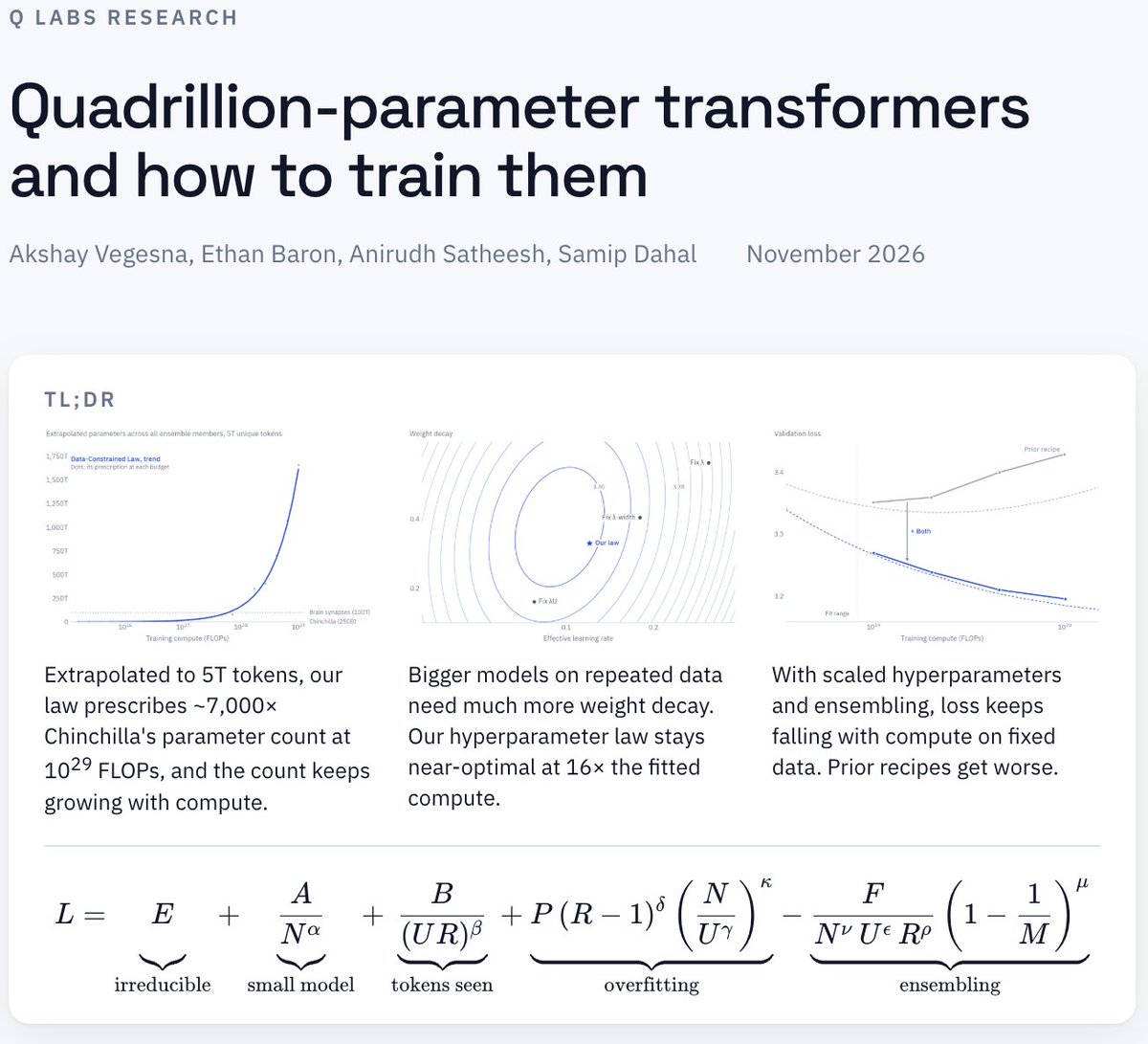
Humans are ~1,000,000x more sample efficient than LLMs, and there are no good explanations.
We’ve found that a big part of the answer is that LLMs are *massively* underparameterized by many orders of magnitude. The brain has 100T synapses learning from ~200M tokens of language. Chinchilla prescribes a 1T-parameter model on 20T tokens. That’s 7 OOMs apart in parameters per token.
After a lot of painstaking work, we present new data-constrained scaling laws and learning algorithms to scale to (extrapolated) quadrillion-parameter transformers.
w/ @akshayvegesna, @EthanBaron78553, @asatheesh6561
Full paper led by @EthanBaron78553, with @ShmuelBerman, @andrewgwils
We asked GPT-6 Astra to edit Qwen3.5-0.8B weights to improve math.
It directly changed only 0.016% of weights, fixing 0.8B's reasoning loops & improving math up to 6x and even instruction following 3x, without gradients or training.
We call this Weight-Space Programming: frontier LLMs can now natively read/write neural network weights! 🧵
Blog: https://t.co/bOWCcFhCVq
tensor calculus is one of those subjects that completely changes how you understand geometry and physics. ordinary calculus tells you how quantities change, but tensor calculus goes a step further. it asks how quantities change when the coordinate system itself is changing, especially when you’re working on curved surfaces or spacetime. a vector might have different numerical components depending on how you describe it, but the physical quantity it represents remains the same. tensors give us a mathematical language to preserve that underlying structure regardless of the coordinates we choose.
the interesting part begins with the metric, which tells us how to measure distances and angles. then comes the connection, which tells us how to compare directions at neighboring points. on a curved surface, you cannot simply move a vector from one location to another and assume its direction remains unchanged. parallel transport gives us a rule for moving it, while the covariant derivative measures how a tensor changes after accounting for the changing geometry. once you understand these ideas, curvature stops being something you only visualize and becomes something you can calculate. this is the mathematical machinery that allows us to describe curved spaces consistently.
and this is where tensor calculus becomes fundamental to general relativity. einstein’s field equations connect the geometry of spacetime to the energy and momentum of matter. gravity is no longer treated simply as a force pulling objects toward one another. it becomes a consequence of the geometry through which objects move. the same mathematical ideas also appear in continuum mechanics, fluid dynamics, elasticity and differential geometry. what i find beautiful is that tensor calculus is really about separating physical reality from the coordinates we use to describe it. the equations may change their appearance, but the underlying relationships remain invariant. that’s one of the deepest principles in mathematics: a good description of reality should not depend on the perspective from which you observe it.
Can more pretraining improve a robot policy’s success rate, yet makes it worse for porttraining? 🤔
In our new work, we find that it can. Continued supervised pretraining of generative robot policies can improve reliability at the expense of coverage, and this tradeoff affects downstream posttraining.
Read on to see why this happens and how we can preserve coverage. 1/n 🧵
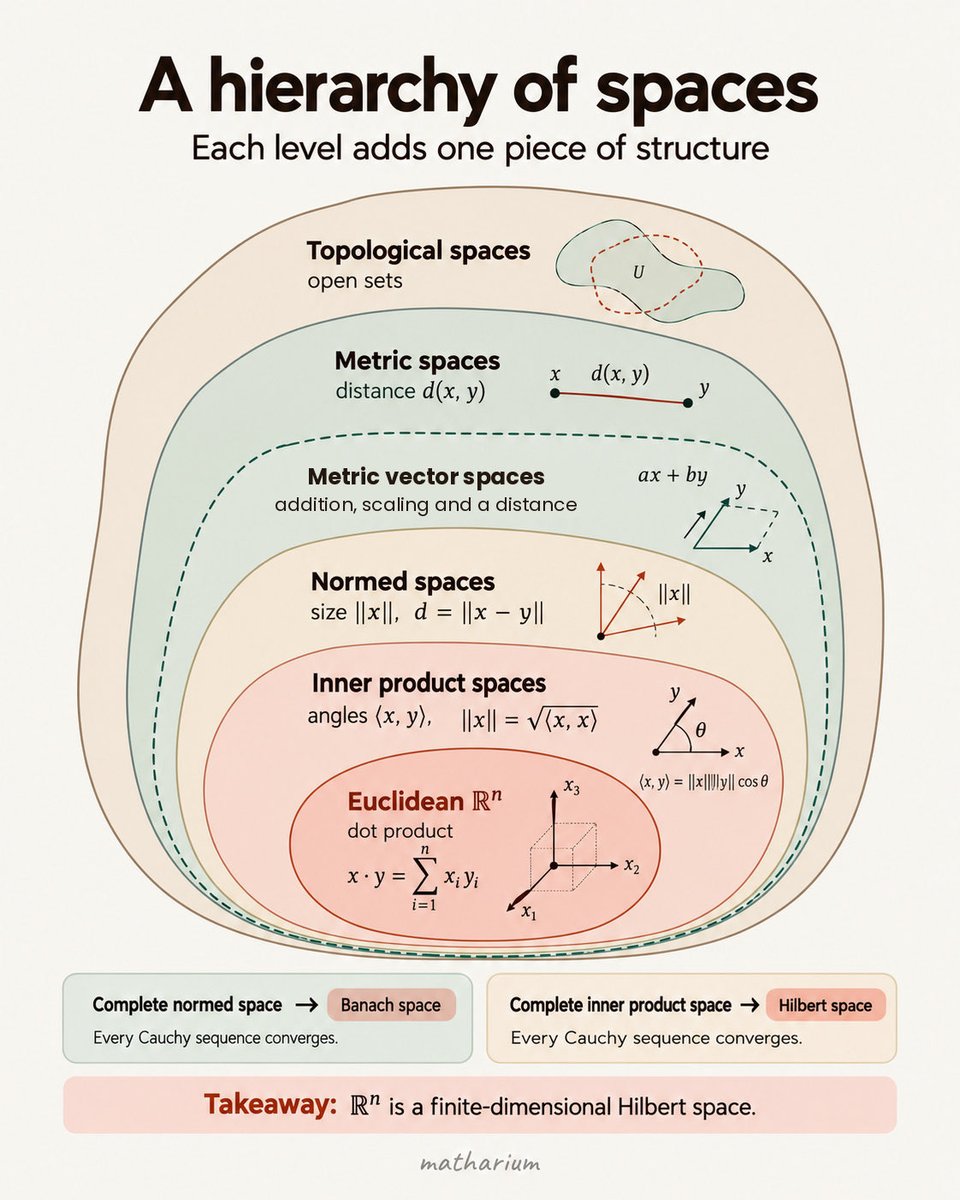
Every inner product space is normed, every normed space is metric, and every metric space is topological. Each level adds one piece of structure.
A topology says which sets are open. A metric adds a distance, a norm adds size with d = ‖x − y‖, and an inner product adds angles with ‖x‖ = √⟨x, x⟩.
Completeness gives the named classes: a complete normed space is a Banach space, a complete inner product space is a Hilbert space, and ℝⁿ with the dot product is a finite-dimensional Hilbert space.
Friday was my last day at Anthropic.
Two years ago, when Claude Code was a small internal tool, I asked it to build an RL env. I steered it for tens of hours but never manually wrote a line of code. It worked, I was hooked, and I joined the team.
When we first launched, most people approved every permission prompt by hand and mostly used Claude to answer questions and write tests.
Today, the default is trusting Claude's judgment to auto-approve. Claude does large migrations and builds new products.
Helping build Claude Code into an industry-defining product has been the journey of a lifetime.
Thank you to the incredible team behind Claude Code, Cowork, and Tag. These products are the sum of thousands of great ideas from you. I'll miss working with you all.
Thank you to our users for embracing a new way of working. Your constant feedback shaped so much of what we shipped and your stories made the work so meaningful.
Excited to see what you all make next!
I feel this article is well worth reading. It helps dispel the myth that critical thinking can be applied to all situations. Many educational programs and business leaders have advocated for learning “higher-order thinking skills,” assuming these skills will then be++
Splatting is going to be a critical part of the ego collection pipeline IMO, so I'm working on improving our current official support.
code here - - <https://t.co/BaB9WPtWyg>
The current shipped version does well for less than 1M splats, but not so much for larger ones such as the iconic garden scene (5.2M splats). I ported over brushes kernels to @rerundotio and now on my M5 I'm getting ~40-50fps when recording or a solid 60fps when not. This is basically a 10x improvement from the current version and this huge improvement that wouldn't have been possible without all the verification loops we've added with the rerun skills and MCP. I'll break down what was required to make this work ⬇︎