By the way, we're hiring at Biohub. Come hang out with us if you want to work on frontier AI or biology.
We have thousands of GPUs, petabytes of data (biology is increasingly an engineering problem!) and billions of cells to image!
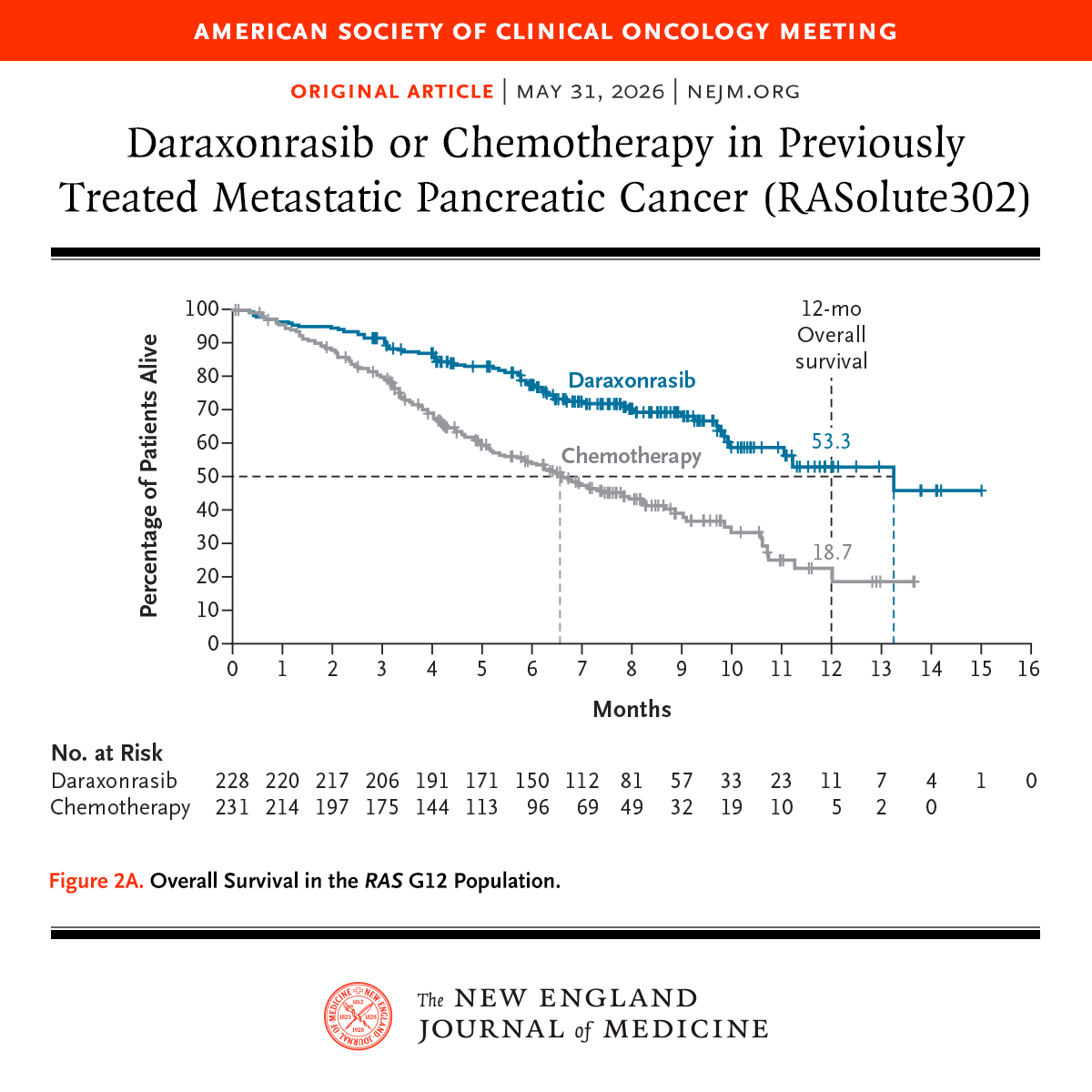
Presented at #ASCO26:
Among patients with previously treated metastatic pancreatic ductal adenocarcinoma, the RAS(ON) inhibitor daraxonrasib led to significantly longer overall survival and progression-free survival than chemotherapy. Full phase 3 RASolute 302 trial results: https://t.co/xwLWBZYRzq
@ASCO
One of the most amazing things I’ve ever seen: a standing ovation for the full Daraxonrasib results
I feel inspired and energised, to put it mildly — we have a targeted therapy for pancreatic cancer now, and nothing is undruggable anymore
New study in @ScienceMagazine performs large scale analysis of mouse strains commonly used in research and shows that around half of the mice that are used by scientists in studies do not have the genetic make-up that they are supposed to have.
There are good reasons to be skeptical of animal model data when it comes to modelling human disease, even independently of this (no mouse is that good at recapitulating human physiology). But such findings suggest it's much worse than I even thought.
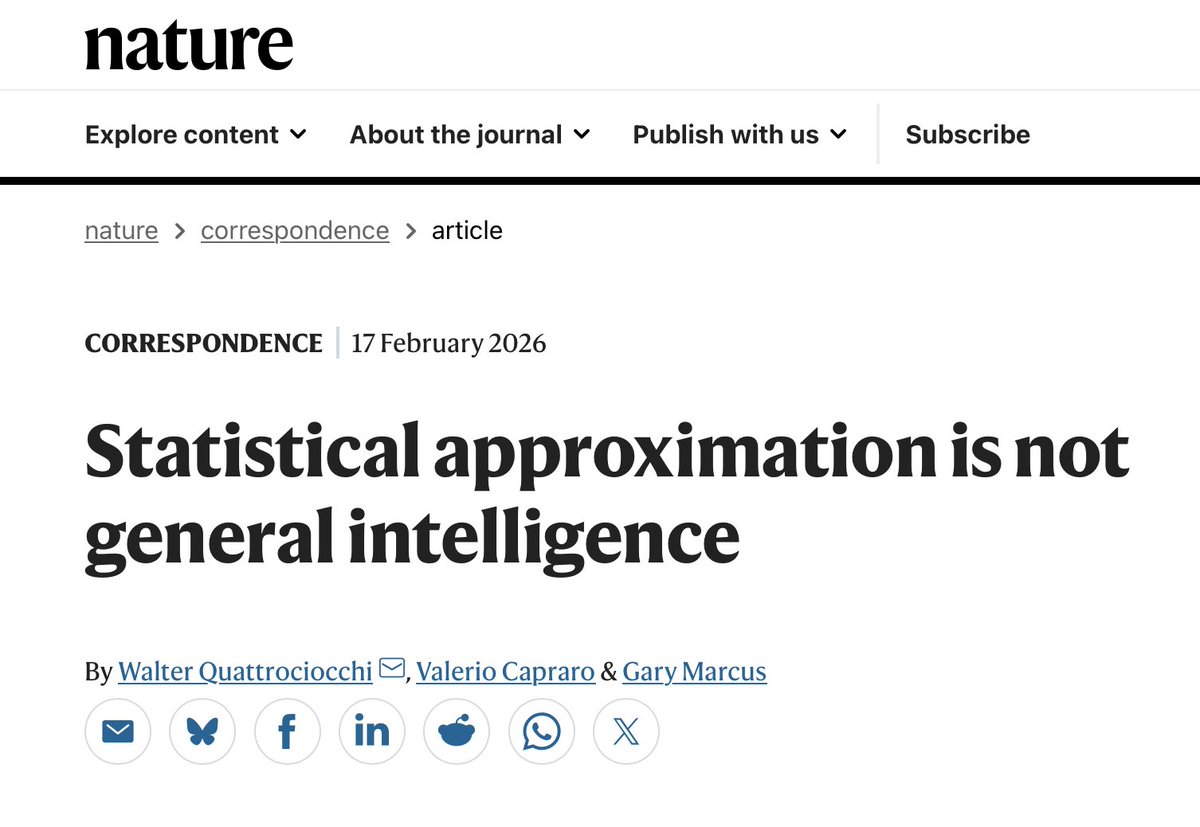
The Pope is making exactly our point. LLMs “may imitate or even simulate, but they do not understand.”
This is the core epistemic fault line.
Most AI evaluation is still based on one assumption: if a system statistically approximates human behaviour, then it is close to human intelligence.
But approximation is not intelligence.
Simulation is not understanding.
LLMs can produce the right answer without knowing why it is right. They can simulate empathy without feeling. They can imitate judgment without responsibility. They can generate coherent explanations without having a world to which those explanations are accountable.
Stop confusing behavioural similarity with cognitive equivalence.
Human understanding is embodied, affective, relational, motivational, and normative. It is not just the production of plausible text.
*
Full paper in the first reply
Today in absurd grant review comments we have:
Only studying females is a weakness…in a grant on endometriosis. 🤷♀️🤷♀️🤷♀️
Aren’t you all supposed to have a ton of education?!?
New paper @Nature analyzing 11,000 profiles of cellular gene expression provides further evidence that aging is not just wear & tear but a reversible loss of epigenetic information linked directly to mortality risk
Reprogramming, embryogenesis & young blood partially reversed aging signals. Why is this important?
The work implies that the youthful state of tissues is not lost permanently during aging.
It can be restored
The work is also the strongest systems-level support yet for the idea that aging is not just random wear and tear, but a coordinated and reversible loss of biological information.
In many ways, it strengthens the Information Theory of Aging (ITOA), which we first formulated back in 2008-2009.
The striking thing is not simply that damage accumulates. It is that cells enter a coordinated transcriptional state associated with mortality risk, which strongly argues aging is an organized systems phenomenon. This is exactly what you would expect if cells progressively lose youthful epigenetic control information.
The work by the Gladyshev lab @harvardmed (no link to us) suggests aging is not a collection of unrelated damage. It behaves more like an attractor state.Cells under many forms of stress drift toward a common aged configuration.
That is deeply compatible with the idea that epigenetic information loss causes cells to progressively collapse due to informational noise. We call this process epigenetic drift, leading to ex-differentiation.
One of the most important aspects is that it links aging directly to mortality risk rather than simply chronological time. Prof Gladyshev and team developed transcriptomic clocks that don’t just estimate age, they measure the progressive loss of cellular function and predict biological decline and mortality risk across mammals.
That is a major advance because it brings us closer to measuring the underlying process of aging itself, not just the passage of time, in a way first shown by Prof. Steven Horvath in 2013.
The team also launched TACO (Transcriptomic Age Calculator Online) allowing researchers to estimate the biological age and mortality risk of tissues using RNA data they may already have. A potentially powerful new tool for aging research
What I find especially important is that the strongest mortality-associated changes involve chromatin organization, epigenetic regulation, inflammation, and mitochondrial dysfunction.
These are all deeply connected to the maintenance of cellular identity and the preservation of biological information over time.
The study strongly supports the idea that aging is not merely the accumulation of damage, but a progressive loss of the systems that maintain youthful cellular organization.
In many ways, this aligns with the Information Theory of Aging, which proposes that cells lose epigenetic information over time but retain a backup copy that can potentially be restored.
Importantly, the paper also confirms that these molecular signatures are reversible, which we and others have previously shown.
They accelerate after DNA damage, and during disease and stress, but slow or reverse during interventions such as reprogramming, heterochronic parabiosis, and early embryogenesis.
That gives real hope that aging is biologically malleable & perhaps, one day, medically treatable 🙏
Thanks for reading all the way down. I gave this whole analysis to a reporter and my quote was 2 words: "Major advance" 😆
So we can all stay abreast of this fast paced field, @JoinLifespan has a new show & a magazine written by real scientists. As a community we are sponsoring young scientists, too. Maybe check us out 🙏
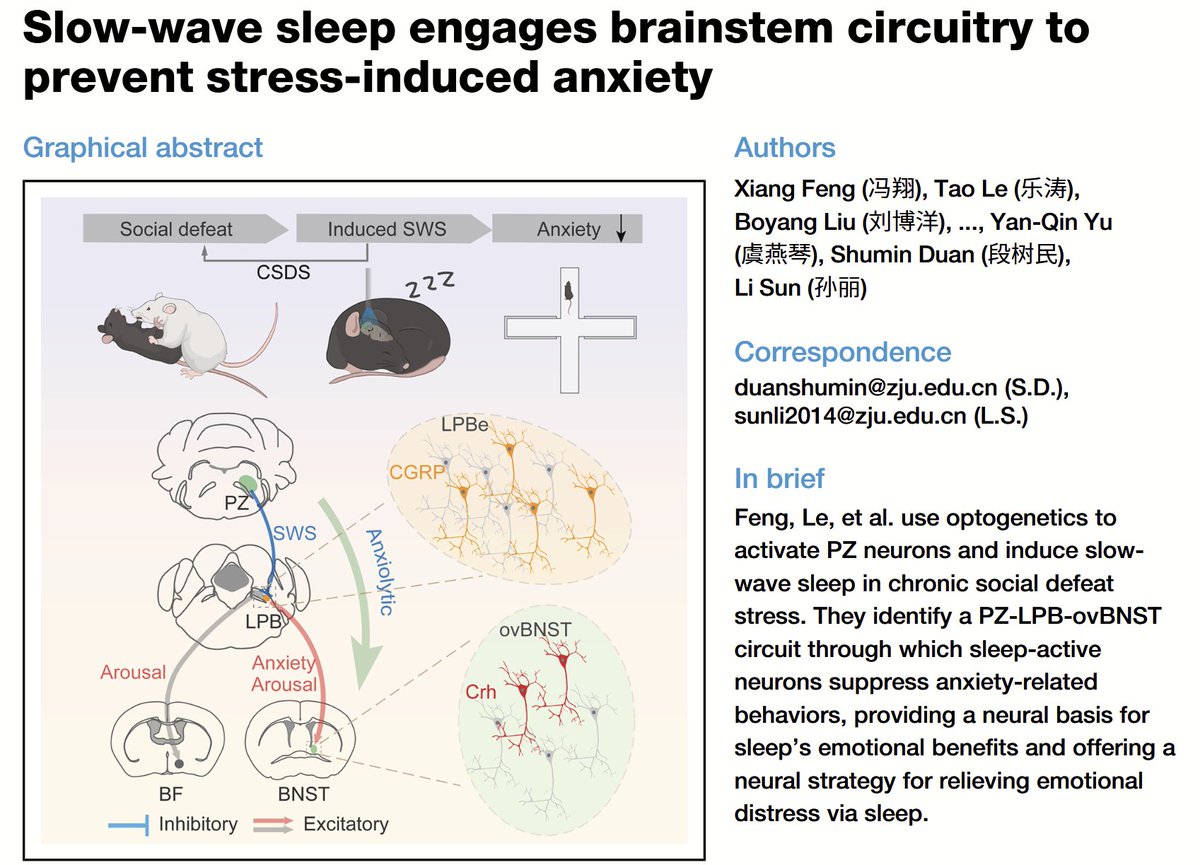
Deep sleep may be one of the brain’s most powerful anti-anxiety tools.
Researchers identified a sleep-active circuit linking the parafacial zone, parabrachial nucleus, and BNST that suppresses stress-related signaling during slow-wave sleep and prevents anxiety-like behavior. #SleepScience #Neuroscience #MentalHealth
https://t.co/0kEEWqKOGG
UNPRECEDENTED SUPER EL NINO SITUATION
Unprecedented Pacific Marine heat wave and unprecedented ocean surface plume El Nino - positioned to blend.
No alarm raised by government or science Why ? Do they want unprecedented number of people to die - remember 1877 El Niño
#ElNino #globalwarming #ocean #climatechange
NORTHERN INDIA RECORD APRIL HEAT
Record-breaking temperatures, as early as April. Intense heatwaves in India with temperatures above 45°C (113°F) in several northern, western, and central regions, with some areas touching 49.9°C (121.8°F). #heatwave#climatechange. #globalwarming
I genuinely don't understand people like Bezos and Musk.
If I had billions of dollars, I would just start fixing everything. Homeless veterans sleeping on the streets? Not on my watch. Hungry children going to bed with empty stomachs? Hell no.
They could be making life better but instead choose to build spaceships and data centers to pump stocks and destroy the planet
احتمالية حدوث هذا الشي مرة اخرى مستحيله:
في فيتنام دخلت فتاة إلى محل تجاري لشراء بعض الملابس، تسمع صوت البائعه لكنها لا تجدها لان كل واحده منهما تحرك في نفس اللحظه بشكل متطابق وتفوت الاخرى مرارا دون ملاحظتها
واخيرا بعد دقيقه حصل قلتش واستطاعوا لقاء بعض في موقف مضحك
Almost everything that happened to you before age six is gone. Whole years, lost while they were still fresh, before you were old enough to hold onto them. Yet one random family trip from when you were seven stuck with you for life. Your brain kept that one on purpose.
The reason is timing. The part of your brain that saves memories, a little curl of tissue called the hippocampus, takes years to finish growing. When you're very young it runs in fits and starts, and new brain cells keep arriving so fast that they bury whatever you just stored. Your steady, lasting memory only switches on around age five or six. A trip you take between five and ten lands right after the lights come on. It's one of the first things you get to keep, and it barely has to fight for room, because the years before it were mostly never saved.
A vacation is also built from the exact stuff your brain likes to hold onto. Two things make a memory stick: it has to be new, and it has to make you feel something. A trip is loaded with both. The first time you ever see the ocean, with a parent finally off work and paying full attention to you. Your brain treats new and exciting moments as if they matter, and floods them with a chemical that makes them stick. A normal Wednesday gets none of that, so it slips away. The week at the beach gets burned in.
In 2025, a team at Yale scanned the brains of wide-awake babies. Getting a squirming infant to hold still in a scanner is brutally hard, which is why almost no one had pulled it off before. They showed each baby pictures it had never seen. The memory part of the brain lit up, and the babies clearly recognized those pictures later. Babies as young as one are making real memories after all. The memories get saved just fine. What breaks is getting them back, because the brain keeps rebuilding itself over the years and loses track of where it filed everything. The drawer is still there. You just can't find the key.
The trip you still carry around stuck for one reason: it showed up at the exact moment your brain was finally ready to hold on. And the Yale team thinks the memories from before that, the ones you're sure are gone for good, might still be in there, waiting for someone to find a way back in.
A mother octopus lays her eggs, then stops eating. She slowly starves to death while she guards them, and by the time they hatch, she's already gone. Her babies float off into the ocean and will never meet her.
An Oxford scientist named Tim Coulson thinks these animals could be the ones to take over after we're gone. He laid it out in a 2024 book, and the case holds up. An octopus has about 500 million brain cells, roughly the same as a dog. Two-thirds of them aren't even in its head. They're spread through the eight arms, so each arm can taste what it touches and move on its own. Octopuses open jars. They carry coconut shells across the seafloor to hide under later. They've squeezed out of sealed tanks in the dark and gotten away. No animal without a backbone comes close.
But being smart has never been enough to build a city. Everything humans built runs on one trick: each generation starts where the last one left off. A kid today learns in school what took people thousands of years to work out, and inherits all of it for free. An octopus inherits nothing. Its mother died before it hatched, so there's no one to copy and nothing left over from the octopus that came before.
So every octopus has to figure out the whole world by itself, starting from zero. And they're good at it, weirdly good. Then a year or two later they die and take everything they learned with them. Peter Godfrey-Smith, a philosopher who spent years diving with octopuses for his book Other Minds, points out that they pass almost nothing on to their young. The cleverest animal in the sea wipes its memory clean every generation and starts over.
Coulson said it could take hundreds of thousands of years, maybe millions, and he's right that the raw ability is already there. The brain is built, and the body can crack almost any puzzle you hand it. The only thing missing is a second generation that remembers the first.
Oxygen already killed most of the life on Earth once. The first time it filled the air, around 2.4 billion years ago, it was so poisonous that nearly everything alive died. Scientists call it the Oxygen Catastrophe.
Back then the oceans were full of tiny microbes, and none of them used oxygen. Then one kind, an ancestor of the green scum you still see on ponds, started giving off oxygen as a waste gas, the same way you breathe out air you don’t need. Oxygen is a wrecker. It rips apart the delicate machinery inside a living cell, including the DNA, and as it built up in the water and then the sky, it triggered the first mass extinction this planet had ever seen.
A few survivors hid in the mud and deep underground where the gas couldn’t reach, and some of their descendants are still down there. But one tiny cell did something nobody else did. It ate a bacterium that had learned to use oxygen rather than die from it, and instead of digesting its meal, it kept it alive inside itself. That trapped bacterium became the mitochondria, the little engines that power your cells right now. Almost every cell you are made of carries hundreds or thousands of them, all descended from that one strange truce with a poison.
The trade was worth it because burning food with oxygen releases about 18 times more energy than burning it without. It is the reason anything can swim fast or think hard. Every big, fast-moving animal on Earth, you included, runs on the gas that almost ended life.
Oxygen changed the sky too. Some of it floated up high and turned into ozone, a thin layer that blocks most of the sun’s harshest rays. Before that shield existed, raw sunlight was strong enough to fry the DNA of anything out in the open, so life had to stay underwater, where a few feet of sea soaked up the danger. For almost two billion years, nothing lived on land at all. Only once the ozone grew thick enough, a few hundred million years ago, did the first plants and animals crawl out of the water.
And the old poison never really left. Every second, the oxygen your cells burn throws off tiny broken bits called free radicals, and they keep nicking your DNA and the proteins around it. The damage adds up, slowly, your whole life. Back in 1956 a scientist named Denham Harman suggested this slow rusting from the inside is a big reason we get old. People still argue about how much it matters, and no antioxidant pill has ever been shown to make anyone live longer, but the basic idea has held up. The gas keeping you alive right now is also quietly wearing you down, year by year. The joke just got the timing wrong. Oxygen really does kill slowly, and billions of years before we showed up, it already proved it can kill fast.