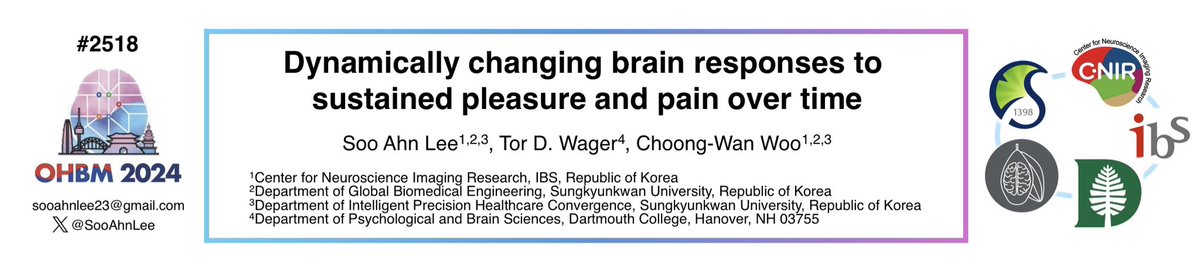
Excited to share our work on the brain representations of affective valence and intensity in sustained pleasure and pain! Now available in Biorxiv: https://t.co/jj5sNZqUj6
The first manuscript based on my lab's data! We show that dopamine activity in the ventral striatum encodes moment-by-moment temporal-difference error during aversive situations, suggesting that dopamine serves as a unified teaching signal across valences. https://t.co/AB2P3Mvtaz
The final (post-proof) version is now finally out. This provides a detailed spatio-temporal profile of brain mediation of the cue-stimulus integration in the pain context. We interpreted the findings in terms of cortical hierarchy. https://t.co/5Ai7wQNLkq
Finally,😄 the first project during my Ph.D. program is published in @PLOSBiology. We examined the spatiotemporal brain dynamics of context and sensory information integration in pain. Thanks my advisor @choongwanwoo and co-authors @hong_seok_jun@lizlosin.
I'm pleased to share our lab’s collective effort: ‘Pain Neuroimager Manifesto: Towards Person-Centered Neuroscience of Pain.’ This manifesto reflects our commitment to a person-centered, pluralistic, and nuanced approach to pain neuroimaging research. https://t.co/H19dc5tT2L
thanks to the great colleagues at @CNIR_IBS, settling in Korea has been going well. it's time to hire! we're looking for postdocs, grad students, & RAs, to work on projects like e.g. inducing blindsight in NHP via electrical microstimulations, or similarly via optogenetics ... 1/
Different brain regions encode different pain-related information, such as the expectation of pain or the intensity of a stimulus.
But where and how is this information integrated? My paper has just been published in @ScienceAdvances! (1/13) https://t.co/QWBuQV3ah3
Our commentary "Interindividual differences in pain can be explained by fMRI, sociodemographic, and psychological factors" on Hoeppli et al. is finally published (https://t.co/0lnDMFE1q1).
See the thread for more detailed information.
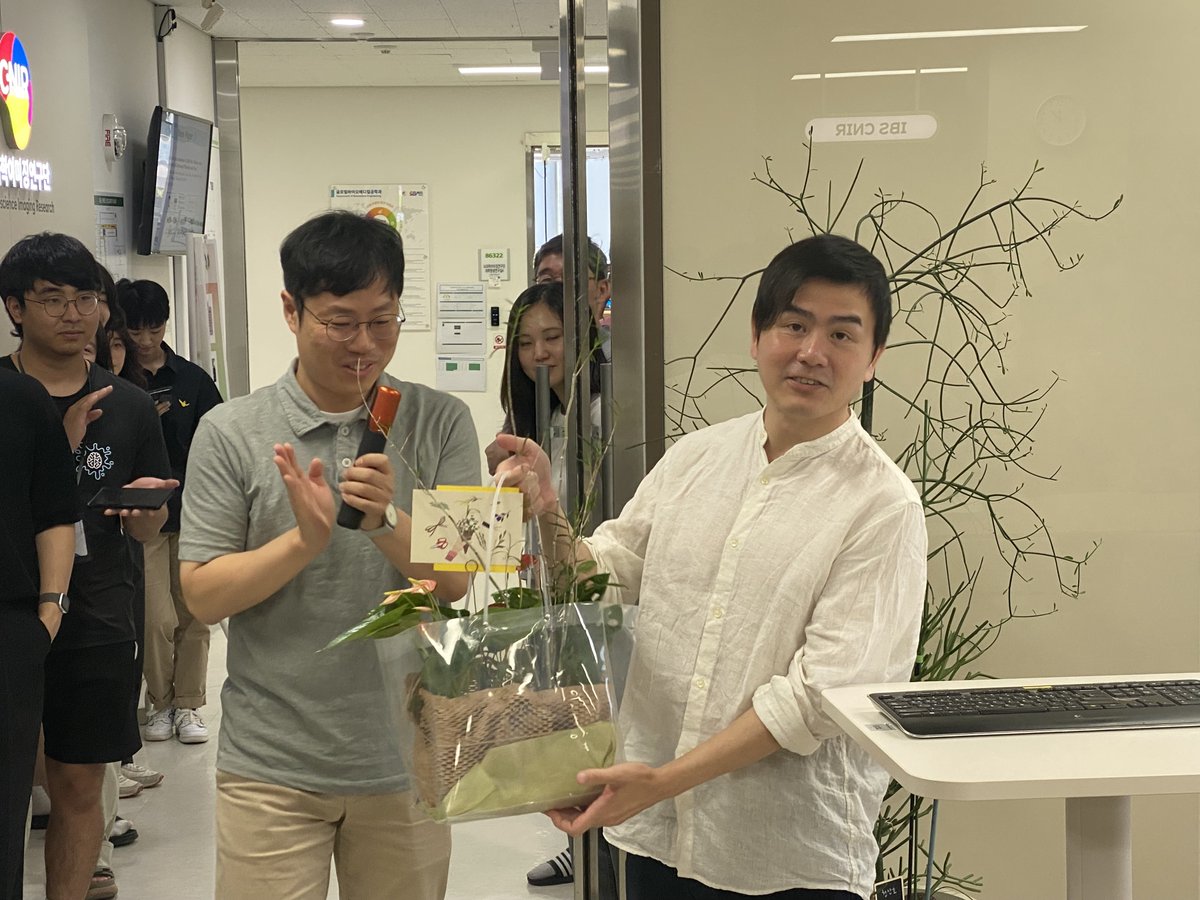
1/4: 🎉We are thrilled to announce the joining of Dr. Hakwan Lau as the Co-Director of IBS Center for Neuroscience Imaging Research! With a unique background bridging cognitive science, neuroscience, and philosophy, Dr. Lau brings unparalleled expertise to our center. @hakwanlau
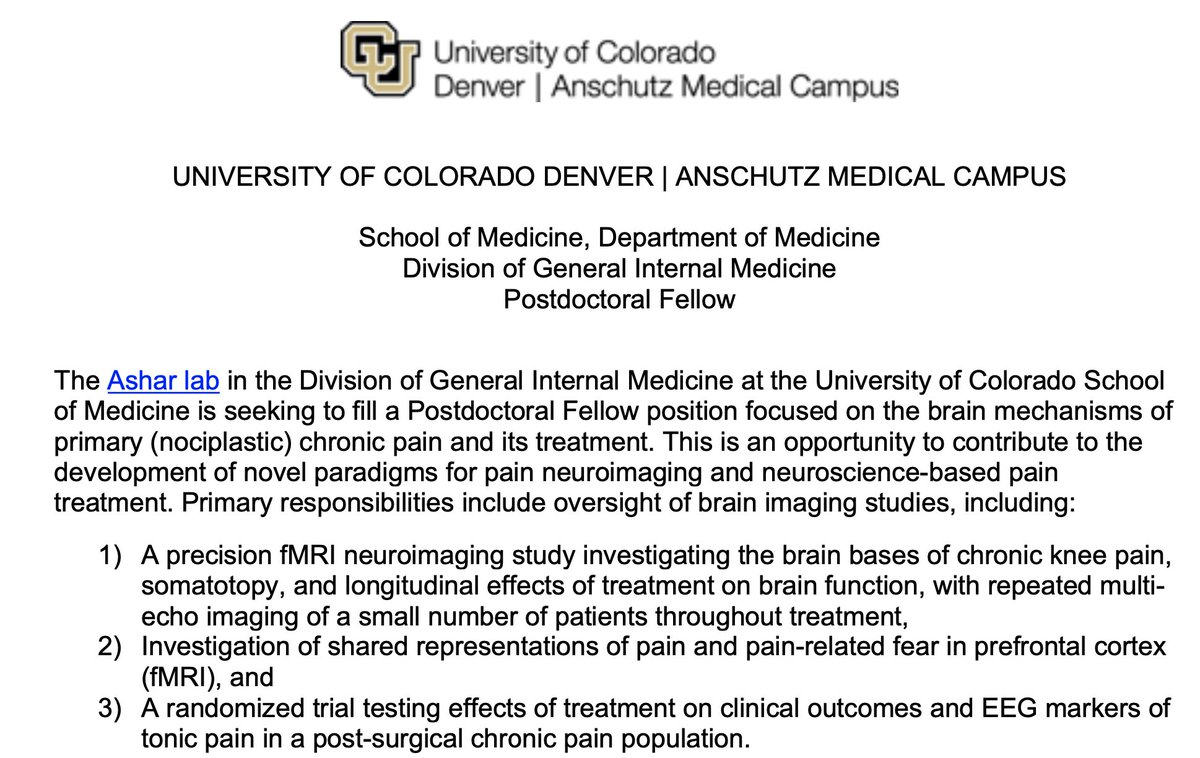
I am hiring a post-doc!!
Focus on precision fMRI of chronic pain & emotion, and how treatments change the brain to relieve chronic pain
Treatments like PRT (https://t.co/E5ytBypb11)
Full posting: https://t.co/4BXkBUZMtO
If you are here, find me to discuss! #IASP2024
Pls RT
Now out @NatureComms! https://t.co/5AHORDIlLJ
With @bogpetre (co-first) @torwager@Na_Friedman@fMRIstats@martaceko we show with fMRI & N=392 that placebo analgesia is driven by changes in brain systems related to affective & cognitive processes, not nociceptive pain processing
Hi everyone, we are teaching our 3-day #fMRI course live online Aug 14-16! #SPM, #ICA, path analysis, #DataScience with @vdcalhoun and Kent Kiehl. We always love talking methods, meeting new colleagues, and connecting! Register at:
https://t.co/b43fyjy85p
#OHBM2024 🧠🇰🇷
Come to my poster #2519 on Wed/Thurs (June 26-27) about a personalized pain biomarker using densely-sampled fMRI data from one individual🙋🏻♂️ (@choongwanwoo) and its comparison to a population-level model (N=124).
@sungwoo320
Come see my poster #2518 on Wed & Thurs about modeling brain responses of sustained pleasure and pain dynamically changing over time! Working with @choongwanwoo@torwager#OHBM2024
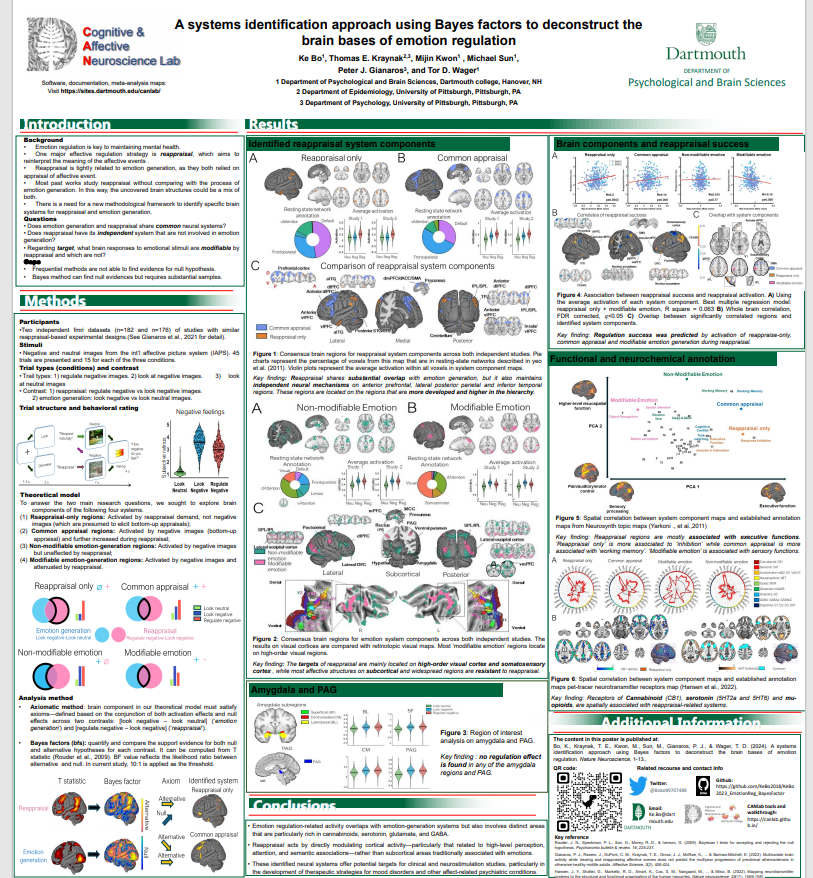
So sad I can't make it to #OHBM2024 in person this year 😞, but my poster will still be there! My advisor @torwager and colleague @mijinjkwon offered kind help to present it for me. Interested in fMRI methods and emotion regulation? Come chat at Poster No. 710!
#SANS2024 Check out my poster tmr (P2-C-16) about within- and between-individual variability in trait-behavior-brain relationships during story-reading! 📚🧠🇨🇦 Work with @la_da_k and @choongwanwoo