Just published on Substack: Why Epigenetic Rejuvenation Won’t Give Us Radical Life Extension — Lessons from 58 Generations of Cloned Mice.
This is my take at the results of a landmark Nature Communications paper (20+ years, 1,200+ mice, 58 generations of serial cloning with full epigenetic reset) shows it still collapses. Mutations accumulated 3× faster. Epigenetic reprogramming works… until it doesn’t. There is an irreducible level of damage that cannot be undone.
To my taste, this is a very important study. Popular literature claims cloning erases aging signatures. In short-lived species it may look that way — the entropic damage simply doesn’t have time to kill. In longer-lived animals we expect the picture be very different (and there is an anecdotal evidence for that with a lot fewer generation before the collapse).
This is also why I dislike the language of “information theory of aging.” Flipping the sign on entropy and calling that "information" (changing from the Boltzmann to Shannon equation) doesn’t repeal thermodynamics.
Of course, you can still hope for better Yamanaka factors or else. My interpretation of the experiment is not yet a proof of anything - certainly not. However, the experiment removes a lot of ground under proponents of epigenetic rejuvenation.
If you want to keep your identity, better to stop aging than try to reverse it.
Challenge me. Subscribe, Like & repost. Link: https://t.co/kBzWMfAQCp
Over the past few months, I've been collaborating with @socialcapital (@chamath's investment vehicle) on a two-part deep dive into the current state of Longevity Biotech and Aging Research. This deep dive aims to be a solid introduction to the field. It assumes no background in biology, medicine, or biotech.
If you've been wondering what science knows about aging, what makes us believe aging can be slowed or reversed, or which companies are making real progress toward developing therapies against aging, this is for you!
Part 1 is out now. It's a foundation for understanding the biology of aging and the current state of longevity biotech.
Part 2 follows shortly, covering the strategies researchers, companies, and investors are pursuing to slow or reverse aging.
Thank you, @chamath and @socialcapital team, for the opportunity to work with you on it. And thank you to all contributors who helped to make this deep dive objective and engaging, and who are making anti-aging interventions a reality: @Andrei_Tarkhov, @elimohamad, @fedichev, @KarlPfleger, @MarkHamalainen, @MartinBJensen, @MaxUnfried, @mkaeberlein, @omri_drory, @RaianyRomanni, @realnathancheng, @sebastiangiwa, @shappiron, @shoylev, @statto, @strygah, @ydeigin
If any errors are to be found in this deep dive, I own them.
RIP Biohackers.
"6.4-7.8 hours" is more ideal than 8 hours...
Wtf are we doing here. Discussing a difference between 12 minutes of sleep is for nerds.
Sleep until you wake up.
If you're sleeping 8 hours you're simply NGMI
turns out biological age has a sleep setting
6.45 to 7.8 hours hits the lowest biological age across 23 organ-specific clocks
brain. liver. pancreas. skin. adipose tissue. etc
bio/acc
@akkkshaaay@m_goes_distance "6.4-7.8" 👀 "Isn't 8 hours..."
Wtf are we doing here. Discussing a difference between 12 minutes of sleep is for nerds.
Sleep until you wake up.
Sometimes we need to zoom out.
I was obsessed with measuring aging in the nest way possble to find interventions, but the complexity became overwhelming.
I zoomed out. Stepped back. Decided that this must be the wrong approach, or at least a futile one.
This is the way. 👇
When most people think about aging, they think biology. Cells, genes, proteins, damage. That's not wrong — but it may be missing the level at which the problem actually lives.
I'm a physicist working on aging. The question I get most often: why physics? Biology is chemistry, chemistry is physics — but chemists don't need quantum mechanics, and biologists don't need to revisit Schrödinger. Fair point. Except it misses something deep.
P. W. Anderson said it in 1972: more is different. Complex systems are hierarchically organized, and at each scale, genuinely new laws emerge — laws that are largely indifferent to what's happening below. Temperature. Superconductivity. Turbulence. None visible in any single particle. All real, all governed by rules that only exist at scale.
The corollary is uncomfortable: information does not flow upward. Macro behavior is insensitive to micro details. This is why drugs mostly fail — not bad chemistry, but a structural mismatch between the scale of intervention and the scale of the outcome you care about. You pull a molecular lever; the organism-level trajectory shrugs.
It also means there is no unified molecular theory of aging. And there never will be — not because we haven't found it yet, but because physics tells us it can't exist. Yeast ages through extrachromosomal DNA circles; mammals through telomere attrition and proteostatic collapse. Completely different mechanisms, convergent macroscopic phenomenology. Different species have different microscopic theories of aging. Physics has seen this before: Landau-Ginzburg theory describes superconductivity without caring about atomic details; BCS and Anderson give microscopic accounts for their own material classes, but no unified microscopic theory exists or is expected to. The universal law lives at the macro level. Always.
Darwin and Boltzmann were contemporaries, and together they produced the deepest tension in 19th-century science. Darwin showed complexity increasing over time. Boltzmann proved that disorder must increase. Two giants, pulling in opposite directions — and resolving that tension took another century. Aging sits right at the intersection: a macroscopic arrow of time in biology, driven by thermodynamic drift that repair mechanisms, themselves finite, cannot indefinitely offset. Hayflick saw it from inside biology: aging is not a disease. It is the second law operating on living matter.
Physics and biology have been circling the arrow of time together for 150 years. Aging is where they finally have to converge.
More on this in my Substack post. 👇
The more data centers we build, the richer we all get.
How?
- Datacenters are intelligence creating machines.
- Intelligence is used to solve problems (curing disease, self-driving safer cars, humanoid robots.)
- Because they will easily do the cognitive work of millions of scientists in many fields that now have thousands if not hundreds of scientists, the amount of co-development of science will likely cause an Industrial Revolution.
- Every single industrial revolution so far multiplied the standard of living of the last. Functionally almost everyone is about to get way way richer.
- The more data centers you build, the richer (and quicker to rich) everyone gets. Poorer people especially experience the biggest uplifts with every industrial revolution so far.
It’s not complicated. It’s not new. Every technology (language, pen and paper, computers, the internet) that boosted functional net social intelligence caused massive multi-order wealth increasing consequences.
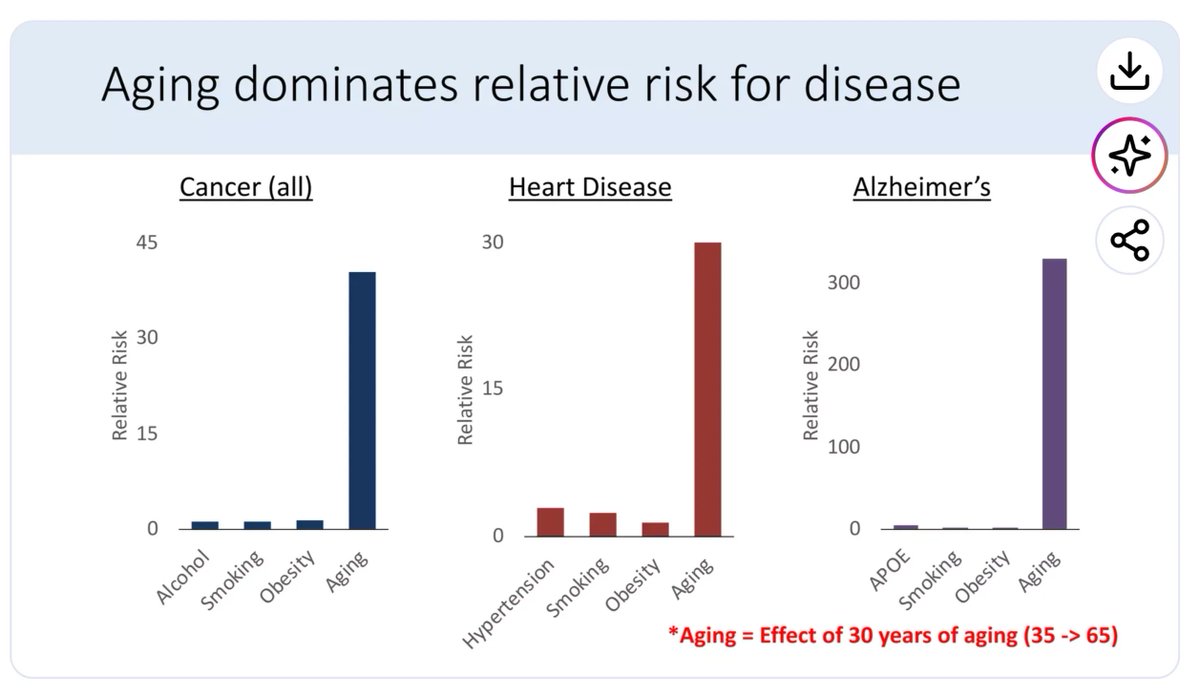
Most of human aging is thermodynamically irreversible.
While it's a much disliked phrase. However, I think it's one of the most important and actionable statements in the field, because it means the goal is not rejuvenation.
The goal is to stop the clock. And now let me tell you how. At @hacking_aging, we feed medical histories across tens of millions of people into physics-based machine learning models, which:
• Use patients medical histories to predict how a person's health evolves over the full arc of their life
• Pull aging out as a distinct process from specific disease trajectories
This happens not because we told the models to, but because the signal is there in the data. Through this analysis, we identify genetic targets that control the rate of aging itself—not a particular disease predisposition or progression, but the underlying aging process closely related to configurational entropy of the aging organism. These genetic factors do not tell stories about treating particular diseases; they're about shifting the fundamental rate at which aging occurs.
In 2021 we were the first estimate the maximum human lifespan from clinical data. What's gets measured - get optimized. Today, that estimate is approximately 120 years.
This is how aging biology can be framed as a data problem, and the data analysis can reveal what no amount of experimentation alone cannot.
Think of this post as a imminent new preprint announcement - please like, share and follow to know more, check and subscribe to my Substack using the link in the first comment.
asking people to read ai-generated text is offensive.
this is not because ai text is intrinsically bad. rather, the author has not paid a cost to write the text himself. this cost is a credible signal he finds its communication important.
so: not paying that cost is telling