I'm really excited about this work (two years in the making!).
We look at how LLMs seek out and integrate information and find that even GPT-5-tier models are bad at this, meaning we can use Bayesian inference to uplift weak LMs and beat them... at 1% of the cost 👀
Do AI agents ask good questions? We built “Collaborative Battleship” to find out—and discovered that weaker LMs + Bayesian inference can beat GPT-5 at 1% of the cost.
Paper, code & demos: https://t.co/ZFPt46XYUj
Here's what we learned about building rational information-seeking agents... 🧵🔽
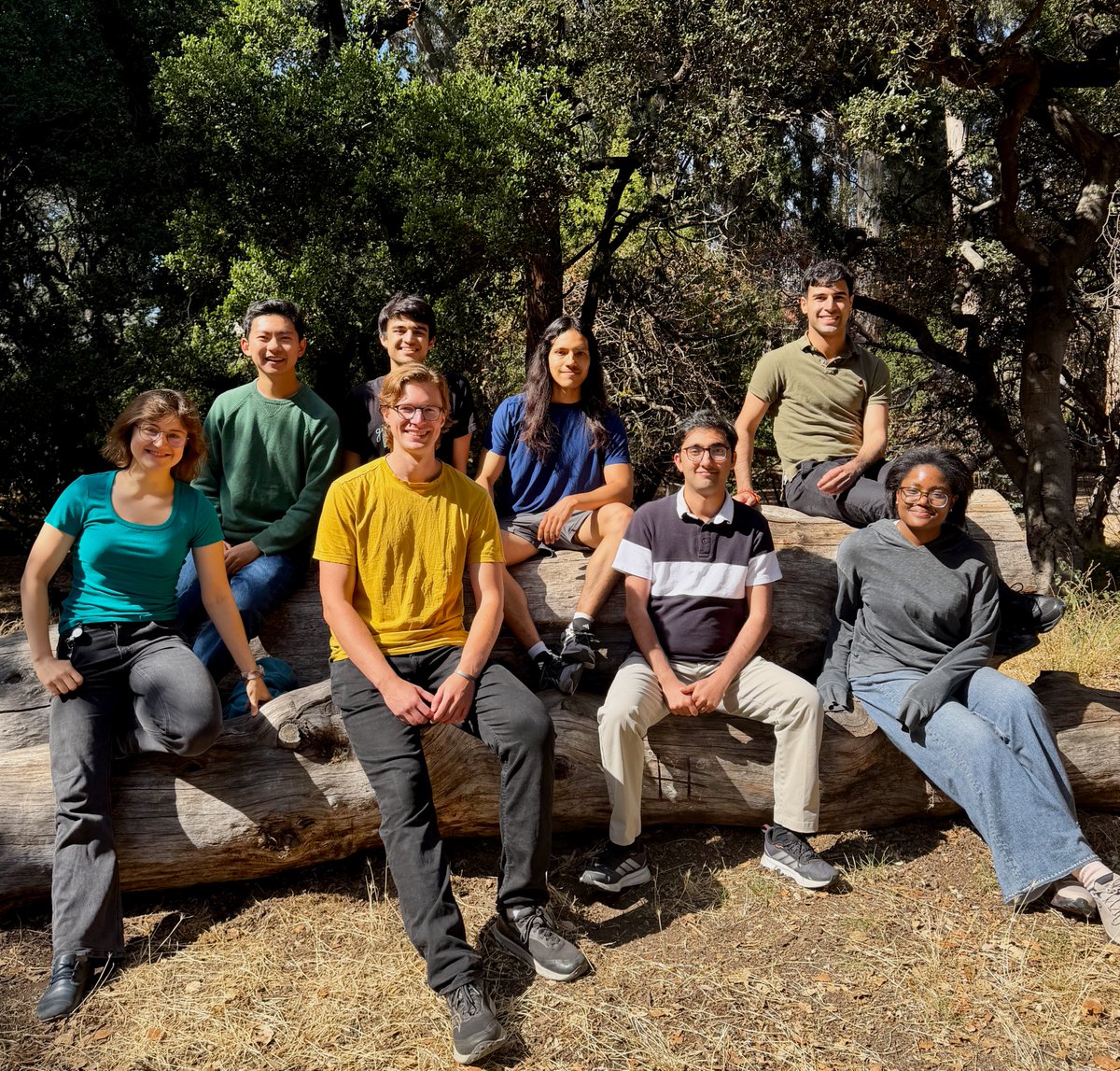
hello from the inaugural cohort of @OpenAI safety fellows!
we're excited to be spending the next few months thinking carefully about and making progress on core issues in ai alignment, control, & interpretability, with the support of great mentors + the community at @ConstellOrg
We raised a $10M seed for @Robocurve, an independent Public Benefit Corporation, to evaluate frontier AI in the physical world.
In less than 3 months, our research has been viewed 6M+ times and our evaluation harness downloaded 97k+ times. Researchers from 200+ institutions, including 19 of the world’s top 20 universities, have signed up to build benchmarks with us.
We welcome more independent evaluators. The more third-party evaluators, the better society can understand how fast robotics AI is progressing. Our evaluation harness is fully open-source, and we publish benchmarks anyone can run and verify.
Our round is led by @Initialized, with participation from @notablecap, @decasonic, @ycombinator, @HalcyonFutures, and many others.
Building robots or frontier AI? Work with us to help the world understand what your systems can do.
For AI to work with us, it needs to understand us
Today, we're introducing Persimmon, the first large-scale model designed to realistically simulate how people talk and interact
I agree with Dario that we need to pace the frontier. This has been a primary topic of discussions we've had at OpenAI in recent weeks.
Committing to having independent evaluators with employee-like access is a great idea, and we will do the same. We'll have more to share soon.
This is a great initiative, and OpenAI should enact and support similar measures.
That said, the devil is really in the details here, and the essay is very light on them. I hope this can be an opportunity to share notes among labs and really race to the top, in Dario's words
We Must Pace the Frontier: I’ve written a new essay on why the AI industry should slow down, with a three-part plan for doing so.
Anthropic is unilaterally committing to the first of these steps. We’ll provide third-party evaluators with permanent, employee-level access to our systems, so that they can verify adherence to our safety measures, report on incidents, and assess models’ alignment during training.
You can read the full post here: https://t.co/OGyPb7yaYt
So proud to announce what I’ve been working on over the last few months with the incredible @314Bansal & many other talented humans!
Persimmon is a huge first step towards a future where AI is built *for people* and we can’t wait to see what work it inspires 🌟
Do reach out (or request access to our research preview!) if you’re interested in learning more.
Very sad to see Levent double down on the plagiarism accusation. I hope my friends at @AnthropicAI stand up to this internally. It should be clear by now what the truth is.
We’re sharing a solution to the Navier-Stokes Millennium Prize Problem, one of the deepest problems at the frontier of mathematics.
The proof was produced by a group of agents, using an OpenAI next-generation model significantly more capable than GPT-6 Astra.
The problem concerns whether the description of smooth three-dimensional fluid motion modeled by the Navier-Stokes equations can break down. It has remained unresolved for roughly 90 years.
The Physical AI Safety Institute is convening the first Science of Physical AI Safety workshop at CoRL 2026 — @corl_conf — Nov 12, Austin TX.
Speakers: Marco Pavone (Stanford/NVIDIA), Andrea Bajcsy (CMU), Vikas Sindhwani (Google DeepMind), Thomas Fel (Goodfire/Harvard).
$20k in travel grants — supported by @robocurve.
Papers due Oct 1.
https://t.co/dVPXqPN8s4
I'm glad we are being more transparent about how new capabilities are affecting the velocity of research --- the speed of everything has been very surprising to me, and it's good that data on this is now public
Today we're releasing data on models accelerating research at OpenAI.
Recursive self-improvement could be the most important contributor to AI capabilities over the next few years, but by default it will only be seen inside a few frontier AI labs. Being transparent is more urgent than ever, so we can inform the public discussion on whether and how to pace model development. I ask other AI companies to do the same.
https://t.co/iLKbrLcBAI
How to approach an unknown language in the ocean?
Here’s one of the first cases of AI interpretability leading to a scientific discovery -- in whales.
We built an artificial baby model that learns language directly from raw sound and trained it to imitate whale speech. Then we looked inside.
Our interpretability method recovered the properties biologists already thought were meaningful and pointed out those that had not been considered before.
This was the initial clue that eventually led to the discovery of vowels in sperm whales.
Understanding AI and reframing language as informative imagitation can help us step outside our human biases and discover new realities about the natural world.
Published in Royal Society Open Science.
An announcement: Under the leadership of Mario Draghi and @patrickc we have set up the Rhine Group: policymakers, economists, entrepreneurs and business people pushing European reforms and the Draghi agenda.
https://t.co/ZtoW7Rb173
As models become more capable, the risks associated with developing and testing them internally also grow.
We temporarily paused reinforcement learning (RL) training on our latest models intended for deployment for two weeks while we hardened and red-teamed our research environments and expanded monitoring coverage.
Our largest planned frontier RL run remains on hold while smaller-scale training and evaluations validate these safeguards and establish more evidence of alignment.
https://t.co/ecbMMmVoox