The demand for clean, always-on power is exploding, and the grid can't keep up. The team at Endurance Energy is going after one of the biggest untapped sources on the planet: geothermal heat beneath the seafloor. They're building systems to deliver gigawatts of zero-emission power faster and cheaper than conventional sources.
Today, they're announcing $54M Series A funding. At @firstround, we're excited to have backed Andrew Redd and the team since the pre-seed. Huge congrats!
I remember first meeting @jakebolling & being 'wowd' by his desire to transform an otherwise overlooked industry. We knew we had to invest.
12 months later, Scotch launched.
3 months after that, pre-empted for their A.
Now, Scotch has passed a $1B GPV run-rate.
Scotch is quickly becoming the defacto operating system for liquor stores nationwide. Kudos to the entire Scotch team, and a big 🍻 to Jake — one of the best operators out there.
Back in February, I got early access to @TownAI. Now 93% of @firstround is using it. There was never a top-down mandate — it went viral inside First Round the way great products do.
Today, Town announced its $55M Series A. Huge congrats to @jgreze, @tonydevincenzi and the whole team!
It’s hard to imagine getting my work done without my Townie “Brock” helping me. Here’s how Town took off at First Round:
1) Most AI assistants want you to come to them. Town comes to you. It learns how you work and then starts working. After connecting email, calendar and Slack, Town gives you a briefing — who you work with most, what’s high priority, your communication style and patterns. Everyone gets a custom version of this. Connect Town to more tools (Granola, Notion, Google Drive, etc.) and it starts drafting perfect emails and nailing investment snapshots. Customization even extends to “Townies,” the names, avatars, and personalities people assign their Town assistants.
2) First Rounders create routines in Town to solve real problems…then share them. Chiefs of staff were nodal users. Town is a glass of water in the desert for them. So much of their work is processing email, filling out updates, checking spreadsheets and gathering context. Town does this natively. Roy Rosin, one of First Round’s board partners, automatically tracks all his follow-ups (“commitments I made to founders”) at the end of each day. We share new routines in a # town-square Slack channel so it’s easy for other people to use the same routines the chiefs or Roy created.
3) Town works for every function — even people who’d never set up Mac minis to get the benefits of using agents. Our finance team saves hours on repetitive work it can now automate. Our marketing team tells me it “essentially replaced Claude and ChatGPT” for them. Without skills or markdown files but with persistent memory, the more you use it, the better Town gets over time.
A few specific routines we’re using across First Round 👇
I’ve been watching @paraga build @p0 before most people knew it existed.
@firstround invested in Parallel’s seed round, and I’ve personally known Parag for over a decade. He’s a singular technical mind, and one of the best company builders I’ve ever worked with. He has a unique ability to envision technology 2-3 years away that will have disproportionate value.
When we invested in January 2024, Parag made a few bets that felt early at the time: agents would eventually use the web far more than humans, and the best way to build for that was to go deep on infrastructure and systems rather than chase the AI labs. He was right, and his bets are proving out faster than any of us expected.
And it shows in the companies trusting Parallel to run their most critical workflows. Harvey, Notion, Clay, Profound, Opendoor, Modal, Baseten and over 100,000 developers — from AI-native startups to regulated enterprises — all building on Parallel.
Today, Parallel announces its $100M Series B at a $2B valuation, led by @sequoia, more than doubling in five months from the Series A.
Proud to have been there from day one. A lot more ahead.
More details below:
Sales is the most expensive function at many companies. It was one of the first orgs many AI tools were built for, but it’s been the last place to see real change. Engineering, support, legal and more have all been transformed by AI — but sales reps still work mostly the same way they did in 2018.
I’ve worked closely with @mgarimella and @agupta_108 since leading @useactively’ seed in early 2022 and what they’ve built over the past few years has been incredibly impressive.
Their core insight is that GTM is exactly the place goal-directed agents are built for. It’s continuous, context-heavy and constantly changing. So they built a persistent AI agent for every account that operates 24/7, researching, identifying opportunities and moving deals forward without having to wait for a human to connect the dots.
Samsara has Actively agents deployed across their 1,000+ person GTM team — account development, sales, rev ops and customer success. They’re seeing 2x conversion rates across Actively-driven outreach. And other customers like Ironclad, Abnormal AI and Ramp are also seeing 20% increases in productivity per rep.
I’m thrilled to be continuing the journey alongside them with this $45M Series B. Congrats to the whole team. Lots more to come.
More details below.
“Blank check founders” are the ones I’d fund pre-idea, no matter what it is. Snir Kodesh is one of them.
I’ve known him for 5+ years through our First Round community: Angel Track, Eng Leaders Forum, PMF Method. His first company was acquired by Lyft, and he later went on to lead engineering at Retool. When he was ready for his next thing, we invested before he even had a specific idea.
He ended up in a domain most founders wouldn’t dare touch — enterprise audit — but one he knows extremely well. Snir is deeply technical and innately commercial, a heat-seeking missile when it comes to finding a big problem and imagining the right technology to solve it.
Today, Petual is coming out of stealth with $20 Million in funding.
They’re bringing agentic AI to SOX testing, autonomously generating auditor-ready work papers in minutes instead of hours. Early customers, including S&P 500 and NASDAQ 100 companies across energy, SaaS and financial services, can see 68-80% efficiency gains on workflows that today eat hundreds of hours per quarter.
$8 Billion goes to SOX compliance in the US every year, but that’s just the start. The broader audit opportunity is massive — and to tackle both, Snir built a team of folks from Stripe, Retool, Lyft and the Big Four who understand these problems from all angles.
I rarely do interviews or talk about my personal life, but I made an exception for the team at @firstround.
Their writer spent hours at my house. We talked about why I started Lenny's Newsletter, what motivates me to keep building it, and a lot of things I don't usually share publicly.
It's an intimate look at what my life is actually like outside of what most people see on the podcast.
Check it out: https://t.co/eNvWu269H0
Recently, @ivanhzhao put words to something we’ve long believed: "The most meaningful things were never built alone. It’s always groups of people, building and believing until something clicks."
So much of that work happens when people are together in offices, where ideas are discussed and tugged at and strengthened when people gather around them. Space influences how people “think together.”
Today, we’re excited to launch a new video series about the stories behind the physical spaces the best companies inhabit, and what those spaces reveal about how great work gets done. It feels especially fitting to begin with @NotionHQ. We began our partnership with the company long before they had an office, or even a product.
Join @akothari as he gives us a tour of Notion’s SF office
We first began our partnership with @zackkanter and @Stedi back in 2017. Today, they announced their $50 million Series C. But most of those years were spent quietly and quite obsessively building the underlying infrastructure.
Once the company built its way into healthcare, things started to inflect quickly. (They were recently named one of Ramp’s fastest-growing vendors across all categories, not just healthcare). But as with most “overnight success” stories, it was nearly a decade in the making.
The ambition to replace legacy clearinghouses with a modern API-first, software-native platform is a big one, and the breadth of the product surface is stunning.
But it’s Zack’s desire to keep grinding towards bigger outcomes that’s truly outlier. He’s built Stedi with unusual levels of patience and persistence. (For example, they threw away the entire codebase 8 times, and took 4+ years to launch anything publicly.)
These choices stem from a determination to avoid what he calls the accumulation of not doing things the right way. His philosophy is rather unique and is best captured in this quote: “As a company, we’ve decided we’re gonna eat glass. That is what sets us apart. We’ll go to the ends of the earth to do things the right way, even when it’s not economical and it doesn’t make sense.”
He gets at more of this idea in the clip below from our recent interview, where he talks about why he’s building Stedi to be a company he wants to run forever.
He’s an incredibly tough founder to bet against, and I feel fortunate to both be an early supporter of his @firstround and to call him a close friend.
Wow. Gumloop has gone from a side project out of a Vancouver bedroom to an AI platform that now automates daily workflows at companies like Shopify, Ramp & Instacart, and a new $50M Series B led by @benchmark (all in ~2+ years!!). It’s been a wild journey for the team, and I feel incredibly fortunate that @firstround led their 2024 seed round.
If you tried it a while ago and still think of @Gumloop as just drag-and-drop workflows, I’d *strongly* recommend giving it another shot, as the product has evolved in massive ways.
They’ve now added their agent builder, Gumloop Agents (lets anyone at a company build/deploy AI agents across workspaces in minutes) and Gumstack (a separate security product that lets IT teams monitor/control how agents use company data across the org). As a user of theirs said to me recently, ever since Gumstack launched, “Gumloop *IS* Gumloop for Enterprise.”
As they’ve built out their product, the Gumloop team has stayed super focused on making it maximally useful to everyone – not just technical folks. IMO, this is a big part of why teams are getting hooked, and usage spreads wall-to-wall, instead of getting stuck in one department.
@MaxBrodeurUrbas, @rbehal1729, and their entire team (who are all amazing btw) have been obsessed with this from day 1 and truly stay embedded with their customers, flying to their offices, running hundreds of workshops, shipping features same-day, and personally answering thousands of questions in customer Slack channels.
They’re hiring across the board right now, more info below!
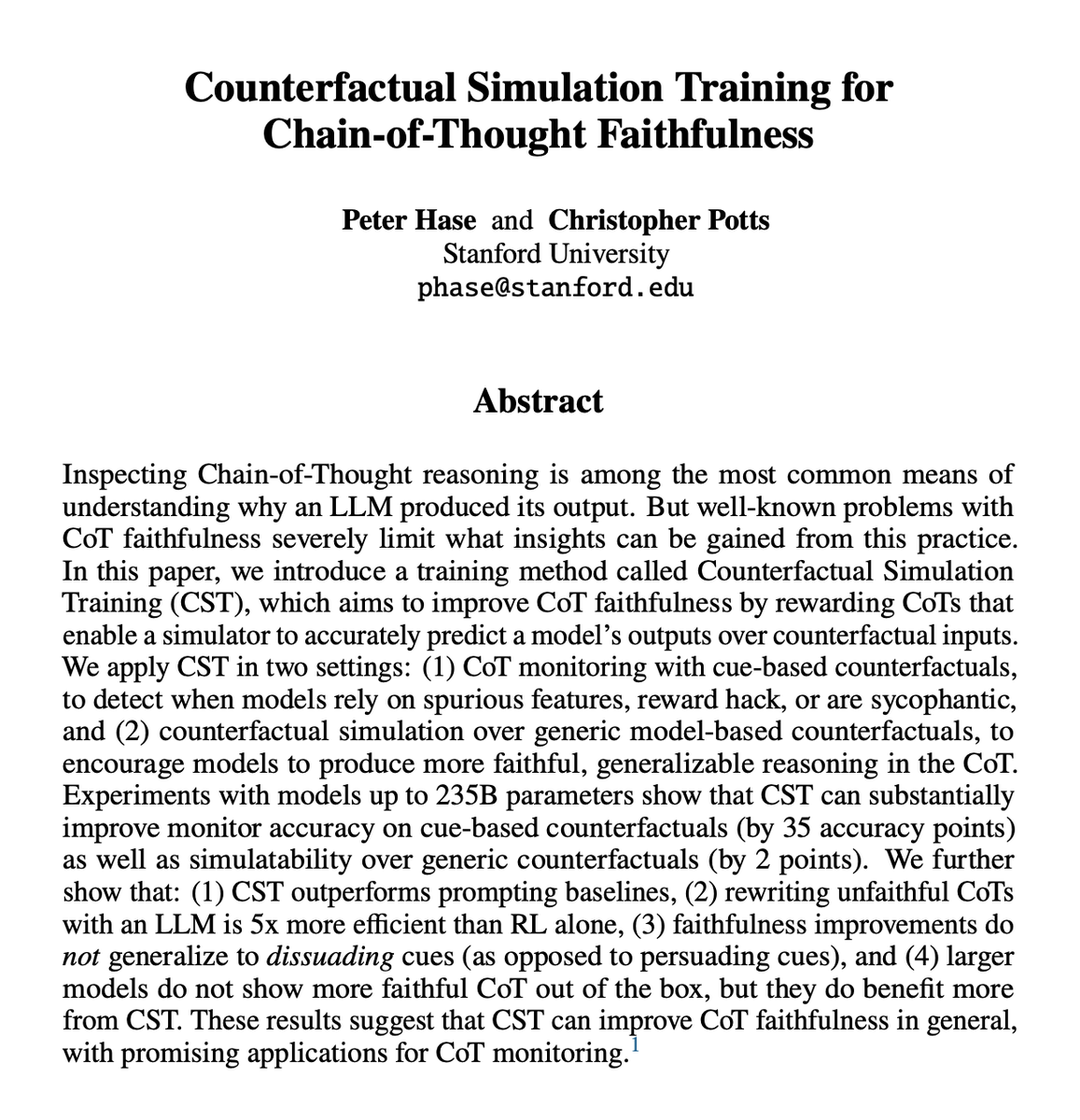
Can we train models to have more monitorable CoT?
We introduce Counterfactual Simulation Training to improve CoT faithfulness/monitorability.
CST produces models that admit to reward hacking and deferring too much to Stanford profs (@chrisgpotts told me this is very dangerous)
Customs brokers are having a moment.
“For the first time in history, our families know what we do for a living. Because all of a sudden, custom brokers became very, very important.”
When a person crosses a border, they show a passport. But when a product crosses a border, it has to show thousands of data points, like materials, origin, safety certifications, and shifting duty implications. Nearly every product in your home was “cleared” by a human in a logistics office manually typing those details into a computer while racing against a clock. And with all the global trade chaos and rapidly changing tariffs, this job has gotten a lot more stressful recently.
@sambuddha_basu and @ArushiVashist started Amari AI to build an AI workforce for global trade, starting with customs and compliance.
Existing “AI tools” in the space just run OCR and scrape data. Amari has built sophisticated decision-making logic that “thinks” through a filing against the most up-to-date trade regulations, which these days can change on a Friday afternoon and go into effect the next Monday morning.
Since we co-led their $4.5M seed last summer, the team has been on a tear, going from a handful of paying customers to over 30 U.S. customs brokers who have moved $15B of goods through the system, cutting clearance time in half and helping them stay more compliant. Excited for what’s next!
Thanks to @sokane1@TechCrunch for covering:
https://t.co/gnttu4girg
Today we’re launching our newest podcast, Executive Function. The question we’re trying to answer is: what is the difference between good and truly great scale up executives?
We’re beginning this journey by sitting down with Jeanne DeWitt Grosser, who’s currently the COO @vercel and previously spent almost 10 years @stripe, where her final role was Chief Business Officer.
So much of her perspective can be summed up in this observation: “Most executives have a playbook and won’t contextualize it. They over pattern match and lack the intellectual curiosity to figure out what’s different. They don’t actually get their hands dirty.”
Hope founders, execs, and future execs find as much value in this conversation as I did.
Timestamps:
(5:04) What keeps star talent from ascending to the top spot in a company
(19:59) How to balance being demanding and supportive as an executive
(22:47) Jeanne’s interview process for hiring executives
(29:04) The thread that ties together failed executives
(34:57) How Jeanne uses “driver trees” to determine metrics
(43:24) Why your executive peer set needs to be your first team
(57:16) How Stripe got 30 execs to operate as one team
(1:02:43) Why execs should be working themselves out of a job
(1:09:26) The performance review from @collision that sticks out in Jeanne’s mind
In 20+ years of building @firstround, I’ve never hired for this specific role before.
I’m kicking off a search to hire an Investor who will work directly alongside me. They will share my obsession to meet with the highest potential founders as early as possible, often before they even have a clear “imagine if” yet.
Although the role itself is still being defined, my commitment is to work closely with this person to help them build the foundation of their investing career.
Here’s what’s probably true about you if you’re the right fit:
- You’re enthusiastic and obsessive. Following your curiosity has taken you down often weird and winding paths.
- You already know a lot of brilliant builders — and more importantly, they enjoy spending time with you. You have a unique ability to generate followership, likely because you give more than you take.
- You actually enjoy the work of building relationships from scratch: the cold emails, the endless events, the persistent follow-ups, the months of coffee chats. It requires relentless execution, and that excites you. You go about this work in an authentic way that isn’t conventional “networking.” If you’re looking for a role where the title does all the heavy lifting for you, this isn’t it.
- You don’t find it difficult to put unreasonable hours into your work because it doesn’t feel like work to you. You’d call yourself a “work enthusiast.”
- You’ve been immersed in the startup world long enough to have real context. What matters most is you’ve been close enough to startups to understand how they actually work and what great looks like.
- You obsess over markets, customers, and why some businesses work while others don’t, but you can also hang when a conversation goes deep into technical choices.
- You’re an exceptional communicator who tends to be more of a “simplifier” than a “complexifier.”
- We’ll work together incredibly closely, but you aren’t someone who needs to be managed. You learn best by watching, by doing, by asking well-calibrated questions — preferring to “take the wheel” instead of being a passenger. You’d rather shape a role than fill one.
If you want to spend your time with builders at the very beginning — and learn this craft of early-stage investing alongside someone who’s been at it for two decades and still thinks it’s the best job in the world — I’d love to meet you.
SF or NYC only, with long days and lots of travel in both directions. Apply below.
https://t.co/wV9Ns4fUE7
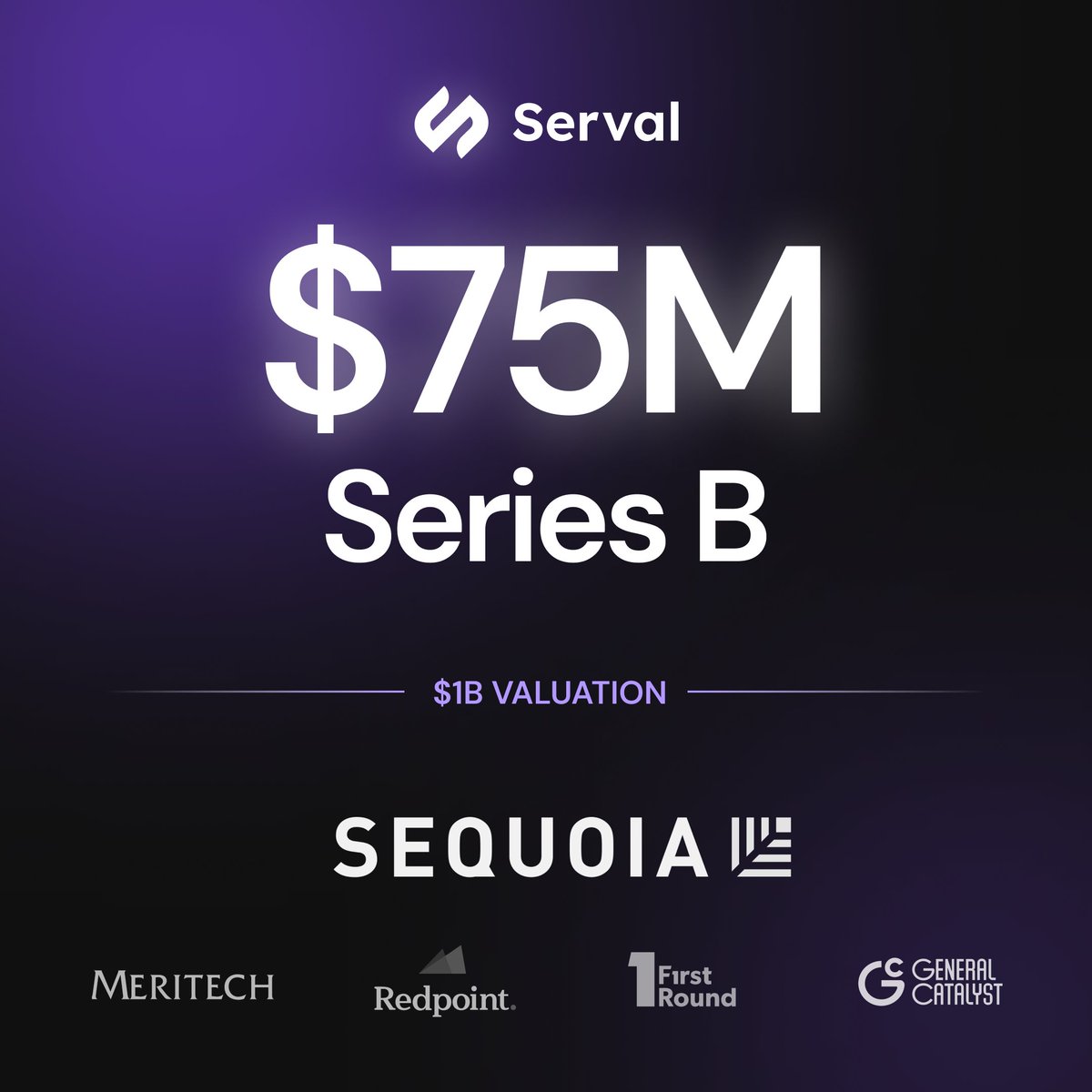
In just 90 days since their Series A, @getserval has grown revenue by 500%, tripled headcount, and raised another round at a $1B valuation. This team is moving at a pace I’ve rarely seen in all my years @firstround.
I've known @jakeserval since his product building years at Verkada, so it’s been a special privilege to partner closely with him and the team right from the very beginning of Serval’s journey.
IMO, it’s the customer love that’s driving this wild momentum. Companies like Perplexity, Mercor, Clay, and Together AI are now able to automate 50%+ of IT tickets with zero human touch, something that would have been unthinkable just a year or two ago.
And Serval’s already catching on beyond IT, with HR using the platform to automate onboarding, finance rebuilding procurement, and legal spinning up NDAs straight from Slack.
Very proud of this team, and very much looking forward to what the next 90 days will bring.
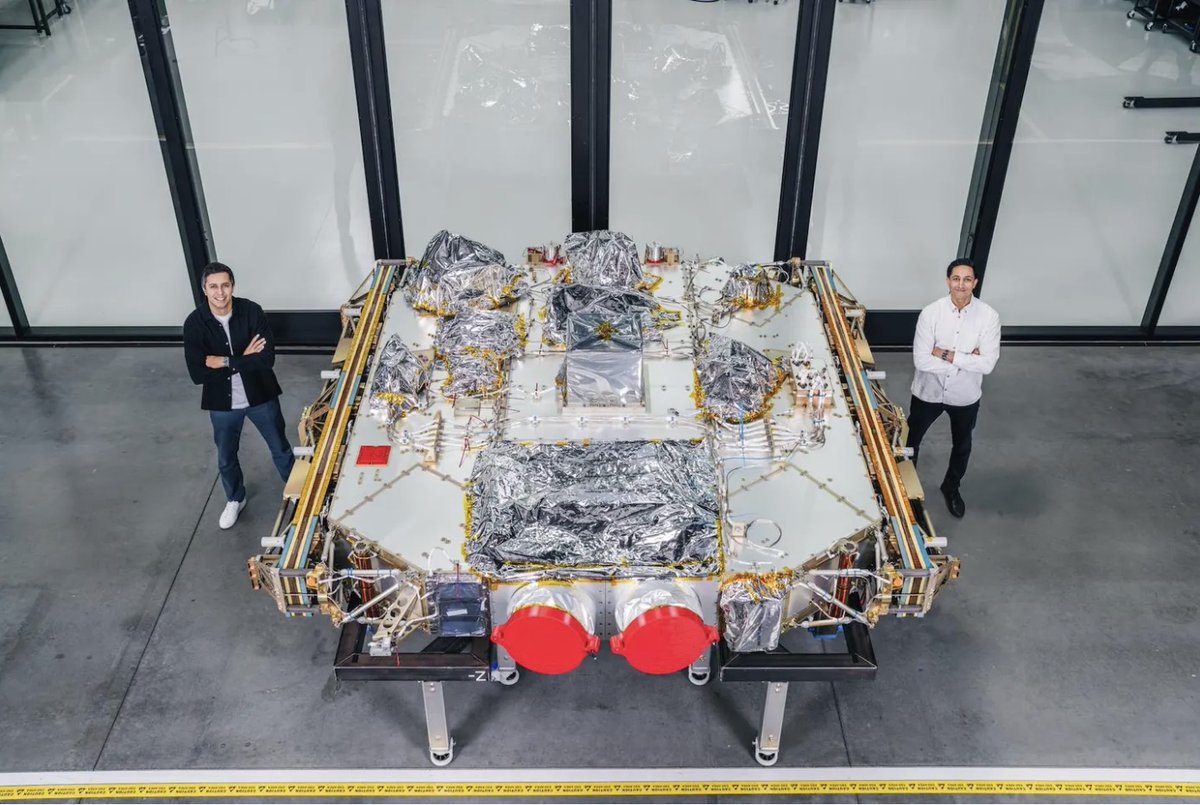
Three years ago, @KaranKunjur and @NeelKunjur pitched me on the idea of building bigger. Today, @k2spaceco has a new $3B valuation (with a $250M Series C round), a business that’s humming (with over $500M in contracts this year), a huge factory where 80% of each satellite is built in-house (right here in the USA), and a massive upcoming Gravitas launch (T-080d as the countdown clock on their slick new website shows).
Couldn’t be more proud of all that this team pulled off in 2025. One of the highlights of my year was going down in person to watch the launch of their first mission flying hardware on SpaceX's Transporter-12.
2026 is going to be even bigger. LFG. 🚀
Great write up on all their progress today in Forbes below.
This was one of my favorite interviews of 2025...
Founders often underestimate how much freedom they actually have. @acv and @meter is a reminder of what happens when you use all of it. They ignored the usual advice and built the company their way. It’s no surprise their story doesn’t resemble anyone else’s. Here are just a few examples:
1. They spent four and a half years pre–revenue, just two people. It was essentially Anil and Sunil, alone, for four and a half years before they had a sales ready product and their first customers. They even scrapped an entire year of operating system work once they realized a different technical approach (inspired by an open source project) was better.
2. They literally moved to Shenzhen to learn how the physical world is made. They were blocked by slow hardware iteration in San Francisco, so they just relocated to Shenzhen for over a year.
3. Full vertical integration as a day one decision, not an afterthought. Meter decided from the start to own the entire stack: hardware, software, installation, and ongoing service. This is in a market where most entrants pick one slice (just switches, just access points, etc.) and get trapped as point solutions that end up acquired.
4. Business model treated as part of the product, not a pricing afterthought. They moved networking from “buy hardware” to: Meter provides the hardware, the software, the installation and ongoing support. The customer pays recurring, per square foot, and effectively “don’t pay us if the network doesn’t work.” Anil thinks about business model innovation on the same level as product and technology innovation.
5. Choosing a massive, incumbent dominated market on purpose. Networking is controlled by a few giants like Cisco. They were pulled toward that exact dynamic: a huge, durable market where the initial ramp is brutal, but if you get through it, there are very few new players alongside you.
6. Deliberately avoided the channel in a channel dominated industry. Roughly 90 percent of networking is sold through the channel.Meter refused to use the channel until they were convinced the product was dramatically better in every way, because incumbents could weaponize the channel with discounts to block them. Only after they had hundreds of happy customers and strong tools did they fully embrace channel sales.
7. The team has an extreme time horizon, paired with extreme urgency. Anil thinks in decades: “I care about where Meter ends up in 25 years, not five.” At the same time, he is obsessively focused on what happens in the next few hours and where every report spends time. That “barbell” between multi decade vision and hour by hour intensity is very explicit for him.
8. An allergy to “meta work” and most conventional management. No OKRs or goals at all. They have a strong skepticism of spending time on docs, processes, and coordination that feel like work but do not move the product forward.