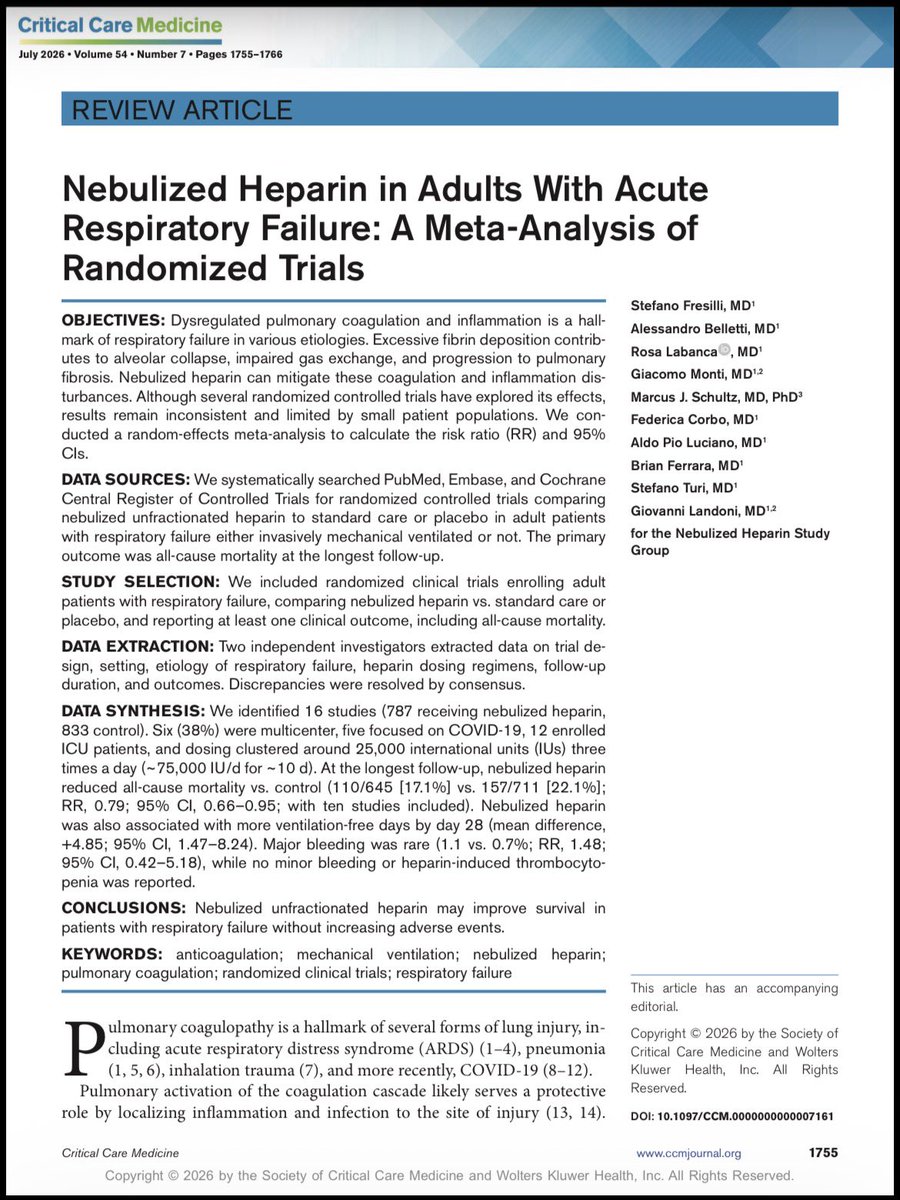
Algo que sí funciona y de bajo costo… Heparina en Falla Respiratoria Aguda
(excepto porque requiere nebulizador con malla vibratoria como el Aerogen, o nebulizador Jet)
✅Menos mortalidad
✅Menos días de Ventilación Mecánica
Se usaron varias dosis, pero 25,000 UI en 5 mL cada 6 h x 7 a 10 días (incluso hasta 21) es sugerida
Revisión sistemática de >1,500 pacientes analizados
DOI: 10.1097/CCM.0000000000007161
Managing perfusion in septic shock requires more than just high-dose vasopressors. This review highlights the importance of catecholamine-sparing strategies, perfusion-guided targets, and non-adrenergic agents. 🎩 tip to the authors.
https://t.co/Sfr6vCn6le
The primary reason people don't achieve big goals is because they don't realize that the only source of truth is making mistakes. They soak up advice and theory, expecting it to be an exact match to their mind, experience, and situation just to fail once and give up completely.
The best way to encourage others to pursue their own dreams is to fulfill your own; people will be moved and pay attention to what you have to say only once it's clear that you have yourself built the life you wanted and are now happily getting rewarded every single day.
A First-of-its-Kind Neurosonology Workshop in Visakhapatnam on August 22nd at Medicover hospitals.
Extensive discussion on the core Neurosonology topics and hands-on practice will be provided.
I thank Dr A.Mohan Rao sir for this opportunity.
Please contact 8499906560 for any queries and registration.
Amjad Masad, CEO of Replit, on why founders have to understand storytelling:
"I think Replit would have probably died if I wasn't telling a story that is larger than the company itself."
"If you're trying to meme a dream into reality, I think you have to play that game."
"I had terrible stage fright. I went and took improv classes in New York, then took a storytelling class. I'm a big fan of exposure therapy. Anything you're afraid of, just go do more of it until you're desensitized."
@amasad@eriktorenberg
We made a 2 min mini-episode of @CritCareTime demonstrating the steps for an emergency front of neck airway (eFONA).
Let us know what you think and if you want more of this content!
Thx to the @TheAirwaySite for letting us film at the difficult airway course!
🫀Macrocirculation is only the beginning.
For decades, haemodynamic resuscitation has focused on restoring blood pressure, cardiac output, and oxygen delivery. These variables remain essential, but they do not guarantee that oxygen actually reaches the cells that need it.
Tissue oxygenation is a sequential physiological process with three interconnected levels. First, the macrocirculation transports oxygenated blood through the heart and large vessels. Second, the microcirculation distributes that oxygen according to local metabolic demand through arterioles, capillaries, and venules. Finally, the mitochondria use oxygen as the final electron acceptor in oxidative phosphorylation to generate ATP. Organ function depends on the integrity of every step in this cascade, not simply on blood pressure or cardiac output.
This explains why a patient with a mean arterial pressure of 70 mmHg and a normal cardiac output may still develop tissue hypoxia and multiple organ dysfunction. Oxygen delivery can appear adequate while microvascular flow is severely impaired, a phenomenon known as loss of haemodynamic coherence. This is particularly relevant in sepsis, major trauma, burns, and acute pancreatitis, where optimization of macrocirculatory variables alone frequently fails to restore tissue perfusion.
The determinants of oxygen delivery are also worth remembering. Oxygen delivery (DO₂) is the product of cardiac output and arterial oxygen content (CaO₂). Arterial oxygen content depends predominantly on haemoglobin concentration and arterial oxygen saturation, while dissolved oxygen contributes only minimally under physiological conditions. Increasing FiO₂ without correcting anaemia or low cardiac output often has far less impact than expected.
Even when oxygen reaches the tissues, the final determinant of survival is mitochondrial function. If mitochondria cannot utilise oxygen efficiently because of inflammation or metabolic dysfunction, ATP production falls dramatically and cells switch toward anaerobic metabolism with lactate generation. Cellular oxygen utilisation is therefore as important as oxygen delivery itself.
The clinical implication is profound. Modern haemodynamic management should move beyond treating numbers. Mean arterial pressure, cardiac output, haemoglobin, tissue perfusion, lactate, venous oxygen saturation, and, increasingly, microcirculatory assessment should all be interpreted together. The goal is not simply restoring circulation but ensuring that oxygen successfully completes its journey from the lungs to the mitochondria.
This shift from macrocirculation to cellular oxygenation represents one of the most important physiological concepts in perioperative and critical care medicine.
Reference 📚
Meier, J. British Journal of Anaesthesia, 136(6), 1761–1775. https://t.co/PRM3vEd1W3
This is why detached effort is such a powerful mindset.
The moment you convince yourself that one interview, one investment, one relationship, or one opportunity will define your entire future, your brain stops performing and starts protecting. Fear takes over. You become more concerned with avoiding failure than producing your best work.
Ironically, the people who appear the most confident are often the ones who understand that no single event is final. If this door closes, another will open. If this idea fails, another can be built. They value the process more than the outcome.
Treat important moments with respect, but never with desperation. Preparation deserves intensity. Execution deserves calm. Your identity should never be tied to a single result.
Pressure is often created by the story we tell ourselves about what will happen if we fail. Change the story, and you change your performance.
This is free advice from an expensive psychologist.
If you're an anxious person, do everything for fun. Go to a job interview for fun. Submit documents for fun. Start a blog for fun. Anxiety feeds on importance. Don't make everything a matter of life and death.
Neuro POCUS is cool. I would argue that residents would benefit from being familiar. It provides useful skill sets that can complement the neuro exam / improve bedside diagnosis / help with certain procedures
I've started to practice it although I am far from being an expert yet
To all the new doctors and especially for new cardiologists from India-
Any degree only means that you have the basic necessary knowledge on the subject and a basic level of competency can be expected from you.
Thats it.
Learning is a continuous process. Try and learn to do and the nuances of whatever your field demands.
Even if you think this might not help you right now, but it will one day surely help you when you least expect it to.
Be curious always, be receptive to a good advice, and always try and form your trusted circle- people whom you can call and ask for an insight.
Read, read and read some more. Try and attend specific workshops related to your field. Do not go into conferences expecting to learn new subject matter- so there to refine existing knowledge and to clear your doubts once you get over your degree.
Workshops are a great way to do that.
Know how to handle basic emergencies and guidelines related to them. Never be afraid to refer a patient that you feel you cannot help much. You cannot save everyone, and sometimes you shall receive patients who are already at the point of no return. Learn to communicate clearly, respectfully but still softly- while breaking bad news.
Always have the phone number of your nearby police station handy. Be ethical, you know when you toe that ethical boundary- stay within it at all times.
Never rely on the vitals and clinical description of someone else - see for yourself or have an equally competent person check it. I tend to trust electronics for my vitals more than many people now.
Delegate. Do not try to do everything by yourself.
Take out time for you and your family. You are also a human. The same problems you are treating, can happen to you too- so take care of your health. Your patients will forget you the moment you die, but your children, spouse and children will not.
Be happy: do not chase money. Do ethical work, the money may be slow, but it will eventually come to you. Never give into the pressure of the corporates. They are there to make a profit, you are there to treat patients.
Have a spine, say when things are not right.
Upgrade as and when you can.
For twenty five years I have sat across from students preparing for their postgraduate entrance, and in that time I have watched the same quiet mistake repeat itself in room after room. A bright student, sincere, hardworking, spends months collecting facts and still walks out of the exam feeling that the paper asked for something they never practiced. The facts were there. The thinking was not.
As one of the people who introduced MCQ based teaching in India, I have spent a long time asking why this happens. The answer is almost always the same. Students try to memorize when they should be learning to anchor.
What anchoring means
Anchoring is a simple idea that changes everything once you take it seriously. You do not learn a new fact by itself. You learn it by attaching it to something you already know and understand.
In Hindi we have a word for the other approach. Ratta. Pure rote. You repeat a fact until it sits loosely in your memory with nothing holding it in place, and on the day it matters most, it slips away exactly when you reach for it. A memorized fact is a stone balanced on nothing. An anchored fact is a stone tied to a rope you already hold.
The known idea is your hook. The new information hangs on it and stays. This is not a study trick. It is the way the strongest clinicians have always thought, and it is the way the new pattern of exams now rewards.
The three layers
Once you decide to anchor rather than memorize, you need a structure to anchor onto. I teach every concept in three layers, and the order never changes.
Layer one: Why is this happening
Start with the pathophysiology. Before anything else, ask why the disease is occurring at all. This is the layer where you should spend your real time, because everything above it depends on it.
Take a patient with pain in the abdomen from appendicitis. Do not rush to the label. Ask the questions underneath it. Why is the pain happening? What does the pathology book say about the obstructed lumen and the inflammation that follows? What is the physiology behind the referred pain that so often begins around the umbilicus before it settles in the right iliac fossa? Where anatomy or embryology explains a finding, keep pulling that thread until it makes sense.
When the why is solid, the rest of the concept has something to rest on. When the why is missing, no amount of memorizing above it will hold.
Layer two: How would you diagnose it
Once you understand why, you move to how you would find it. The diagnostic arm of medicine is radiology and pathology, and both matter far more in the new pattern than students expect.
Here I want to correct something that costs aspirants marks every year. Many treat radiology as a short subject, something to skim near the end. That is a mistake. Radiology is not a short subject at all. It is a part of every subject, sitting inside each one as its diagnostic arm.
Think about the natural order in real practice. Radiology is usually the noninvasive investigation, and it is usually the first thing you do. Pathology tends to be the confirmatory step that comes later. Both have their own clear role, and both carry the weight of the visual integrated questions that define the new pattern. If you have neglected radiology, you have quietly neglected a piece of every subject you study.
Layer three: How would you manage it
Only after why and how to diagnose do you arrive at management, and here you should think the way a patient would want you to think.
In most conditions, medical management comes first. Then there is a threshold, a cutoff, beyond which you reach for the scalpel. Learning where that line sits is one of the most testable skills in the entire pattern. When do you operate. When do you treat medically. And the option that students forget most often, when do you do nothing at all, because watchful waiting is itself a decision.
Then comes the final layer of maturity. Ask what complications the treatment itself can create. A clinician who only knows the cure and not the cost of the cure is not yet finished thinking.
Why this matters more than ever
Put the three layers together and you have a single line of thought. Understand why it is happening. Work out how you would diagnose it. Decide how you would manage it, from medical management to the surgical cutoff to doing nothing, and stay alert to the complications of treatment.
This is not a longer way to study. It is a faster way to become unshakeable. A student who thinks in these three layers does not panic when a question is framed in a way they have never seen, because they are not searching their memory for a matching fact. They are reasoning from the why upward, and the answer reveals itself.
The new pattern is built to reward exactly this kind of thinking. It is integrated. It is visual. It refuses to hand marks to anyone who only memorized. So stop trying to hold a thousand loose facts in your head. Build the hooks instead. Anchor everything you learn onto the why beneath it, and trust that structure to carry you.
Understand it, diagnose it, manage it. That sequence is how you think now. #MBBS #NEETPG #NEETPG2026 #Learningapproach #MedX #MedTwitter
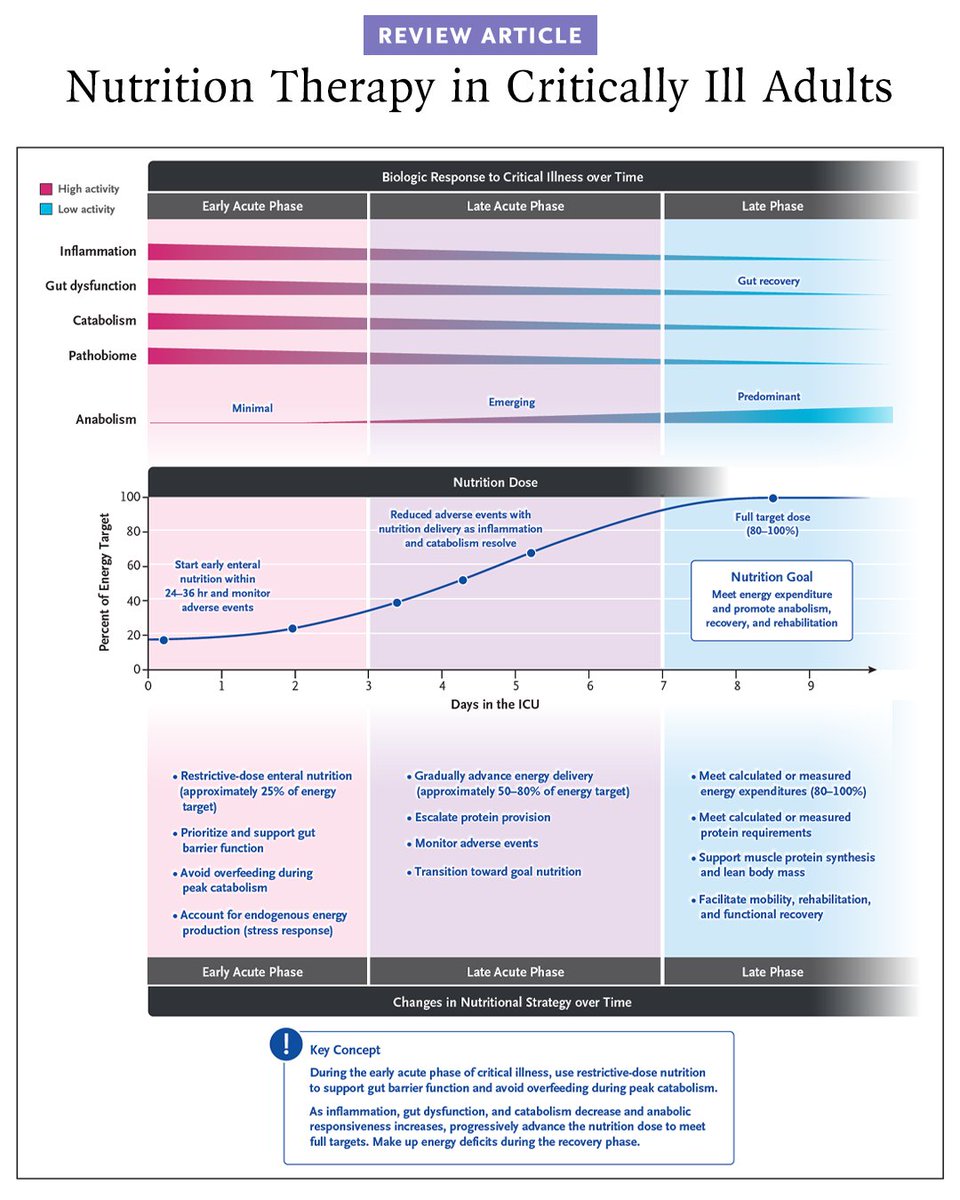
New in this week's issue of NEJM: Jayshil J. Patel, MD, and Stephen A. McClave, MD, review nutrition therapy in critically ill adults.
Nutrition therapy, the provision and monitoring of enteral and parenteral nutrition, is essential for critically ill adults who are unable to maintain volitional intake during both the acute and late phases of illness.
In the acute phase of critical illness, adults have severe catabolism, inflammation, muscle loss, and gut dysfunction, all of which shape nutritional requirements. Early enteral nutrition supports gut integrity and microbiome health, but trials have shown that early short-term parenteral nutrition is a safe alternative when enteral feeding is not possible. Large trials have shown that early full-dose energy delivery offers no benefit over restrictive dosing and may increase gastrointestinal and metabolic complications, findings that support a restrictive nutrition strategy, especially in patients who have circulatory shock or are at risk for refeeding syndrome. Similarly, large trials have shown no advantage of high-dose over standard-dose protein and suggest harm in patients with acute kidney injury. Because adverse events are common with enteral nutrition, safe nutrition delivery requires gradual advancement, strategies for prevention of refeeding syndrome, glycemic control, and avoidance of routine gastric residual volume monitoring. Patient heterogeneity underscores the need for precise, biomarker-guided, phase-specific nutrition to preserve lean muscle mass and improve recovery.
Read the full review: https://t.co/8W5uAgxrl4
#Endocrinology
The graveyard is full of people who wished they had taken action on that thing they wanted to do. “It’s too late” has killed more dreams than a lack of talent or intelligence ever will.
It’s never too late.
The older I get, the more I realize you can reinvent yourself as many times as you need. New career. New standards. New habits. New mindsets. New people. It's never too late. You're never stuck. There are no fixed timelines for reinvention. No age restrictions. No maximum limit. You can change. Today, tomorrow, and as many times as it takes to create the life you want.
Every time you think it’s too late, it’s probably still early.
The older I get, the more I realize how much of your life is shaped by the stories you tell yourself. I’m not ready. I’m too late. I’m bad at this. I never follow through. Be careful. You believe what you repeatedly rehearse. Tell better stories. Then prove them through action.