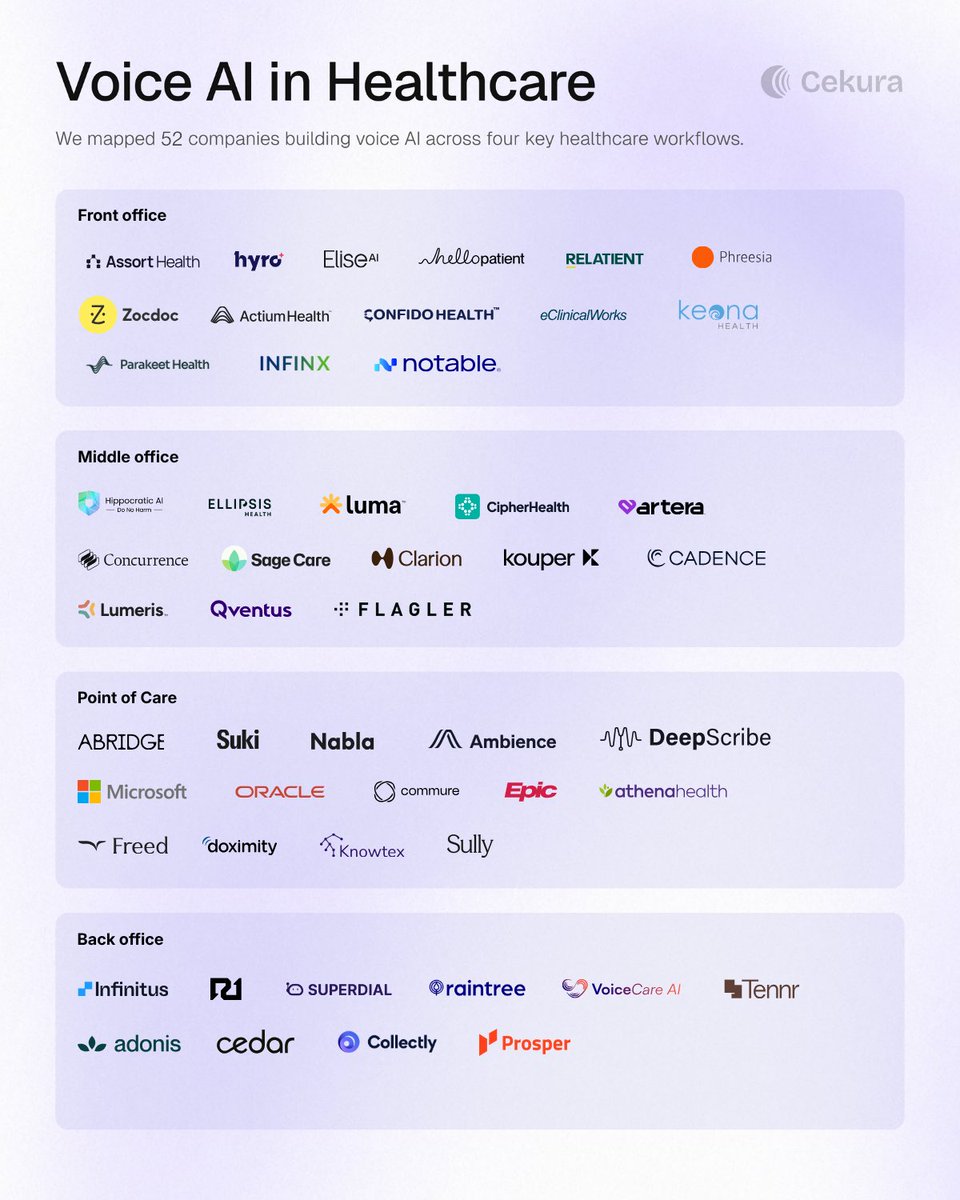
We mapped out voice AI in healthcare: 52 companies across 4 workflows.
The same technology is doing very different jobs depending on who is speaking: a patient booking a visit, a care team following up after discharge, a clinician documenting an appointment, or a billing team calling an insurer.
We grouped the companies by workflow:
1. Front office - patient access
@assort_health, @hyro_ai, @elise_ai, @HelloPatient, @Relatient, @phreesia, @Zocdoc, @notablehealth, @actiumhealth, @Infinxinc, @confidohealth, @keonahealth, @parakeethealth, @eClinicalWorks
These products answer patient calls, manage appointments and referrals, and route requests that need staff attention.
2. Middle office - care outreach and follow-up
@hippocraticai, @EllipsisHealth, @cipherhealth, @lumahealthhq, @Artera_io, @concurrencehq, Sagecare, @clarionhealthai, Kouper Health, @innovaccer, @Lumeris, Cadence, @Qventus, Flagler Health
Here, voice helps teams reach patients about screenings, missed visits, care plans, and needs that surface after discharge.
3. At the point of care - clinical documentation
@AbridgeHQ, @SukiHQ, @nabla_ai, @AmbienceAI, @DeepScribeAI, @Microsoft Dragon Copilot, @OracleHealth, @CommureOS, @HeyEpic, @athenahealth, Freed, @doximity, @knowtexai, @sullyai
These tools use speech to turn clinical conversations into draft notes or structured documentation for clinicians to review.
4. Back office - payer and revenue cycle calls
@InfinitusAI, @R1RCM, Raintree Systems, SuperDial, @TennrOfficial, VoiceCare AI, @AdonisRcm, @CedarNY, Collectly, Prosper AI
Their voice workflows tackle benefits verification, authorization, and claim follow-up. These calls often involve phone trees, hold times, and payer-specific rules.
The companies may all work with voice, but the mistakes they need to catch are different.
• A scheduling agent might book the wrong type of visit.
• A follow-up agent might miss something a clinician needs to hear.
• A payer agent might come back with the wrong coverage details.
Those are the kinds of calls we test at Cekura. We check whether the agent gets the job done, including when the conversation takes an unexpected turn.
Bookmark this and share it with someone who would find this list useful.
Also, let us know if we missed any companies that should be on here.
After co-inventing ChatGPT, I kept asking myself: why have superhuman chat models not led to AGI?
I’ve spent the last 2 years in stealth building a new way to train models (RLCD), and a new type of frontier AI model that we are releasing today: Jev
• 20-200x faster
• 40-400x cheaper (w/ output tokens free)
• Frontier composable intelligence optimized for decisions
AFAICT the shortest path to AI-based economic revolution
Presenting recently published findings on how dermatology AI tools may help laypeople with their own skin-related questions, such as increased ability to name conditions, & some benefits in determining what next steps to take. Read more →https://t.co/X6vXFsXbQk
Today, I’m open-sourcing /fuck-cancer, an AI skill that helps patients and caregivers navigate cancer diagnosis and treatment and advocate for themselves and their loved ones.
Here’s what patients and caregivers have told me since I shared my mom’s story:
“You have to be a huge patient advocate. Ask questions and push for answers, biopsies, and proper testing.”
“I need help navigating difficult conversations and advocating for myself.”
“The volume of doctors, documents, and insurance paperwork can quickly become overwhelming.”
I built the skill to help with these problems. It creates and updates a practical brief with five sections:
1. Patient and care-team information for easy reference during calls
2. What to do next, limited to three specific actions
3. What we know, separating confirmed facts from what remains unclear
4. Medical terms explained in plain English
5. A care log with recent updates and decisions
It builds this brief from documents, and context you provide. When research is needed, it uses trusted sources such as the National Cancer Institute and the ClinicalTrials gov API.
I use it with ChatGPT/Codex and Claude Code to prepare for conversations and research. It can save the brief locally as a Markdown file or update a shareable Google Doc so the whole family can work from the same information.
📌 Get the free, open-source skill here:
https://t.co/YUGoFbhnNc
If you find it useful, please ⭐ the repo and share it with someone going through this BS disease.
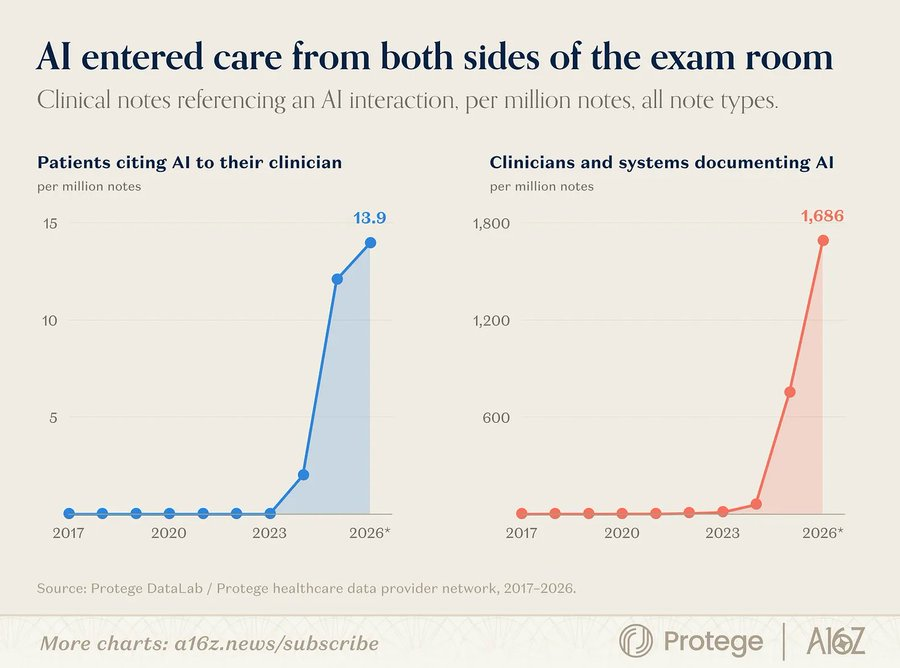
AI use by both patients and clinicians inflected shortly after the launch of ChatGPT
Protege CEO Bobby Samuels on the Oracle Problem in health AI and how to solve it: https://t.co/U0Wc7OChua
My conversation on @SquawkCNBC covered everything from how we make accessing care more affordable to how AI is transforming healthcare, and why data is the most powerful tool we have for putting people in charge of their own health.
But more than anything, we discussed how dramatically different experiences can be on a platform that knows you well enough to help you act long before you're in a crisis.
When healthcare feels like concierge medicine without costing like it, that’s when real transformation starts. Great to chat with you, @andrewrsorkin.
https://t.co/062aRxKCnB
Trust me on this: Possibility expands when you move. You meet someone because you went. Discover something because you tried. Find an opportunity because you asked. The world reveals doors to people in motion that remain completely invisible to people standing still.
UI/UX Designers, this might be one of the best animated component libraries to bookmark.
Thinking Orbs gives you animated thinking orb components in different sizes big or small, light & dark modes, plus a playground to experiment with them.
Bookmark it for later 💜
We applied to @ycombinator 30 seconds before the deadline, had 5 major typos we couldn't edit after, and watched people on X get interviews within days while we heard nothing (thought it was joever).
1 month later, I was booking a highly overpriced, last minute flight to be in SF for <24 hours to interview with @bosmeny and @borisjabes!
And now, we're more than 1 month into grinding out the S26 batch :)
F26 applications are due tonight. Apply, no matter how rough the application is or how late! You never know what kind of miracles happen overnight.
Attached is the 67th take of our founder video in my Berkeley dorm common room (had a resident ask why she heard the same script a million times across 4 days). Your journey can truly start anywhere :p
Everyone owns skincare products, but nobody knows what's actually working.
Today, @theantheaguo and I launch @lumeriaskin (YC S26) to end that.
The Lumoscope is a multispectral camera that clips onto your phone and scans your skin at home with the same light used in clinics, so you see what a mirror can't: a breakout days before it surfaces, and sun damage years before it shows.
Every scan is scored on hydration, redness, texture, and sebum, and it compounds into a record of your own skin. Lumi reads that history, connects flare-ups to causes you'd never suspect, and matches products to YOUR data, instead of a population average.
Preorders are officially open today at $199 only until Aug 16th. Starting today, skincare will no longer feel like guessing. ☀️
@marionlepert Really interesting! I’d love to hear more about how it holds up across skin tones. Melanoma in darker skin tends to show up in spots people don’t think to check and often gets caught late. Curious whether tracking change over time helps close that gap
Catching skin cancer early is a home robotics problem.
Melanoma is highly treatable when detected early, yet today’s screening process depends heavily on patients noticing tiny changes across their entire skin surface. This requires patients to solve a near-impossible visual-memory and registration problem.
I built OpenDerm, an open-source 4-DOF robot that captures high-resolution images of the skin and uses them to reconstruct and track the skin surface in 3D over time.
The best way to make skin screening truly routine is to bring it into the home. OpenDerm shows that inexpensive robotic skin imaging is possible, but the path to scale is not a dedicated screening robot in every household—it is to make skin screening one of the many useful things a general-purpose home robot can do.
Read more about why I built OpenDerm and how it works here:
Blog: https://t.co/KYlNIkF3TV
Project: https://t.co/c9d4KuwXUP
Where I go when I run out of design ideas. Save this 👇
- https://t.co/MxeRSvBDxr - best of social post design
- https://t.co/5SM6zQRHrH - daily web design inspiration
- https://t.co/21RG68ReVa - minimal websites directory
- https://t.co/c7NA6ro0zG - OG images done right
- https://t.co/D9m4nLo37C - beautifully designed decks
- https://t.co/zX9pbvqced - 1,200+ logos by top designers
- https://t.co/ru7zu4VJhD - branding & editorial projects
- https://t.co/O58AD1CIyO - real brand guidelines library
- https://t.co/OPC3oYmGIe - best of recent design, daily
What am I missing?
I don’t think you understand what ChatGPT Voice unlocks
I went on a 4 hour hike yesterday. Through the northern California redwoods.
Got more work done in those 4 hours talking to Voice through my AirPods then I do in 8 hours at my desk
Work can be done ANYWHERE now
45 minute drive back using self driving? Now 45 minutes I can talk to Voice and work on side projects
20 minutes in the cafe? I can sit and talk to Voice and when I get home I have drafts on my computer for my newsletter for the next month
Being able to just use your voice to talk to a super intelligence that controls your computer is unlike anything we’ve ever experienced before
I don’t even care that the voice sounds human like, or you can interrupt it, or any of the wild advancements they made to the tech
It’s the fact that it can control my computer, meaning all I need to get incredible work done is talk through my AirPods anywhere in the world that is the major game changer for me
I don’t think people truly understand the implications of this yet
Why even have a desk or monitor anymore. Work can be done ANYWHERE now
The key is your set up:
1. Choose one device (preferably an always on desktop) as your main “headquarters” device all your work gets done on
2. Get the ChatGPT app on all your other devices (iPhone, iPad, laptops, Mac Minis)
3. Set up ‘connections’ in your settings so that all your ‘node’ devices can control your ‘headquarters’ device
4. Go legit anywhere in the world. Turn on Voice. Ask it to brief you on your projects, give you a recommended next step, then spin up new threads to do work
I really don’t think work looks the same moving forward.
The opportunity, especially in access-constrained fields like dermatology is significant. But the product should help people understand symptoms and reach appropriate care sooner, never delay it
This case raises an important question for anyone building conversational AI in health: how do we design systems that expand access without creating false confidence?
https://t.co/2AcnXpp7Vj
Wait time for specialists is going up at a moment AI is about to change it all
I have a feeling AI will bring the quality of care up 100x and not a moment too soon for patients everywhere