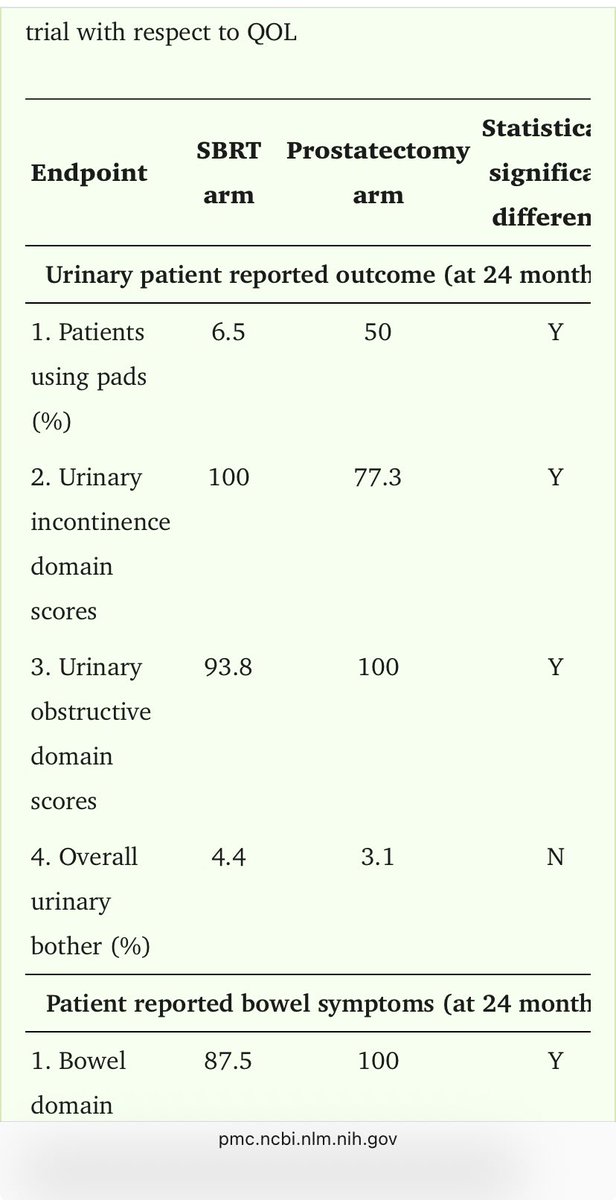
Regarding urinary function in EPIC-26:
5-year results: 14/29 (48%) in the RP arm vs. 3/36 (8%) in the SBRT arm.
But don't let the number fool you into overlooking the nature of how they reported it.
The authors chose a single question about the number of pads needed per day to give impression .
Other urinary questions in EPIC-26 were reported, but only as secondary endpoints.
If the results were reported in full, the picture would be different:
RP is worse for urinary incontinence, while SBRT is worse for obstructive symptoms.
But overall, the degree of urinary bother between the two arms shows no statistically significant difference.
@RSanchez_Salas There are some nunbers available here: https://t.co/c0VVIdejG5
However just like the recent london study it is retrospective and also lacks toxicity grading as far as I can see. We should wait for the results of the several RCTs in this space before the next twitter debate.
@DongNguyeb@DongNguyen614x@DrSpratticus I think the area of contention here is that prescribed D95% to CTV was 40Gy in PACE B which doesnt seem to be the case in GU005. With hotspots dose would end up much higher. I dont have access to the GU005 protocol though so correct me if I am wrong.
@tompowles1 If 57.1% had path CR, how will you identify these patients? Until then the neoadjuvant EV-P approach seems the right direction? Also, pt cohort fit enough to receive 9 cycles of EV-P should also be offered 3x NA chemo prior to chemoRT in control?
WATCH: @andrewmeyerson - a junior doctor from the US - shares his love for the #NHS & why he's striking to save its future.
As patients we stand united with NHS junior doctors as they begin a historic 5-day strike for #PayRestoration. Solidarity! ✊
#JuniorDoctorsStrike