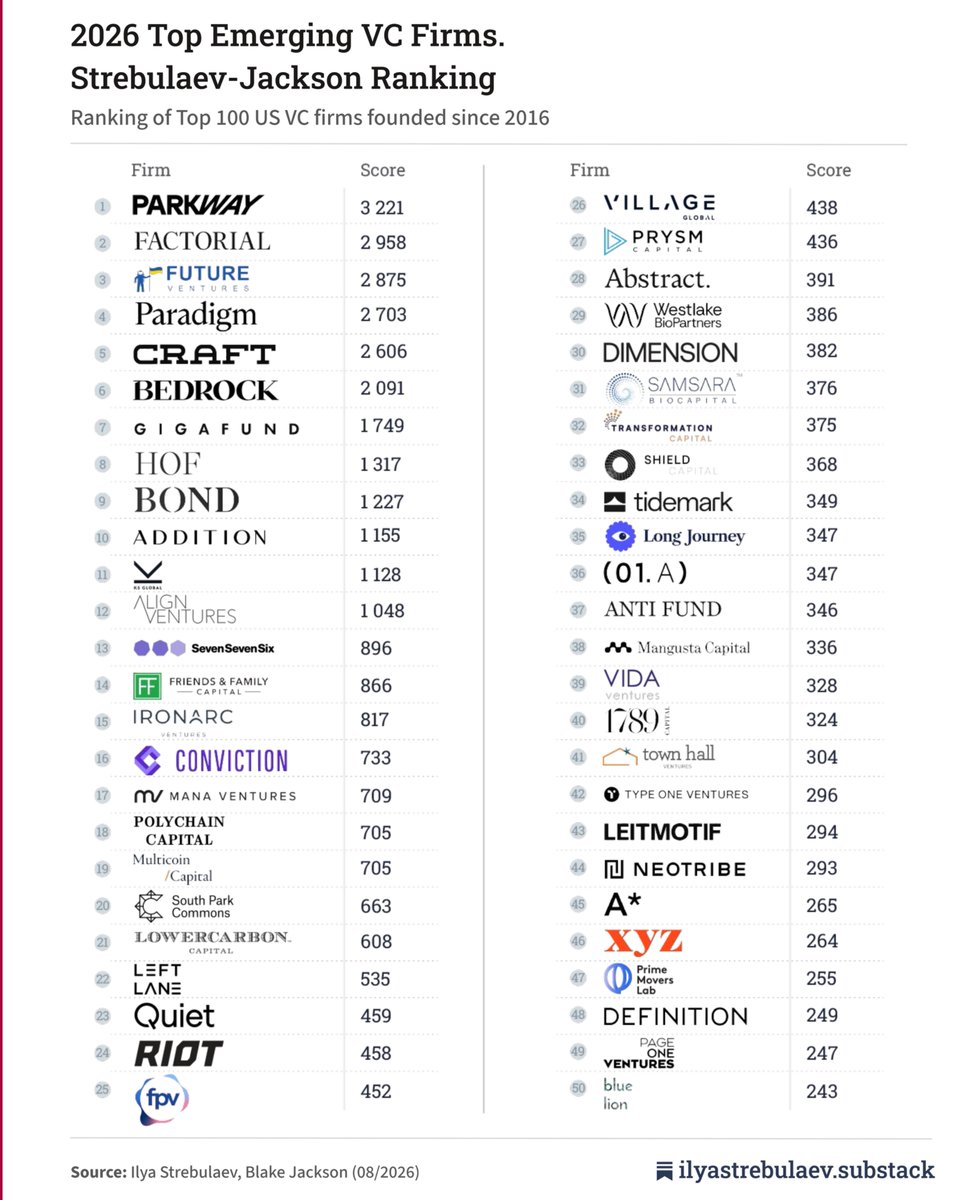
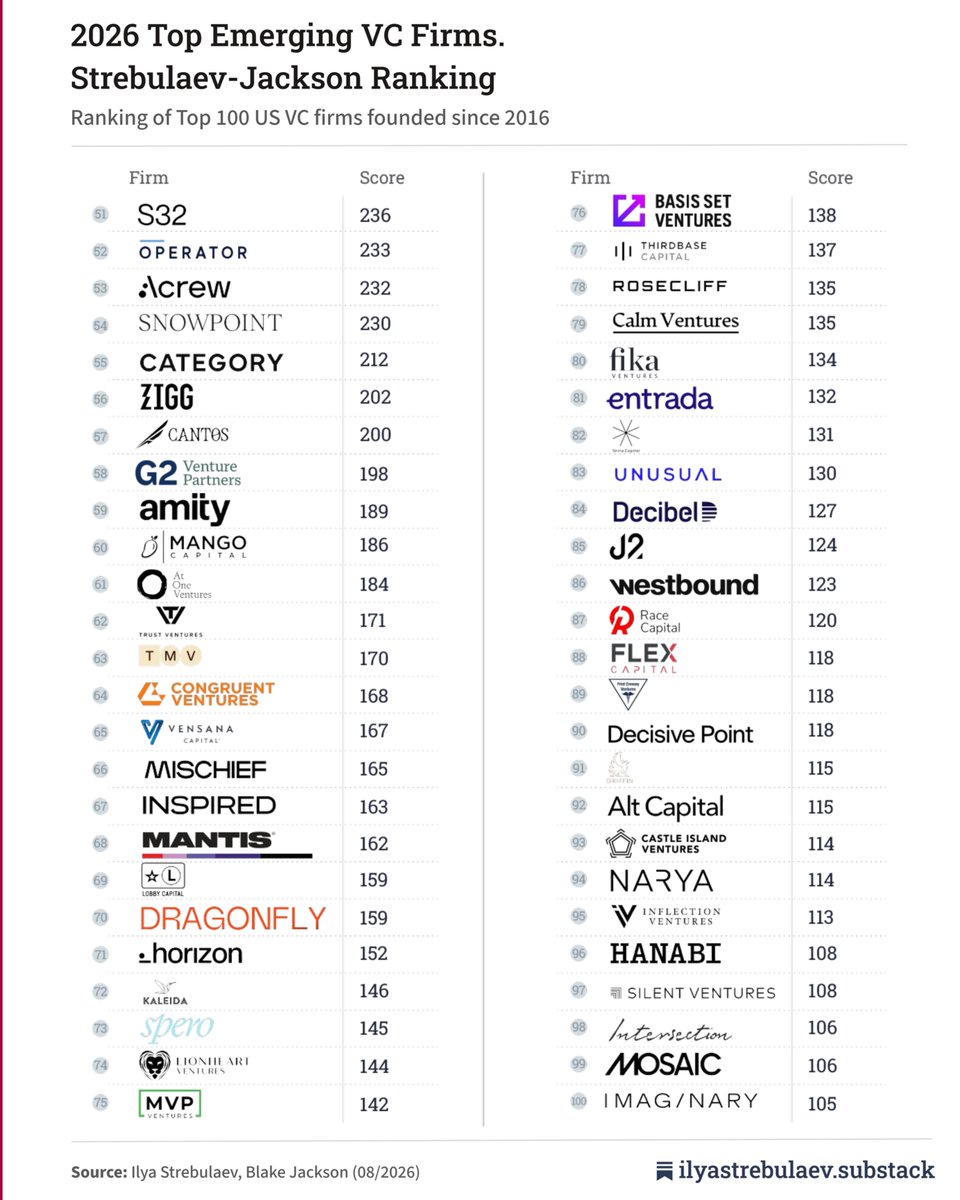
A few months ago, my friend @davidwehrs told me he was leaving a great job at a big fund to join a brand new one, which seemed crazy bc how can new funds compete with big ones in the capex heavy AI race?
Looking like a good call so far!
Dusting off this tweet from April because this gap in shared understanding of LLM capability is *widening*. It's now less "two groups of people speaking past each other" and more a sharp funnel.
- Napkin math somewhere around 6B people (~75% of the population) have barely come in contact with LLMs at all.
- Around 1-2B (~20%) are casual and infrequent users of free-tier ChatGPT-like products. This group sees derpy chatbots and treats them a bit like a better Google search, a writing aid, or etc. Maybe an agent tries to book you a flight. I have non-tech friends who (reasonably, imo) say they have not much use for it at all. Even many professionals outside of math&code are in this tier. For example, execs and many other functions spend a lot of their time talking to other people, so while they understand what is happening intellectually, it is still second-hand and a bit abstract.
- Now we get to professional use of frontier-grade LLMs in math&code. Somewhere around 20M people (0.2%) see first-hand that large, complex projects that used to take them weeks/months can now be completed by agents with a prompt. Building apps, copying apps, translating apps, decompiling apps from binaries... This has all happened very quickly and recently - less than 1 year ago, I was writing code manually by hand, typing memorized computer code commands into a code editor character by character, occasionally pressing Tab to autocomplete a little chunk of code.
- And finally we get to the ~5,000 people (~0.00006%) with access to frontier-grade systems internally. The external world has seen the preview. It looks like swarms of thousands of agents collaborating over weeks on software mega projects: minting zero days, running cyber attacks and defenses at machine speeds, discovering new science, advancing the frontier of mathematics. Things that would have taken top professionals in the industry years of work. Meanwhile, human review and comprehension are starting to fall behind. For example, people are still involved in the "archeology" of the OpenAI-HF incident from many months ago. Mathematicians may be poring over the 722 manuscripts on frontier mathematics for a while.
The funnel is driven by a combination of factors:
1. The impact scales with ambition, problem size, and horizon. A question with a paragraph answer barely stresses the system. You need a reservoir of big, difficult problems that you really care about. This aspect drives the consumer / professional dimension of the funnel.
2. The jaggedness of the system (which I have written about a lot separately). Capability peaks in domains that are digital, verifiable and economically valuable. This is because LLM capability emerges from reinforcement learning on verifiable rewards on a curated environment mixture driven by revenue potential. This aspect primarily drives the area (e.g. math&code) dimension of the funnel.
3. Access. Free-tier, paid-tier, internal.
So this is the weirdness of the moment. The general public has mostly not interacted with these systems. When they have, it looks like a derpy chatbot. The majority of professionals still see only a modest uplift. And a small sliver of professionals are experiencing the vertigo of the curve going vertical. And it is all happening at the same time.
Of course, that’s your contention. You’re a first-year machine-learning engineer. You just got finished readin' Attention Is All You Need, probably watched a Karpathy video too. So now you’re convinced everything is just transformers and scaling laws.
That's gonna last until next month when you discover convolution, and then you're gonna be talkin' about inductive biases and locality and how CNNs were actually incredibly compute-efficient for vision.
Then you're gonna read the FlashAttention paper, and suddenly everything's about IO complexity and SRAM and how FLOPs don't matter because the whole goddamn thing is memory-bandwidth bound.
That'll last until somebody shows you an MoE model, and then you're gonna be in here regurgitating DeepSeek, talkin' about expert parallelism and active parameters and how dense models are economically obsolete.
Then six months from now you'll write one shitty Triton kernel, look at an Nsight trace for the first time, and start telling everybody Python isn't actually the bottleneck because the GPU is asynchronous.
And by next year you're gonna be standing right here explaining to me that your 400-billion-parameter model is fast because you turned on CUDA graphs.
Ask any founder. Building a company is a herculean effort. In health, very few have the formidable combination of deeply authentic, patient first leadership and sweeping, objective, and data driven domain knowledge. @ZReitano is a force.
Prediction. Agentic commerce is going to drive a MASSIVE resurgence in fintech.
Once agents start truly shopping, buying for consumers, helping sellers interface with those buy-side agents, etc. I think it'll be parabolic.
The largest market in the world will be buying and selling intelligence.
Some markets will trade as derivatives of this. Their margins will be a function of intelligence prices / capability.
Most other markets will be adjacent. Either supplying inputs or reselling output in novel, downstream ways.
@factorialfunds we've been calling this 'the reset'. This is chapter one of a new technology arc. Not chapter eight of the last 75 years.
Some of the earliest money in Cursor (the largest vc-backed acquisition ever) turned a $750,000 investment into a ~$1 billion return. @davidtisch and his midas touch at Box Group strike again! Great profile here of one of the best early stage investors who wins while going against the grain @agarfinks https://t.co/hirdBa5RnP
Stripe has finalized an agreement to acquire OpenRouter, a startup that helps companies switch between artificial intelligence models, for more than $7 billion, according to people familiar with the matter. https://t.co/NZRt1tYhX5