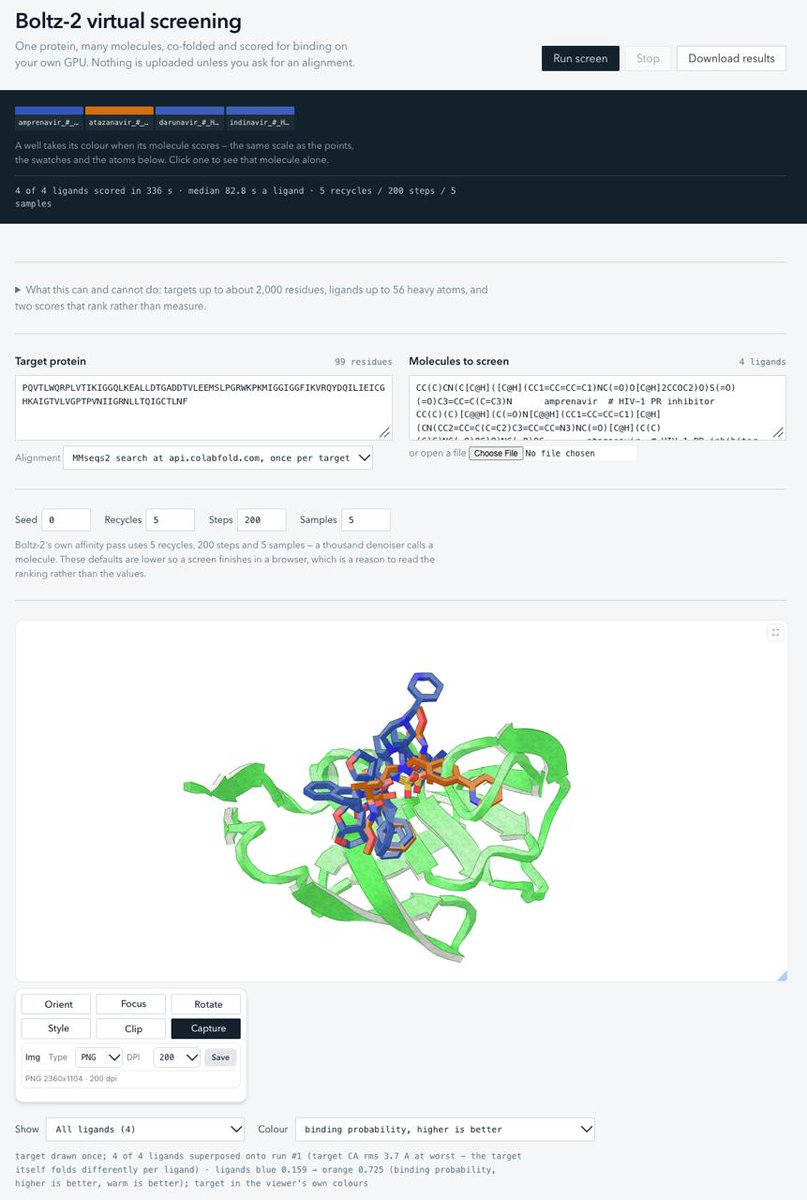
Virtual screening in your browser: paste a sequence + SMILES, and Boltz-2 co-folds and scores each ligand on your own GPU. Nothing uploaded.
100 ligands in 39 min on an M3 Pro. Bigger targets → one Colab cell.
Built on LocalFold by @sokrypton 🙏
https://t.co/p23gZCezw7
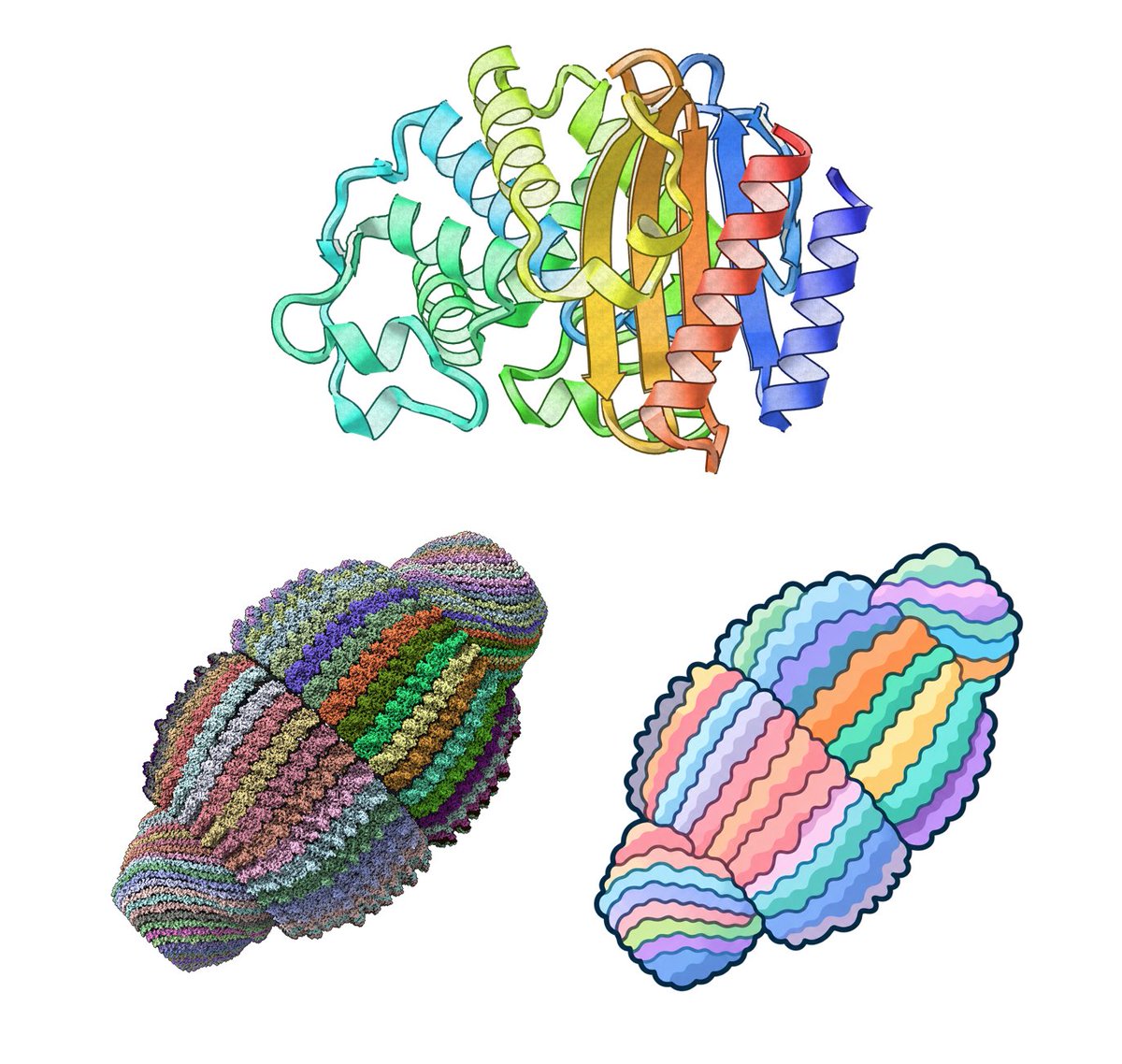
It's toooo easy to create good images of protein structures. Just use Sergey's py2dmol to render them in the Richardson style, or take a structure from ChimeraX and pass it through ChatGPT to create a minimalist icon
¯\_(ツ)_/¯
https://t.co/8hp3zSSjT2
One force field for proteins, DNA, lipids and carbohydrates?
Introducing SO3LR Tauri, a pretrained ML force field that couples a fast neural network with explicit repulsion, electrostatics and dispersion. It takes a step toward a unified model that describes all major classes of (bio)molecules at quantum-mechanical accuracy.
https://t.co/jWSCTJD8wq 1/12🧵
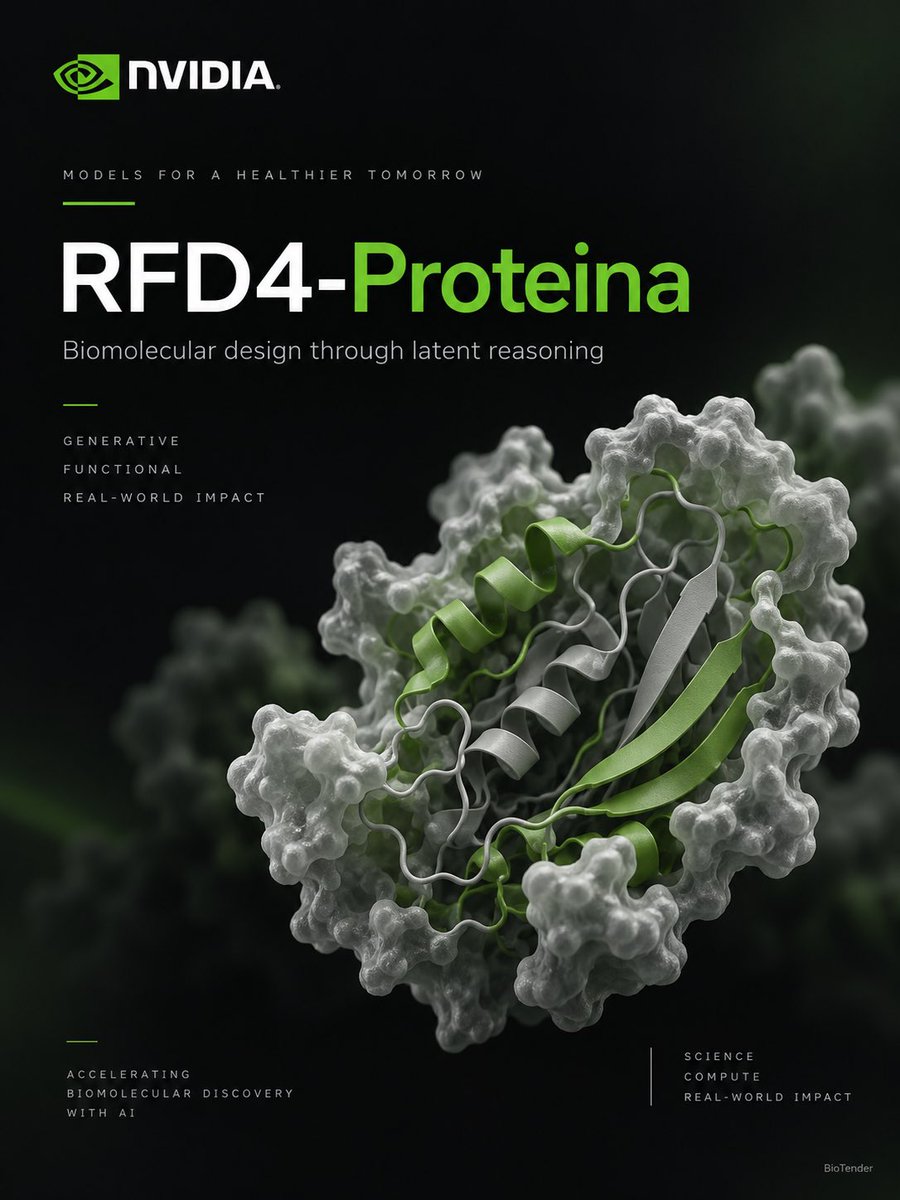
🚨 NVIDIA × Nobel laureate David Baker’s team just unveiled RFD4-Proteina.
Protein design is entering the reasoning era.
The model unifies proteins, noncanonical amino acids, sugars, DNA, and RNA in a shared latent space, enabling iterative refinement and inference-time search.
🧬 10.6% computational success rate on protein binder design benchmarks, with 42× the throughput of BindCraft.
Even more impressive: wet-lab validation includes a de novo designed enzyme for a key step in the synthesis of the HIV drug lenacapavir.
Code and model weights are now available.
🔗 https://t.co/Z06B21fiMC
🧬 Design proteins faster and send fewer, better candidates to the lab.
Introducing RFD4-Proteina, a new NVIDIA BioNeMo open model co-developed with @UWproteindesign.
▫️Fast: 13× faster generation than RFdiffusion3 at 200 residues
▫️ Smart: state-of-the-art across 12+ protein design tasks
▫️ Programmable: set your design inputs and use test-time compute on harder problems
Start with our binder-design tutorial https://t.co/fmS7miF1VD
🧬 Design proteins with natural language.
Pinal is now online in Nature!
Pinal democratizes computational protein design by turning functional intent into protein candidates.
Open weights + code: https://t.co/mm8mynEuxL
Paper: https://t.co/VxZRSfpDjw
Public preview of BioEmu2! @MSFTResearch AI for Science’s new foundation model for biomolecular structure, dynamics and function. Open weights, MIT license.
https://t.co/wsqcLPh8Sk
Movie: BioEmu2-simulated binding of intrinsically disordered peptide PUMA to MCL-1 receptor. 🧵⬇️
David Baker’s team just unveiled Chaperone, an AI agent harness for protein design.
🧬 86% fewer tokens
⚡ 64% fewer GPU-hours
📈 Computational pass rate nearly doubled (6.1% → 11.7%)
Plus, a 1.32 nM cortisol binder designed in just 2 weeks.
🔗 https://t.co/v2uWTubmM8
@googlescholar_ came up with a quick read feature - Useful to #summarize#papers without having to use #chatbots. #AskGemini on @googlechrome can do the same on desktops, but on my phone, this is great.. especially when included in email alerts (like below).
We are bringing agents to the wet-lab bench at Google Research to navigate complex biological landscapes. Learn how we are grounding agents in physical lab robotics to run fast closed-loop molecular design cycles, ultimately discovering single-digit nanomolar protein binders for cancer targets →https://t.co/iPesR5MXCd
Today, RFdiffusion3 is out in @ScienceMagazine!
https://t.co/hITqU9p4Ot
We have many exciting updates to share! We're also releasing Chaperone, an agent harness for general bio-molecular design. 1/n
Our AM-3 paper is out in Cell. Opioids are critical drugs, but have severe side effects. Because they are administered systemically, it is hard to dissect how they work, and to separate side effects. So we built one you can switch on and off with light. https://t.co/9sb9TRvA2Q
🚨 OpenAI is bringing GPT-Rosalind to academic labs!
The new **Rosalind Academic Plan** offers eligible U.S. university labs:
🧬 Access to OpenAI's specialized life sciences model
🔬 Up to 30 free seats for 12 months
🧪 AI tools for protein design, genomics & drug discovery
Access is subject to approval.
https://t.co/RIM8ZpXp8a
also works with *molecular* machines!
here, ATP Synthase, a 25nm rotary motor in your cells that uses a flow of protons to make ATP, the molecule that powers almost everything a cell does
Introducing AlphaProtein Novo, a pipeline for de novo enzyme design! In collaboration with @francesarnold's group, we developed AP Novo and used it to get SoTA "novel-scaffold" activity on 2 benchmark reactions and create enzymes to synthesize the pharmaceutical motif piperidine and degrade the environmental toxin DEHP.
Work led by @ZvxyWu@ZiqiLi0513 with teammates @alexechu_@kelly_ruijie@schulluc@jacobjinkelly@rosaliags@davidla@solserpens@j_reisenbauer, @pengliu_group, Josh, Thomas, Amy, Tristan, Harshnira, and others. It was a joy and privilege to work with you all!
Preprints and code:
https://t.co/Q3aaoSAFcv
https://t.co/NTtjUmk354
https://t.co/RoA7wEfzYn
Today we are announcing Topos-2, our next-generation model for generating the full range of shapes a protein can take, across the order-disorder spectrum.
We are also previewing Topos-Bind: to our knowledge, the first generative model to capture the range of shapes for disordered proteins bound to small molecules.
Read the technical blog post here: https://t.co/BLAXHAgsH4
(1/7)