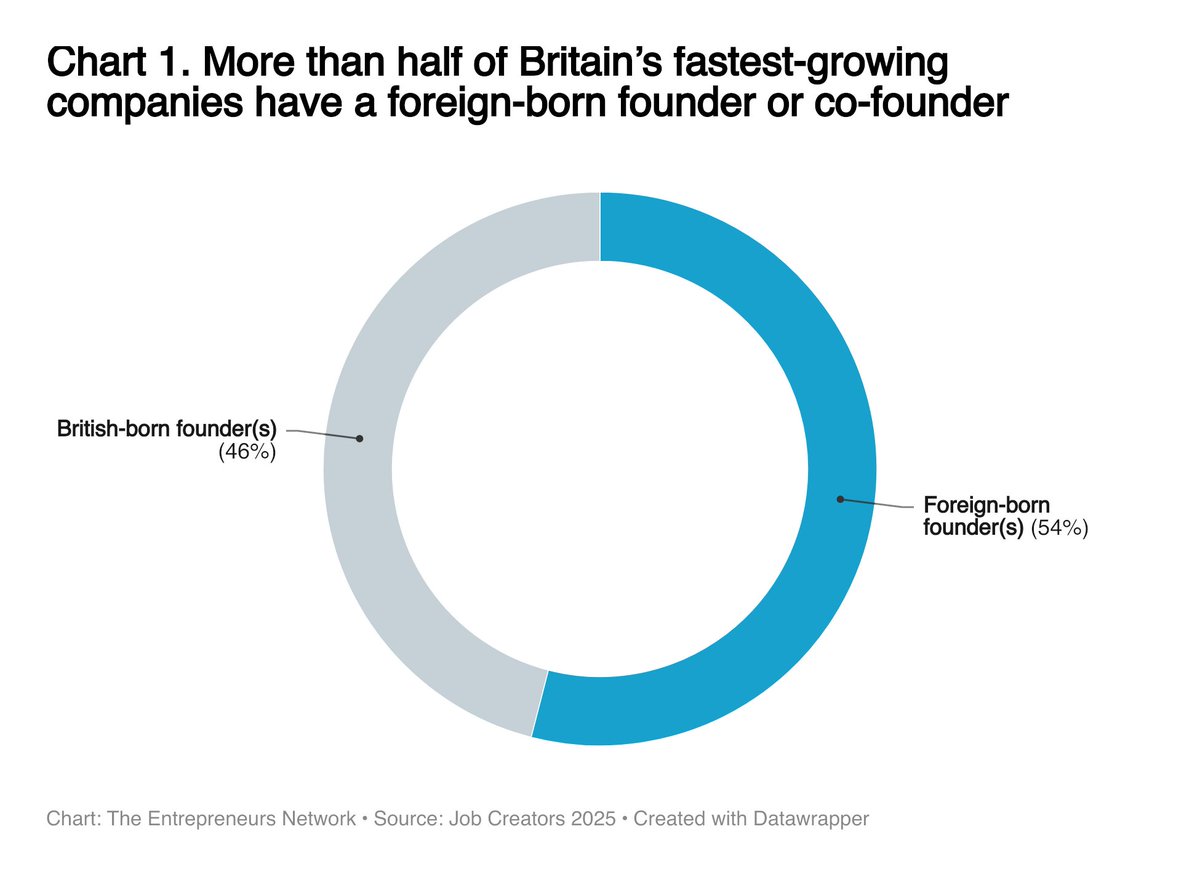
⏩ We analysed Britain’s 100 fastest-growing companies and discovered that 54% have a foreign-born founder – the highest percentage on record since we began tracking it in 2019.
In other words, over half of some of our most amazing businesses exist because of immigrants.
Chagos aside — and I think that's a bit of a special case — I'm not really sure any of these hit the mark for the point you're trying to make. I disagree with a couple of them but they all seem like extremely reasonable and forecasted things for a centre-left government to give to its electorate?
So cool to see this finally out in the wild! It was a real privilege to play a small part in its development.
If you're interested in learning more about how to make R&D budgets as effective as possible, do take a look. 👇
At @IFP, we’ve spent the past 3 years thinking about all the different ways the US government & philanthropy fund R&D.
Until now, R&D funders haven’t had a systematic way to match the innovation problem to the right funding tool.
We built THE ATLAS OF INNOVATION to fill that gap.
https://t.co/XZshJ7pr1f
Alongside @UChi_MSA, we’ve boiled down thousands of hours of research into a handful of questions covering how much the R&D funder knows about:
- the problem they want to solve
- the solution it should have
- the team that should build the solution
Why the Atlas matters:
The US government spends close to $200 billion every year on R&D. And after the Anthropic and OpenAI IPOs, there will be hundreds of billions of dollars in new philanthropic giving.
Choosing the correct funding approach to the social problems they’re trying to solve will mean the difference between success and failure.
For example, NSF research grants have helped seed breakthroughs from MRI machines to search engines, but grants aren’t built to deliver the kind of industrial speed and scale that a project like Operation Warp Speed required.
Picking the wrong funding approach can leave programs behind schedule, over budget, or without anything to show for all the money they spent.
How we built the Atlas:
1. We began by creating a matrix of dozens of considerations that a thoughtful policymaker or funder would ideally weigh before deciding how to fund a project.
2. We looked at every major funding approach, from grants to R&D tax credits to advance market commitments, analyzing when they work well and when they fail to meet the mission.
3. We spent months deep in the weeds of contract theory and incentive design, looking at historical examples and the state-of-the-art research in innovation economics.
4. We then worked to turn that research into a tool that time-strapped policymakers and philanthropic funders could rely on at the start of an innovation funding cycle.
5. Three years later, we are launching just that: a new (and visually stunning) website to help funders decide how to best incentivize innovation. And all they have to know… is what they currently know about their innovation goal! The Atlas takes care of the rest.
How to navigate the Atlas:
Answer questions about your goal to find the funding approach aligned with the information you have.
Each funding mechanism has its purpose for particular technologies and specific moments in development.
There shouldn’t be an ARPA for every field, just like we don’t need a prize or AMC for every innovation. The Atlas helps you navigate those tradeoffs.
✨Personal post warning ✨
6 months ago we lost our baby boy, Leo, at 33 weeks.
It is, unsurprisingly, the hardest and worst thing we have ever been through. My wife has been utterly amazing, and we have had loads of support from friends and family, but nothing could have ever prepared us for the pain. It is harrowing and isolating, and we miss him every day.
I'm saying this here for two reasons.
First, because I want friends/colleagues/acquaintances to know that if, god forbid, they come up against anything similar, that they can reach out to me. I have found a lot of support in people that can at least half understand what we're going through, and I want to be able to offer that to others if they need it.
Second, because I have reached the sixth stage of grief: 'run a half marathon'. I will be running the Royal Parks Half in Leo's memory to raise money for @SandsUK who continue to support my wife and I, and do so much more for bereaved families across the UK, including funding research to help prevent baby loss.
If you fancy chucking a quid in the hat to support my attempt to exercise, the link is below. And if anyone does want to talk or share pain, I'm always around for a pint.
🚨🥳 It’s time for our Friday Thread! 🚨🥳
Here’s a rundown of the key stories and interesting articles relating to entrepreneurs, economics, technology, and innovation this week…
@AlexNowrasteh Superb piece. I've been banging the 'anti-culture' drum for explaining differences in entrepreneurial outcomes for too long... Will just send this to people in future!
Nobody disputes that artificial intelligence is disrupting labour markets, but too much commentary about it never progresses beyond bland platitudes like “job-category-X will go extinct.”
That’s why I was so excited to chat with Alfie Pearce-Higgins, Co-Founder of Rodeo, to get his from-the-coalface insights on how the very nature of work is transforming as companies begin to integrate AI into their operations.
Among other things, we discussed…
🧩 How AI could reshape the traditional employee-employer model in more sectors than you might think;
🤝 The policy choices that are driving companies to offload staff and embrace contractors;
💷 What the implications for government could be — from our tax regime, to the education system, to the future of the welfare state;
📃 How AI has turned hiring into an arms race between automated applications and automated screening;
💡 And much, much more!
While I’m proud of every interview we’ve published here at @tenthinktank, I reckon this is our best yet — so do please give it a read in full!