ICRIER is India's premier policy think-tank seeking to augment knowledge content for policy-making for India's effective engagement with the global economy.
Policymakers, economists, and market experts in one room, asking the hard questions about Indian agriculture. Watch the highlights from the launch of Getting Agricultural Markets Right.
Farmers are at the heart of India's rural economy, and building a resilient agricultural future requires innovation, collaboration, and supportive institutions.
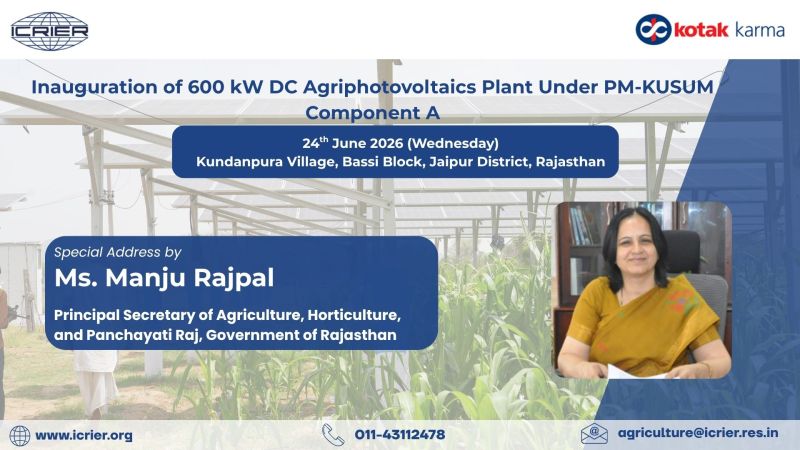
We are honoured to welcome Ms. Manju Rajpal, Principal Secretary, Agriculture, Horticulture and Panchayati Raj, Government Of Rajasthan, who will deliver a special address at the inauguration of the 600 kW DC Agriphotovoltaics Plant under PM-KUSUM Component A.
Her leadership in advancing agricultural development and strengthening rural institutions in Rajasthan brings valuable perspective to the conversation on how agriphotovoltaics can support farmer prosperity, sustainable land use, and climate resilience.
🌾☀️ Empowering farmers. Strengthening rural communities. Powering the future.
📍 Kundanpura Village, Bassi Block, Jaipur, Rajasthan
📅 24 June 2026 | 🕘 9:30 AM
Strong institutions and sustainable development are built on long-term vision.
We are honoured to welcome Mr. Chandra Shekhar Rajan, Chairman, Kotak Mahindra Bank, who brings over four decades of distinguished experience in governance, infrastructure, rural development, and public policy, including serving as the Chief Secretary of Rajasthan.
As we inaugurate the 600 kW DC Agriphotovoltaics Plant under PM-KUSUM Component A, his keynote address will offer valuable perspectives on building innovative partnerships that advance farmer prosperity and India's clean energy transition.
🌾☀️ Powering rural development through innovation and collaboration.
📍 Kundanpura Village, Bassi Block, Jaipur, Rajasthan
📅 24 June 2026 | 🕘 9:30 AM
As India advances towards its renewable energy goals, PM-KUSUM has emerged as a transformative initiative for empowering farmers through decentralized solar energy.
We are honoured to welcome Ms. Suman Chandra, Director, MNRE, whose leadership and contributions to the implementation of PM-KUSUM have played an important role in advancing farmer-centric solar energy solutions across the country.
Join us as she delivers a special address at the inauguration of the 600 kW DC Agriphotovoltaics Plant under PM-KUSUM Component A.
How can Agrivoltaics transform the future of Indian agriculture while improving farmer incomes?
Join us as Dr. Ashok Gulati, Distinguished Professor at ICRIER and one of India's foremost voices on agricultural policy and farmer welfare, sets the context for this important conversation at the inauguration of the 600 kW DC Agriphotovoltaics Plant under PM-KUSUM Component A.
🌾 Food. ☀️ Energy. 👨🌾 Farmer Prosperity.
What if every acre could produce both food and clean energy?
On 24 June, we will inaugurate our 600 kW DC Agriphotovoltaics (Agri-PV) Plant under PM-KUSUM Component A in in Kundanpura Village, Bassi Block, Jaipur, Rajasthan.
This pilot demonstrates how farmers can remain Annadata while also becoming Urjadata, generating solar power alongside crops on the same land. By unlocking dual value from every acre, Agri-PV has the potential to enhance farmer incomes, improve land productivity, and accelerate India's clean energy transition.
We look forward to welcoming policymakers, researchers, industry leaders, financial institutions, and farmers as we explore the future of sustainable rural development together. The countdown has begun!
Join us as we explore how Agrivoltaics can help power India's clean energy transition while strengthening agricultural livelihoods.
📍 Kundanpura Village, Bassi Block, Jaipur, Rajasthan
📅 24 June 2026 | 🕘 9:00 AM
#Agriphotovoltaics #AgriPV #PMKUSUM #SolarAsAThirdCrop #AnnadataSeUrjadata #SolarEnergy
We are pleased to share that four reports developed under the The Agricultural and Processed Food Products Export Development Authority (APEDA)–ICRIER Knowledge Partnership Project were released today at the APEDA BHARATI Business Meet, held at Bharat Mandapam.
Prepared by the APSI team at ICRIER, led by Prof. Ashok Gulati, the reports examine export opportunities and strategies across four commodity segments — Pickles & Sauces, Honey, Grapes, and Citrus. They outline evidence-based strategies to strengthen value chains, improve quality and standards, enhance market access, and expand India's presence in global agri-food markets.
📘 Strategies to Boost India's Pickles & Sauces Exports — Suvangi Rath, PhD, Tanay Suntwal, Kirti Goel & #AshokGulati
Link: https://t.co/5jqO22nl4l
🍯 Strategies to Boost India's Honey Exports — Suvangi Rath, Tanmoy Adhikary & #AshokGulati
Link: https://t.co/8TCrjrBwrS
🍇 Strategies to Boost India's Grapes Exports — Harsh Wardhan & #AshokGulati
Link: https://t.co/N4TYSwjWKe
🍋 Strategies to Boost India's Citrus Exports — Harsh Wardhan, Tanay Suntwal & Ashok Gulati
Link: https://t.co/ZVgK0Ueh8w
How can Digital Public Infrastructure (DPI) strengthen public service delivery while balancing the objectives of inclusion, efficiency, and security?
We are pleased to share the Outcome Document from the workshop "Digital Public Infrastructure and Public Service Delivery: Inclusion. Efficiency. Security." held on May 8, 2026 jointly hosted by ICRIER and the University of Queensland under the Australia-India Cyber and Critical Technology Partnership (#AICCTP), supported by the Department of Foreign Affairs and Trade (DFAT), Australia.
The workshop featured a Distinguished Address by Dr. V. Anantha Nageswaran, Chief Economic Adviser, Government of India, and a keynote address by Shri Saurabh K. Tiwari, Additional Secretary, DBT Mission, who reflected on the evolution of India's DBT ecosystem and the opportunities and challenges associated with DPI-enabled public service delivery.
The discussions were further enriched by special addresses from Rajesh Bansal (Former CEO, RBIH) and Dr. Rajeev Shorey (Director, IIIT Surat), alongside contributions from experts across government, industry, academia, civil society, and international organisations.
Key themes that emerged from the discussions include:
• The need to evaluate DPI not only through efficiency gains but also through citizen experiences and inclusion outcomes.
• The critical role of last-mile delivery systems, human intermediaries, and grievance redressal mechanisms in ensuring equitable access.
• The importance of institutional coordination, interoperability, and data quality in sustaining administrative efficiency.
• The growing significance of trust, cybersecurity, privacy, and robust governance frameworks as DPI systems scale.
• The recognition that inclusion, efficiency, and security are deeply interconnected and must be addressed together in the design and governance of digital systems.
The discussions and insights captured in this outcome document will contribute to our ongoing research on DPI-enabled public service delivery under the project "A Paradigmatic Shift in Public Service Delivery: Inclusive, Efficient and Secure DPI."
Read the full report here: https://t.co/OJ6cxfjBmK
What if the same land that feeds us could also power us? 🌾⚡
A new chapter in clean energy and farming is about to begin.
From Annadata to Urjadata - this is the first on ground glimpse of our Agri-PV pilot under PM KUSUM in Bassi, Jaipur , Rajasthan.
Pilot launching soon.
Watch the teaser.
As financial pressures mount, many Indians are turning to illegal online gaming and betting platforms in search of quick financial relief. But what appears to be an easy way to earn money often comes with significant economic and social costs.
This latest op-ed by Angana Parashar Sarma and @profarpita1 examines the factors driving participation in illegal online gaming, the risks posed by unregulated platforms, and the broader implications for consumer welfare and financial security. The authors also highlight the need for robust consumer surveys to better understand the motivations behind participation and inform evidence-based policy responses.
Read more: https://t.co/1scAgIGV3p
Behind every successful person is an army of women- often, that army includes women domestic workers.
They cook meals, care for children and the elderly, clean homes, and manage countless tasks that make it possible for others to go to work, build businesses, pursue careers, and create wealth. They are, in many ways, the invisible infrastructure that sustains our economy.
Yet domestic work is rarely recognised as value creation.
As we marked International Domestic Workers' Day on June 16, it is important to reflect on what the growth of domestic work tells us about the changing nature of women's employment in India.
India's domestic workforce has expanded significantly over the past decade, with women accounting for nearly three-fourths of all domestic workers. The sector has become increasingly feminised as more women enter the labour market, but often through occupations that require limited formal qualifications, offer low wages, and provide little social protection.
This points to a larger structural challenge. While India's female labour force participation has risen in recent years, many women remain concentrated in low-productivity, low-paying, and informal jobs. Domestic work has become an important source of employment for millions of women, particularly migrants and those with limited educational opportunities, but it also reflects the barriers women continue to face in accessing better-quality jobs.
As India seeks to harness its demographic dividend, the focus must move beyond creating jobs to creating good jobs for women. Expanding social security coverage for domestic workers, strengthening labour protections, investing in skills, and enabling women's transition into higher-productivity sectors will be critical for achieving both gender equality and inclusive economic growth.
India's commodity futures markets had a strong beginning — and a familiar ending. At the launch of Getting Agricultural Markets Right, Dr. Ashok Gulati (@agulati115) recalled the promise of 2003, when the Vajpayee government opened the door to agricultural futures with the launch of NCDEX. China started at the same point and never looked back. India, every time domestic prices rose, chose to suspend the markets rather than trust them.
At the launch of Getting Agricultural Markets Right, Dr. Ashok Lahiri, Vice Chairman, @NITIAayog, cuts to the heart of one of India's most contested agricultural policy debates on subsidies vs. transfers. The answer may seem obvious. The politics are anything but.
Tune in to listen.
India’s fertiliser subsidy regime is placing a growing burden on public finances while contributing to imbalanced nutrient use and environmental stress.
In a recent interview with @EconomicTimes, Dr. Ashok Gulati (@agulati115), Distinguished Professor, ICRIER, argues that the current subsidy model is fiscally unsustainable, import-dependent, and in need of urgent reform. He advocates replacing input subsidies with direct income support to farmers, enabling more efficient resource use and promoting long-term agricultural sustainability.
Watch here: https://t.co/BYZ7dclnAM
🌐𝗜𝗻𝗱𝗶𝗮’𝘀 𝗧𝗿𝗮𝗱𝗲 𝗗𝗶𝗴𝗶𝘁𝗮𝗹𝗶𝘇𝗮𝘁𝗶𝗼𝗻: 𝗙𝗿𝗼𝗺 𝗗𝗼𝗺𝗲𝘀𝘁𝗶𝗰 𝘁𝗼 𝗖𝗿𝗼𝘀𝘀-𝗕𝗼𝗿𝗱𝗲𝗿 𝗜𝗻𝘁𝗲𝗴𝗿𝗮𝘁𝗶𝗼𝗻
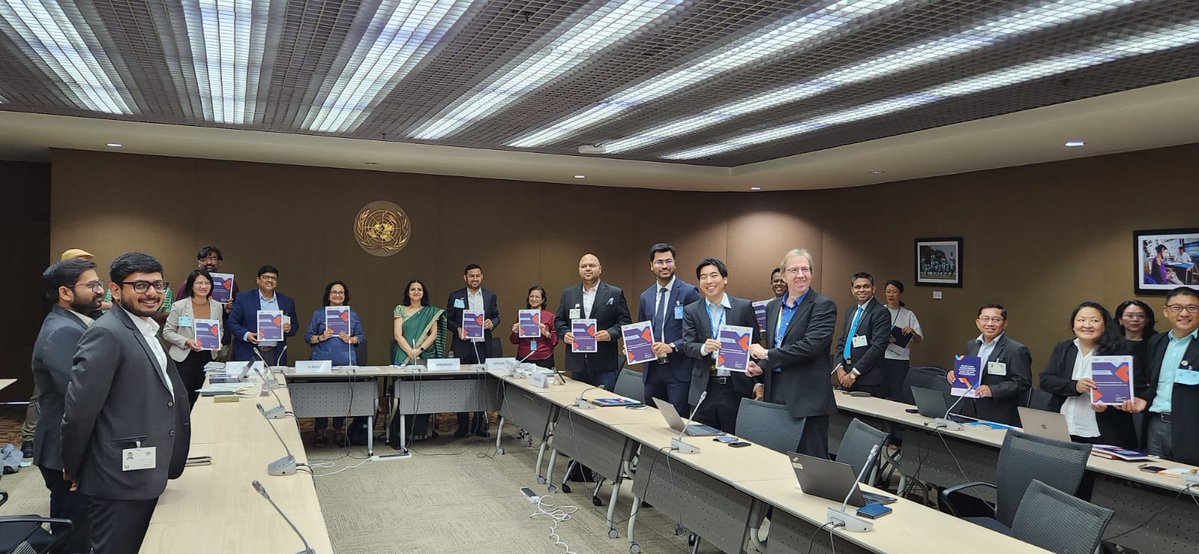
At the Asia-Pacific Trade Facilitation Forum x Paperless Trade Week (APTFF x PTW) 2026 in Bangkok, @RIS_NewDelhi and @ICRIER, in collaboration with the @ADB_HQ and @UNESCAP, convened a high-level session on “India’s Trade Digitalization: From Domestic to Cross-Border Integration.”
📘 The occasion also marked the release of the joint ICRIER–RIS–CWS Policy Brief on India’s Drive Towards Paperless Trade: Recent Developments and the Way Forward, co-authored by Dr. Arpita Mukherjee (@profarpita1), Dr. Prabir De (@Prabir_India), Dr. Pritam Banerjee, and Ms. Geetika Gupta.
🏛️ Prof. Sachin Kumar Sharma, (@SKSharma_World), DG, RIS, delivered the welcome remarks, highlighting the importance of digital trade facilitation in strengthening India's trade competitiveness and regional integration.
🌏 Dr. Rupa Chanda, Director, UN-ESCAP, emphasized the strategic importance of India's engagement with the Framework Agreement on Facilitation of Cross-Border Paperless Trade in Asia and the Pacific (CPTA) and its potential to shape regional digital trade governance.
🕊️ Ms. Jagpreet Kaur (@JagKaur_IFS), First Secretary, Embassy of India, Thailand, underlined India's ongoing efforts towards trade digitalisation and seamless cross-border connectivity.
📊 Dr. Prabir De, Professor at RIS, presented key findings of the policy brief, noting India's significant progress through initiatives such as ICEGATE, SWIFT, faceless assessment, BharatTradeNet, and the proposed Trade Facilitation Bill, 2026, positioning India strongly for CPTA accession.
💡 Panel Insights: Promoting Exports through Digital Trade
• Mr. Manoj Kumar Meena, Deputy Director, DGFT,(@DoC_GoI) highlighted India's progress in implementing paperless trade reforms.
• Ms. Khanit Phatong (Electronic Transactions Development Agency (ETDA), shared Thailand's experience in advancing cross-border paperless trade.
• Ms. Yogita Hatangadi, @IndiaEximBank, discussed financing solutions to help MSMEs access global markets through e-commerce.
• Mr. Srinidhi Kalvapudi, @amazonIN, emphasised the role of digital platforms and public-private partnerships in reducing trade costs.
• Mr. Vasudevan Rajagopalan @DHLExpressIndia, outlined policy reforms needed to lower compliance burdens.
• Mr. Prateek Goyal, Enterprise Growth Lab, shared practical perspectives from MSMEs on trade facilitation and digitalisation.
@MEAIndia@FinMinIndia@wto@NITIAayog@IndiainThailand@ThailandinIndia@SSWA_UNESCAP@dgftindia@CWS_iift@EICIIndia@aparnaray_ifs@RajanRatna@profarpita1@TheAtulKaushik@sujeetsamaddar@shishir_sh@sabya_saha@pdash76@PV_Chat@AmitK_PhD@susheco@GaurPankhuri@cmec_ris@DakshinNews@AIC_aseanindia@fitm14@fisd19@FIDC_NewDelhi
#RIS #ICRIER #ADB #UNESCAP #India #CPTA #Trade #Digitalization #CrossBorder #PaperlessTrade
🌐 Powering the future of digital trade
India Exim Bank participated in #APTFFxPTW2026 in Bangkok, engaging with global stakeholders on India’s readiness for the Cross-border Paperless Trade Agreement (CPTA) and its impact on exports, MSMEs, and digital trade governance.
📊 Key highlights:
✅ 100% domestic paperless trade implementation
✅ Cross-border adoption up from 28% (2015) to 67% (2025)
✅ 10% adoption increase → 1.4% reduction in trade costs
✅ CPTA could reduce regional trade costs by ~25%
✅ Draft Trade Facilitation Bill 2026 seen as a key enabler
💡 India Exim Bank highlighted its focus on strengthening MSME participation in #GVCs through the Export Promotion Mission (#EPM) — enabling credit enhancement and risk mitigation support for exporters.
🚀 Through the Trade Assistance Programme (#TAP), the Bank has already facilitated USD 4+ billion in incremental trade, supporting exporters amid global uncertainties.
🔗 Access the policy brief: India’s Drive Towards Paperless Trade: Recent Developments and the Way Forward - ICRIER
#PaperlessTrade #TradeDigitalisation #MSMEs #Exports #IndiaEximBank #APTFFxPTW2026
@ICRIER@ADB_HQ@UNESCAP
At the launch of Getting Agricultural Markets Right, Dr. Ashok Gulati highlighted that India's MSP policy has become a cost-plus exercise with little regard for demand, and the consequences are visible in the numbers.
Hear his full insights.
At the launch of Getting Agricultural Markets Right, Dr Ashok Lahiri put India's agrarian challenge in stark terms, when half the population depends on one-sixth of GDP, distress is inevitable. The long-term solution, he argued, lies in job creation outside agriculture.
India's trade digitalisation story is well underway, but the next frontier is cross-border integration.
ICRIER and @RIS_NewDelhi, in partnership with @ADB_HQ and @UNESCAP, convened a session at APTFFxPTW 2026 in Bangkok to examine India's readiness for the Cross-border Paperless Trade Agreement (CPTA) framework and what it means for export competitiveness, MSME integration, and India's role in shaping Asia-Pacific digital trade governance.
The session also marked the release of the ICRIER-RIS-CWS Policy Brief, "India's Drive Towards Paperless Trade: Recent Developments and the Way Forward."
𝗞𝗲𝘆 𝗧𝗮𝗸𝗲𝗮𝘄𝗮𝘆𝘀:
🔹 India's domestic paperless trade implementation stands at 100%, with cross-border scores rising from 28% in 2015 to 67% in 2025.
🔹 A 10% increase in cross-border paperless trade implementation reduces trade costs by 1.4% — from both a country's own reforms and its partners' improvements.
🔹 CPTA accession could reduce cross-border trade costs by an estimated 25% across the Asia-Pacific, strengthening regional integration and India's influence over emerging digital trade standards.
🔹 The Draft Trade Facilitation Bill, 2026 — granting legal equivalence to electronic trade documents — was widely welcomed as a critical enabling measure for CPTA accession.
🔹 Pilot projects with trusted neighbours such as Nepal and stronger MSME-focused capacity building were identified as practical near-term steps.
Access the policy brief: https://t.co/kN2F8tOmtq
Women and the Internet in India: Significant progress, but the digital gender divide persists.
Between NFHS-5 (2019–21) and NFHS-6 (2023–24), the share of women aged 15–49 who had ever used the internet nearly doubled—from 33% to 64%. In just five years, this represents a remarkable 31 percentage point increase in women's internet use.
What is particularly encouraging is that this growth has been broadly inclusive. Several states that started from relatively low levels of connectivity witnessed some of the fastest gains. Andhra Pradesh (+42.6 percentage points), Uttar Pradesh (+39.4 percentage points), and Bihar (+37.8 percentage points) stand out as examples of rapid digital diffusion among women.
This matters because internet access is no longer a luxury—it is increasingly a gateway to opportunity. For women, being connected can mean greater access to:
✅ financial services and digital payments,
✅ employment and livelihood opportunities,
✅ government schemes and public services,
✅ educational resources and information,
✅ markets and networks that support entrepreneurship.
Yet, access alone does not tell the full story.
Nationally, 80.5% of men reported having ever used the internet, compared to 64.3% of women, leaving a gender gap of 16.2 percentage points. Even relatively better-performing states such as Karnataka, Tamil Nadu, and Telangana continue to exhibit gender gaps of around 22 percentage points.
The next frontier of digital inclusion is therefore not just connectivity, but capability.
Women continue to lag behind men in a range of digital skills, from sending emails and using basic productivity functions to conducting online banking transactions and reporting cybercrime. As economies, workplaces, and public services become increasingly digital, these gaps risk translating into new forms of exclusion.
Closing India's digital gender divide will require a dual focus:
➡️ Expanding access: through affordable devices, reliable connectivity, and inclusive infrastructure; and
➡️Strengthening digital capabilities: by building women's digital literacy, confidence, safety, and skills to participate meaningfully in the digital economy.
For more data insights, visit https://t.co/725bvHFY8A