Just out @CellCellPress. The Future of Genomic Medicine - Imagine a new standard of care involving the analysis of complete genomes with the assistance of AI models...
Physicists say they have successfully demonstrated via high-resolution simulations that a DNA molecule can in principle behave like an Archimedes screw in nanoscale.
Learn more: https://t.co/KsDUDxzkj5
Together with UC Berkeley we are announcing the laser phase plate - a breakthrough in atomic resolution imaging. This is the brightest continuous wave laser in the world, 100 million times the intensity of the surface of the sun.
Phase contrast plays an important role in microscopy, but it was thought close to impossible for electron microscopy, where it would require interfering with an electron beam. Holger Mueller and Robert Glaeser proposed exactly this using a standing wave laser. It has taken over 15 years to make this a reality. Biohub partnered with UC Berkeley and Mueller to support this work and to engineer and build the technology.
Contrast has been the critical barrier to achieving atomic resolution imaging of the cell. In cryo-electron tomography, a cellular imaging technology that uses electron microscopy, the low contrast makes it impossible to resolve anything but the largest proteins within their cellular context. The laser phase plate removes that barrier.
With advances in AI this breakthrough in contrast will start to open up a new frontier in structural biology, that will allow us to see the molecular machines of the cell, and how they assemble into far more complex and dynamic systems, and understand how they work.
New paper! How do RNAs "know" where to go inside a cell? We dug into the sequence elements that route RNAs to the right place. It turns out that, in mammals, they're surprisingly massive (>200 nt), multipartite, and wonderfully complicated. 🧵
Biological development reliably builds complex structure from local cell interactions. How does it do it?
Beyond self-organisation itself, a substantial amount of organisational information is offloaded to initial conditions: maternal morphogen gradients and pre-patterns.
We model this with a Neural Cellular Automaton paired with a learned coordinate-based generator (SIREN), trained jointly. In our model, offloading information to initial conditions improves robustness, encoding capacity, and symmetry breaking. 🧬
Check it out:
https://t.co/btRRWTu2fn
Life at every scale is such an energetic process.
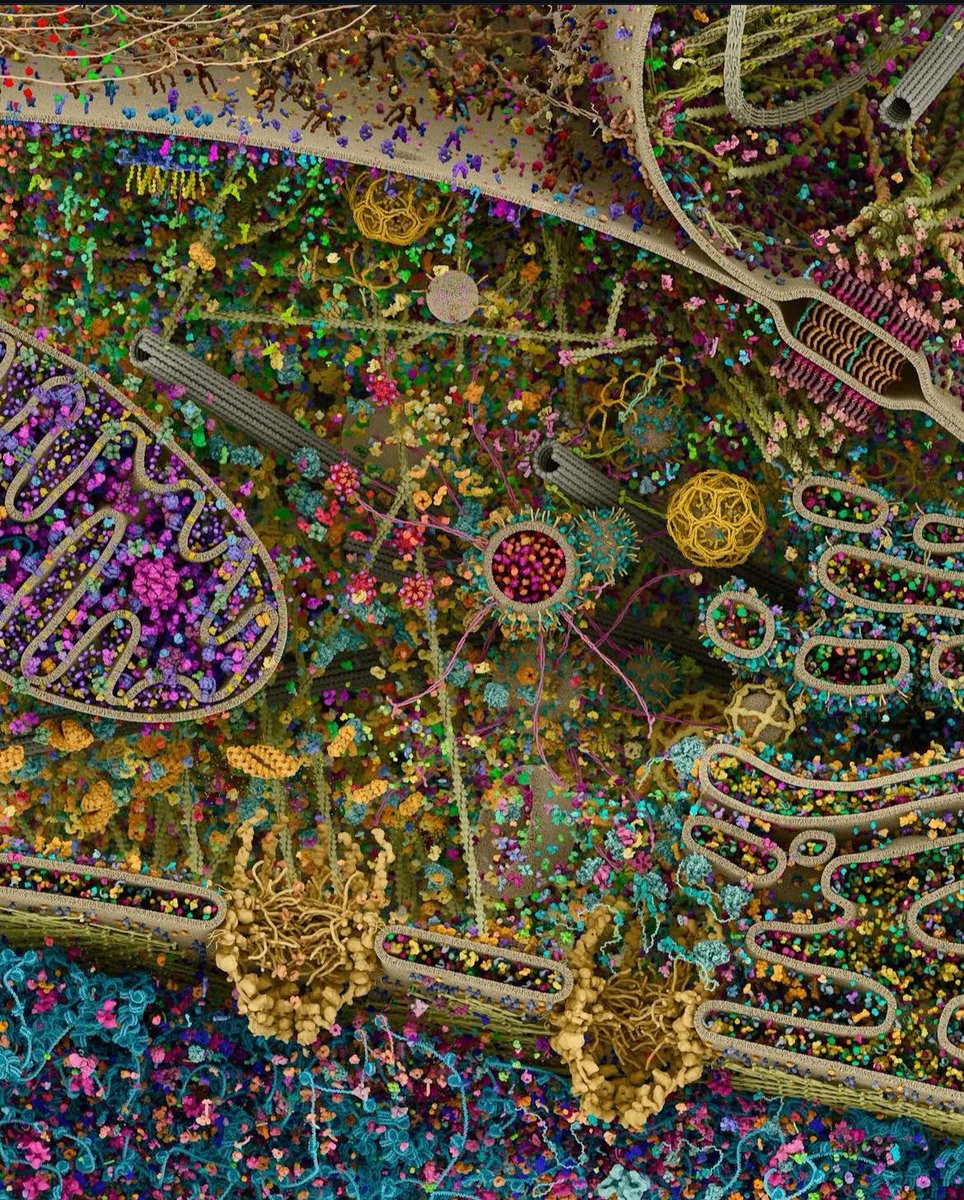
Here is a phagocytic cell, exhibiting what is likely the precursor to animal curiosity, finding and eating invaders.
How much energy does it cost to move about the world with vibrant curiosity?
Extremely excited to announce LigandForge 🧬⚡
Generate high-quality peptides at over 10,000x - 1M the speed of state-of-the-art methods like Bindcraft and Boltzgen. Predict binding affinity with 83% correlation to experimental binding data. 150 protein targets benchmarked.
We've uploaded a fruit fly. We took the @FlyWireNews connectome of the fruit fly brain, applied a simple neuron model (@Philip_Shiu Nature 2024) and used it to control a MuJoCo physics-simulated body, closing the loop from neural activation to action.
A few things I want to say about what this means and where we're going at @eonsys. 🧵
Just saw something that actually feels like a real leap in robotics hardware.👋
@AllonicRobotics built a robot hand using 3D Tissue Braiding,basically weaving high-strength fibers around a minimal rigid skeleton the way human connective tissue wraps around bone.
No hundreds of screws, bearings, cables or fiddly joints.
Instead,a continuous automated process that creates the tendons, soft tissue & compliant structure all at once.
The outcome is wild:
»strong yet naturally soft & safe for close human interaction
»surprisingly dexterous
»produced from digital design→physical part in minutes
»cost drops so much that you could eventually swap end-effectors like disposable gloves
This is starting to feel like the moment robotic bodies get their own “3D printing revolution”.
Hardware iteration speed finally approaching software speed.
If this scales, it could be one of the missing pieces that lets dexterous humanoid robots move from lab → factories → homes.
(Oh, and the company just raised $7.2M Pre-Seed,largest ever in Hungary. Budapest-based with US HQ. Led by Visionaries Club + angels from OpenAI, Hugging Face, ETH Zurich, Northwestern etc.)
Prototype hand looks insane,the woven fiber texture is unreal.
Technology will eventually have to drive human evolution (embryo selection, gene editing).
Otherwise, our technology will evolve faster than our biology and lead to Paleolithic humans facing Neolithic stressors.
The revolution in organ transplants is here thanks to gene editing.
A 62-year-old man on dialysis needed a new kidney. Doctors implanted him with a pig's kidney that had been given 69 edits to be human-compatible.
He immediately stopped needing dialysis.
Releasing METAGENE-1: In collaboration with researchers from USC, we're open-sourcing a state-of-the-art 7B parameter Metagenomic Foundation Model.
Enabling planetary-scale pathogen detection and reducing the risk of pandemics in the age of exponential biology.