Ben Horowitz explains why a16z doesn't invest in neoclouds after living through the dotcom bubble
"If you get into a pathological debt situation, that can wreck anybody. It's why, by the way, we're not invested in any of these neoclouds, for that reason. That whole thing scares me, having been through it."
"It can end up being a very dangerous arbitrage business where you can get upside down easily."
"You look at Loud Cloud just as an example, here's a simple thing that happened to us in 1999. Bandwidth was $1,500 a megabit. And you couldn't get it, it was very hard to get. And so you had to get a long-term contract, three years."
"By 2001 it was $50 a megabit. So if you were holding bandwidth, you were just dead."
"So that kind of thing is so out of the control of the entrepreneur. And so different than what we'd like to fund. That, you know, it just scared me to death."
Same old Infantino. The only thing he’s culpable of, according to this, is getting carried away with his determination to help federations around the world.
Fatuous, staged nonsense and an insult to everyone’s intelligence.
@finphysnerd $H02.SI just needs the Wee family to step away to work. $OU8.SI has decent insider purchases support but still drop alongside broader market
#MCFC’s key defence in its appeal over the Premier League guilty verdict was denied by its own title sponsor Etihad Airways in an extensive submission to the US government in 2015
With @SamWallaceTel
⬇️
https://t.co/GEYJT2cm7C
The panel referred to Manchester City suddenly owing £20m at the end of the 2012-13 season, which corresponds, according to those familiar with the case, to a payout owed to then-manager Roberto Mancini and his staff, who had been sacked at the end of the season following the FA Cup final defeat by Wigan Athletic.
Had the money been paid immediately, City would have been “£9.9m ‘short’ of complying with UEFA FFP for that season”, the panel said.
The tribunal reported that “in a matter of days, a number of modified sponsor agreements were generated… to increase recorded fees, pay bonuses for events that had already taken place, and to pay for a U.S. tour”, thereby plugging the shortfall. City also asked sponsors to pay out bonuses for the FA Cup final as if they had won the match — rather than being defeated by the minnows thanks to Ben Watson’s injury-time header — according to people with knowledge of proceedings.
The Premier League also raised the example of Sergio Aguero’s late, final-day winner against Queens Park Rangers in 2012, which secured City’s first Premier League title. That goal unlocked a number of bonuses within the squad which, if it had not been for the club’s operation of their disguised funding scheme, would have seen City exceed PSR for that season.
📝 @jwhitey98
https://t.co/iZ74j9gKJE
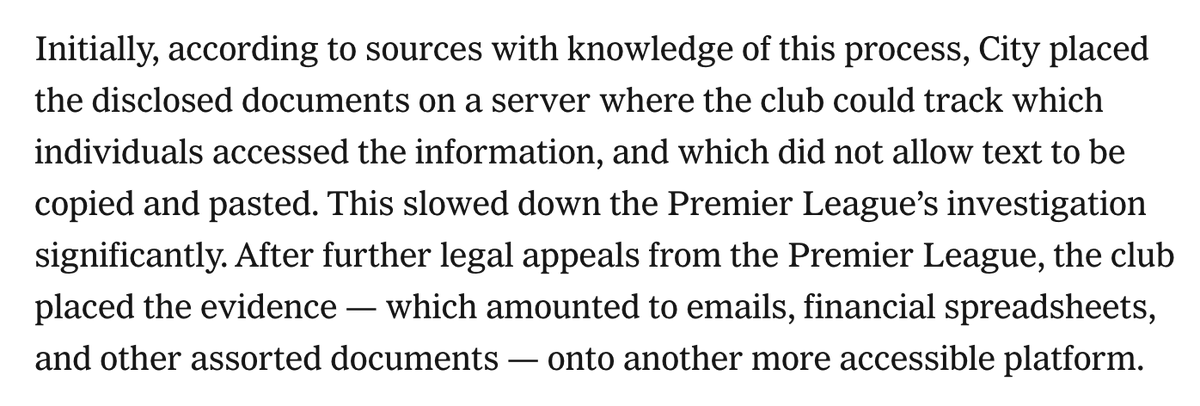
Some middle manager at Man City had to tell their IT team to custom-build a server that stopped the Premier League copy/pasting any text from the documents they handed over.
"Yeah, we're innocent, but can you just make life as hard as possible for the people investigating us?"
Back in 2014, there was a man who was already aware of the irregularities involving Manchester City. That man now runs FIFA. The infamous Gianni Infantino, then UEFA General Secretary, abused his authority, shared confidential documents and, in short, outmanoeuvred the Investigatory Chamber, doing everything in his power to ensure that both Manchester City and PSG would merely receive a fine, avoiding a deeper investigation that could have led to a Champions League ban. All of these details were also revealed through Football Leaks.
Given his actions as UEFA General Secretary and, more recently, as FIFA President, I can only say, in my humble opinion, that Gianni Infantino has become a cancer on football and should have no place in the future of the game.
It's funny how some folks think the helicopter money drop from the Singapore central bank to fund managers is a godsend and much needed boost to Singapore equities
Having been in markets and done sell-side work here and rest of AxJ for the last 20 years, i think I've seen enough. I'm also pretty sure there's a good number of old hands here with similar experiences
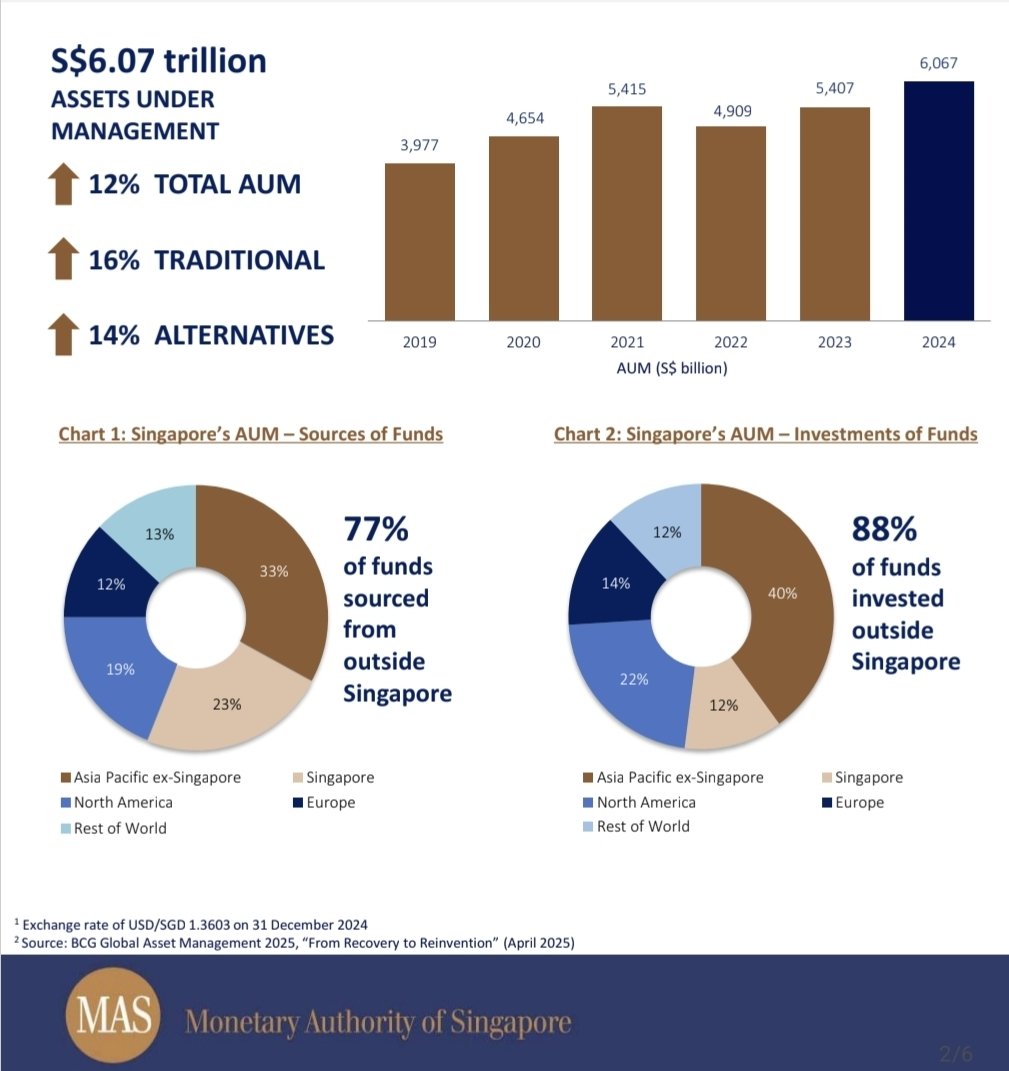
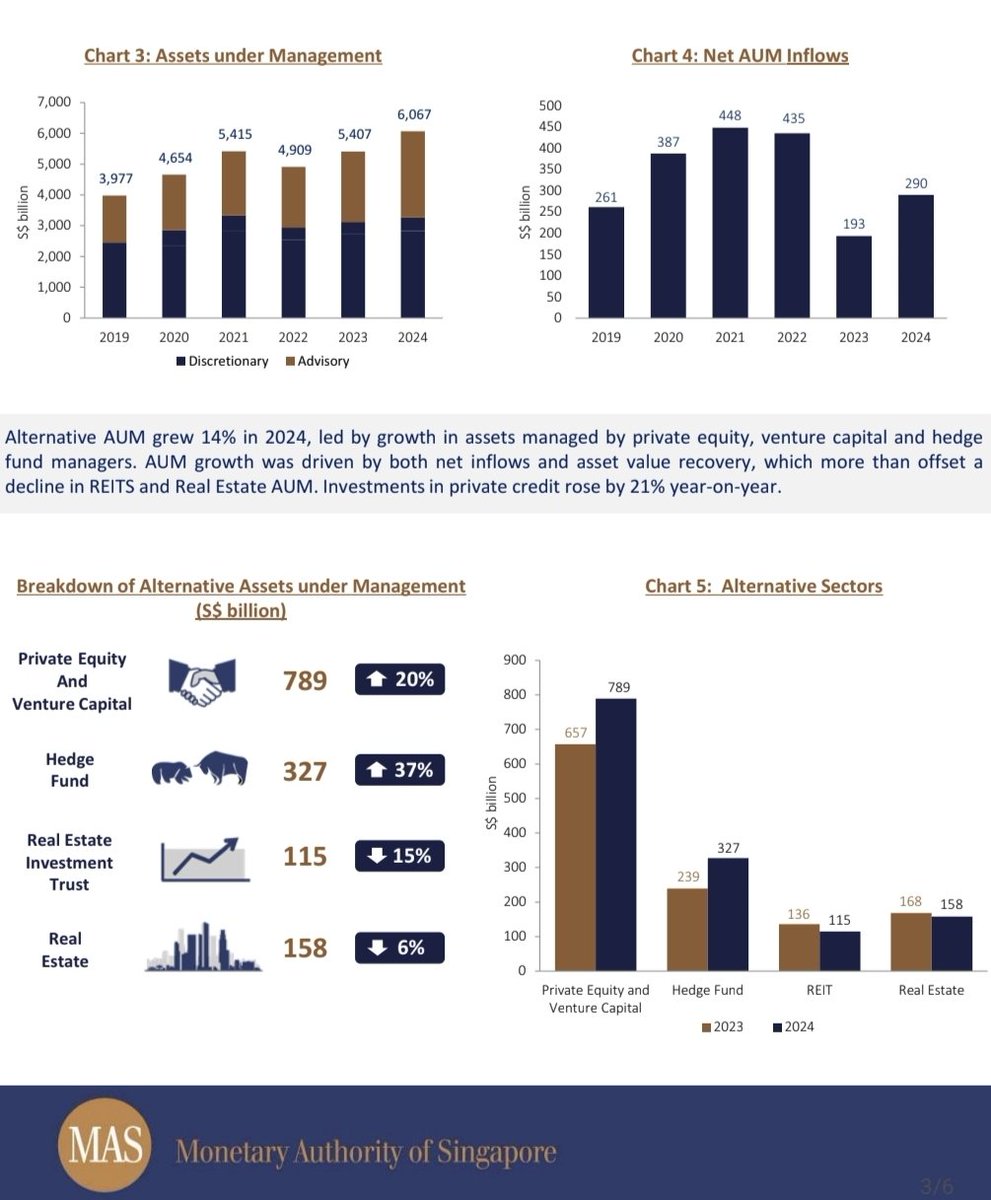
Let me share some stats in the charts below
Before EQDP, Singapore hosted over S$6 TRILLION (>US$4.5 trillion) in AUM in 2024
Of this amount, only 12% (~US$500B) was invested inside Singapore - including the pool of REITs
These figures shouldn't come as a surprise since Singapore is a major financial center within APAC
The country never has a liquidity problem. Not in the past, not now
But, it has market breadth and quality issues, which shows in the low proportion of the AUM invested inside Singapore
Those who've been trading Singapore equities since early 2000s will have stories to tell about the numerous public market blow-ups due to frauds, accounting irregularities, trading/penny stock scandals, bankruptcies:
- S-chips: listings of Mainland Chinese small-mid caps
- Offshore marine names: Swiber, Ezra, etc
- Hyflux
- Noble Group
- LionGold, Asiasons, Blumont
- Eagle Hospitality Trust
- No Signboard
And the list goes on
Many investors/traders had lost money, but none, to my knowledge, received restitution. There's no class action mechanism in Singapore. Investor recourse is non-existent. The only way investors can vote against any AGM/EGM is by selling their shares
Ironically, a lot of the individuals involved in some of these episodes (such as S-chips) are still very much in business. A former CFO of an offshore marine name became the CFO of an industrial conglomerate large-cap. Some of the aforementioned companies are still listed, after name changes
EQDP's liquidity injection has two inherent issues - one of market distortion, and the other of moral hazard risks
On the first, a rising tide lifts all boats
For the second, it's still unclear to me what KPIs/return hurdles and investment period had been defined for the fund managers who had received allocation
Also, are these monies grants, or co-investments? Do the fund managers charge a fee on them? Are there monitoring and reporting mechanisms in place to ensure that the state-sponsored liquidity is going to the right places, e.g. small-mid caps, with no flow back to the large benchmark names such as banks and REITs? None of these information has been made public, if available at all
I mean, there should be some accountability, right?
After all, the fund managers who have received allocations are enjoying a boost to their AUMs. Several have even managed to raise more money on the back of the allocations
Hopefully things are different this time
🚨 Premier League confirms Manchester City ruled guilty of every charge related to financial rule breaches across 9 seasons + majority of charges on #ManCity failure to co-operate with probe. Situation discussed w/ @JamesHorncastle@kvlmason@TheAthleticFC https://t.co/eqQJBGqzSu
🚨 FALSE INFO ALERT!
Fabrizio Romano has covered similar matters many times, yet remains selectively silent when it comes to Manchester City and Barcelona. 🤥
Manchester City have been found guilty on almost all of the charges relating to breaches of the Premier League’s financial regulations.
The sanctions have not been decided, with all possibilities remaining on the table, and City are expected to appeal.
@SamLee and @David_Ornstein join @mjshrimper in a live episode of the The Athletic FC podcast here ⬇️
https://t.co/R8WsrYTLgI
🚨 EXCLUSIVE: Manchester City found guilty on virtually all charges relating to breaches of Premier League financial regulations. #MCFC expected to appeal against verdict issued by independent commission. Sanctions undecided, process ongoing @TheAthleticFC https://t.co/Muxqp4beK9
@DRTnky Seller of the neighboring unit got special approval to sell after 2 years of MOP, so the buyer of the neighbour unit served 2+5 MOP.
Probably HDB gg to tighten this conversion scheme. Otherwise scarcity premium means high headline price which is bad publicity.
@GabGrowth Newcomer to BNPL business and I understand atome is positioned more as a growth tech biz.
But lending biz valued on EBITDA sounds like BS to me, unless of course it’s EBITDA excluding interest funding costs n thus more of EBITDA for the origination. Is that the case here?