The deadline to apply for Y Combinator's first fall class is August 28th, at 8pm. If you're considering applying, do it!
Flashback to 2019.
Our team had built two successful startups together, but we were looking to try something more exciting and impactful.
After working together on a remote team, we needed a tool to help us get everything done in one unified workspace.
Taskade was born.
It was more than an idea; it was part of our daily workflow by that point. We were understandably excited to present our concept.
If you watch this video, you'll feel our excitement and a bit of nervous energy, too.
Then, the best thing happened: we were selected for the 2019 batch!
Little did we know, the 2020 pandemic would push remote work to the forefront of the conversation and push Taskade to new heights.
We also could have never predicted OpenAI's launch that spurred our team to create Taskade AI and introduce AI Agents which have changed the game forever.
So, if you're on the fence, I'm here to tell you to apply. It's not too late.
Even if you only have an idea, go for it. It will change your life and, most importantly, it'll change the lives of others. We're proud to say that we now have a tool that is critical to the daily workflows of thousands of users, personal and business alike.
You can do it, too. Don't give up. Keep the faith. You can change the world, if you want to. 🚀
Here's to your success!
With many 🧩 dropping recently, a more complete picture is emerging of LLMs not as a chatbot, but the kernel process of a new Operating System. E.g. today it orchestrates:
- Input & Output across modalities (text, audio, vision)
- Code interpreter, ability to write & run programs
- Browser / internet access
- Embeddings database for files and internal memory storage & retrieval
A lot of computing concepts carry over. Currently we have single-threaded execution running at ~10Hz (tok/s) and enjoy looking at the assembly-level execution traces stream by. Concepts from computer security carry over, with attacks, defenses and emerging vulnerabilities.
I also like the nearest neighbor analogy of "Operating System" because the industry is starting to shape up similar:
Windows, OS X, and Linux <-> GPT, PaLM, Claude, and Llama/Mistral(?:)).
An OS comes with default apps but has an app store.
Most apps can be adapted to multiple platforms.
TLDR looking at LLMs as chatbots is the same as looking at early computers as calculators. We're seeing an emergence of a whole new computing paradigm, and it is very early.
We talk about disruption in tech so much that the word is overused and lacks the same kind of punch it used to.
That being said, one area where disruption is happening in its purest form is in consumption - which is almost 70% of US GDP.
The disruptor here isn’t China or some other low cost manufacturer but content creators. They are the biggest threat to an entire panoply of products and $100Bs of revenue and market cap (see below).
The virtuous cycle of content creators is impossible for old line CPG to mimic:
Make compelling content —> Acquire an Audience —> Retain and Build Trust —> Sell them a new version of something —> take profits and reinvest in making compelling content —> Repeat
More generally, as platforms like X make it possible for all of us to become content creators, a million new products will eventually appear and collectively chip away at the revenues of established CPG brands over time.
A few examples:
Gatorade —> Prime
L’Oreal —> Kylie
Spanx —> Skims
Hersheys —> Feastables
These old line CPG companies are in a very difficult position that spending money with Madison Ave will not solve. While these old businesses won’t disappear overnight, they are melting icebergs.
If there was a way to be “long content creators” and “short CPG”, it is likely a winning trade.
So as content platforms catch on and help amplify content from creators - it will not only make their platforms stickier but it can slowly replace ad revenue from the dying companies below with rev share from the upstart thriving ones who replace them.
This will only accelerate the virtuous cycle already emerging. Disruption comes slow until it comes fast…
My notes from Poor Charlie's Almanack: The Wit and Wisdom of Charlie Munger turned into maxims:
1. Find a simple idea and take it seriously.
2. Good ideas are rare. When you find one bet heavily.
3. Humans have been writing down their best ideas for 5,000 years. Read them.
4. Avoiding stupid mistakes is more important than being smart.
5. Don’t work with anyone you don’t admire.
6. Don’t sell anything you wouldn’t buy.
7. Avoiding a bad habit is easier than breaking a bad habit.
8. Work on your best idea. Don't diversify
9. Incentives rule everything around you. Look for them.
10. Great businesses are built by going ridiculously far in maximizing or minimizing one or a few things. Think Costco.
11. Learning is changing behavior.
12. Do the unpleasant tasks first.
13. Charlie has read hundreds of biographies. Do the same.
14. Stop multitasking. Concentrate.
15. Many hard problems are solved best when approached backwards.
16. Think of ideas as tools. When a better tool comes along use it.
17. Clip your business and personal expenses. Small leaks sink big ships.
18. Make friends with smart dead people. Adam Smith, Darwin, Cicero, Ben Franklin —whoever interests you. Read their writing. Steal their ideas. They don’t need them anymore.
19. Don't confuse intelligence with invincibility.
20. Bad things will happen to you. It’s inevitable. When they do get up and keep going and remember the next maxim.
21. Self pity has no utility.
22. Find out what you are best at. Then pound away at it. Forever.
23. Only plays games where you have an edge.
24. Avoid mob rule. Avoid demagogues. Avoid dogma. Avoid bureaucracy.
25. Optimize for independence.
25. Use money to buy freedom.
26. Develop durability.
27. What do you have an *intense* interest in? Do that for money.
28. Self improvement has no end.
Tips on writing:
How to Write Usefully: https://t.co/Bu41gy8Fmx
The Age of the Essay: https://t.co/HdUSjESNGl
Write Like You Talk: https://t.co/pcEpHBRsXR
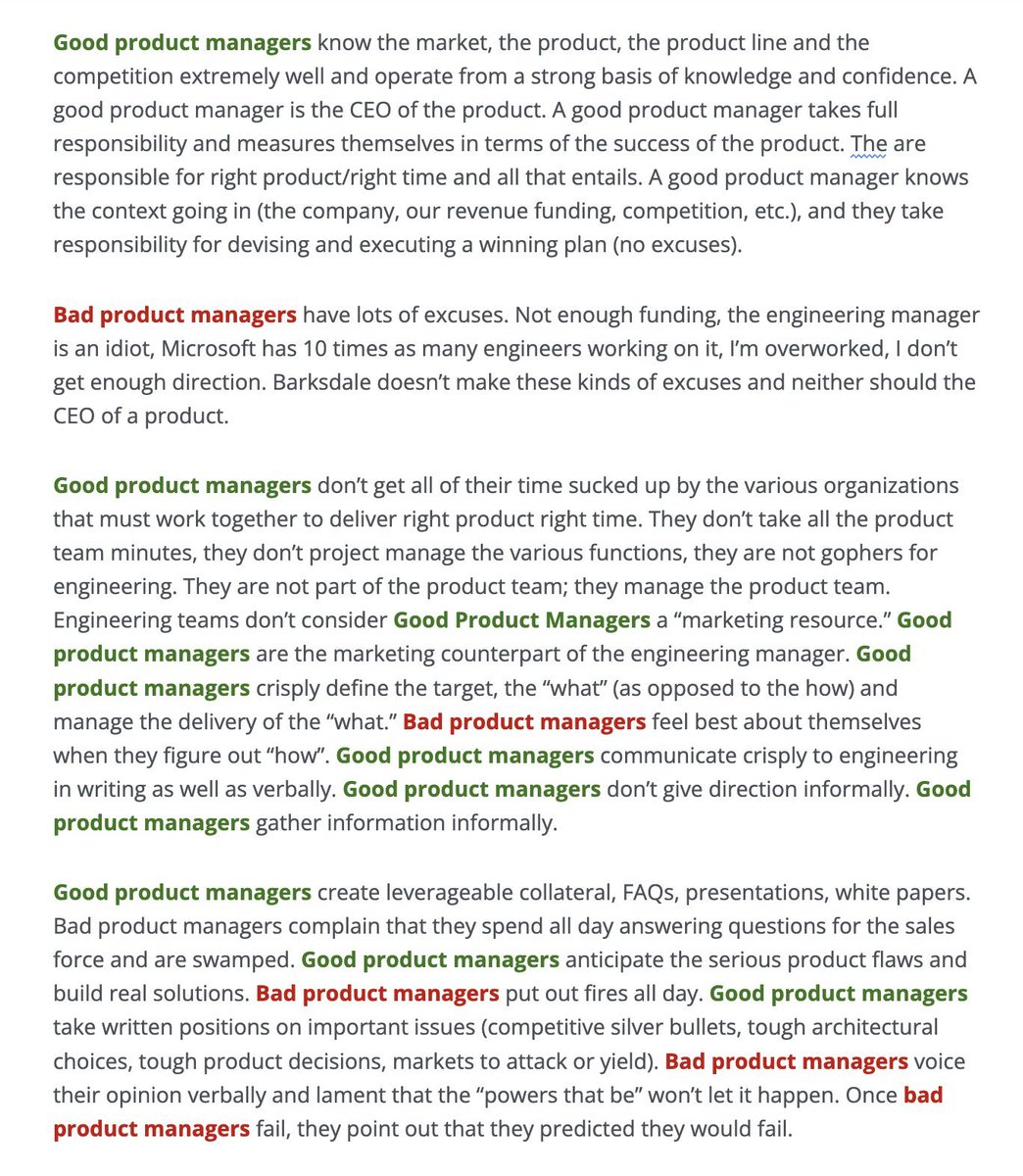
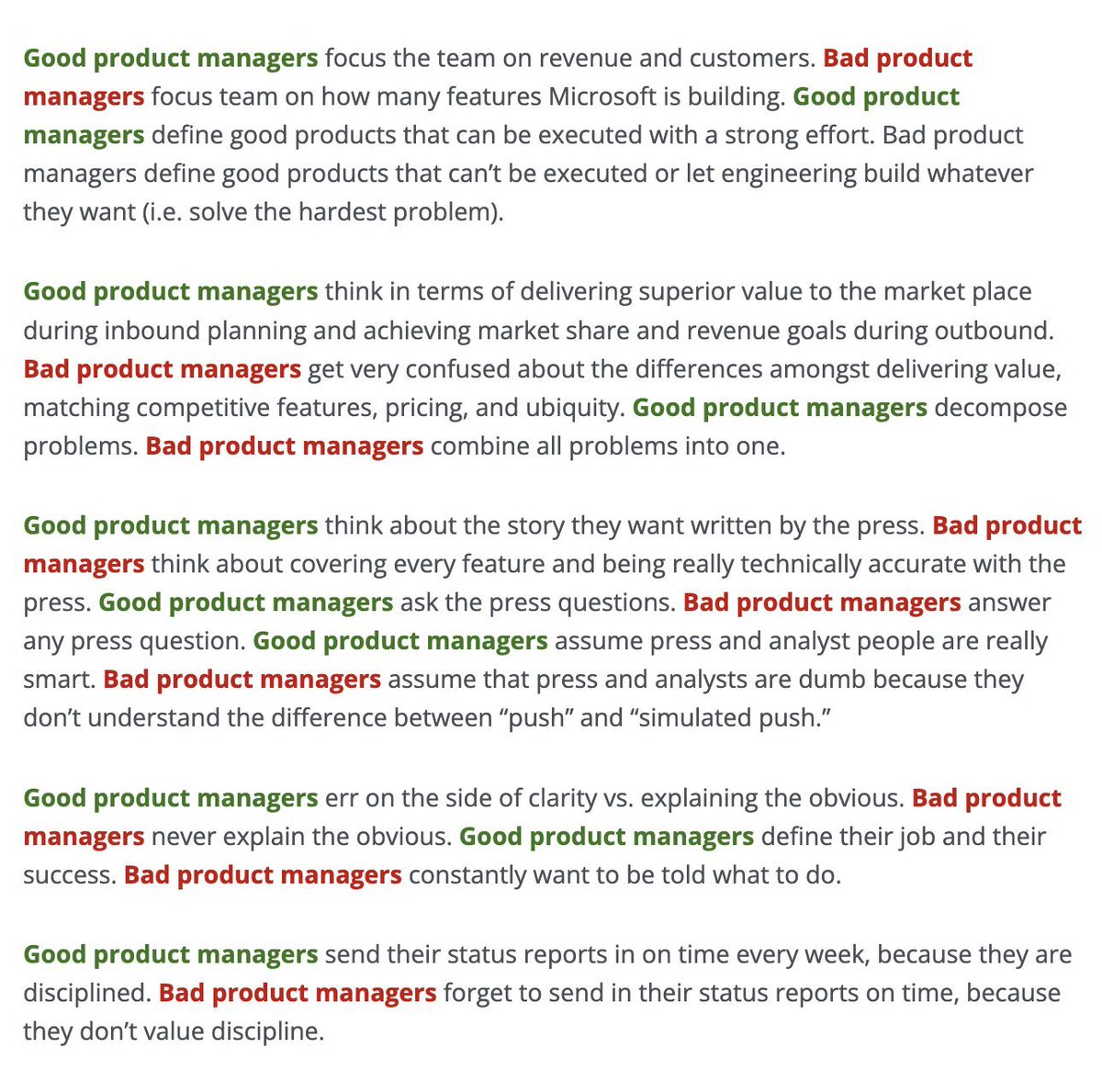
Every PM should save these 2 screenshots to their desktop.
@bhorowitz's Good Product Manager / Bad Product Manager:
(15 years old and still ridiculously relevant.)
I had lunch with Sam Zell.
We talked for over 2 hours.
I could ask him any question I wanted.
At 81 he is still *ferociously* intelligent and completely authentic.
Here are 7 key ideas I learned from our lunch:
1. Go for freedom
Freedom allows you to control what you work on.
If you control what you work on then you can work on what you love.
If you love it you will do it for a long time.
If you do it for a long time you will get really good at it.
Money will come as a result.
2. It's extremely important to be obsessive about understanding everything you possibly can about your craft. Consider it an obligation. Hold yourself accountable. Keep learning over time. Study the history and know the pioneers. — @bgurley
Sam Zell has been doing this for 60 years.
Every time I mentioned some obscure figure from the history of business Sam
-knew who the person was
-knew what company they had built
-and had read their biography
Every. Single. Time.
He has all this information stored in his head.
He never looked at any notes or had to Google anything.
It was all in his brain.
3. The right information is priceless
It can save your life (the right information helped Sam’s family escape the Nazis)
and help you build a wonderful business
(Sam used an idea he found in William Zeckendorf’s autobiography in both his real estate and business career)
4. Have fun
You’d be surprised how many rich people don’t have any fun.
Don’t be like these people.
Sam is still curious and is seeking adventures all over the world.
5. You have an obligation to share what you have learned
Sam flies all over the world to talk to other entrepreneurs (at his expense!) just to teach everything he has learned.
He considers it an obligation to pass knowledge onto the next generations.
6. When you a few decades of experience —write an autobiography
Sam hated writing his. It was difficult.
But it is one of the best things he ever did.
His favorite day of the week is Monday.
That is the day Sam and his team go over the messages people send Sam telling him how his book changed their life.
He finds this deeply satisfying. You will too.
7. If you love what you do the only exit strategy is death
Sam will be doing deals, building businesses, and sharing everything he learned until he dies.
- - - -
“People sometimes ask me when I’ll retire. Retire from what? I love what I do.” — Sam Zell
- - - -
A scene from our lunch:
David: I bought Zeckendorf’s book because you mentioned reading it in your autobiography
Sam Zell: Did you read it?
David: Not yet
Sam Zell: READ IT!
David: Yes sir 🫡
- - - -
The first 30 minutes of episode 298 is what I learned from having lunch with Sam Zell.
I go into a lot more detail than I can fit here.
The rest of the episode is what I learned from reading the book Sam Zell told me to read:
Zeckendorf: The Autobiography of The Man Who Played a Real Life Game of Monopoly and Won the Largest Real Estate Empire in History by William Zeckendorf
You can listen in any podcast player right now!
Finally got GPT4 API access, so built an app to test it: here's Q+A assistant for all 121 episodes of the @theallinpod. You can ask any question abt the shows. It uses @OpenAI whisper model for audio -> text, @pinecone, @langchain. App is here: https://t.co/46rs1YrvKn
The future of building startups:
- MVP speed (1x per month)
- AI-accelerated
- Superniche is the new niche
- Community 1st, software 2nd
- No-code 1st, some code 2nd
- 10x more automated
- Global teams, localized products
- 95% dominated by solopreneurs and microentrepreneurs (teams less than 12)
- Pop-up digital experiences (apps that only work on certain times)
- Needs the marketing holy-trinity to hit escape velocity: 1. product/market fit, 2. content/market fit and 3. community/market fit
- Team is half robots 🤖, half humans 👨🦰 (cc @youneedarobot)
- Accelerated by "boring marketing" (cc @boringmarketer)
- Multiple revenue streams
- Design matters. The bar is high
- Partnered w/ creators (creators are the distribution)
- Feels like a game (levels, status, badges, in-app currency, challenges, collectibles/items)
- Purpose-driven moonshots: societal impact matters
- Productized agencies to generate cashflow (ex design agency @DispatchDesign)
- Product studios become the norm
- 99% of MVPs won't need VC
How do you know if a social app will be a "hit?"
Predicting what goes mainstream - and what stalls out - might seem random.
But after years of leading growth @Snap & investing in consumer social at @a16z, I've found early signs of huge products 👇
language models just being programmed to try to predict the next word is true, but it’s not the dunk some people think it is.
animals, including us, are just programmed to try to survive and reproduce, and yet amazingly complex and beautiful stuff comes from it.
How Duolingo reignited user growth—the story behind Duolingo's 450% growth acceleration, leaderboards, streaks, notifications, and innovative growth model, by @jorgemazal
https://t.co/jeDNjQJNB8
If your plan is to fill a gap in the market that the established players have missed, first figure out why they missed it.
In my experience, the biggest players in a mature industry know their industry pretty well. Yet I’ve seen countless business plans based on the notion that there’s an opportunity that the established players have missed; often a neglected market or an overlooked efficiency.
But here’s the thing: it always looks easier from the outside. If the leader in a streaming media space isn’t offering a certain kind of content, well sure, it’s possible that they’re unaware that there’s demand for it.
But it’s more likely they already looked into it, and discovered that the numbers didn’t work. Maybe it’s too expensive to license. Maybe negotiating the rights is more trouble than it’s worth. It’s probably not because they didn’t do their homework.
And if you’ve come up with an obvious idea and can’t believe it doesn’t already exist? Well rather than getting excited about the huge white space you’ve discovered, spend some time trying to figure out why it hasn’t already been filled.
You need to do your homework. Ask around. Make the calls. Do the research. Before you start, you need to understand clearly what tripped up all prior efforts - and have a plan for why your particular version won’t run into that same problem yourself.
If you don’t know where the holes are in advance, you’ll find out soon enough once you’ve fallen into that exact same hole yourself.