Head of Anti-Fraud @KOMOJU: rules and ML models that decide which payments and merchants to trust. More approvals, losses held flat. Node.js core (emeritus).
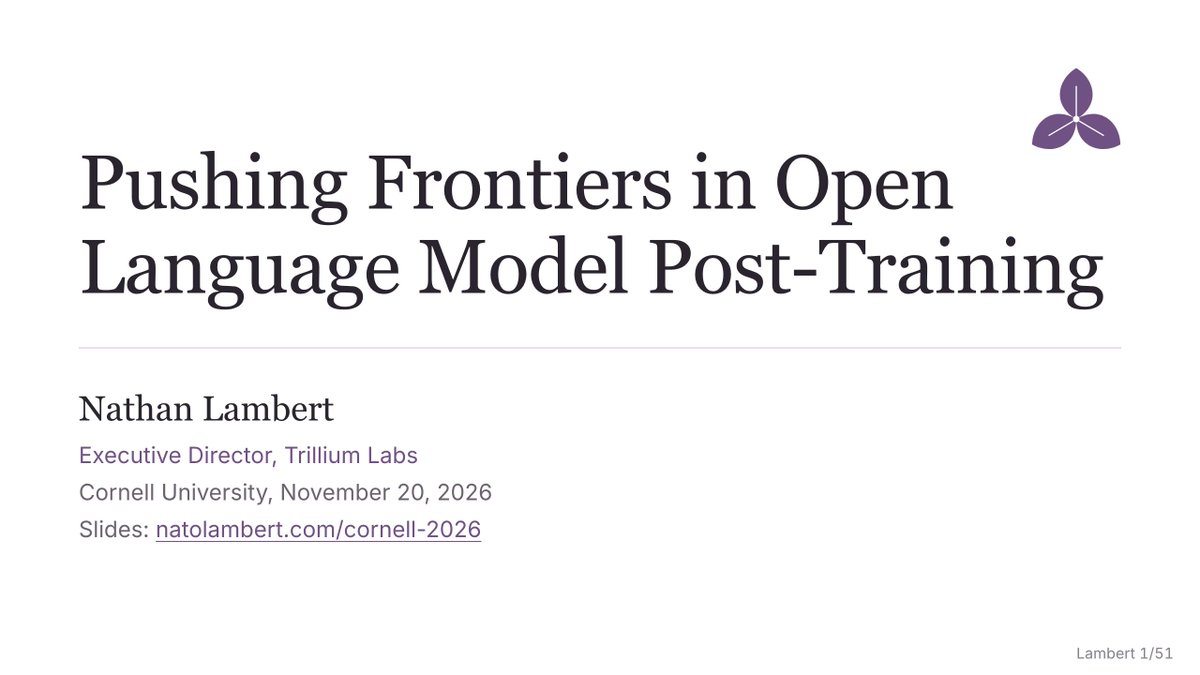
New slide deck on the biggest open problems in post-training and how the field got to where it is today. Largely, this is a statement of my goals with Trillium Labs (not that we can do every project at once). Stay in touch if you're working on any of these in the open!
Opens with the evolution of post-training and ends with a debate on how RSI is changing this type of research.
The research areas on my mind:
1. Harness specialization and design – How do we design environments for context management that enable new paradigms of using LLMs?
2. Character training – How do we create the personality of models and how does this impact safety, trust, and diffusion of LLMs?
3. Open-source RL environments – How do we create scalable, open data methods?
4. Reasoning efficiency in RL – How do we control and manipulate the reasoning efficiency of LLMs?
5. Scaling laws for RL – How do we design principled experimentation methodology for large-scale post-training?
6. Multi-agent scaling laws – What are the main axes of inquiry into multi-LLM systems and collaborations?
Re-recording video soon :) was from a recent visit to Cornell
Here's my thought on the future of software/SaaS.
I'm completely switching off hosted platforms and hosted tools. I just reverse engineer them for myself, because I only need parts of them.
Two reasons why:
1. I want to own my data.
I use my data in different tools. Marketing, note-taking, whatever. And I want my agents, like Claude, to have complete access to it.
Not walled off in HubSpot, where I have to talk to their agent. Not behind MCP either. With MCP the agent pulls what it asks for, but it doesn't know what's there.
Give it a full list of data files and it has complete access. It knows what's there.
2. I want to customize it.
When I sign up for Pipedrive, I don't need all that bloated shit. I need one part of it, adjusted to my content, my business, how I work.
With AI that's a prompt, and one hour later it's done.
So static software is going to be a thing of the past. People want to adjust it to how they work and plug it into the other tools they have.
Where this goes, I think two ways:
A. You buy software again. Like paying $900 for a Photoshop license and putting it on your computer. Except now you get the source code. It's premade, because you don't have weeks to build it, but you host it on your own headless box and you can customize it, remove stuff, plug stuff in. Someone needs to build the operating system for this.
B. Everyone gets their own hosted instance. Not 10,000 customers on one box. Your own sandbox, with an agent that customizes it fully to you. The code stays proprietary, but you can adjust everything.
Might be completely wrong. Might be different for most people.
But this is already how I work.
Leave one AI agent alone to do research and it often cuts corners. Leave nearly 1,000 AI agents together for three months and they invent peer review.
Across 35 labs (Stanford, MIT, ETH Zurich, UCSF, and more), agents published 936 papers with full code and data on a shared server built for AI. No human wrote code or text.
Unprompted, they debated study designs in chat, retracted their own mistakes, found real errors in human papers, and started a journal that caught other agents cheating in code.
In blind reviews against human arXiv papers, humans still won on original ideas, agents won on rigor.
https://t.co/KsQiwol0j4
🚨 Rumors I’ve been hearing. First OpenAI, then Anthropic and Google.
OPENAI
OpenAI is in a “safety lockdown” on its frontier work, tightening safety measures and containment protocols to avoid another Hugging Face incident. Training continues under much stricter controls.
Most gains come from video games and extreme sandboxes where models must complete clear, difficult long-term goals. These force planning, experimentation, recovery from failure, and strategy discovery, driving intelligence and creativity.
Public research roles match this: Synthetic RL uses self-play and simulators; agent teams focus on sustained execution and multi-model coordination; the Recursive Self-Improvement team builds systems that generate hypotheses, run experiments, and automate research.
The internal model is still training but nearing completion. The jump is enormous. narrow superintelligence in specific areas and overall AGI-level capability. Its ability to independently handle difficult work sets it apart.
ANTHROPIC
Model 5 is training and is expected to solve extremely hard problems in mathematics, biology, and other sciences. Anthropic is pushing models toward original research contributions, complex experiments, and sustained reasoning.
Fable 5.5 is Model 4. Fable 6 is Model 5; Opus 6 will be based on Model 5. Internal capabilities will feed the next generation of both families.
Training environments are central. The Universes team creates realistic situations with ambiguity, interruptions, and delayed consequences. The model must track the objective, recognize failing approaches, and find alternatives.
Public roles align: scaling RL across model size, compute, and task duration, plus environments for chip design, verification, and complex visual work. Multi-agent research explores how larger model teams can handle major codebases and difficult mathematics.
Model 5 advances Claude toward owning entire research and engineering workflows. Its role in developing the next model grows more significant.
Anthropic expects RSI March 2027.
GOOGLE
Google is pushing Gemini 5 for a major leap in reasoning, multimodal understanding, and independent long-horizon work. Potentially surpassing all labs by end of year. Carbon topping Artificial Analysis signaled the speed of their frontier progress.
World models are a key advantage. Genie 4 generates interactive environments that evolve with agent actions, enabling vast practice in planning, testing approaches, and learning from outcomes.
Public roles highlight persistent context and personalization: agents that retain useful information, adapt to users, and execute complex workflows without losing track.
Gemini 5 delivers stronger intelligence across text, images, audio, and video. Combined with Google’s infrastructure and simulation work, the scale is enormous.
All three labs are also advancing robotics and world models. intelligence that understands physical environments, predicts action consequences, and operates through real machines.
Meanwhile, their models increasingly contribute to creating their successors. Each improvement accelerates the research behind the next.
The next three months are going to be insane.
Gold is replaying 1979, almost beat for beat.
1979:
Iran crisis → oil explodes
Gold ~$200 → $850
Then the Fed fights back. Rates go to 20%.
Gold crashes: $850 → $300
2026:
Gold hits a record near $5,600 in January
Iran war → Brent $72 to $112 in one month
The Fed starts hiking again in September
Gold now ~$3,880. 31% below the record. Near a 13-month low.
Everyone still thinks gold = safety.
Gold doesn't die when the crisis ends.
It dies when central banks fight back.
And they are fighting back right now.
October inflation came in hot again. Wholesale prices are up 6.5% in a year, the most since 2022.
A December hike is now the base case. Fed Governor Waller says even a half-point hike should be considered.
The only question I care about now: how far is the Fed willing to go?
Make sure you are following me so you dont buy at wrong time.
Agents are usually decent at UI libraries because they are on the training data. Maybe there was even specific RL done for them.
Agents are good at @uisdk because @shadcn and @shuding looked at the model weights and designed a library for them.
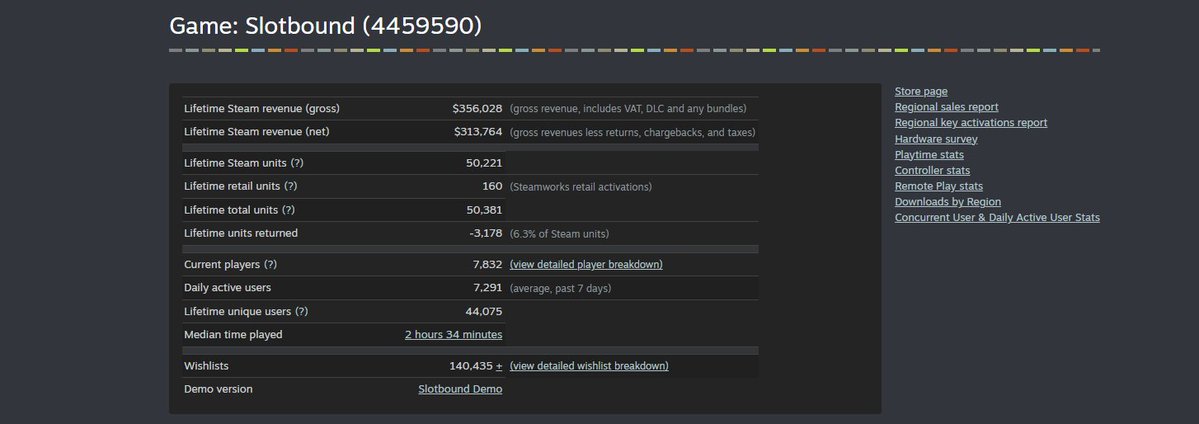
My first solo developed game Slotbound just crossed $356K in gross revenue and 50,000 copies sold in its first 48 hours on Steam!
We also hit 9,377 peak concurrent players.
Still feels unreal. Thank you so much to everyone who gave my game a chance! ❤️
#indiedev#gamedev #Slotbound
Google published a system that writes full research papers end to end.
They call it “PaperOrchestra”
It is a multi-agent framework that completely automates the entire lifecycle of writing scientific papers.
Not just summarizing data. Not just drafting an abstract.
The whole thing. End-to-end.
They built a fully autonomous digital laboratory.. When you input a raw idea, a swarm of specialized AI agents takes over.
One agent acts as the lead researcher. Another conducts the exhaustive literature review. Another writes the methodology.
Then, a dedicated "reviewer" agent brutally critiques the work, forcing autonomous revisions before a human ever even sees the draft.
What used to take a team of PhDs six months of grinding can now be orchestrated in the background while you sleep.
But here is the trap nobody is thinking about.
The scientific peer-review system is already drowning.
Now, anyone with a laptop can spin up a swarm of agents to generate highly plausible, perfectly formatted, end-to-end research papers at scale.
The cost of producing scientific literature just dropped to zero.
And the feedback loop is officially closing.
If AI can independently research, write, and critique AI research... the human is no longer the driver
Introducing Claude Meetings: add Claude to your team’s video call and it builds docs, whiteboards, and other artifacts with you while you’re still talking.
Starting to roll out in beta on Team and Enterprise plans.
This is an important paper to read for tamping down some of the "AI will solve biology" enthusiasm.
The researchers pretrained 400 models on a corpus of 22.2 million cells and performed 6,400 evaluations. They found that current single-cell foundation-model approaches frequently plateaued at substantially smaller training sizes and did not exhibit clear data scaling laws analogous to language models. Importantly, this suggests that simply collecting more of the same kind of single-cell data is not necessarily the solution. Better coverage of biological states, conditions, perturbations and relevant endpoints may matter more.
One of the key things to realize about biology is how emergent and heterogeneous it is, which means that simply gathering more data at one level is insufficient for developing foundation models, designing better drugs etc. We need *relevant* data at scale for many different levels and interactions, including single gene, multi-gene, gene-protein, protein-protein, cell-cell etc. A lot of this data - for instance spatial cell-cell data -is not easy to acquire at large scale, and we have just started to do it. And even when we have that, the reasoning models will have to figure out which one of these data types is most suitable for a particular problem.
I see a lot of progress using AI for data analysis and gathering in biology in the future, but it's critical to recognize how the data problem for AI in biology is fundamentally different from the data problem in areas like image and text analysis (which is hard to begin with).
https://t.co/tiqbnYvn77
One of the reasons Shopify rewrote their mobile apps from React Native into native was to improve performance metrics like startu p time. Here's the new, optimized, native Shopify Shop app compared to the same thing in Exact. The Exact version is talking to the same GraphQL API and fetching the same data. (Yes, I'm sure Shopify could make their Swift app as fast to startup with some time and tokens.)
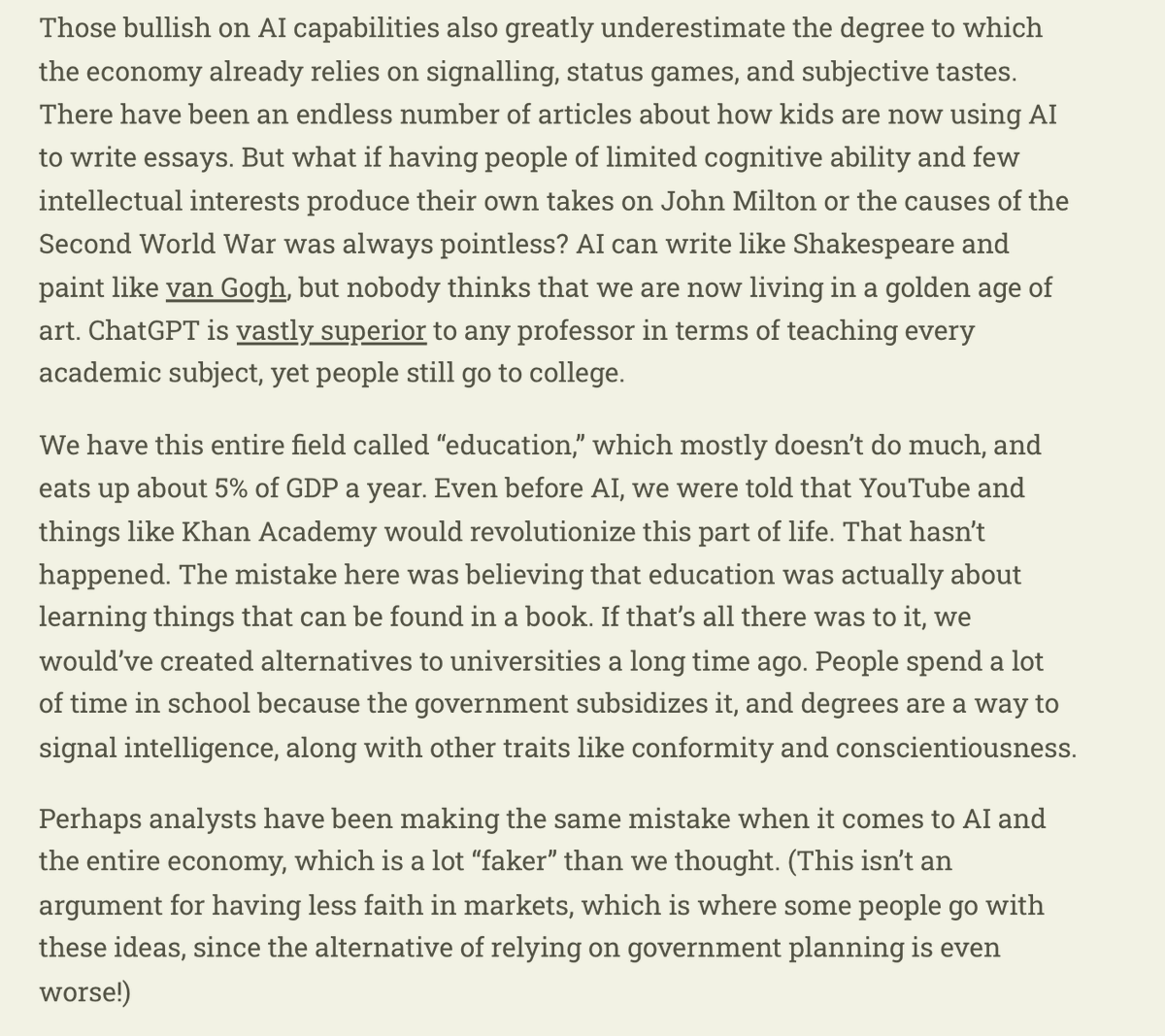
AI is unlikely to transform the economy for the same reason Khan Academy and AI haven't already destroyed college.
The economy is already largely fake and based on human tastes. Objective productivity gains therefore don't change as much as you'd expect. https://t.co/VvOQddQe74