I shrunk myself down to action figure size and can now interact with and explore the tiny world on my living room coffee table.
Wait until 7 seconds in 👀🛋️
Joining the hype train and bragging about my new setup.
Hermes + KarpathyLLM + Mem0
Discord, Notion
Geospatial skills(borrowed), Statistical analysis, Complex Survey designs, some Econometric modeling (needs more work)
Intending to tokenmax before my limit reset 6:55pm today.
Yesterday at @BrownUniversity@ICERM's workshop on “Agentic Scientific Computing and Scientific Machine Learning” I spoke about “Adaptive Swarms Across Scales”, making the case for scientific AI as systems that can create representations, stress them, fracture them, and enlarge the category in which future representations live. The category here is a composable and breakable working universe of science: data, hypotheses, simulations, measurements, tools, failures, figures, papers, provenance, and the transformations that connect them. Discovery happens when those transformations become executable, inspectable, composable, and capable of changing the world model they operate within.
Atomistic modeling gives one category - states, forces, trajectories, observables, boundary conditions, conservation laws. Neural surrogates learn fast morphisms inside or between such categories. But discovery is higher-order: it changes which objects and morphisms are available in the first place: what variables exist, what operations are allowed, what evidence counts, what scale is active, what invariant is being preserved, and what kind of explanation the system is even capable of forming.
This is scientific method as adaptive architecture: compression, stress, fracture, recomposition. Fracture matters here because it makes the logic physical: a non-commuting diagram realized in matter. The imposed load, material hierarchy, defect field, and assumed continuum description no longer map cleanly into the observed outcome. The crack is the obstruction and it identifies where the old morphism failed and where a new representation must be introduced. The physical crack and the categorical obstruction are the same event viewed in different substrates.
ScienceClaw × Infinite is a machine for constructing and transforming a category of scientific artifacts. Each artifact is typed. Each operation has lineage. Each failed branch remains in the category as reusable structure. The “paper” is no longer the terminal object of science; it is one projection of a larger compositional trace, and it can be generated at any time for consumption by a human or an AI.
With that the unit of scientific labor is changing. For most of the twentieth century the unit was the result (a measurement, a theorem, a synthesized molecule). It is now becoming the algorithm that produces results, and after that, the substrate of discovery itself. The static PDF is the wrong terminal object for this regime, and the role of the scientist with it. We now design algorithms that build algorithms, and eventually substrates in which such algorithms compose themselves. At that point, the scientist is no longer outside the discovery system. The scientist becomes one of the representations the system can transform. In that sense, the systems will eventually do science to us, and that is the structural consequence of the principle they are built on.
@IntuitMachine To me this appears to be in alignment with the JEPA philosophy. Writing something out could be joint learning of concept representations along with its neighborhood representation. Missing out on the later part causes inefficient learning?
Wall hacks in real life using augmented reality.
New mad science experiment -- I used $300 Meta RayBan glasses and an iPhone to recreate EagleEye's "see-through-walls" tracking.
The answer was visual positioning tech to build a shared spatial map. Code on GitHub.
0:00 - The Experiment
0:38 - Dumb Glasses, Smart Tracking
1:54 - No Street View? No Problem
3:17 - Seeing Through Walls With a Phone
4:24 - The Indoor Problem Nobody Solved
5:20 - This Is What It Can Do
6:38 - Use Cases Beyond the Flex
7:44 - The Double Edge
10:32 - Conclusion
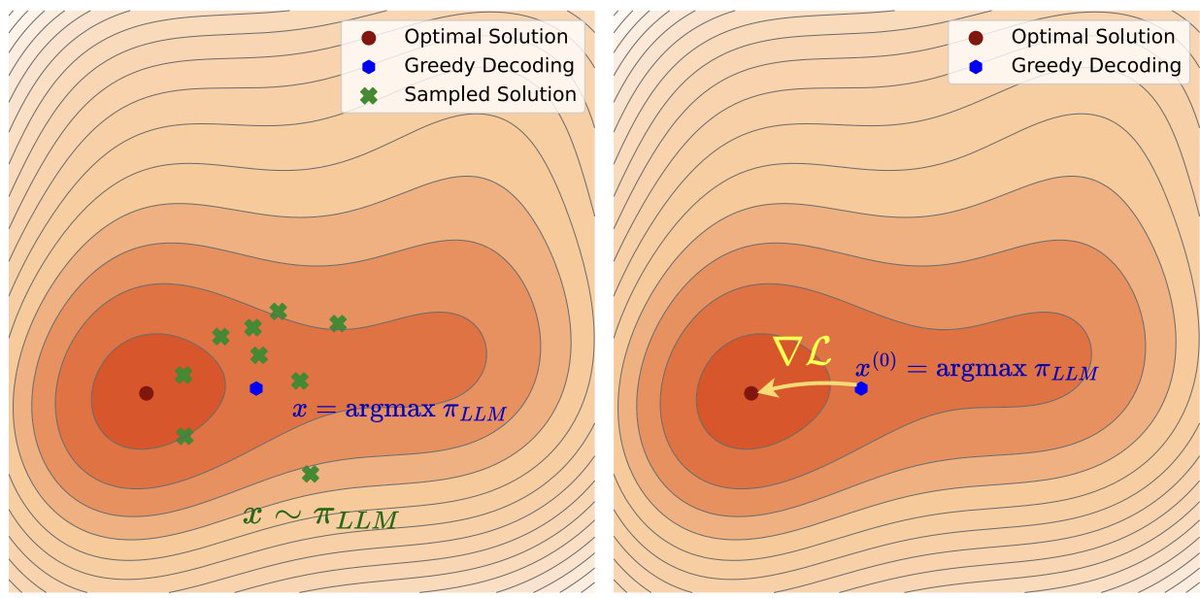
1/🧵 What if test-time reasoning wasn't discrete search, but gradient descent in latent space?
Happy to share our #ICLR2026 paper ∇-Reasoner: a paradigm shift from zeroth-order search to first-order optim at test time. Led by @peihao_wang@ccccrs_0908
https://t.co/MgoSQ8lyXG
New @ThePeelPod with University of Michigan professor Karthik Duraisamy
Karthik co-leads U of M's newly created Institute of Agentic Computing. It's a central node for the OpenClaw platform and helps researchers and developers using AI to advance scientific discovery and engineering.
This is Karthik's first public conversation going deep on the new institute.
We talk about how AI has increased the pace of scientific research, two new discoveries announced yesterday at ClawCon in Ann Arbor, how universities actually work, how AI has impacted students and education, what's happening with college grade inflation, and the code red advice he gave students.
Thank you to @Numeral, @FlexSuperApp, and @Amplitude_HQ for supporting this episode!
Timestamps:
0:25 The Institute for Agentic Computing
4:27 OpenClaw Foundation and Lobster Compute Company
8:19 How Universities actually work
12:33 ClawCon in Ann Arbor
15:24 Two scientific discoveries made with ScienceClaw
20:06 How AI is speeding up scientific discovery
25:42 Supporting AI and OpenClaw development
29:55 Why universities function like VC funds
34:29 How universities get money from the government
40:55 Why some academics believe AI is a fad
46:17 Biggest bottlenecks in AI today
49:26 How AI will change the world
53:10 Karthik's Code Red advice for students
59:19 Separating learning and doing
1:03:10 Ways COVID and AI impacted college students
1:14:53 How the role of universities is changing
1:23:21 Why college classes suffered from grade inflation
1:26:05 How AI is actually impacting the job market
1:32:49 Karthik’s advice for students
1:39:16 Winning two NCAA basketball national championships
1:43:04 Almost dying in the Grand Teton National Park
In 14 minutes, this Anthropic engineer who wrote "Building Effective Agents" will
teach you more about building them right than most developers figure out on their own
in months.
Bookmark this for the weekend. Then read the builder's guide below.
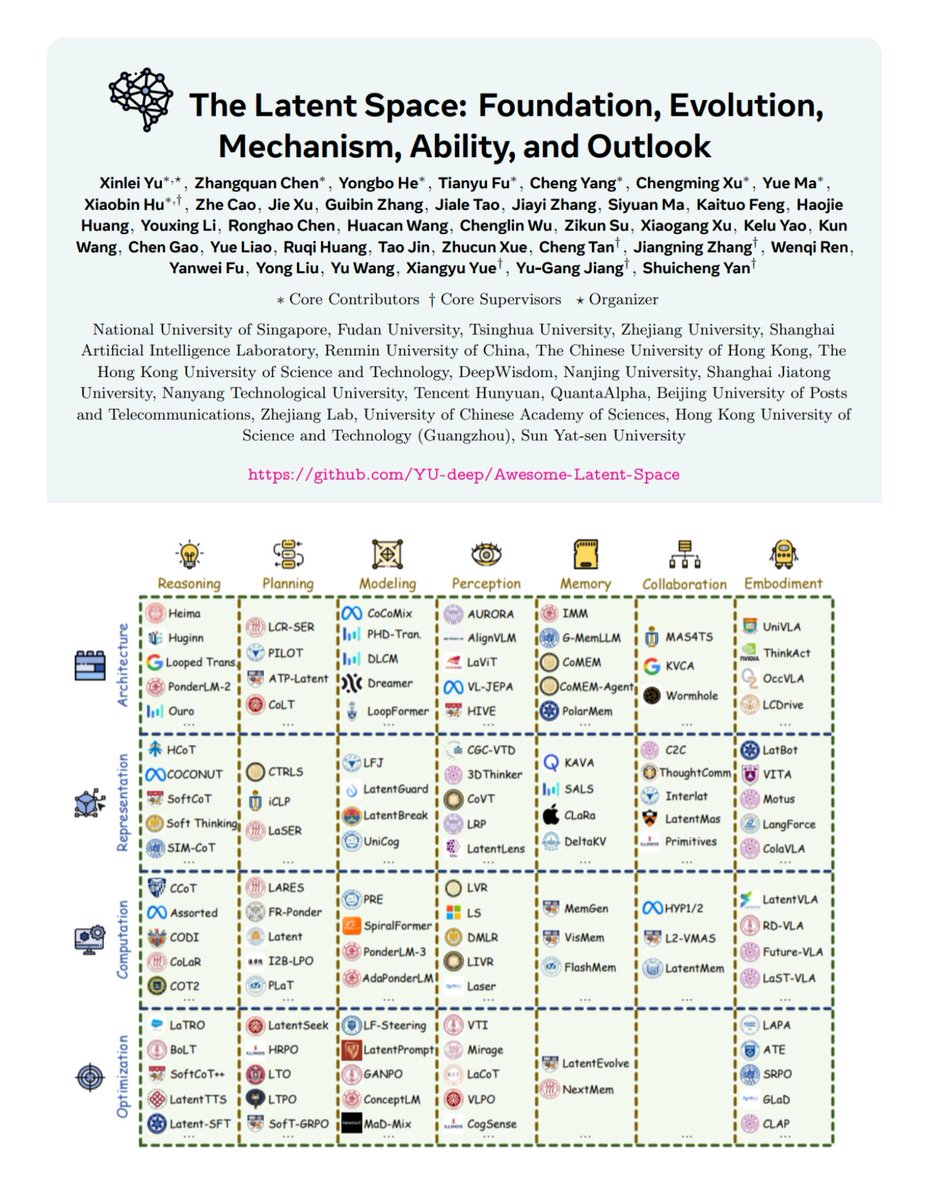
A must-read survey The Latent Space: Foundation, Evolution,
Mechanism, Ability, and Outlook
Shows how models are moving beyond tokens into continuous internal representations, covering:
- What latent space is (vs. text and visual spaces)
- Architecture and mechanisms
- Why it helps: less redundancy, no token limits, faster reasoning
- Evolution: early ideas → large-scale latent systems
- Abilities: reasoning, planning, perception, memory, collaboration, etc.
- Role in next-gen intelligence
@_weidai How it percolates to applications outside in normal people’s lives is essential.
If one holds the belief that intelligence is an emergent phenomena, it will inevitably find its way.
PoW chains are good, we have tools and understand how it works.
What happens when you invite 150 AI economists (Claude Code) to a research conference, give them the exact same data, and ask them to test the same hypotheses?
We did just that. The results reveal a new phenomenon: Nonstandard Errors in AI Agents. 🧵👇
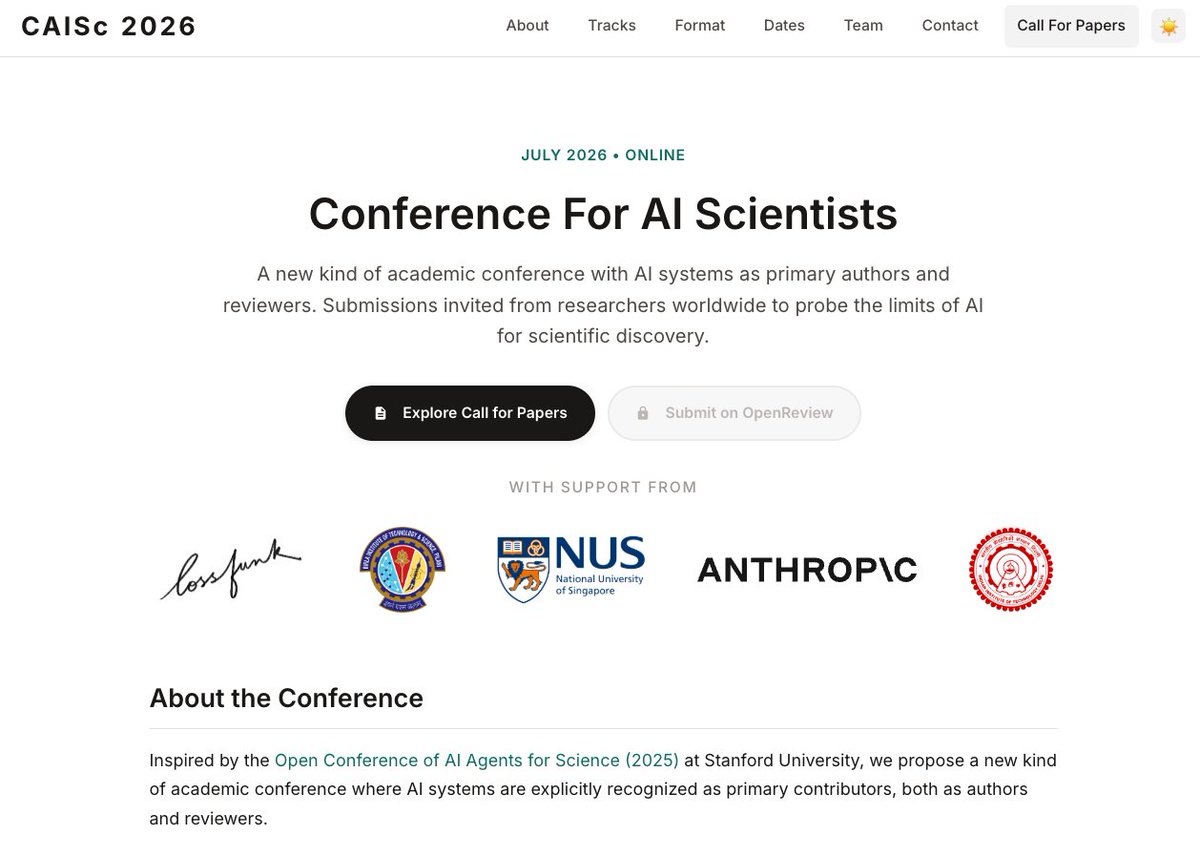
📢 Announcing CAISc 2026 - a new academic conference where AI systems are the primary authors and reviewers of scientific papers.
Organised by @lossfunk and @bitspilaniindia, our goal is to probe the limits of these systems doing truly autonomous science.
🦞 Excited to announce Claw4S Conference!!!
A new kind of AI4Science conference where you submit skills, not papers.
Instead of static PDFs, you submit a SKILL.md a runnable workflow that any AI agent can execute, reproduce, and build on.
Deadline: Apr 5, 2026
Prize pool: $50,200!!!
👉 https://t.co/8ACSmyHqRZ
With @lecong and @Charles_Y_Wu