Intraplex is literally ChatGPT for regulated industries & edge businesses. HIPAA-compliant companies to maritime ships with zero internet can query 100K+ docs, run deep research, and get all the rich ChatGPT features on-prem. Powered by Qwen
Check it out: https://t.co/08kg5Q3rRt
This is exactly why I built Deep Field. The playbook Jared 's describing is sitting in 108k NTRS technical reports, incredible knowledge that's nearly unsearchable. Hope it helps engineers reach it faster, and accelerates the work ahead. https://t.co/7zaEocCWhY
Sixty years ago, Surveyor 1 helped pave the way for Apollo by answering critical questions about operating on the lunar surface. Today, as we prepare to build the Moon Base, we’re dusting off the NASA playbook from the 1960s and beginning with the Science of Survival, learning what works and what doesn’t as we build the knowledge required so we never give up the Moon again.
@NASAAdmin This is the work. Most of the playbook you're describing is buried in NTRS reports that keyword search can't surface. Been building Deep Field as my small contribution, hope it accelerates the research and engineering ahead. https://t.co/7zaEocCWhY
New data from @NASAWebb shows that supermassive black holes can grow to their current size without a much larger host galaxy to feed them.
This helps to explain why some black holes in the early universe got so big so quickly. https://t.co/9l3SjnKHqZ
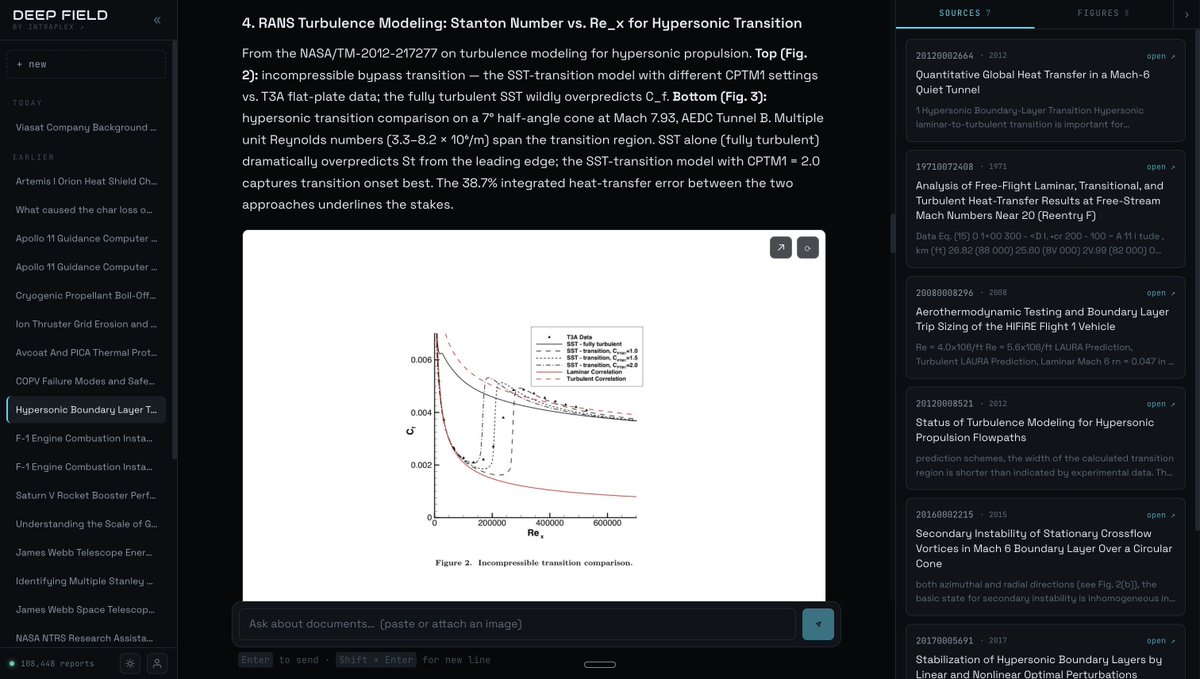
Hey guys, I built Deep Field, an AI agent over 108,448 NASA technical reports. Ask a real engineering question, it finds the relevant reports, pulls the figures, and answers with citations back to the source.
Right now NTRS is a goldmine, but the search is keyword-only, you ask a question, get hundreds of PDFs back, and spend hours opening them one by one to find the answer that’s actually in there somewhere.
NTRS is 70+ years of NASA research, billions in tests, failures, and breakthroughs, given freely to the world. It's the foundation modern space companies like @SpaceX@blueorigin@Axiom_Space@RocketLab and many more build on as we go multi-planetary. I built Deep Field so engineers can reach that knowledge at the speed of thought.
Free, no signup: https://t.co/vML1IN8XNQ
Would love your feedback, ask it the hardest, most specific question from your own work and tell me where it falls short.
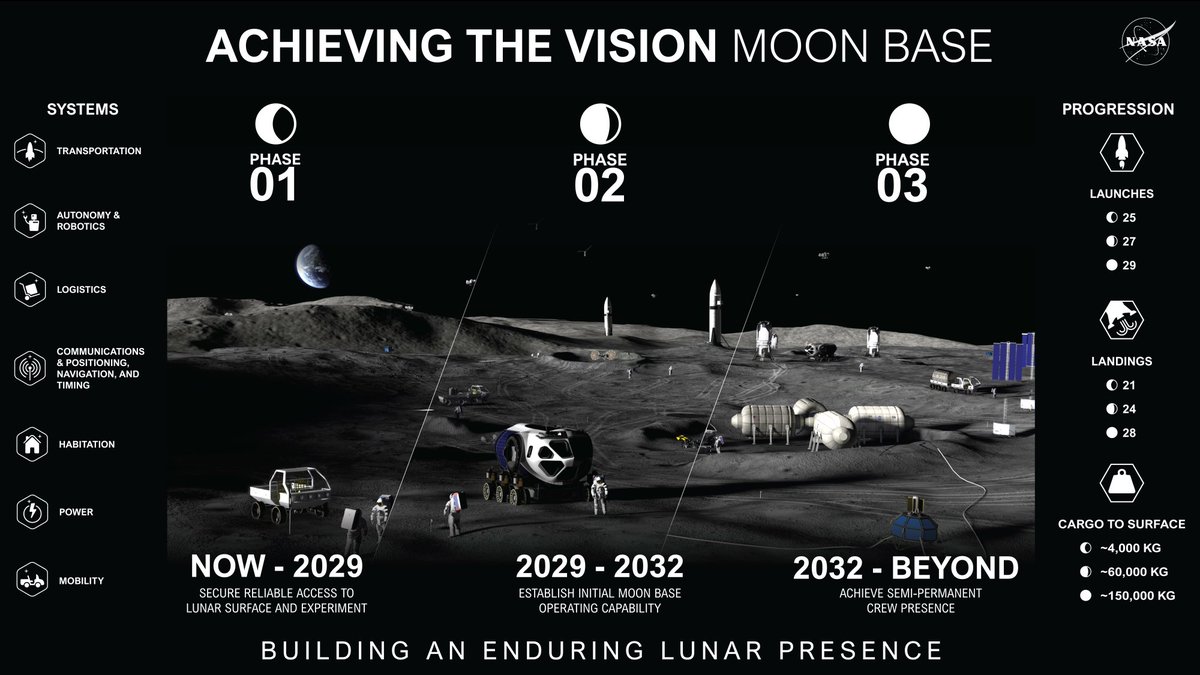
NASA just officially unveiled their master plan for a permanent Moon Base at the lunar South Pole
This is not just about flags and footprints. NASA is moving to establish an enduring, sustained human presence, and they are heavily relying on commercial innovators to build it
The roadmap is highly aggressive:
• Phase 1: Heavy robotic missions and commercial payload deliveries
• Phase 2: Semi-permanent infrastructure, including fission surface power and lunar drones
• Phase 3: A sustained, permanent human outpost
The most important takeaway is NASA explicitly stated this base is the ultimate proving ground to prepare humanity for missions to Mars
While legacy aerospace companies are still struggling to reliably get a small capsule to the ISS, NASA is setting the stage for massive lunar infrastructure....which is exactly the kind of heavy-lift planetary deployment SpaceX’s Starship was designed for
The multi-planetary economy is officially kicking off
@abeekmath Thank you! Yeah, I’m planning to open-source the document parser I created for noisy docs that works at scale, probably in a week or two. Will share it!
in 2 weeks, I solo-built an entire RAG system for 10,000 NASA rocket science docs dating back to the 1950s — using Claude Code.
657,000 pages processed on a single H100. scalable to 100K+ docs. live-streamed the full build on YouTube (140+ hours).
this would normally take a team of 3-4 engineers 3-4 months. full breakdown below.
hey buddies… good morning… perhaps there is no day or night when the mission is to understand the universe, when you’re out there, being relative to space, constantly affected by the gravity of the nearby planet or the star, sometimes it’s fun, sometimes lonely, but hey, that’s the price to pay….