Excited to share our latest publication in Molecular Biomedicine! 🎉 We engineered a cyclotide-based antimicrobial peptide with enhanced stability and intracellular activity against MRSA. Proud to contribute the molecular docking & MD simulations. 🧬📄 https://t.co/pMG1bxrc2d
Excited to share our latest work in @BiophysJ showing how hypoxia reshapes nuclear mechanics and nuclear envelope architecture, enabling enhanced cell migration and invasion.
https://t.co/UF09eOdDca
@abhijit_MLab
Happy to share our Current Opinion review on the key challenges in accurately predicting 3D distances between chromatin segments and computing their dynamics. Thanks to Daniel Jost @djost_physbiol & Luca Giorgetti for the invitation to write this review @DuttaShuvadip@BsbeIitb
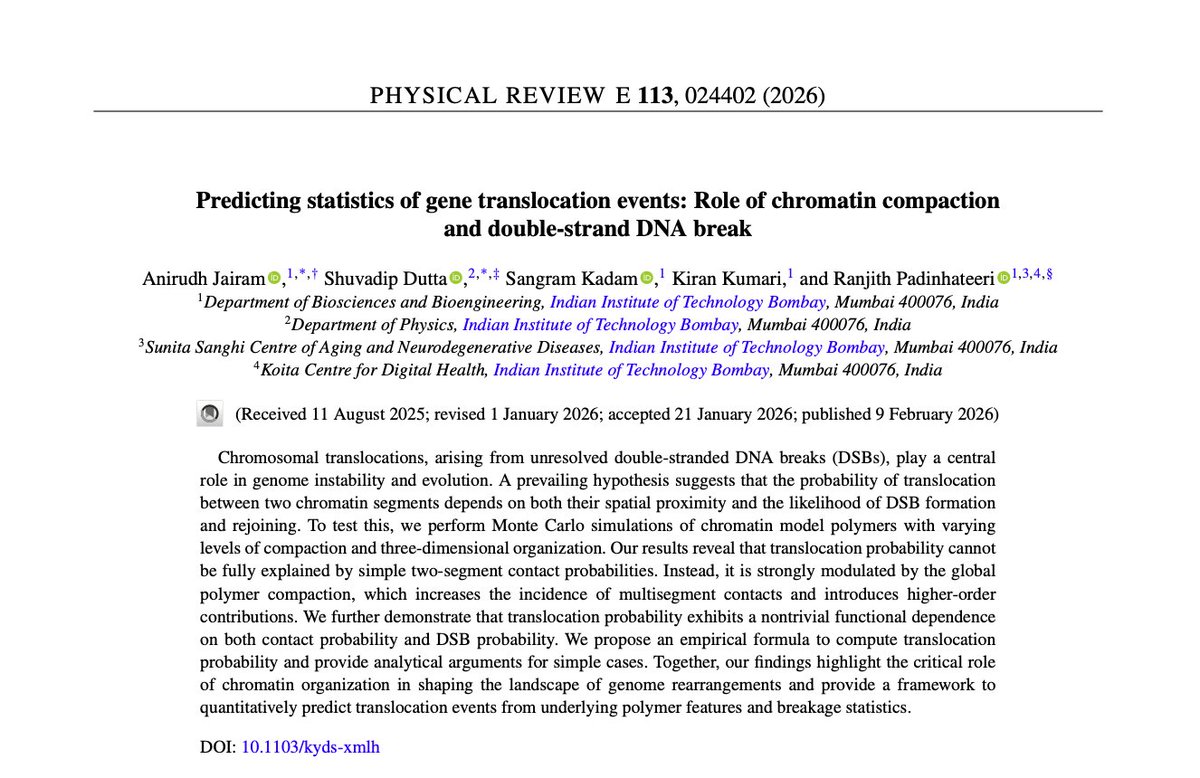
How does 3D chromatin organization affect translocations? Our work shows that translocation probability depends not just on local contact probability, but also on global chromatin compaction.
Cool work by Anirudh (then an MTech student @BsbeIitb), with @DuttaShuvadip et al.
A paper in @NatureMicrobiol reports that the use of AI to mine proteomes of archaea led to the discovery of archaeasins, antimicrobials that kill drug-resistant bacteria in laboratory and animal models, offering a promising source of future antibiotics. https://t.co/Z1KKEqbD6Y
For over a century, the hunt for new antibiotics has focused almost exclusively on bacteria and fungi. Today, that paradigm shifts. By coupling state-of-the-art AI with the vast, largely uncharted diversity of Archaea, we open a new frontier for molecular discovery.
Our APEX model sifted through hundreds of archaeal proteomes in silico, revealing a previously hidden family of antimicrobial peptides we call “archaeasins.” Of the 80 candidates we synthesized, 93% were active against pathogenic microbes in vitro, and one—archaeasin-73—matched the in-vivo efficacy of last-resort drugs such as polymyxin B.
These results show that the marriage of deep learning and evolutionary diversity can surface potent therapeutics at digital speed, expanding the antibiotic toolbox when humanity needs it most. Archaea, once thought biologically esoteric, now stand alongside bacteria and fungi as a rich reservoir of useful molecules.
We are excited to keep discovering antibiotics at digital speed with AI.
Link to the paper @NatureMicrobiol@NaturePortfolio: https://t.co/6BE2mO7GbR
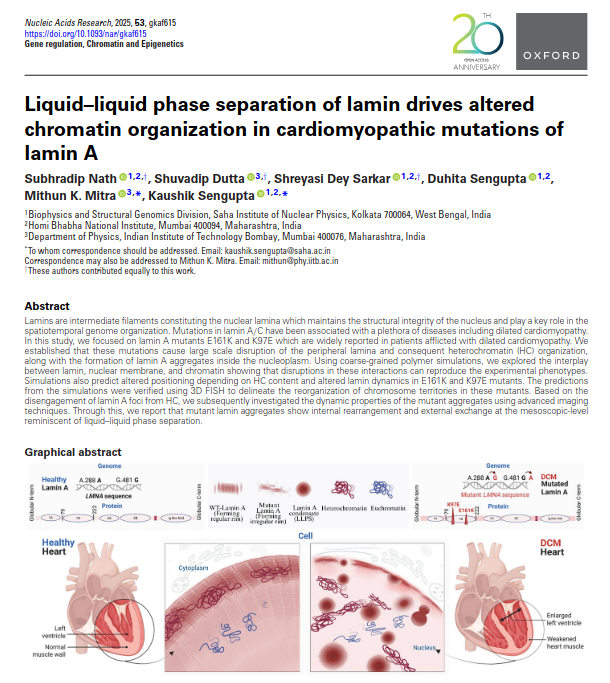
Our new work "Liquid–liquid phase separation of lamin drives altered chromatin organization in cardiomyopathic mutations of lamin A" is now out in NAR.
Experiments by @Subhradip1225, Shreyasi & Duhita.
Led by @mithunmittir & Kaushik Sengupta.
🔗https://t.co/Ln3tHVR38i
(1/5) Venoms are a vast, largely untapped library of bioactive molecules—and our new paper in @NatureComms@NaturePortfolio reveals just how powerful they can be. 🐍⚡️https://t.co/wQIpsu3zhz
(1/3) New in @ImmunityCP@CellPressNews: A single protein inside mitochondria, NDUFA4, keeps some immune cells in tumors “asleep.” Cutting its levels wakes them up, so they start attacking the cancer https://t.co/s76eLekO5m
The immune system responds like a forest fire unless you control the spark. @raviradhak of @cbe_penn@pennbioeng and @jakebrenner of @pennmedicine decoded how protein spacing flips the immune “on” switch, paving the way for safer nanomedicine.
Read more: https://t.co/c0byxJFBEm