Neuroscientist, cell biologist - microscopy, astrocytes, GJs, mitochondria, microtubules
Statements and opinions are my own and do not reflect employer's
The whole body MRI thing is controversial for obvious reasons. It’s costly & there are a lot of false positives. But I have neurosurgeon friends who tell me they do life-saving surgeries *every month* b/c people got full body MRI merely b/c they curious & found operable issues.
Research from @attila_losonczy Lab found that dendrites, the branchlike structures that extend from neurons, act as minicomputers in the brain, independently processing information. The research is a paradigm shift in current models of learning and memory. https://t.co/9QxyvTbY8P
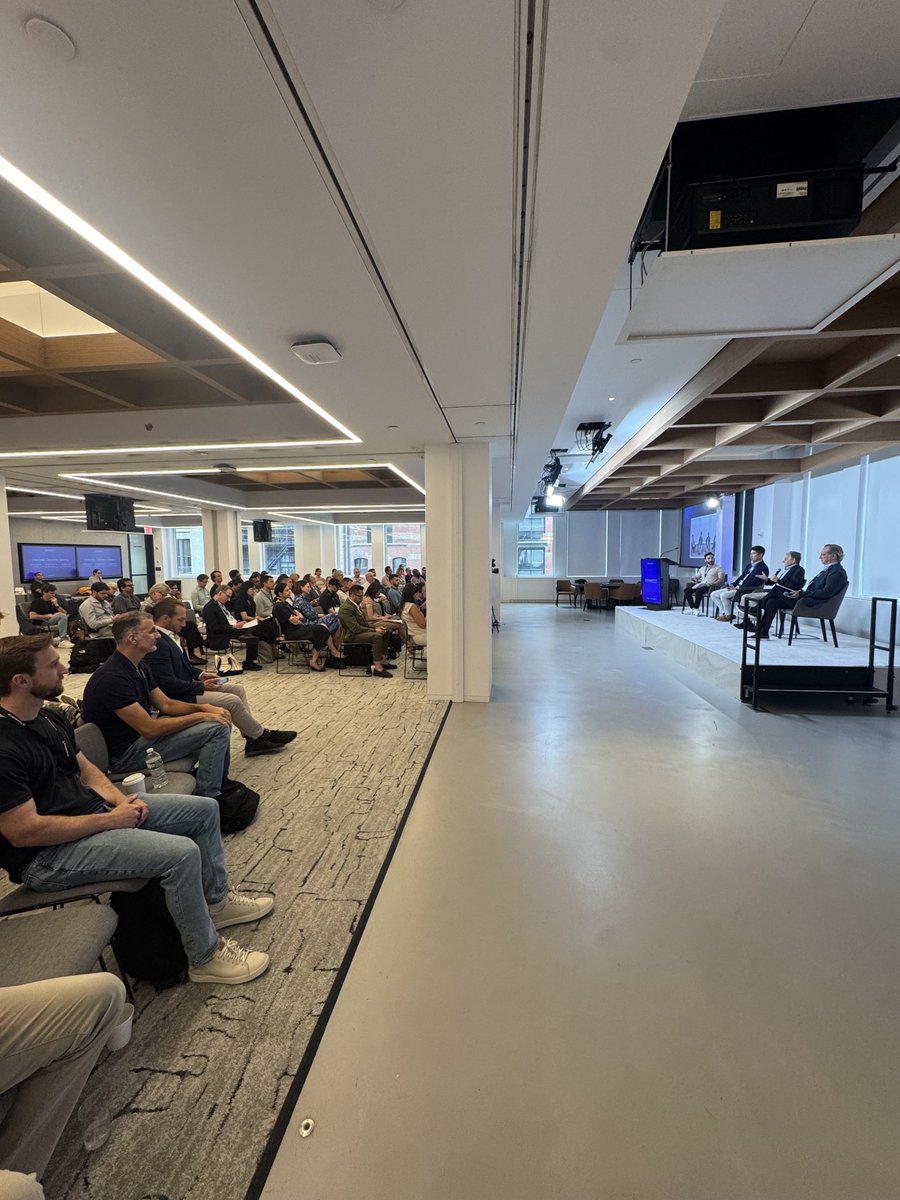
Catalyst NYC last week brought together people from across the research and funding world to talk about where science funding and translation are heading. Amazing lineup, from Joni L Rutter (@NIH /NCATS) and Bridget Turaga (@NSF) to biotech founders, investors, and patient advocates.
My personal highlight was the talk by @JAC0BSTERN on going founder mode on cancer. He walked through the N=1, data-driven approach he and @sytses took to Sid's osteosarcoma: maximal diagnostics, single-cell and multiomic profiling, and personalized therapies built around one patient's tumor. Coming from cell therapy and multiomics myself, it was striking to see that level of individualized, engineering-minded medicine performed in real time!
We presented with @ResearchHub & @ResearchHubF new ideas and implementations on how funding can become faster, more open, and reviewed in real time. Great talks by @joycesticks and @jeffyfish9 on ResearchHub's new funding model and the really cool new idea of auto-generated proposals that could turn soon your ongoing work into fundable projects almost on its own. More coming soon!
Interesting times ahead for how research gets funded.
#CatalystNYC #OpenScience #TranslationalScience
Vision Pro is the best 3D display ever made but it couldn't play a single 3D movie from my collection. 3D MKVs won't even open. Plex shows them flat and doubled.
So Kimchi and I built the fix: a free Mac app that streams your whole 3D library to Vision Pro in real 3D and Spatial Video. Lossless conversion, minutes on Apple silicon, plays in the native player in true stereo.
It's called Spatial Film AirStream. Completely free! Because this community kept 3D movies alive, and I'm one of you.
What's the first 3D film you will watch tonight? 🍿
@gfodor The tracking was surprisingly good but the more impressive thing for me was 8 years ago being able to engineer the easy setup and the flexibility to position the camera on a surface or outward facing on the headset.
@NSF is in the building! 🌎
Dr. Bridget Turaga just shared how NSF TIP bridges science with society through a variety of resources, funding, and training opportunities.
“There has to be crosstalk between people who have problems that need solutions, and the scientists and technologists who have the solutions.”
We’re officially underway at #CatalystNYC!
@ResearchHub Co-Founder @joycesticks just kicked us off.
We’ll be updating this thread throughout the day with what’s going on.
Stay tuned ⏳
Next, a superb panel on accelerating the pipeline from bench to bedside.
@KevinJTraceyMD emphasized the importance of designing research from the outset with clinical translation in mind.
@CliffordF66814 shared the advantage of @NorthwellHealth’s integrated system: in a recent case, they went from FDA approval to first clinical implementation in just 22 days.
But it’s not just infrastructure and planning; it also takes courage. As @itchdoctor put it:
“When your research is in clinical trials, you’re kind of sweating. Like, is my science going to hold up? But it’s about having the courage to put it out into the real world.”
@TinkeredThinker Sapolsky’s knowledge of neurobiology is great and his insights in this area are probably valuable and useful. I tend to think his positions on free will and consciousness are circular, cognitively shallow, and seem boringly pedestrian to me.
Meta's CTO reaffirmed that the company is still working on "multiple next-generation headsets", and perhaps hinted at a reveal at Connect in September:
https://t.co/ernU1J87RD
Today’s the day. Welcome to #CatalystNYC!
We’re bringing together academics, funders, founders, and builders to reimagine how scientific discoveries get funded and turned into real-world impact.
See you soon.
The choice of compression algorithm is part of a creative process, here's why I think that: Because that choice relies on explanatory knowledge. Individual items of explanatory knowledge are fungible, but the set of explanatory knowledge associated with any given person in a given place and time is unique. Because the choice of algorithm is dependent on the problem to be solved and the knowledge set available to the person solving it, the choice of algorithm is intrinsic to a creative process. ...or at least that is what I think about this issue right now, but of course I could be more mistaken than others engaged in this discussion.
@dchackethal@ConjectureInst The creative part is in what you choose to compress and what existing knowledge you choose to use if the compression can be accomplished in different ways.